The finest cloth in the world is woven for a man who has never broken his word. Orme had believed this for two hundred years without examining it, because the belief had made the city rich. Cloth went out of Orme to nine countries and the buyers paid triple for a bolt the Guild had certified as whole. The certification was Orme's whole advantage. The certification was true. Nobody had ever asked what a whole cloth looked like on a person. The Emperor Verrik was the first to ask. He was sixty-one and had been on the throne thirty-four years, and in the spring of his thirty-fifth he sent for the Reader of the Guild, whose entire office is to look at a finished cloth and say aloud what it is made of.
He sent for her because the Chancellor had advised it, and the Chancellor advised it for reasons of his own, and Hilde Marr, thirty-four, who had held the Reader's chair for nine years, went up to the palace with the Chancellor's man beside her and understood that she had been brought up to be looked at.
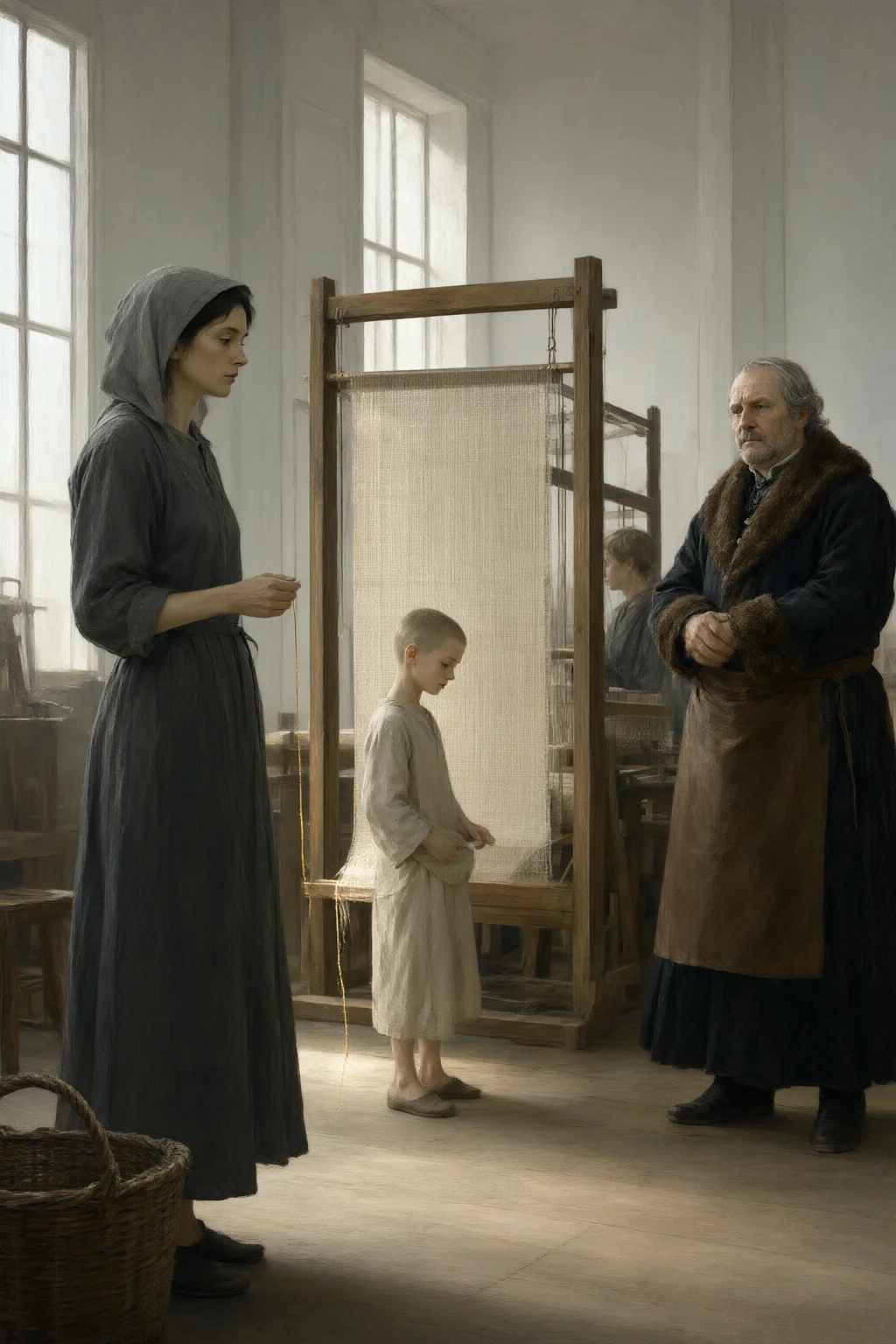
The proofing hall of the Guild stood at the bottom of Tanner's Steps with its long windows north, so that the light came in even and left no shadows anywhere. Hilde had stood in it every working day for nine years with a pair of shears she never used. Beside the north light stood the great loom, and beside it Master Ivo Sarn, a weaver of fifty-one years who had woven for the imperial house since before Hilde was born, and beside him the two court clothiers the Emperor had brought, who were looking at the empty frame with the expression she had seen on the faces of people who have been told to sign something. The frame was bare. The Emperor stood in the middle of it in his ordinary coat, hands behind his back, in the manner of a man being patient with tradespeople.
"Reader," said the Chancellor, who was called Sire Anse and was fifty-three and had the face of a man who enjoys being the second most careful person in any room. "The Guild will weave for his Majesty." "The Guild will weave," said Hilde. "Then let us see it done." "It will take nineteen days," said Master Ivo. "The register is full. His Majesty has four hundred and eleven oaths standing, of which one hundred and ninety-six are discharged, two hundred and two are kept, and thirteen are unperformed and unexpired." Hilde wrote that down. It was a working number. Thirteen was a good year for an emperor; the average was forty. "Thirteen," said the Emperor. "They will show, Highness," said Hilde. "That is the trade. A man whose oaths are all kept is not wearing cloth. He is wearing nothing that anybody can read."
Sire Anse said, "Reader Hilde, the Emperor has been told that the cloth is a fashion. A garment is a garment. I will not instruct a Guild, but I have stood in this hall and looked at a bolt, and I could not have told you where a thread was unpicked." "You could not," said Hilde, "because you have not had my job." She said it without heat, and the hall went quiet in the way a hall does when two people have discovered that one of them is not afraid.
Here is how the record cloth was made, in the plainest words the Guild allowed. The city kept a register. Every oath sworn within the walls of Orme was entered by the clerks of the Table, with the name of the person, the name of the counterparty, the day, and the thing. Oaths sworn before a hearth, to a dying man, to a child: all of them, because the city had learned that the important ones are the unwitnessed ones. Beside the entry the clerks kept a second column, the one that mattered, headed not performed, and into it they wrote the date the oath was broken, the place, and the name of whoever reported it. Any subject could enter a report. The Table did not check reports. It recorded them.
The loom in the proofing hall was attached to the Table by a wire. When an entry was made in the first column the corresponding thread in the warp was left slack; when an entry was made in the second, the thread was drawn out and the hole was left, so that a hole in the imperial cloth could be measured, located and dated, and any subject who wished to check the Emperor's oaths against his own knowledge of the world could do it with a finger. A whole record wove close and dark and gave a soft sound when you struck it, like a wall. A broken record gave a thin, bright cloth with holes in it, and the holes did not have to be hidden, because the law forbade it. Falsifying a record cloth was not embroidery: it required unpicking the web and re-setting it, and re-set web holds a different tension, and every Guild reader can see it. Two of the Emperor's own court clothiers left on the nineteenth day to ask their Guild in another city whether this was permitted.
Hilde read the Emperor in the ninth month, alone with him in a small room off the hall, because he had asked for that and had been embarrassed to ask. He stood in the finished cloth. Where the record was kept the weave was dense and dark, and where it was broken there were holes, and the holes were not small, and they were not up near the collar where a man might cover them with a chain of office. "There," said the Emperor, indicating the third hole down on the left, over the ribs. "That is the Assembly." "Yes, Highness." "I have sat in it four times in nine years. I swore it in the first year of my reign and thought it a formality. I do not now remember swearing it." "You swore it before the granary order. It reads that you would sit in the Assembly yourself, in person, without a screen, once in every year of your reign." "I sent a proxy."
"A proxy is not a person. That is not in the oath, Highness. The oath is about your body. Nobody else in the history of the empire has broken that one, and I include your grandfather, who could not read." He was quiet for a while. "The second hole." "The granaries of Cord Street. You opened them for nineteen days and then closed them, and the Table had to send out for grain at a price they could not meet, and the ward did without until March. The oath does not read open them. It reads to feed the ward of Cord Street through the winter at the city's charge." "I opened them." "Nineteen days." He looked at the cloth for a long time. "The last one," he said. "The lowest."
Hilde looked at the lowest. Four holes in a row above the hem, close together, and the weave around the last of them was not torn. It was absent. Somebody had gone in with a needle and taken a small square out and left the edges raw, which was not a thing the loom could do, because the loom did not know about the year of the fever. "That is not a record," said Hilde. "That is a hole a person made with a needle." "I did not come to be measured on it. I came because the Chancellor said the cloth would hold the whole of the house, and I wanted to know whether I would be able to wear it in the Assembly." He looked down at himself, at the dark close cloth and the four holes and the one square gap, and he said, "Can I?" "Yes," said Hilde. "The square will be there, and it will not be in the register, and every person in the hall will see it, and there will be no way to explain it, because there is nothing in the cloth to point at."
The year of the fever was entered in the register, and the entry is as follows: In the sixth month of the year of the Long Winter, the fever entered the river wards. By the counting of the Table, four hundred souls of the wards passed. The Emperor swore before the Assembly that the year should be set down in all its truth, and it is set down thus. Four hundred. Hilde had read the entry a hundred times. She had been fourteen when the fever came and had lived over her mother's laundry in Sleet Lane, which is river ward, and she had buried four people from that lane, and she could not make four hundred fit into the number of people she had known who died that summer. She had asked once, at fifteen, and a clerk had looked at her and said that the count was the count, and she had understood, in the way that children understand administrative facts, that the answer was no.
That was the summer the River Watch was disbanded. The Watch had been a hundred and forty men, their wage voted every spring by the Assembly, and the Emperor's assent had been required; in the sixth month of that year the assent was given with a rider suspending the Watch until the spring, and by the time the freight came the fever had gone and there was no one left to drown.
The boy was eight. His name was Piet Osgood, he lived with his mother in one room on Sleet Lane, she washed, and nobody had ever asked him to swear anything in his life. He came to the proofing hall because Hilde went to get him, which she did because the two court clothiers had been stripped of their seals and put out of the city, and the Guild had to replace them, and the Guild had looked at her, and she had said no twice, and on the third morning she had put on her coat and walked down to Sleet Lane herself, which took two hours and cost her a pair of good boots. "Do you know why I'm here?" she said, in the yard, where the washing was. "No," said the boy.
"Your mother has told you. A man has died who did nothing wrong, and the city is short of people to weave, and the Emperor has asked for cloth, and I cannot do it, and neither can anyone else, so I have come to the only person in this city who has never sworn anything at all." He looked up at her with the flat, unhurried attention of a child who has been left alone a great deal. "Is that a good thing?" "No," said Hilde. "It is a strange thing. Come and be measured. It will take a day and it will pay you a week's washing."
They put a boy-shaped frame in the middle of the hall, which they had had made for no purpose, and Hilde dressed him herself, out of a bolt she had chosen, and she did the whole cloth in one day because a boy's record is short. The register had nothing on him. That is not a figure of speech. There was no entry: no oath sworn, none kept, none broken, nothing owed. He had been born in the ward, and the ward had been counted in the fever and had not been entered. The cloth came off the frame whole. It was the plainest, densest, softest cloth in the history of the Guild, and when Hilde struck it with the flat of her hand it made the sound she had heard perhaps four times in nine years, the sound of a wall. The Emperor's cloth had made almost no sound at all. "It's perfect," said Master Ivo. "It is empty."
"There is a difference, Master," said Hilde, "and it is the difference the city has been selling for two hundred years." At the hem there was a thread loose. One thread, at the left, about the width of two hairs, hanging an inch, and not a fault of the weaving, and not a loose end, because a register cloth has no ends; the loom cut nothing. Hilde put her finger under it and lifted, and the boy watched her do it. "That is not me," he said. "It is from the second column," said Hilde. "It is a thing you were asked to do and did not do, and it is dated, and it is one." "Who asked me?" The hall was very quiet. Master Ivo had gone out and had not come back, and the boy looked around the room and found nobody in it but the two of them, which was presumably the only reason she said it.
"Yourself," said Hilde. "The Table enters civic duty as well as sworn promise. Every resident of a ward owes the ward a watch. If you see a person go into the water, you owe the city a call. That is not a thing you swear. It is a thing you are born owing." The boy did not say anything for a while. Then he said, "How long does it go back for?" "Eighty-one years," said Hilde. "The entry beside the thread is the year of the fever."
His name was Bex Osgood and he was forty-one years old and he went off the towpath at the second bend on the fourteenth day of the seventh month, in the evening, in full view of four people. Piet was on the towpath because he was always on the towpath. He was six. Bex Osgood was the coalman and he had been drinking and he had put his hand out for the rope of a moored lighter and the lighter went out with the current. There were four people and all of them saw it and none of them moved, and the boy ran eleven paces and stopped, and this is the part the register had in it as a single thread: he stopped. Then he shouted.
He shouted for what the man on the towpath said afterwards was a very long time. The Watch was a quarter mile down at the Bridge, and the bell there could be reached in ninety seconds, and the bell was not rung for eleven minutes, and the Watch came in nineteen, and Bex Osgood was in the water for twenty-six. Hilde had the deposition. She read it to herself once a year at midwinter, in a room off the proofing hall, alone, and never to the Guild. The boy's mother had brought him to the ward house. The officer had asked what he had shouted. The boy had not answered, and after a while the officer had written the child made no sound, which was the sentence that had gone into the case, and the sentence the cloth had been reading for four years as a loose thread at the hem of an otherwise perfect garment.
"He shouted," said Hilde. "That is what the thread is. You shouted, and no one came, and in the fourth year after, a man fell in at Sleet Bridge and you did not shout, and the year after that. There has been one man a year in that ward since the Watch went, and every one of those years is a thread, because a thread is a single time that a person owed the city a call and did not make it." "How many?" She had not expected to answer. She had come to Sleet Lane to fetch a boy to fill a loom, and now she was standing in a light hall with a loose thread in her hand and the question was not hers, and she was the only person in the city who could read it. "Eleven," she said. "Four years, and eleven."
Sire Anse's memorandum of the twenty-second month survives because it was found in the copy of the register, which was the one object in Orme that no one ever thought to look inside. He had not invented anything. That is the part no one in the Assembly could get past. He had not forged an oath, had not bought a clerk, had not entered a lie. What he had done was this: on the fourth day of the Long Winter he had ruled that the second column of the Table should be kept in a separate book. The reasoning is in his own hand, and it is short, and it is the most frightening thing in the history of the empire, because it is not the reasoning of a villain. It is the reasoning of a man who had read the column.
> The second column is a list of leverage. It contains the Emperor's Assembly, the Emperor's granaries, the Emperor's fever, and eleven hundred other citizens of rank, with the date, the place and the reporter of each. A list of leverage is not evidence. It is an inventory, and an inventory has a name on it, and the name is the person who holds it. If it is bound into the register, then whoever may read the register may read the inventory, and there is exactly one man in this empire who may not, and he is the one whose name is on every line. > > Separate the column. The oaths remain. The house is not accused of keeping them. The house is merely not accused of breaking them. This is the whole of the change and I have made it three times before for lesser houses and it has held every time. > > The Guild may say the loom takes what the register holds. Let it. The loom will take what the register holds. The question was never the loom.
The cloth was re-woven in the eleventh month, in nine days instead of nineteen, because the two city clothiers worked through the night and nobody gave them leave. Sire Anse was not charged. This was the Assembly's decision, and the reason given in the finding was that the separation of the second column had been ordered by the Chancellor in the ordinary course of his office and had not been minuted. The finding also recorded, in a manner the clerks thought showed more feeling than the law required, that the separate book had been kept in the Chancellor's own house for nine years and had been lost in a fire in the eighth month. The Emperor wore the cloth to the Assembly. There were four hundred and sixty people in the hall, more than had come in eleven years, and they had come to look at a hole in a garment, and there were forty-one holes, and every one of the people who could see them knew which of their own broken promises each gap corresponded to.
Hilde read it aloud. That was her office and there was nobody else in the city who could do it, and she had thought about declining for about a day and a half. The first hole was the Assembly. The second and third were the granaries of Cord Street. The fourth was the four hundred. "Thread at the hem, left," she said. "Eleven of them, in four years. Column two, ward of Sleet. One, the fourteenth day of the seventh month of the year of the fever: he shouted for eleven minutes. He owed the ward a call and he made it. Ten of the eleven are years in which he owed it and did not make it." Somebody in the hall said something. Hilde did not look up.
"His name is Piet Osgood. He is eight. He is standing at the back with his mother, and I am obliged to tell you that he is not the only child in this city with a loose thread at the hem, and that the Guild has eleven thousand in the second column, and that we have never once counted them, because a thread is a fault in the weaving and no one had ever thought to ask what a fault was for." The Assembly sat for four hours.
What came out of it was not absolution and was not disgrace. The Watch was re-founded that spring on the old hundred and forty, the wage was voted without a rider, and the rider that had suspended it in the fever year was read into the minutes in full for the first time. The four hundred was left standing as four hundred, with two clerks appointed to amend it to a figure the survivors should agree, which took two years and in which Hilde was not permitted to take part, because she had made a cloth out of a boy's grief and had not asked him.
They gave her an assistant in the twelfth month, because the two clothiers were working again and the reading had doubled and one person could not stand in the hall for eleven hours. The boy was the only one who applied. He was nine. His mother said that a wage was a wage, and Hilde did not argue, because the alternative was that the boy went back to the towpath, and she had learned by then that this was not a thing one was entitled to prefer. He was good at it, and better than good. He could unthread a whole bolt in an afternoon and count, and he counted the way a person counts who has been counting something else for four years. Her office had a box under the window where the second-column cloth went, the cloth of people who had not performed, which was by then most of the city, and there was no room in it.
So they had made a second box, for the ward cloth, the small sizes, of which there was not much, and the Guild put it in date order with a card. On the first day of every month Hilde took the boy's cloth off the frame, struck it once with the flat of her hand to see what sound it made, and read it. It made the sound of a wall. It was whole. It had been whole for four years, which was the point of it, and there was one loose thread at the hem, left side, and there was one loose thread at the hem, left side, and there was one loose thread at the hem, left side. She wrote the card: the date, the number of threads, the number of calls owed, and then, in the line at the bottom that the form kept for the reader's finding, the two words that by then were written several thousand times a month in Orme and meant nothing to anybody except the boy who carried the box. No change.
She put the cloth back on its frame, and the boy put the lid on, and the box went out under his arm the way it went out every month, and the door of the hall sticks in wet weather, so the lid had to be lifted at the same moment as the door, and so they did it together, in the manner of two people who have a system.