The winter of the worst year was the fourth winter in five in which the farthing fund had gone out in October, and the farthing fund pays the ash-runners, and the ash-runners are the only people in Emberwyke who will carry a sack of ash to the Scale House for nothing, and so the fourth week of that October the ash of the poorer quarters began to go down to the Slag Bank in the mornings instead of the Scale House in the evenings, and the Slag Bank does not keep a book of who brought what, it keeps a tally of barrow-loads for the fill, and the tally is read on the Saturday by a man who is not on any roll. The Crown came in the last week of March, which is the week the season closes, which is the week the duty is computed, and the Crown came with four pages and a form. The Receiver of Ash for the lower river was a different man from the one who had written in January. This one was fifty or thereabouts and had a bad cold and did not apologise for it, and he came down from the trap with his hat in his hand because the hall was warmer than the street, which is the only compliment he ever paid Emberwyke.
“There is no question,” he said, “that this city cannot pay. I have the winter return and I have the Ledger Room’s figures and I have walked down your Sallow Bridge and I have seen your Slag Bank. I am not here to be thanked and I am not here to be blamed. I am here because the duty on the ash of the season is computed at the close, and the close is on Friday, and if I do not either collect it or remit it this week then it is carried a year, and carried debt is worse debt, and I would rather hand you an instrument than carry you a year.” “You have a hundred and ninety-three tons and four hundredweight on the city,” said the head of the Ledger Room. “I have one hundred and ninety-three tons and four hundredweight on the city,” said the Receiver, “and I would like to give it to you. That is the whole of my errand. There is an instrument of abatement and it is the standard instrument and it is four pages and I have read it to eleven boroughs this winter and nine of them have taken it.” “What is the price of the instrument,” said the head of the Ledger Room. “The roll,” said the Receiver. “The roll of the hearths, for seven years, in the county’s hands, and the licensing done out of the county.”
The Crown did not need to be told anything about a roll. That is the thing about a roll. A hearth is a chimney with rooms round the bottom and a number cast into the brick at the third course, and the number is the only thing the city knows a person by, and the number is entered on the roll, and the roll is a roll of eleven thousand hearths and their fuel and their ash right, and a fire in this city is a thing people are lent. A hearth whose number is not entered on the roll for the season will take a match, hold it, and go out. There is no point at which it can be hurried. So a county that holds the roll does not have to do anything to put out eleven thousand fires. It has to be slow, and to be in the county seat, and to be four hours’ ride away in February. The Receiver had said none of that. He had said the word roll and had sat down. Amos Rill, who was the second clerk and who had been the second clerk for three years and had signed two winter returns and had found the beam out by one part in three hundred and one and had had the figure written down in a form with the date on it, heard the word roll and went up the two flights to the Ledger Room and sat down in front of the eleventh volume, which is still filling, and began, because that is what he is, to add it up.
It took him two days and it is worth setting out what he added, because the whole of the meeting turns on the order of the four figures and not on their size. The first figure was the Crown’s. One hundred and ninety-three tons and four hundredweight of ash duty, being eleven seasons of the beam’s error with the interest the schedule allows. It was the smallest of the four and it was the only one anybody in the room was going to be asked to be grateful for. The second figure was the city’s own. Every hearth in Emberwyke carries a balance forward: what the Scale House weighed from it, less the ash right the licensing roll gives it, less what it has paid, and the result is a number that is a deficit or a credit and a deficit is what goes to the crown of the page in the roll. Totaled at the close of the season across eleven thousand hearths, the city was six hundred and eleven tons and two hundredweight in the red. That figure had never been totalled before, in any volume, in any year, because a hearth’s balance is a hearth’s business, and a clerk is told to enter a line and not to know what the lines add up to.
The third figure was the claims. A claim is a debt with a name and an hour on it, and a claim is entered against a person and not against a hearth, and there were four thousand one hundred and something of them in the season, and the total of the claims answered was small and the total of the claims refused was smaller and the number of refusals was two hundred and nine, and a refusal is worse than the debt, so the two hundred and nine was not a number of money at all. The fourth figure was the guarantees, and the guarantees are not in the Cinder Ledger at all. So the fourth figure could not be added at all, and the boy wrote it on the back of the sheet as a word instead of a number, and the word was out, and it stayed out for two days, and then it came into the meeting from the other side of the room and it was four hundred and six tons.
Nobody could call the meeting, which took four days to establish and is the first fact about it. The instrument requires the assent of the city, and there is no such thing as the assent of a city. The city is a roll and a beam. It has no assembly and no council and no clerk that can speak for it, and the officers of the Scale House are the officers of a weighing, and a weighing does not assent to anything. So the notice that brought the people to the Salt Hall on the Tuesday was a sheet of foolscap with a heading on it and no authority under the heading, and it was nailed to the oak counter of the Scale House by the ash-runners, and the ash-runners nailed it there because the farthing fund had gone out in October and they were in the building every night anyway and had nothing else to do with their hands. The notice said that the Crown had come with an instrument, and that the instrument would be read aloud in the Salt Hall at eight, and that anybody might come, and it gave the date, and the date was the twenty-fourth of March, which is the last Tuesday of the season.
It filled the room for the reason that the poorer quarters are in the street every night in a winter when the runners are not paid. There is nowhere else for them to be. The fires went out of the Rope Walk at nine o’clock on a normal night and at seven o’clock on a night when the fund is gone, and the Scale House closes at ten because the beam is not licensed after ten, and after ten the whole of the lower city stands on the Coalquay steps in whatever they have. What came into the Salt Hall on the Tuesday evening was four hundred and twelve people and a vote, and Cobb Renn was very careful with the two of them, and said so to the City’s man at the door, and the City’s man, who was sixty-eight and had been a beam-man in his time, agreed with her that a vote is a thing that men do and is not a thing that a city does, and that the two ought not to be put in the same sentence on the notice, and the notice was already up, and the notice had never claimed to be a city.
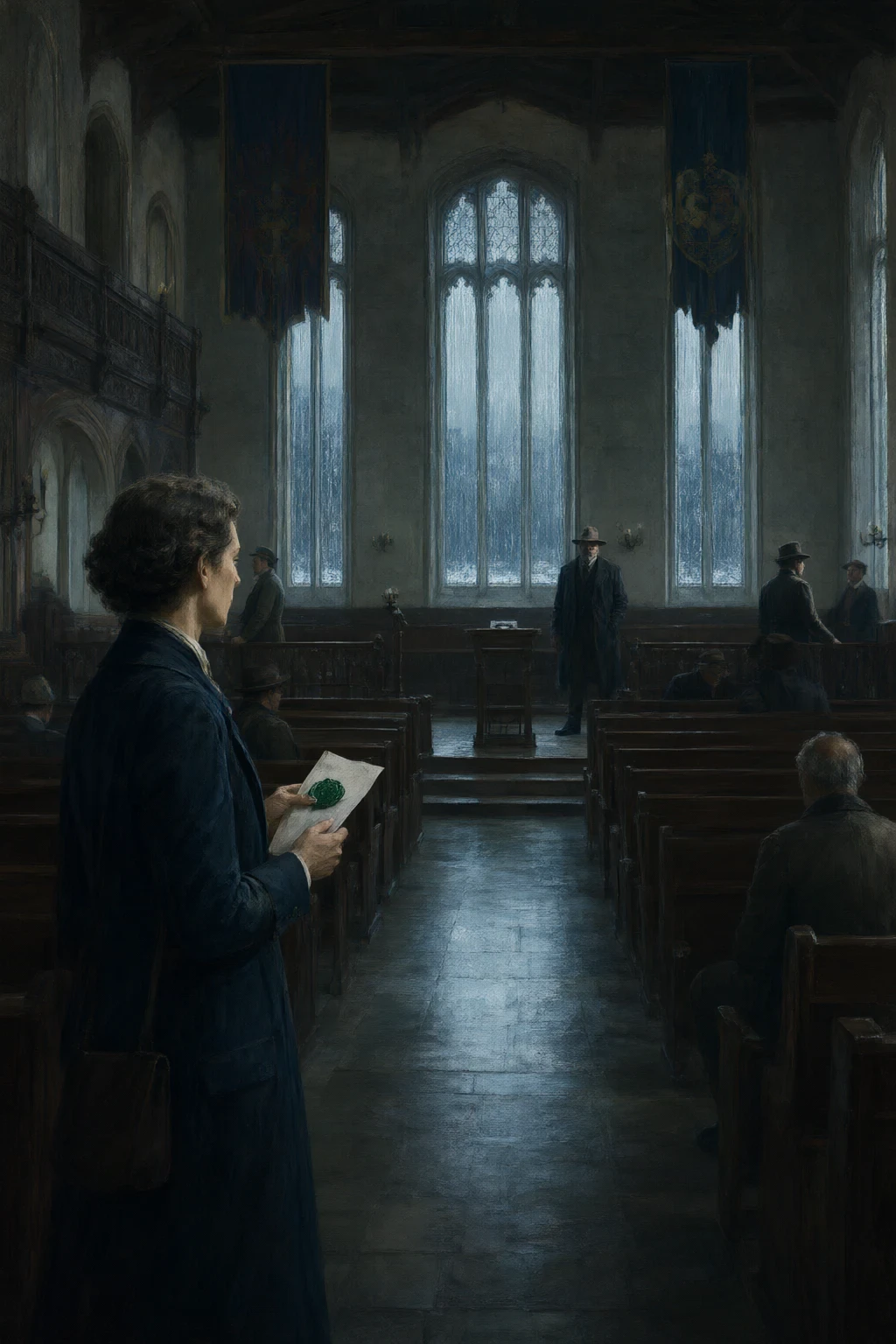
The Salt Hall is a long cold chamber off Sallow Bridge, lit by six tall windows and no fire at all, and the charter that puts it there predates the licensing and nobody will light a fire in it, and the Hall is used for weddings and wakes and the settling of disputes that must not be warm. It has benches. It has never had rows. There are six benches down one wall and six down the other, and a stone floor, and a lectern at the north end, and the benches are benches for two sides, because a dispute is a thing with two sides and the room was built by men who believed that disputes would always be between people who could both afford to come. Cobb Renn is thirty-nine and is a godmother by trade and guarantees eleven hearths on the Coalquay, and she came into the Hall at seven in the evening, before it was full, and she counted it, because she counts a room as she enters it and has done since she was twenty-two, and the number she arrived at was four hundred and twelve. Amos Rill had four hundred and nine, from the ash-runners’ returns, which are a weekly tally of sacks and are not a head count and are wrong by three or four most weeks.
The Crown’s man read the instrument at eight. It took him fifty minutes. He read it aloud because the Hall is a room where things are read aloud, and the instrument has to be read in full before it can be spoken to, and he read all four pages including the schedule of the four hundred and six towns and the words of abatement, which are as follows, and they are the exact words and the Receiver was careful about it: “All debts, claims, reckonings and demands of every kind, whether of debt, damage, penalty or otherwise, owing to the Crown, to the parish, to the county, to any body corporate, or to any person, body corporate or otherwise, at the date of this instrument, in the city of Emberwyke, and whether the same be had before the sealing of this instrument or at any time thereafter before the execution hereof.”
“There,” said the Receiver, and put the pages down. “That is the instrument. It is not mine. I did not draw it and I could not alter a word of it without the county, and the county drew it in eighteen hundred and ninety and has used it ever since, and there are eleven of you who have had it read to you this winter and nine of you have signed it and two of you are here tonight instead of in a county office, and I have been sent to read it and not to argue with it.” Nobody spoke for a while, in the way of a cold room. Then Cobb Renn stood up on the fourth bench from the north end and said, “Before anybody says yes or no, I would like to say a figure, and I have had it since Tuesday, and I have not said it because a figure said before the instrument is read is an opinion.” “The instrument has been read.” “The instrument has been read,” said Cobb Renn, “and my figure is four hundred and six tons, and it is not in the book you have just read, and it is the largest number in this room, and I would like the room to have it before it votes anything.”
A guarantee of a hundred and forty pounds of a hearth’s debt is a promise to pay that debt first, out of everything, before any other creditor, before the parish, before the Crown. It is a promise made in writing, and writing is the whole of it, and the writing is in a leather book and the leather book is not in the Cinder Ledger and is not in the county and is in eleven kitchens and one purse with a green wax seal that is never closed. Cobb Renn had made eleven of them on the Coalquay. Five were hearths of a bricklayer and his sister. Two were a widow with a licence to sell kindling. Two were the families of the two men who work the barge at the head of the Coalquay steps, and one of those men is deaf in one ear and carries a hundred and ten pounds a day. One was a girl of nineteen who sells hot coals from a barrow at the Salt Hall steps and has the name of an aunt who is in the county workhouse.
And one was entered in the book in the spring of this year, on a Thursday, in a hand that was not the guaranteee’s and not the godmother’s, and Cobb Renn had not known about it until the Tuesday, and the hand had been the hand of an ash-runner of sixty-one who had come to the Coalquay with a barrow and asked whether she would take a page, and had apologised before she asked, and had given the ash-runner’s own name and address and the number of the hearth, and had said that she had arranged it and was not going to tell anybody, and Cobb Renn had taken the page and had said yes, because she cannot refuse a sponsorship, which is her trade and is not a virtue, and is the single fact about Cobb Renn that this story is mostly about. The eleven guarantees came to four hundred and six tons and two hundredweight at the season’s close. “You have read that aloud in a cold room,” said the Receiver, “to four hundred and twelve people, and the figure is not in the instrument. I will ask you to notice that the instrument extinguishes it. Every guarantee in this city, every claim of every kind against every person at the date of the instrument, is extinguished. Your eleven are not excepted, because a guarantee is a claim. That is the good half of what you have been told and it is true.” “It is not the half that matters,” said Cobb Renn, “and you know it is not, and I am not going to stand in a cold room and pretend otherwise to a man who has ridden four hours to be decent to us. The abatement extinguishes the guarantee. The abatement does not repay the guarantee. Those are different, and the difference is the whole of my trade, and the difference is why there are eleven people on the Coalquay who signed a page in my book.” She sat down.
“I will say the other half now, because I would rather say it standing up. If the eleven guarantees are extinguished, then the eleven hearths are standing in February with no one in front of them. A hearth with a godmother and a hearth without are not the same hearth, and they are the same hearth in the book, and the book is the only place the difference is written down. If the guarantee goes, the difference goes, and the eleven hearths find out about it in April, when they are asked for a lease, and a marked name cannot hold a lease.” The Hall was very quiet. “So I am against the instrument,” said Cobb Renn, “and I am a creditor, and a creditor who says no is the worst sound in a room, and you are entitled to think I am standing on my own book. I would like somebody to check my figure. I have had it since Tuesday and I have not said it because I wanted somebody to say it who is not me.”
Two people said things, and one of them was right and one of them was interesting. The interesting one was a glass-founder of fifty-two who stood up without being asked and said, in answer to a question nobody had asked, that the Hall could be got warm. “It is not a fire,” said Ivo Sarn. “A fire cannot be lit in here, because the Hall is not on the roll and coal will not burn for a hearth that is not on the roll, and any man in this room who has tried to cheat a hearth with a match has watched it go out and has not tried twice. So the Hall is cold and the Hall will be cold. But eleven tons of coke in a brazier against each end wall would take the room to about sixty in three hours, and the flue would have to be cut through the north gable, and eleven tons of coke is not a fire, it is a shortage with smoke in it. Forty hours’ work for a man who does this, and four hundred pounds of coke at to-day’s price, which we do not have. Eleven hundred and holding is the furnace. I have not measured the Hall.”
The right one was a boy of twenty-five with a bad cold who came down from the two flights over the Scale House with a sheet of paper in his hand, and the head of the Ledger Room did not stop him, which was afterwards described by two people as the correct decision. “The instrument is dated for the twenty-eighth of March,” said Amos Rill. “It is executed at the close, on the Friday, or it is not executed at all this year. The duty is computed on the season’s close, and the season’s close is the Friday, and I know it is the Friday because I have signed the return for the last two years and the form says so in the fourth line. “I have the total of the city’s own deficit, which is six hundred and eleven tons and two hundredweight, and nobody has ever had that figure before, and it is the second figure in the room and it is the largest. And I have the Crown’s, which is one hundred and ninety-three. And the Receiver has told us that the instrument extinguishes all of it, and he is right and he is not the man who drew it, and I believe him.
“But the reason the second figure is six hundred and eleven and not something else is in the Crown’s own schedule, on the second page, in the fourth table, and the fourth table is the ash right.” The Receiver put his hand flat on the pages. “The ash right is one pound of ash for every seven pounds of fuel licensed,” said Amos Rill. “It has been one in seven since the schedule was drawn, and the schedule was drawn in a year when this city burned coke, and one in seven is a fair figure for coke. A hearth that burns fuel-grade matter instead of coke returns about one pound in three. The licence does not care. The roll does not care. The roll enters the two hearths in the same column of the same page under the same heading, and the one on the discount has twice as much to carry and one pound in three against an entitlement of one in seven. “So a fuel-grade hearth in the poorer quarters is entered in this city’s books as owing two thirds of everything it makes, every night, all winter, and it has been entered that way since the fuel-grade matter was first sold here at a discount, and the discount is the Crown’s own concession, and the concession is in the same schedule as the ash right, and the two of them were drawn by the same hand in the same year. “The six hundred and eleven tons is not a bad year,” he said. “It is a schedule.”
The Receiver of Ash for the lower river said nothing for long enough that somebody at the back laughed. Then he said: “That is correct.” The room waited for the rest of it and there was no rest of it. “That is correct, and I have known it since the eleventh of December, when your Scale House wrote to the county about the fourth table, and I have a copy of that letter in the saddlebag, because I was told to bring it and I have not had an occasion to use it. I am not going to stand here and be a villain about a table. I am a man who computes a duty at the close of a season out of a schedule, and the schedule is the schedule, and the county cannot make two concessions on the same hundredweight, and if we amend the fourth table we have amended the price at which the fuel-grade matter is sold, because the discount is in the same table.
“The county can amend the fourth table. The county has offered to amend the fourth table. It did so in the letter of the fourteenth of December and it did so for the coming season, and the coming season begins on the first of October, and the amendment will take effect on the first of October, and it will be in your hands in April, in time, and every hearth in this city that burns fuel-grade matter will be two thirds of a hundredweight a night better off from the first of October, which is a very great deal better off, and I would not want to be a man who told you it was nothing.” “Why did you bring an instrument to a meeting in the last week of the season?” said Cobb Renn. “Because the duty is computed at the close,” said the Receiver. “The abatement is dated for the twenty-eighth because the twenty-eighth is the last day on which the schedule can be made to apply to this season, and I did not choose the date. The county chose the date, in the same way that the county chose the twenty-eighth for a hundred and forty years, and if the amendment had come into force on the first of December this instrument would be a pleasant piece of paper with nothing behind it, and I should not have had to ride four hours in a bad cold to read it out in a hall with no fire in it.”
Amos Rill had the letter in the saddlebag, or the Receiver had it, and it was dated the fourteenth of December and it was a courteous letter of two pages and it offered the county’s amendment of the fourth table with effect from the first of October, and the second paragraph said that any instrument of abatement must be executed before the close of the season to which it is to apply, and the third paragraph said that the county would be glad to receive the assent of the city at any time before the twenty-eighth of March. A quarter must run between a letter that offers an amendment and a letter that receives an assent. The letter of the fourteenth of December was in the county seat in the first week of January. A reply written in January was in Emberwyke in the second week. The assent had to be executed and sealed and witnessed and sent, and a thing that takes a quarter takes a quarter, and the meeting was on the Tuesday of the last week, and the season closed on the Friday. There is a date in December on which anybody in Emberwyke could have prevented the whole of it, and the boy in the Ledger Room had it, and the boy in the Ledger Room was twenty-five and had been the second clerk for three years, and the fourth table is on the second page, and a clerk who is told to enter a line is not told to read the schedule. He said that out loud, in the room, and nobody in four hundred and twelve people said anything about it, and it was the only honest thing anybody said all evening, and it went into the minutes because Cobb Renn asked for it to go into the minutes, and it is the ninth minute of the Salt Hall book for that Tuesday, and the minute reads: Mr Rill stated the date of the fourteenth of December and stated that no reply had been sent.
Then somebody asked whether the city could take the abatement and keep the roll, and the Receiver said no, in the plainest words anybody had used all night, and he said them twice because the room had not understood them the first time. “The instrument is the instrument. The consideration is the roll. Those are two things and they are not separable by a city, because the county does not give the roll and take back the licence; the county holds the roll and the licence goes in the county. For seven years, every fire in Emberwyke is licensed out of a book in the county seat, by a clerk in an office four hours’ ride away, and the clerk’s year begins in April, and the clerk does not come here in February.” “You would not do that,” said somebody on the third bench. “I would not do anything,” said the Receiver. “That is what I am telling you and it is the reason I can tell you. I would not have to do anything. I would have to be in the county seat, and the county seat is where the office is, and the book is in the office, and the eleven thousand numbers on the front of the book are the only reason any of you have a fire between now and the first of March.”
And Mared Holt, who was sixty-one, and who had a barrow at the door of the Hall with her tarpaulin over it, and who had stood at the back through all of it with her hands on the rail, said: “Sorry. I am sorry.” The room turned round. “Sorry,” said Mared Holt. “I am not speaking to the gentleman. I am speaking to the benches, and I will say it in one sentence and then I will sit down, and it is a sentence about February and it is the only thing I know anything about. A hearth in this city is licensed for a season, and the season is the first of October to the thirty-first of March, and in February a fire is not a comfort in this city, a fire is the difference between a person being alive in the morning. If the licence is in the county seat in February, then in February this city is a place with eleven thousand chimneys and no fires in it, and we shall all sit in our coats, and the ash-runners will have nothing to carry, and there will be nothing on the Rope Walk to weigh, and the beam will be weighing an empty street for seven years.” She apologised again before the next sentence, as she apologises before every sentence she has ever said, including the word no. “I would take the abatement over the roll,” she said, “and I would not take it over February, and I am the ash-runner, and there are two hundred and nine of us.”
They tried to settle it for another two hours and they could not settle it, and the reason they could not settle it is in the charter, and the charter is one paragraph, and the paragraph is what everybody in that room had been standing on all night without looking down. The Salt Hall was given to the city in the year before the licensing, by a charter that predates it, and the charter grants the Hall for the settling of disputes that must not be warm, and it says, in the twenty-second clause, that a matter settled in the Hall is settled when the parties have agreed in the Hall and the agreement has been named in the Hall book and the book has been signed by the parties, and that nothing done in the Hall is a fire, and no fire may be made in the Hall, and no matter that requires a fire may be settled in it.
Nothing in that requires a fire. Everybody in the room had assumed for a hundred and forty years that it did. It requires a matter that requires a fire, and the Crown’s instrument requires a fire, because executing an abatement is a lighting-up and a lighting-up is settled in the ordinary way in this city, which is with a licensed hearth and a recorded figure and an hour, and the Scale House holds the only licensed fire in a public room in Emberwyke, in the stove in the Ledger Room, which burns at a fixed figure recorded every hour. So the instrument was properly proposed in the Salt Hall and could not be properly settled in it, and the City’s man said so, and the Receiver said the instrument required no fire, and the City’s man said that was true, and that a resolution passed tonight would be a resolution of the Salt Hall and would bind the City and nobody else, and would expire at dawn, and the Receiver said: “Then it expires at dawn.” They counted the hands at twenty past eleven at night in a cold room on the Coalquay side, because Cobb Renn asked for it and because a count is a thing you do before you go home. For the instrument, including the abstentions counted as for: two hundred and six. Against: one hundred and ninety-eight. And the abstentions that were not counted: eight, and one of the eight was a girl of nine who was not at that end of the room, and one of the eight was the Receiver, who said that a man who administers an instrument does not vote on it and that if the City wished to record that he had an opinion he could do it in the fourth minute, which was not minuted. Cobb Renn voted for the instrument. She said afterwards, to nobody, in the passage, that she had voted for it because the Crown was owed one hundred and ninety-three tons and she had made a hundred and eleven of them, and that a woman who guarantees debts for a living does not get to decide that a creditor may not collect.
The Receiver executed on the Friday morning, at the Scale House, at the close. That is the ordinary practice and it is not a ceremony. An instrument of abatement is executed before the close of the day to which it applies, at the Scale House, in the presence of the officers of the city, and the roll is amended, and the amendment is entered in the Ledger, and the day’s sheet is made up after it with the amended figures in it. The Receiver came at four in the afternoon with the four pages and a pen and the green wax, and the officers came, and Amos Rill came with the roll. The roll is in the Ledger Room, in the form of a book. The book for the season does not exist. “The eleventh volume is made in April,” said Amos Rill. “It is made in April out of the day-sheets, and the day-sheets are in the rack by the window, and there are one hundred and eighty-one of them for this season, and they are the roll, every figure of them, in the same hands, in the same order, with the same totals at the foot of each one, and the totals have been added up every week since the first of October by the man whose job that is, which is mine, and by nobody else.”
The Receiver looked at the rack. It is a rack of rolled paper on a north wall in a cold room and it holds a year of a city. “Is the roll not the book?” he said. “The roll is the figures,” said Amos Rill. “The book is the roll with a history in it. I can hand you the figures this afternoon. I cannot hand you the book, because there is not one, and because there is not going to be one until the eighteenth of April, and because you are on the road at four o’clock on Friday to be at the assizes on Monday, and I am not going to stand in this room and invent an instrument of attestation for a book that has not been ruled.” So the Receiver took the day-sheets. That is the whole of it, and it took eleven minutes, and no two men in the room disagreed about anything at any point in the eleven minutes. The Receiver rolled the hundred and eighty-one sheets into three bundles, tied them with the tape the Ledger Room uses, wrote on the top sheet of each bundle what it was and what date it covered and what the total was, and the City’s man countersigned the top sheet of each bundle, and the wax went on, and the Receiver put the three bundles in the saddlebag and the saddlebag on the trap, and the trap went up the street at half past four with the roll of eleven thousand hearths in it, in three bundles, on a stage, in a bad cold. And that is the last thing that happened. There was no villain in it and there was no trick and nobody had lied, and the City’s man had written to the county in the first week of January about the fourth table, and the county had answered in the second week, and the answer was in the file, and the file was in the rack, and the file was one of the hundred and eighty-one.
In the morning the book is correct. That is the first fact of the morning and it is not a small one, because the eleventh volume is the most-checked document in Emberwyke and it is checked every morning by nine clerks and a stove that is the only legal fire in the building and burns at a fixed figure recorded every hour. Amos Rill came in at half past eight and made up the day’s sheet for Monday night, and the sheet is one printed line ruled into three columns, and the three columns are the ash weighed, the ash entitled, and the difference, and the difference is two hundred and four pounds, short, and the beam is out by one part in three hundred and one, and the figure is on a form in the third drawer with the date on it, initialled by two men, and the Crown’s tolerance is one part in two hundred, and the beam is inside its warranty, and it is a good beam.
The Rope Walk was short again on the Monday. The boards came in at the hour the ash-runners turn out, and the one on top was carried by a girl of fourteen with a slate on a loop of tarred twine under her coat, and she set it on the oak counter with both hands and said the number before anybody asked her for it, and the beam-man put down the farthing without looking at the right-hand column, because the farthing is for saying the number and not for looking at it. Bess Tallis took the farthing and went out into the rain. Sim Uncle Prawd read the sheet over the clerk’s shoulder at the counter, the way he had read it every morning for forty-four years, and said the number, because he always said the number. There is no column in the Cinder Ledger for an abatement, and there never has been, and it is not a column the Ledger Room is permitted to rule, and so the Crown’s one hundred and ninety-three tons and four hundredweight stands in the season’s return as a liability of the city of Emberwyke and will stand there until the eleventh volume is closed and ruled and shelved, and until the eighteenth of April, when the hundred and eighty-one bundles come back from the county seat, and a clerk in the Ledger Room will untie them and count them and find that there are a hundred and eighty-one, and will enter the county’s receipt in the front of the volume, in the ordinary course, in the ordinary hand.
The Salt Hall book for that Tuesday has thirty-one minutes in it, and the ninth is the one about the fourteenth of December, and the twenty-fourth is the count, and the twenty-eighth is the Receiver’s four words, and the thirtieth is Cobb Renn’s single sentence from the passage, which the City’s man entered because she asked him to and because the Hall book takes what anybody asks it to take: The instrument cannot be executed in this room, and the meeting is dissolved, and the city of Emberwyke is owed one hundred and ninety-three tons and four hundredweight and owes six hundred and eleven tons and two hundredweight, and both figures are correct, and the second figure has not been in a book until this year, and the whole street is owed and owed. The last business of the evening was at the Coalquay steps, at half past eleven at night, in the rain, and there were nine or ten people still on the steps because the passage is where people stand who have not gone home. Cobb Renn was one of them. She had her purse open, which it always is, with the green wax on the clasp and nothing shut, and she was saying no to a man who wanted a page, and she was apologising before the word, as apologising is done to people who are not her trade.
“No,” she said. “I am sorry. No. I have eleven and eleven is as many as I can carry in a winter and if I take a twelfth then I will be a woman who has twelve, and nobody counts it, and a number that is not counted is the same as a number that is not there.” The man went. She shut the purse, which she does not normally do. There was a girl on the top step with a hat too large for her turned up twice at the brim, and she had been there for the whole of the last hour and had heard all of it, and Cobb Renn had counted her in the room at eight o’clock and had not thought about her since. “Who is it for?” said Ottoline Vray. “It is not for anybody,” said Cobb Renn. “It is for a man who has asked me a question and I have answered it, and there is no more in it than that.” “It is a book,” said the girl. “You have a book and you are going to write in it.” “I am not going to write in it tonight.” “You are going to write in it,” said Ottoline Vray, “because you are the only one with a book.”
Cobb Renn, thirty-nine years old, guarantor of eleven hearths, keeper of a purse with a green wax seal on the clasp and nothing shut, put her hand in and took out the book, and put it on the wet rail of the steps, and opened it, and there was a page with the last entry on it in a Thursday hand that was not the entry of a name she had chosen, and there was a space under it, and she took out the pen and held it over the space for a while, and apologised before the next sentence, which she did not say aloud, because it was not to anybody. “I will see it through,” said Cobb Renn, to the rail. “That is what I say, and I mean it, and I am always late, and the sooner a thing has a date on it the better it is for everybody in it.” And then she wrote.