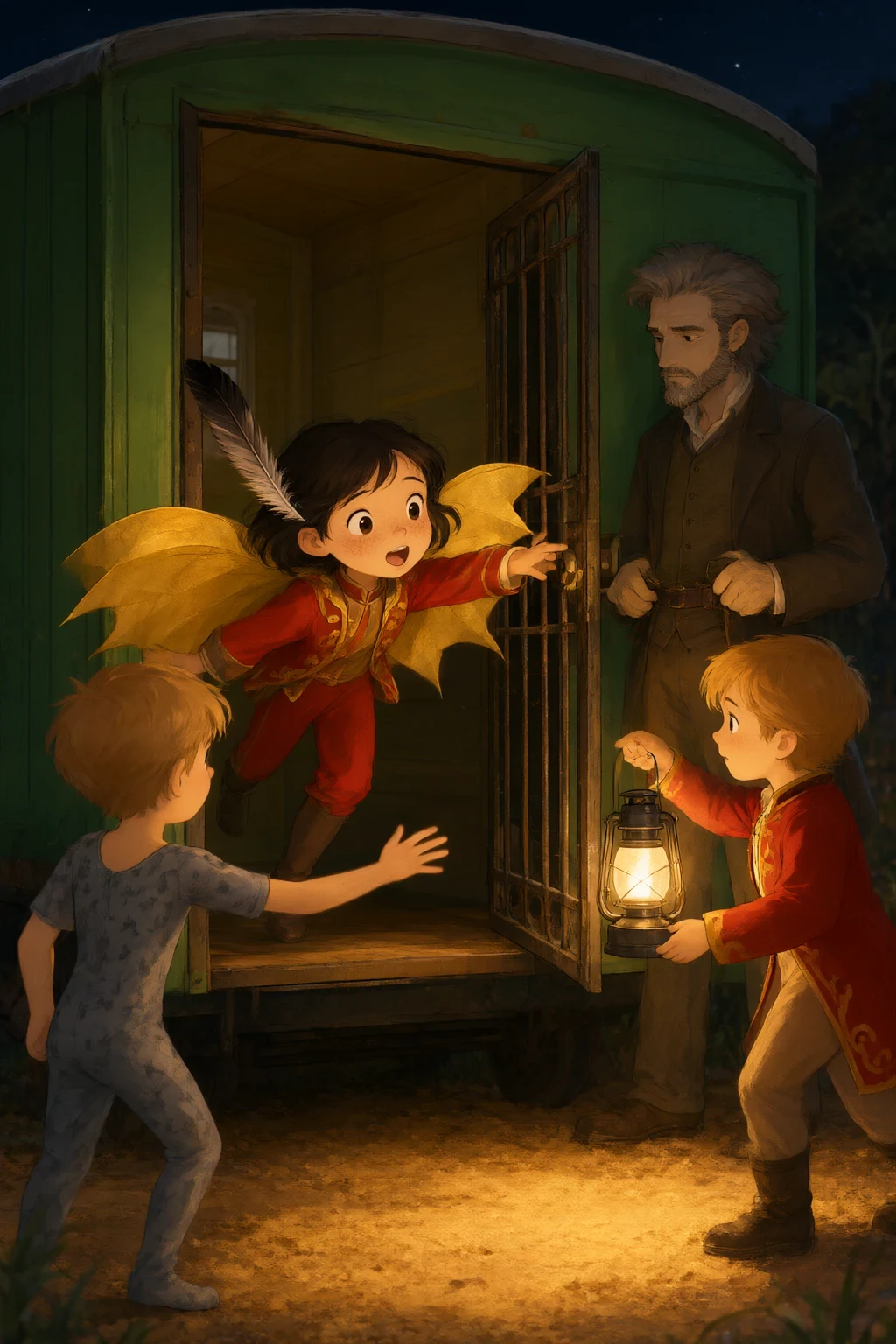
The act took forty seconds. Everyone in the company knew that, and everyone had seen it two hundred times. Junie Sparrow came out of the Widow’s Pew in the sparrow jacket, scarlet and gold, sequins and flying straps, and ran the ring with her arms out like wings, and was back in the Pew in three counts, and came out again as the lion. That was the whole act. Out as the bird, in as the lion, and the crowd did not so much watch it as get hit by it.
She was ten. She had freckles across the bridge of her nose and a single soft feather, black-tipped, tucked behind her left ear, and she was the youngest signature in the Gilded Menagerie and the best quick-change in the company, and there was not a night in nine seasons that somebody had not said so in front of her.
The trouble began on a Tuesday, and it began small, and it began with her hand. Twice in the Tuesday matinee Junie put two fingers up behind her left ear and smoothed the feather down where the hatband rubbed it. That was all. A girl will do that a hundred times a day. By the matinee on Wednesday there were two feathers. The second one was smaller, and it had grown out above the first, and it was black at the tip the same way, and it was in exactly the wrong place, and it itched. All day. And here is the thing about Junie Sparrow: she did not know she was doing it.
“Do this. Now. Again.” Odette Vrain was crouched in the middle of the Widow’s Pew with a bootlace in her teeth, threading a buckle that would not thread. “I am doing it,” said Junie. “You are doing it every time you look up.” “That is not the same as doing it on purpose.” “It is on purpose to the hand,” said Odette. “The hand does not care about your intentions. Do this. Now. Again.”
Junie did it. Her hand went up behind her ear and the feather came smooth and her scalp went quiet for about four seconds, and then it started again. On Thursday the cuffs of the sparrow jacket had gone downy. That was the part that ended the argument. You could not get your fingers round a sleeve with a soft black fringe growing down the edge of it, and when Junie pulled, the sleeve came apart the way a wet glove comes apart off a hand.
She got the change done. But it took fifty-one seconds, and the lion came out late, and the lion is a great big animal that has to be on time.
Dax Ollerton was eleven and a Rope Tight and billed in the bills as the Hound. The Hound was not a shape. It was a nose, and it went round the edge of the ring, and it found things: a dropped collar stud, a loose shackle pin, the one person who had come on the wrong night. The joke in the tent was that the Hound would find Birdie’s missing button before Birdie did.
“Forty seconds,” said Dax, on the Friday, hanging upside down off the rope. “That is your number. It is on the board in the book room. You have been doing it in fifty-one, and everybody has been very kind about it.” “I know what my number is.” “Everybody knows your number. I found it in the book room. It is written down. That is the whole difference between you and me, and it is not a talent, it is a fact on a board.”
“You are very annoying,” said Junie, in a voice with a great deal of edge on it. “Yes,” said Dax. “Bird. I will bet you the lion’s mane.”
The lion’s mane was a beautiful terrible thing. It came down over Mateo Brill’s shoulders, and it had been the thing Junie wanted since the day she was signed. You cannot be a sparrow and a lion at once, but you can hold the mane in your hands for four seconds in the middle of the ring, and everyone in the tent will forget you have a feather at all. “Hit one cue,” said Dax. “One. Not the whole number. One, and it is mine, and the mane is yours for the season.” Junie put her hand up before he had finished the word cue. “Done,” she said.
Then, about four seconds later, with her hand still up, some small honest piece of her arrived and said: what is a cue. Which is how it happens every time. She agrees first and understands after, and everything that has ever gone wrong with Junie Sparrow has gone wrong in that order, and nobody spots it until it is over. “Dax,” she said. “What is a cue?” He came down off the rope in one swing and landed on his feet like a cat dropping off a table.
“It is the thing where somebody counts out loud and you do a bit on the number,” he said. “That is all it is. It is not a trick and it is not a test, it is a number somebody says out loud.” “So it is easy.” “It is not easy, it is just honest,” said Dax. “That is worse. Come on, Bird.”
The paper wings were on the shelf in the Widow’s Pew. They had been there two years, under a stack of old quick-changes, three pairs of them, made of card and glue and gold paint gone green, with the name on the back of the smallest pair rubbed nearly off by a thumb. Junie had looked at them two hundred times and had never touched them, because they belonged to an act that had been put away, and because there is a rule about things on the shelf.
She got them down on the Friday night, set them against the wall of the Widow’s Pew, and looked at them for a long time. They were not wings for flying. A bird in a cage does not fly, and a bird in a cage is still a bird, and Junie had been trying to be a bird who flies for two seasons, and she was the worst flyer anybody had ever seen.
Here is what the act had become by Saturday, and for the first four days it was the worst thing the Gilded Menagerie had ever put in a ring. The idea was to change the quick-change into a bird act and to do the bird act through a cage door, and the reason was that Junie could not make her hand come back to the ring. Dax counted her out of it over and over, loud, in front of everybody, like a man reading a bad ledger.
“Cue three. Your hand is on your head. Cue three. Your hand is on your head. Cue three, Bird, you cannot open a cage door with one hand on your head.” “Thank you, Dax.” “I am helping you. If I said the number and your hand was in the right place, we would be halfway across the ring by now.” They did it four hundred times. Mateo sat in the corner of the Pew the whole of Saturday, tail tucked through his belt, and watched, and said nothing.
“Mateo,” said Junie, at about four o’clock, on the four hundredth, “is it the jacket?” “Mmm.” “Because Odette says it is not the jacket.” “It is not the jacket,” said Mateo. “Then what is it?” Mateo Brill said Mmm before every answer, as if the answer were worth weighing twice. He had been contracted eleven years and renewed three times. “The jacket is quick,” he said. “Forty seconds for a jacket is generous. The hand is the act, and the hand is the fastest thing you own. And it has gone to your head.”
That was the whole of it. That was the entire night. Odette Vrain, who thought about doors, sat down on an upturned crate and worked the rest of it out in about a minute. “Do not hide it,” she said. “Hide what?” “The preening. Every bird does it. You have been trying to do an act where nothing goes wrong, in a costume that has grown a fringe, with a hand gone somewhere else. Do not hide it. Give it to them.” “They will laugh.”
“They will laugh at you either way, which is what a bird is,” said Odette. “A bird that cannot preen is a bird that is not a bird. Make the preening the beat. Put it between two cues, right in the middle, where they will all be looking at your face. Make them wait for it. And when it comes, do it on purpose, and finish it, and go.” Junie thought about that for a long time. “They will laugh at me,” she said.
“They will love you,” said Odette, in a low sweet voice. “There is a difference, and you will not be able to tell them apart from the ring, and that is the whole business. Do this. Now. Again.”
The cage door came out of the Scented Row. It was a prop, not a cage. Brass-tipped, four feet high, painted green, with a hinge that worked and a bolt that had been painted shut in nineteen hundred and four. It had been part of a tableau called the Vanishing Lady, which ran for two nights that year and was then put away, like the wings. Mateo fetched it out of the wagon-line and set it down in the middle of the ring and stepped back and said Mmm.
Junie opened the bolt with the point of a pencil, because it was painted shut, and opened the door, and shut it again, eleven times, and Dax counted every one.
On the Saturday night they hit the cues. All of them. Nine, first to last, and the third cue was the preening, and the preening was on the beat, and it finished exactly, and Dax came off the rope and hit the boards and said, “Cue three, Bird,” in a voice of pure disgust, and then said, “was good.”
They did it again at half past nine, and again at eleven. Junie came out in the sparrow jacket and ran the ring and stopped dead in the middle of the amber light and put two fingers up behind her left ear and smoothed the feather down, on purpose, and finished it, and went through the cage door, and came out as the lion forty seconds later with the mane in her hands.
Behind her, in the front stalls, Nell Ferrule counted all nine cues out loud, which she could not help, with a knotted red thread cuff on her left wrist.
The ringmaster came out afterwards and stood in the empty ring under the corona, one sooted jet throwing a spidery shadow up the canvas, and asked for the cage door to be left in. “August would like the door left in,” said Dax, in a voice like a saw through a board. “Then August will have the door left in,” said August Vane, in his oiled black hat with the worn brass band and one white glove with red threaded through the cuff. “August can hold a room. August can hold a room. Let him hold it.”
“Thank you, sir,” said Dax. “Also,” said August Vane, “the bird is billed as Sparrow.” “She is billed as Sparrow,” Dax agreed. “Then bill her as Sparrow, and not as anything else, because a thing called something else all season stops being that thing,” said the ringmaster, and went in. And Dax Ollerton looked at Junie Sparrow and said, “He is right. Bird was never yours. Sparrow is on the bills. Bird is what I called you because I wanted a reason.” “You had a reason.” “I had a reason,” Dax admitted, “and it was a bad one.”
They walked back to the Widow’s Pew together, Junie carrying the paper wings, which were hers now. “Dax.” “Mm.” “If I had asked you what a cue was before I said done, would you have told me?” “I would have told you the same thing I told you after,” said Dax. “Nothing changes. You just get to choose with more in your hand.” That was the whole of what she learned, and it was not very much. At the wagon step she stopped and turned round.
“Tomorrow,” she said, “if somebody offers me something, I am going to ask them what the words mean first.” “That will be exhausting.” “It will be worse for them than for me,” said Junie Sparrow, and went in to hang up her wings.