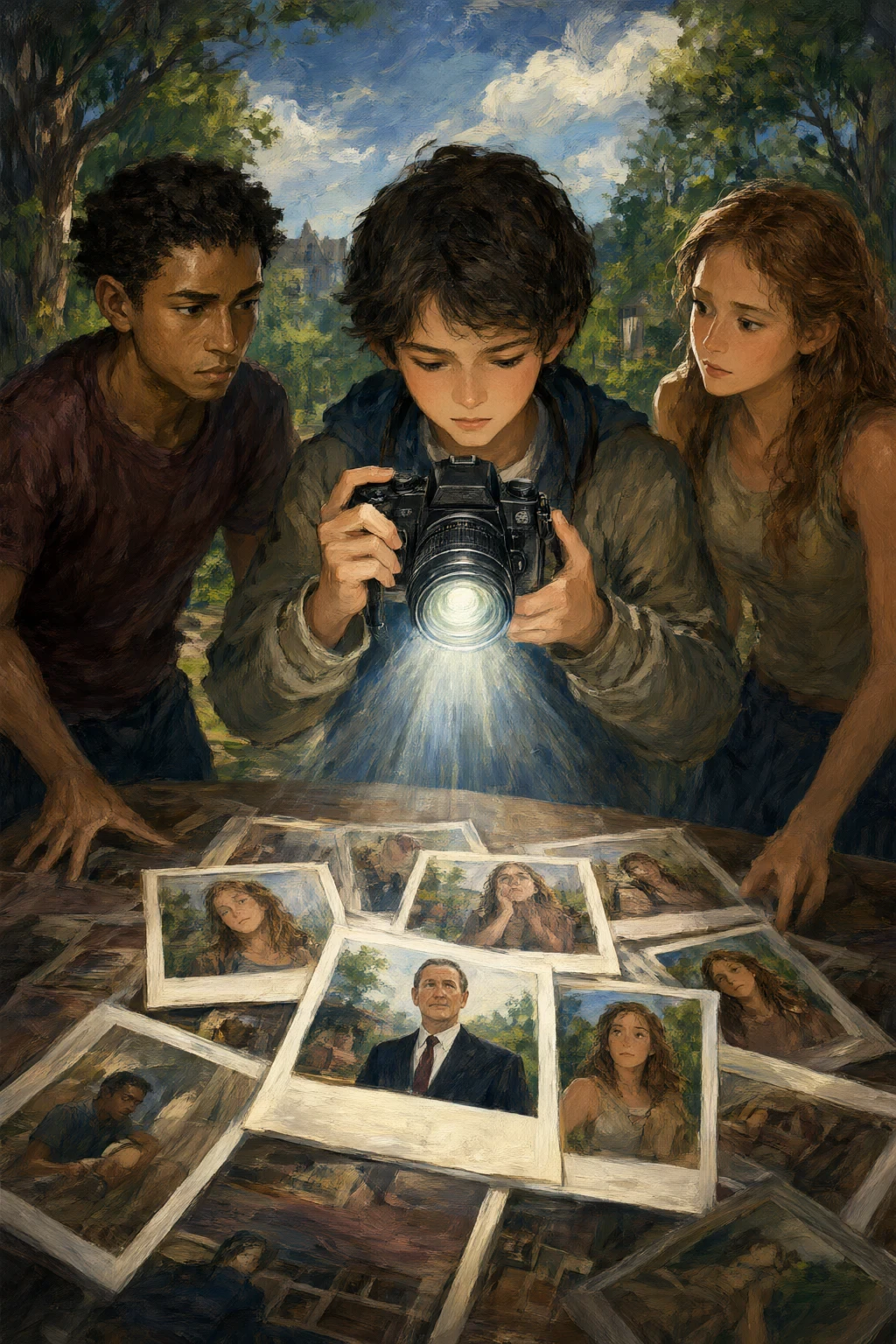
The camera appeared in the school newspaper office on Monday, beneath a carton of old sports photographs. It was black, square, and cold enough to make Mira’s fingers ache. A silver word on its lens read WITNESS. No brand number. No scratched-off owner’s name. When Mira turned the camera toward the sports editor, the paper around his shoes filled with a tiny red badge marked LIE.
The editor stepped back. “That is not a joke.” “Maybe someone hid a prank lens.” He leaned toward the lens. The badge disappeared. Mira turned the camera toward the mayor’s photograph on the wall. The red appeared again, even though the mayor was a glossy still.
The camera showed Mira a small light on its back. She pressed it only because the dark wooden cover was beginning to warm in her hand. The viewfinder opened by itself.
Behind the school lay the old freight road. In the gray predawn light, three council dump trucks rolled toward the river. Their beds were covered, but the camera saw what the tarps hid: drums marked CLEANING SOLUTION—DO NOT OPEN. The trucks had no permit tags. One turned toward the town pump. Beside the image, Mira saw words: COUNCIL SAYS: NOTHING HAS ENTERED THE AQUIFER SINCE MARCH.
The words shone like hot metal. Mira blinked. The viewfinder closed. A square photograph slid from the camera. It showed the trucks, the drums, and the pump. Below the image was a number: 03:17. The editor took it carefully. “A date.”
“A timestamp,” Mira said. Her stomach felt as if a stone had dropped into it. The newspaper had spent a week calling a petition against the trucks “a campaign of fear.” The editor read the paper again. “This is enough to print.”
But when they went to find the trucks, the freight road was empty. The council office said the trucks had been in storage. The pump records showed no unusual use. The mayor gave an interview and called the photograph an “unreliable novelty.” The one witness who had been near the river, Mrs. Ily, said she had seen nothing because she was asleep. The editor looked at the photograph. Its edges had begun to darken, but the trucks remained.
On Tuesday, Mira tried again. She aimed the camera at an empty council desk. The viewfinder filled with the room as it had been before: a public health officer holding a report. The badge said LIE. This time the words beneath it read THE PUMP WAS SAFE.
The officer had not said that. The report on the table was marked DO NOT PUBLISH—PRELIMINARY. A woman’s voice came from the image. “My son drinks from this water.” Mira lowered the camera. The officer’s face had been private. The report was public. Both had appeared in the same square. The camera made truth visible, but it did not make truth simple.
That afternoon, Mira’s best friend Tavi found her in the darkroom. “Could it show who starts the fires?” Tavi asked. There had been three small fires at the abandoned mill, and people blamed one another. “Could it show who really took the scholarship money?” “It isn’t ours,” Mira said. “Then why does it have a picture button?” The camera’s button glowed.
Tavi’s mother had been seen leaving the mill the night of the first fire. A boy in Tavi’s class had lost his scholarship envelope. If Mira pressed the button, the camera might give them both what they wanted. It might also give them something neither had chosen to see. Tavi watched the lens. “I don’t want to be caught in a picture about my mother.”
Mira understood. Evidence could protect people, and it could strip them bare in the same breath. They went to the newspaper editor. “The camera keeps showing private things with public lies,” Mira said. “We can’t publish every frame.” “Of course we can,” the editor said. “The public has a right to know.” “Does the public have a right to see a person crying in a kitchen?” He paused.
“Do we have a right to know who poisoned the school well?” Tavi asked. “If the camera is the only proof?” The editor looked at the photograph of the trucks. “Then we need rules.”
The rules took a week to make. The camera could not be pointed inside a home, school changing room, or hospital without permission. A frame showing a public official or public danger could be printed, but faces of bystanders were covered. Private evidence would be sealed unless the person pictured agreed to its use.
The camera could not be carried to a hearing to embarrass someone merely for having an unpopular opinion. If a public statement and an image contradicted each other, both had to be checked against witnesses, records, and the people who could be harmed. The editor hated the rules. Mira knew they were necessary.
The town council announced a hearing about the trucks. Mira carried the camera in a wooden case. The editor carried the photograph. Mrs. Ily came too, though she still said she had seen nothing. A council lawyer called the camera “an unverified magical instrument.” The mayor called it a “dangerous invitation to fantasy.” The editor placed the photograph on the table.
“There is a date,” he said. “There are drum labels. There is a route to the pump.” A council member asked whether the camera had been altered. The editor said he did not know. Mira said, “Neither do I. But the people who made the claim that nothing entered the aquifer should explain the trucks.”
Mrs. Ily stood. “I heard a truck before dawn. I thought it was a bakery van.” The council asked why she had stayed silent. Her face tightened. “Because my husband works for the council. Because I have a granddaughter at the school.”
No one told her she should have spoken sooner. The mayor promised an investigation. Mira knew promises could be erased, too, but this one would be written in minutes. The camera stayed in its case during the testimony. It did not pulse, spark, or whisper. The photograph on the table was enough to begin a question.
The investigation found that the trucks had dumped solvent near an old service tunnel connected to the pump. The council had known about the risk and had delayed testing. The company that owned the trucks paid for a temporary pump, but the families of Juniper Creek still faced months without reliable water.
The families were not satisfied with a temporary pump. At a public meeting, they asked who would pay for the extra water trucks, which clinics would receive filters first, and why the council had waited three months to test the tunnel. The company’s lawyer offered a spreadsheet. One mother, Bera, placed a jar of cloudy water beside the paper. “Your numbers do not drink this,” she said.
The council hired an independent tester. When the result confirmed the solvent, Mayor Pelloran admitted that he had known about the old tunnel but believed the risk was theoretical. Mira read the sentence in the minutes and heard how a real danger could become unreal by sitting in a meeting. The town paid the first bills, then argued for months over the rest. Some families moved.
Some stayed and organized weekly checks of the tap water. The camera was not magic proof that someone had lied. It was magic proof that something had been hidden in a shape the mayor wanted people to ignore. At the next school meeting, Mira read the new rules aloud. Tavi asked what happened to the photograph of the public health officer.
“We use the report,” the editor said. “Not the kitchen. Not the face.” The school paper published the trucks photograph with the faces of a passing cyclist covered. It also published the council’s denial, the investigation, and the names of the families waiting for clean water. On the last page, the editor wrote: This image is evidence to examine, not a spell that ends inquiry.
Mrs. Ily brought Mira a small brass button from her husband’s coat. “I don’t know what it means,” she said. “Maybe nothing.” Mira looked at it. The camera case remained closed. “Some things need more than one picture,” she said.
The mayor resigned before the next hearing. The council replaced the pump and began paying families for damaged medical bills, though not everyone agreed the amount was fair. The photographer took a new image of the repaired pump. It showed workers, pipes, and a child holding a cup. No red badge appeared.
Mira looked through the viewfinder anyway. The camera showed the hands, the rust, the water, and a strip of sky. Truth was there, but it was not the whole sky.