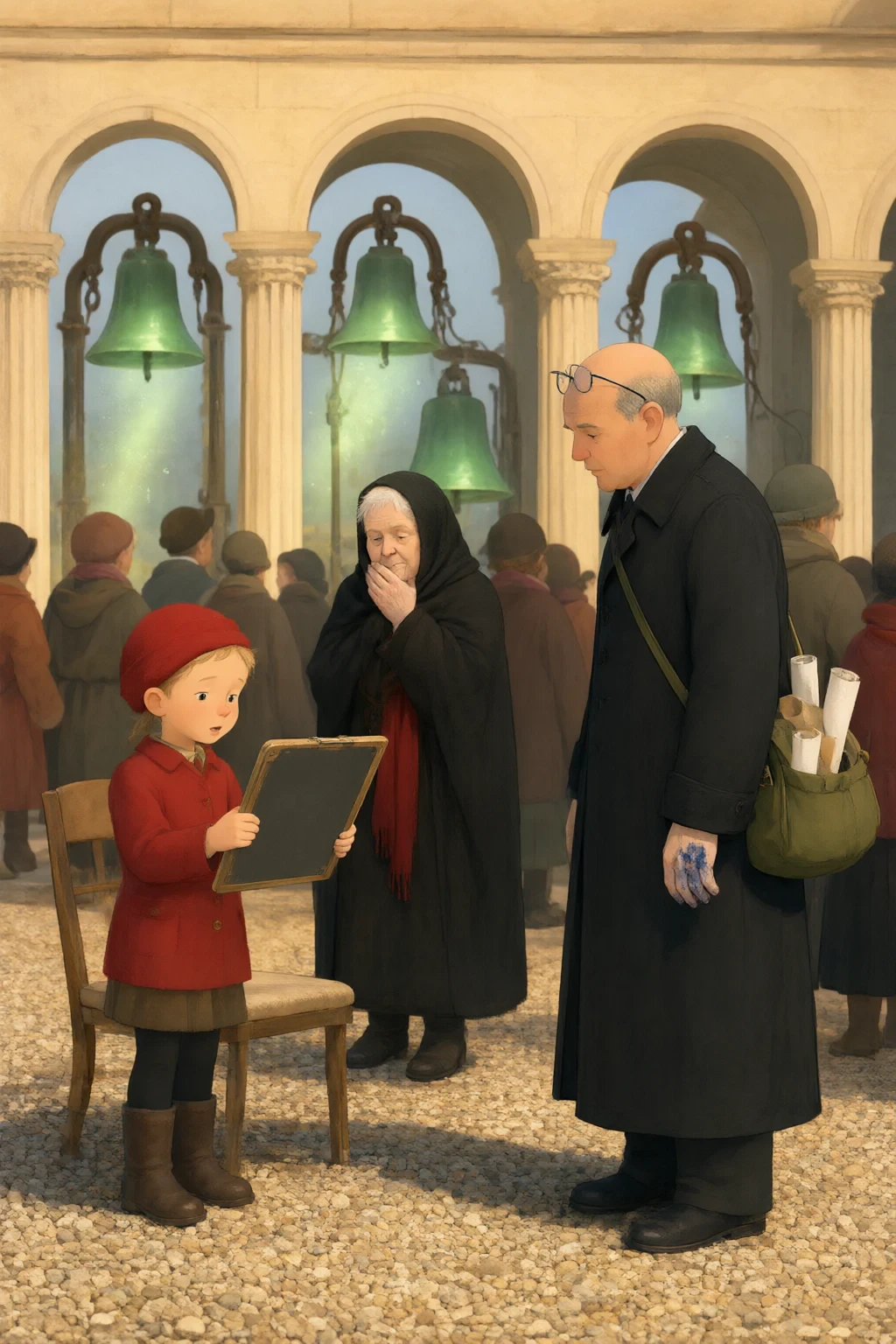
The Register of the Living is read out loud in the schoolroom every Monday at ten o’clock, it is nineteen years old, and nobody in Coldrow has ever once been asked to check it. “It stands in the record as follows,” said Ansel Roke. He was forty-nine, with a long black coat inked at both cuffs and a blue ink stain down the side of his right hand. His spectacles were pushed up on his head, because he was always thinking. “Nine hundred and forty-one names,” he said. “Every soul in the valley of Vesset Grail who is not dead.” “Master Roke,” said a boy in the third row. “Is that true?” “That is what it stands in the record as. Which is not the same as true.”
Old Widow Hesk was waiting in the yard when the children came out. She was eighty-one, stood with her back very straight, and said everything twice, the first time to be heard and the second to be sure. “You keep the list of the living.” “I compile it. It is paper.” “It is a list of the living,” said Old Widow Hesk, “and I have twelve people on this paper who are not on it.” She took out a folded sheet gone soft as cloth, worn through in one place and mended with black thread.
“I went down the market on the Thursday. Twelve people, twelve times over, in the yard, in front of everybody, by name, at the top of my voice. A thing said quietly in a market is a thing that did not happen.” She held the paper out. “And nobody has ever heard of one of them. Not one. Twelve times.” “Madam Hesk—” “You will want to tell me I have the wrong names.” “I was going to say that I compile the list. Which means it can only ever agree with me, and I have known that for nineteen years and gone on compiling it anyway, because there is nobody else in this valley allowed to do it.” She nodded, as if he had finally said the thing she came to hear.
He read the twelve out that afternoon on the school steps, and the market did not come, because the market is only on Thursdays. He found nine of them in an afternoon. Four had been listed under the name they were christened with. One had gone over the ridge at nineteen and come back at sixty, and nobody knew him. Two were women who had died in the winter, and their names had been taken off correctly. One was a man who had gone deaf in his own house for six years.
Two were not explained at all, and one of them was Bram Hesk, and Bram Hesk was her brother, and he was at that moment alive. “Three weeks, then,” said Old Widow Hesk. “You said three weeks.” “I did not say three weeks.” “You said the Sleetmonth wind comes on the eleventh, and that after that nothing in this valley can be moved, because the Chart House will not have a bell unhooked in it. I have listened to you for an hour and a half.” “The eleventh,” he admitted. “Three weeks.”
Petra Vole was nine years old and could count to a thousand without going wrong, and nobody had ever thought to make any use of it. She was Perrin Vole’s sister. Perrin was fourteen and had lost the squeak out of the Chart House winding wheel and told nobody. Petra could no longer whistle either, and told nobody, and made a private arrangement where counting took the whistle’s place. “Petra. You are going to help Master Roke count bells.” “Count how many?” “Sixty-one.” “That is not counting,” said Petra. “That is finding out. They are different.”
The rota is the only instrument that exists. It is a wall chart in the Chart House: five columns of black chalk ruled on whitewashed plaster. Date. Bay. Bell. Ringer. Called. To the right of the last column there is six inches of blank wall. Petra stood in front of it for a long time. “Why is there a space there?” “Because there are five columns.” “There is a space,” said Petra, “and spaces are for things you have not written yet.”
Ansel Roke took his spectacles off the top of his head, put them back on the top of his head, and then took them off again. “The chart has a column for the date. A column for the bay. A column for the bell. A column for the ringer. A column for who is called.” “And a column for who is in the bell.” “No.” “Why not?” He sat down on the long table, which he was not supposed to do, and looked at the six inches of blank wall.
“Because a bell holds a thimbleful of ash and a name cut in lead, and neither of those things happens in here. The chart is for the wind and the bell and the ringer, so it has a column for those.” “But if the name is cut in the yard, how does anybody know the bell is right?” “They don’t,” said Ansel Roke. “They copy.” Petra looked at the six inches for a while longer.
“So if somebody writes a name in the wrong place once, and then everybody copies the wrong place for nineteen years, then the wrong name is in the lead, and the lead is on the bell, and the bell is in the colonnade, and the man is in his chair at his sister’s table.” “Yes,” said Ansel Roke. “Then it isn’t the lead that is wrong.” “No,” he said. “It isn’t.” So they counted. Ansel Roke unrolled the Register along the long table, nineteen years of it, and Petra Vole went along the rota line by line with a stub of chalk, writing down every name in the bell column and saying them aloud, because she liked it. Sixty-one bells. Nine bays. Two hundred and one days of chart.
It took them four days, in the Chart House and on the Pillar Walk, the flagged route behind the colonnade, a kilometre long, with no window in Coldrow looking out onto it. Petra walked it twice a day in a red wool hat, counting the bells in the hard low sun that came through the pillars in narrow bars, full of glass dust, saying the numbers aloud, because a number said aloud has been checked. On the fourth day she put her chalk down. “Nine of mine are on your list and fifty-two of yours are on mine, and there are nine on neither, and that is eleven, and you said twelve.” “Eleven,” said Ansel Roke. “You said twelve.” “The twelfth is in the chart, but the name on the crown of the bell is not the name in the chart.”
Which left two, and one was Bram Hesk. His name, cut crooked in the lead on the crown, was on the twenty-second bell of the fifth bay, and nobody in the village had ever stood under it. Bram Hesk was at the mill, mending a wall. He was sixty-four and had been at it since Candlemonth, and was doing it badly on purpose, because a wall done badly takes a man twice as long. “Master Roke,” he said, and set down the hod. “Master Hesk. You are listed in a bell. In the fifth bay.”
Bram Hesk looked at the girl in the red hat, and then at Ansel Roke, and laughed once, the short bark of a man who has been mending a wall for months. “I have been here the whole time,” he said. “Forty years in this valley, on this side of the water. I have never once been anywhere else, and I would know, because I hate the far township.” “Have you ever been certified dead?”
“No. Not once. Why would I? I am standing in a hole in the ground with a cold leg and a perfectly good reason for it.” He picked the hod up. “My mother used to stand under it.” “Twenty-ninth of Sleetmonth,” said Ione Sarrack, before she said anything else, which was how she said everything, “and no bell comes off a yoke in a Sleetmonth wind, and the wind is three days out, and I will not be argued with.” “You have three weeks,” said Ansel Roke.
“I have three days. I am writing it where it stands, in the margin, in the ringer’s column, and I am signing it, because if it is wrong then it will be wrong in writing, which is better than a thing that is merely unknown. And I want two witnesses and the ash reader.”
Marget Oskell was sixty-three, in a black apron worn white at the knee, and she came up to the fifth bay with the finest of the brass sieves and a shallow tin of dry ash in her pocket, and tapped the tin twice before she said anything. “Have you seen it twice?” “I have seen the name on the crown twice,” said Ansel Roke. “Once in the bay and once in the wax.” “That is not the same question,” said Marget Oskell, “but it will do for a Thursday.”
It took three of them the better part of two hours. The yoke is wrought iron and bolted, and the bolts are four hundred years old and they do not care. The bell came down at last with a sound like a bucket set down in a room where somebody is sleeping, and it did not ring, because nothing struck by a living hand has ever rung a bell here. Then they turned it over. A bell turned on its side on the paving shows you two things: the ground mark of the blowpipe on the crown, and the inside. Marget Oskell went down on one knee in the ash of nine hundred years of people and put her hand into it. “Nothing,” she said. “Nothing at all?” said Petra.
“A little mould dust in the bottom, and no more than there would be in a thimble of sand.” She took her hand out and looked at the grey of it. “A thimbleful is what a person weighs. I have weighed nine hundred and forty-one, and I know a person’s weight the way you know a face. There is no person in this bell.” Petra wrote it on her slate. She wrote it large, because a thing written small in the cold is a thing that can be argued with later. Bram Hesk. Bay five. Bell twenty-two. NOBODY IN IT.
For a while nobody said anything. The wind came down off the Washing Steps and went through the ninth bay, and one bell in the eighth bay said its note, high and clean and slightly wrong, the way all of them are. “Nineteen years,” said Ansel Roke. “I have read that name out of a book every Monday, and it is a bell with nobody in it.”
“Then somebody wrote it in the wrong column,” said Marget Oskell, without looking up, “and somebody cut a lead seal out of the wrong column. And there is wax on the underside of the yoke.” “Bela’s wax,” said Ansel Roke. “Bela’s wax. And on the annealing rack at the Crown Kiln there is a rack of it that this valley has never once been permitted to read, because the woman who keeps it cannot read a number and answers to a mark.”
They went on the thirtieth, because the Crown Kiln does not keep its marks for anybody at night. Bela Truce came out of the roar with one ear redder than the other, and stood in front of the annealing rack with her hands behind her back and did not touch it. The notched wax was on the ninth place from the mouth. “That is a ring blank,” said Bela Truce. “Not a bell. A ring blank is what you blow and hang while you are waiting for a name.” “Waiting for a name.”
“The Kiln blows a bell, and the bell is empty, and it goes up into the colonnade and hangs there, and the Ash Yard sends the name up on the sled, and the name goes in the lead.” She put her thumb on the notch. “I notched it because that one had been up there a long time. It never came, so I never cut a name in it, and I never moved it.” “So where did the name come from?”
“Off a page,” said Bela Truce. “Somebody carried a page up the Pillar Walk with a name at the top of it and cut it into a lead blank that was not waiting for that name. The Kiln does not blow a second bell and does not re-cut a seal, because a seal is cut once, and a name cut in a bell belongs to it for ever.”
On the last day before the Sleetmonth wind, Ansel Roke put a chair in the middle of the Chart House courtyard and a folding table beside it, rolled out the Register of the Living, and laid the rota slate on top of it with a stone on each corner. The courtyard filled the way it fills on a Thursday, with capped and shawled people carrying jars, and it is the only place in the valley where nine hundred people can stand and hear nothing happen.
“Master Roke,” said Ione Sarrack. “You have no authority to read a name out of my chart.” “No,” said Ansel Roke. “I have a black coat and a book I wrote myself. If I read that line off that table then I am a man reading my own book, and everybody in this yard will be right to go home and say I read it to suit myself.” He got down off the chair.
“Petra Vole. You were born in the year I started this Register. You are nine, you have no office, no seal and no standing of any kind, and you counted sixty-one bells in four days without a mistake. Will you read the line?” She looked at the slate, and then at the yard, and then she took off her red wool hat, because you cannot read properly with a hat coming down over your eyes. “All of it?” she said. “All of it. Slowly.”
They were quiet for as long as it took her to find the place, and the yard was so quiet you could hear the wax cracking on the cold shutters behind her. “Twenty-second of Frostmonth,” read Petra Vole, in a small flat voice, with her eyes on the slate. “Bay five. Bell twenty-two. Ringer: Bram Hesk. Called: —” She stopped. “Go on,” said Ansel Roke. “Called: nobody. There is a place on the rota where it says who a ringer has gone to fetch, and for that bell it says nobody, because he was fetching nobody. He was a ringer.” She looked up. “Somebody has been reading Bram Hesk off that line for nineteen years without asking him what it said.” She held the slate up.
“It is a bell with no person in it, and his name is on it, and his mother stood under it, and he is alive, and he is at the mill, and he has been at the mill the whole time.” And then Old Widow Hesk, in the second row, said, in a voice that was not loud and did not need to be: “That is my brother’s name. Somebody has said it.”
Ansel Roke uncapped his pen with his teeth and wrote on the Register, in the middle of a Monday page from a year nobody could now remember, in ink, in his own hand, in the space where the name should have been all along. Hesk, Bram. Of the mill. Alive. Which is not the same as true. But it is the same as written down, and in Coldrow that is not nothing.
Eleven names were still wrong on the board when the wind got up at four o’clock and came down off the ninth weir. Petra’s slate had eleven chalk marks on it and one wiped off. Master Roke’s Register had one name in it twice, which is a thing the schoolmaster of Coldrow can assure you does not happen, and does. The wind did what the wind does. That is all it ever does, and it is the only thing in the valley of Vesset Grail that is allowed to make a noise about the dead.