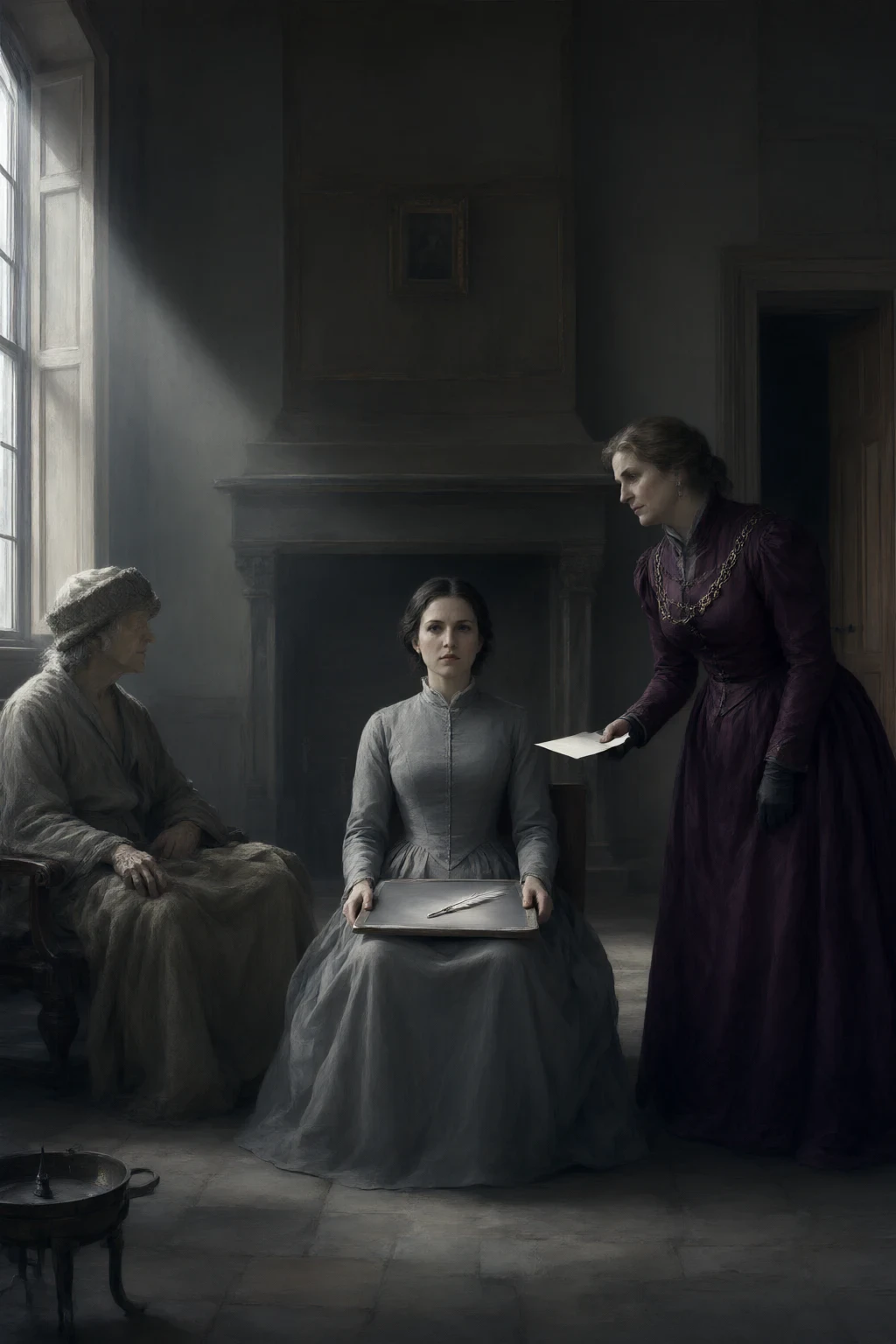
The King of Kirrem had spoken to nobody for twenty-one years, which everyone in Ashgate agreed was a mercy, and the Princess Anneke had not spoken since she was eleven, which everyone in Ashgate had stopped noticing, because a person who does not speak is not a person who has said anything. Both of these things were true, and neither of them was a coincidence, and only one of them was known. The audience was at half past seven, before the heating came on, because her father liked it cold and liked it early and had spent a reign choosing the hours at which the kingdom's business could be conducted without anybody enjoying it. He was seventy-one and had bad hands and a good head, and he sat in the north room of the Cold House in a dressing gown and a wool hat, with the fire laid and unlit, and a ledger open on a board across his knees, and the other one already in her hands. "Say it back to me," he said.
He did not say that to her. He never once addressed a remark to her, in twenty-one years, because a remark addressed to a person requires an answer and he had spent a very long time constructing a room in which no answer could be given. He said it to the fire. He said it the way he said everything, to the air in front of the hearth, and Anneke, who had been raised to take instruction from a man who gave none, had learned to treat the air as a third party with standing. He gave her the harbour, the northern levy, the price of bread in the salt towns, and a paragraph about his cousin's debts that was entirely invented, and she read it all back in her head, silently, in the order given, holding nothing in her hands, because hands are what people look at. "Say it back."
She did. Not aloud. Her eyes went down the board and came back up, which was the whole of their system, and had been for twenty-one years, and it worked, and there was no one in Kirrem who could have told you what it was. The first ledger was the day's business. The second ledger was what he had told her was untrue, and she ruled it herself, and she had never shown it to anybody, and the two books looked exactly alike from the outside, down to the marbled boards, because he had chosen the boards himself in a stationer's in the capital and had had four made and had arranged for one of them to be the wrong colour, so that a person who had seen the first and then found the second would think they had found the first. "It is going badly," said Halvard, to the unlit fire. "It is going badly and everybody is being careful and I have not been able to establish why."
In the second week of February, the Harbour Board of Kirrem appointed a pilot. The pilot was a competent man from the delta who had been before the council once, in the autumn, and had asked a question in the autumn. He was appointed in the second week of February by a board of eleven, in a chamber, with a quorum, and the appointment was published.
The King had decided on the appointment on the ninth of February, at half past seven in the morning, in a cold room, to a daughter who had not spoken in twenty-one years, and he had recorded eleven words of the deliberation in the first ledger, and he had recorded the rest of it in the second, and the rest of it was that the pilot was honest, that the Council had offered him money, and that the Council had offered him money on the third of February, and that the Council had offered him money on the third of February because somebody in the Council's household had been told in the first week of February that the King was minded to have him examined. There is no mechanism by which a first week fact reaches a chamber in the delta. There was, in this case, exactly one mechanism, and she was sitting at the table writing it down. Anneke Vahl had never said a word about it, and the whole of Kirrem was speaking through her, four times a day, in bundles, wrapped in state cloth.
The state cloth went out to the laundry on Tuesdays and came back on Fridays. This was not a symbol. It was a laundry contract, held in the family name Rennard for two hundred and eleven years, and the contract was for the washing and pressing of the household cloth of the Cold House: the table linen, the state cloaks, the banners, the covers for the chairs used at the four audiences a year, and the blue wool in which the King's correspondence was folded for carrying, because a king in Kirrem did not hand a paper to a stranger; a king in Kirrem handed a paper to a fold of blue wool, and the fold went out on the Tuesday cart, and came back clean on the Friday. Vale Rennard was twenty-five and had been doing the Tuesday cart since he was nineteen, and he had one talent, which was that he could tell by looking at a thing how it had been handled by somebody who was not handling it properly.
On the fourth Friday in February he came into the wash-house at the bottom of Sennet Lane with eleven folds of blue wool over his arm and stopped in the doorway. Mrs Tace Anspeth was eighty-two and had run the wash-house since before Vale was born, and she was folding. She always folded. There were four women in the wash-house and three of them worked, and the fourth was Tace Anspeth, and she folded, and nobody had ever in her life been able to explain to her that this was not a task. "Your Majesty's cloth," she said. "Thank you, Mrs Anspeth." He put the folds on the table. The first three were as they should be. The fourth had a crease in it that was not a fold of the wool; it was a soft, rounded crease, the kind a thumb makes when it has pushed into a thing and lifted the corner of a paper out of the pocket underneath. Vale Rennard put his hand flat on the crease and looked at it for a while.
Mrs Anspeth folded. She did not look up. She had a way of not looking up that people mistook for deference and which was in fact the result of eighty-two years of a profession in which the person who looks up first is the person who admits to having read something. "Mrs Anspeth," said Vale, "do you open these?" "Never." "Do your girls?" "Never." "Because somebody's opened this one with their thumb, and they haven't used a knife, and they've been careful, and it's the fourth one down, which means it's the fourth one that came off the King's desk on the ninth of February, and there were six that day." Mrs Anspeth put a folded sheet down on the table, squared it, and picked up the next one.
"Vale," she said. "I have been washing other people's linen for fifty-four years and I have never once read a word of a thing that was put inside it, and the reason is not that I am a decent woman, though I am, and it is that the King of Kirrem has kept me in this trade since the year of the fever." He waited.
"He wrote to me in the year of the fever," she said, "and asked me for a list of the people in this town whose businesses had fallen in, because he wished to be certain that none of them should be bought up cheap. I sent him twenty-two names on the back of a delivery note. He has paid my rent every year since, through a clerk, in an envelope, with no letter, and he has done it for thirty-one years, and he has never once walked into this wash-house, and I have never once said thank you, because a woman who says thank you for that has asked to be thanked, and he did not want to be thanked, he wanted it not to be discussed, which is the hardest of his talents."
Anneke Vahl worked it out on the Sunday, in a cold room, alone, which is what she had done every Sunday for twenty-one years, and which nobody in Kirrem understood to be a day's work. The mechanism was this, and it was elegant, and it had been elegant since the ninth of February and probably for years before that. The only courier in Kirrem who could not be questioned, could not be bought, could not be followed, could not be searched, and could not be made to repeat herself, was a woman of thirty-two who had said nothing since she was eleven, and every party in Kirrem that wanted to know what the King thought knew this, and the party that knew it best had spent nine years arranging for its own people to see the cloth.
And it was not a leak. That was the part she had been getting wrong for three days, sitting with a slate on her knees like a schoolroom. Nothing had been stolen from her. Nothing was taken out of the blue wool between the Cold House and the wash-house at the bottom of Sennet Lane. A woman of eighty-two with a laundry and four girls had been reading the King's correspondence for years, in a warm room, with good light, and had never taken anything, and had never been asked to take anything, and was still there. Which meant somebody was reading what the laundry read. Which meant somebody had made it safe and easy and ordinary for a laundress of eighty-two to open a fold of a king's private correspondence, and had spent nine years ensuring that nobody would ever have reason to look at the wash-house on the bottom of Sennet Lane.
The Chancellor had been to the wash-house in the autumn. She had gone in for a cup of tea, as she did everywhere, and had been there twenty minutes, and had left a very good cup and a plate of biscuits, and had asked Mrs Anspeth, in the manner of a person asking a woman of her age about the price of something, whether the rents in that street had gone up. She had been raised in a house where a person is a road, and she had walked on this one, and it was perfectly formed, and it went from the man who cannot be questioned to the woman who cannot be doubted, and it had been used, and it was going to be used again, and the place where it started had to be stopped.
Anneke Vahl sat in the cold room with the second ledger on her knees and understood, with a clarity that she would carry for the rest of her life and never be able to explain to anyone, that in a kingdom where nobody could prove a thing, the only safe person was the one who would not say it. That her father had known it. That he had spent twenty-one years feeding her a country, day by day, in two ledgers, on the theory that a person who cannot speak is the only person a frightened man will tell the truth to, and that this made her a vault, and that a vault is only ever as safe as the number of people who know what is in it. There was one. There was one, and he was seventy-one, and he had a bad chest in the wet months.
The Chancellor came on the eleventh of March, at the ordinary hour, and did not sit down. "Your Majesty may leave us." "No," said Halvard, to the fire. "She is better at minutes than you are, and I have never once known her to improve a sentence, which is a compliment." Ilse Merrow laughed, because she was fifty-eight and had been laughing at that joke since the year after Anneke was born, when it was actually funny, and laughing at a thing for thirty years does not stop being a technique. "Then your Majesty will permit me to use her," she said, and Anneke watched the sentence land, because that was the word. Use. Not consult. Not attend. In the vocabulary of a woman who has governed a country for nineteen years, use is the word you keep for a tool you have understood.
She put a paper on the table. It was a sheet of the estate's own paper, not the household's, and it was a draft minute of the council, and it recorded that the Council of Nine had resolved, in the ordinary course, to submit to the Protector the question of the northern command. It was not true. Halvard had not formed an intention about the northern command. He had, that morning, before the audience, eaten two pieces of bread and thought about a drainage. "Your Majesty has spoken of the northern levy on several occasions," said Merrow. "I have taken the liberty of reducing it to a form the Council can sign. I would be grateful for the Princess's confirmation that it is in your Majesty's words."
It was perfectly designed. It required a signature from the only person in Kirrem who could not be asked what the King thought and could not contradict him if she were asked, and it was a small thing, a housekeeping matter of the first importance, and it would have gone into the file in four minutes, and in three months the Council would have signed a Protectorate over the northern command on the strength of a summary written by a woman who could not write. Anneke Vahl did not move. She had eleven ways of not moving. She had spent twenty-one years perfecting the smallest of them, which is the one that looks like attention, and she used it, and Merrow waited, and then said, "Your Highness?" She reached over and put the hand that held the slate on the table, palm down, and did not write. "No," she said.
The word came out in a whisper with no air behind it, the way a word comes out of a person who has not used one in twenty-one years, and the Chancellor heard it, and the King heard it, and neither of them moved either, and it went through the north room like a dropped glass. "Your Highness is not well," said Merrow. "Second," said Anneke. That is all she said. She had said three words since she was eleven and she had said two of them to the Chancellor of Kirrem in a cold room in a dressing gown, and afterwards she did not say anything else for a long time.
The last entry in the second ledger was dated the second of March, which was nine days before the Chancellor came. It was not in her father's hand. It was in hers, because on that day he had asked her to write it out, which he had done perhaps a dozen times in twenty-one years and only ever for things he could no longer do with his own hand, and he had stood at the window the whole of it and not once looked at the page, which was how she knew he had written it before. Nine. For the succession, when it comes, the Council will do what the Council does. There is nothing for them to find and they will find nothing. Do not be frightened of an empty file. It is the correct shape.
And this, which is the whole of what I have for twenty-one years: forty-one names, at the back. They are not the Council's and they are not the Chancellor's. They are mine. I have paid the rent of a laundry, a cooper, a dyer, a woman with a good hand at binding, and thirty-seven others, and no two of them know, and the reason I did it is that in this kingdom a man's misfortune is a sale, and a sale is a man with money, and there is no law in Kirrem that says a man may not buy a pauper.
You will be asked one day for that book. Everyone who has ever governed this kingdom has needed a list like it, for the other list, the one with the names crossed out. When they ask, you must not give it and you must not burn it, and you must not answer, because an answer is a repetition, and you are the only person in Kirrem who has never repeated anything, and there is no one standing behind you. Take it to the bindery. They pay by the sheet. You will want the money and you will not be able to say why you want it, and that is fine. People who cannot say why they want money are not cheated by anybody for very long. Your hand is the best in this city and no one knows you have one.
He died on the twenty-ninth of March, in the night, quickly, in the way of a man whose chest had been settling up for a year and had finally finished the argument. The Council of Nine met on the second of April, as they had met in 1611 and 1748, without kings, and appointed a Protector, as they always appointed a Protector, and the business of Kirrem continued, and there was no crisis, and the file on the northern command contained nothing at all, which was the correct shape, and which the Protector looked at once and did not find interesting. On the ninth of April, a woman of thirty-two walked into the bindery at the bottom of Weir Street, where four men and two women cut, fold and stitch, and asked for a job at four shillings the hundred sheets, and paid for the first week in advance in coin she had counted out on a table in a row, and asked for no name to be used, and gave a name.
The clerk wrote it in the wage book. The clerk did not ask. The second room at the bindery does not ask, and the clerk had been in the second room for twenty-six years, and it was not curiosity that kept clerks in second rooms, it was the opposite. `A. Vahl. Copyist, second room. Four shillings the hundred. Entered 9 April.` Nobody in Kirrem had ever seen the hand. It is not a large hand, and it is not a beautiful hand, and it is a very plain hand, and it is so even that a man who has done it for thirty years came out of the store room in the middle of the afternoon to look at a page she had left face up on the bench, and stood there, and said, to nobody, "We have had a palace copyist here four weeks and there is not a man in this trade who has ever seen a hand go down a page like that."
It took her nine months to copy out the list. She did it four sheets at a time, at a table in a cold room on the second floor, and when it was done she had two copies, and she sent one to the Council of Nine in an envelope with no return address, and she walked the other four miles herself, in the rain, in the spring, to the bottom of Sennet Lane, and gave it to a woman of eighty-two who read standing, at a window, without her spectacles, in about ninety seconds. "What's this?"
"It is the names of forty-one people in this city who are not to be bought up cheap in a bad year," said Anneke Vahl, "and it is a copy, and the other is in the Council's, and neither has my name on it, and I have not written to you about it before because I have never written to anybody. I am telling you now because your rent is paid to the end of next year, and after that you will have to find out who is paying it." Mrs Anspeth looked at the sheet for a while. "Twenty-two," she said. "It was twenty-two names." "Yes," said Anneke Vahl. "He asked me to add nineteen. He said it was the one useful thing a king could do and the only one he had time for."
She put her hand flat on the table as she had put it flat on the table in the north room in March, and did not write. Mrs Anspeth, who was eighty-two and had not been thanked in thirty-one years, put the sheet face down on the ironing board and put a clean cloth over it, because that is where a thing goes in that house when it is going to be kept.