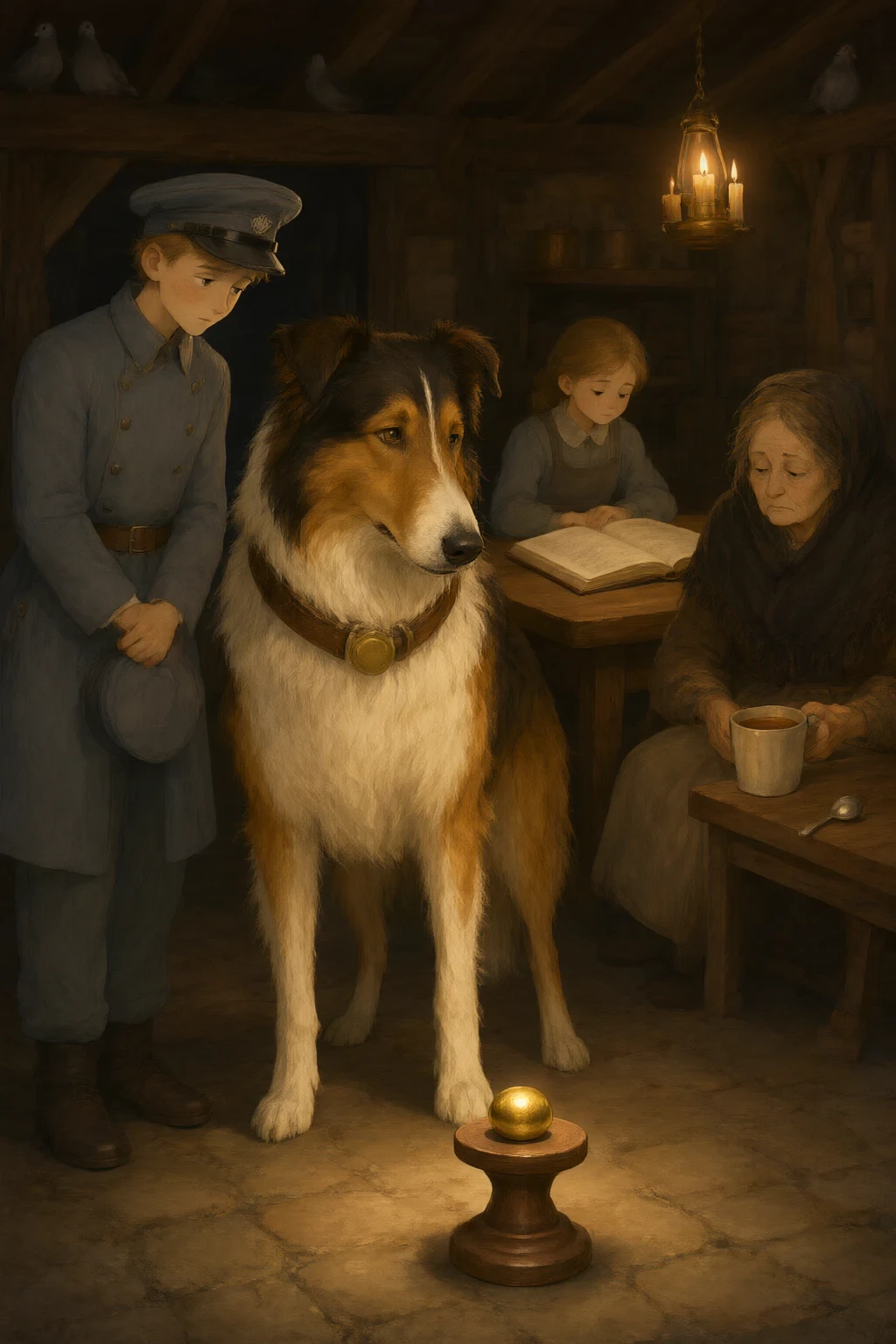
The small court at Krag Noll met once a month in the upper room of the old mill, where the pigeons walked on the beams and everything smelled faintly of flour. It had nine chairs, a bench, a summons-stone in a wooden stand, and a ledger the size of a hymn book. Private Ansel stood outside the door with his cap in his hands. "I will wait," he said. "You may as well come in," said a girl of about fourteen from the table. "You are the only person here, and the hearing is yours."
She was Nell, the copyist. She had a quill, a blotter, and the temper of someone who had been up since four. Beside her, stirring a cup of cold tea with a silver spoon, sat an old woman in a shawl. That was the witch of Krag Noll. The village had told Ansel that a witch lived in the mill tower and kept her gold in an old tree, and Ansel had believed it, because the village had believed it for a hundred years and nobody had gone up to look. The old woman was the magistrate. Her name was Vetch, and she was tired of it.
"Close the door," she said. "Nell, find the writ." Nell turned back a page, then another, then a third. "There is no writ, Grandmother." "Begin with the summons, then." Ansel had come about pay. His quarters' allowance had come out short two months running, and it was not fraud, he said, it was a clerk's arithmetic at the depot, and he could make it good by the quarter's end. If he could not, his small house on Water Lane went to the landlord, and his mother went with it. "I will testify to the arithmetic," he said. "It is just arithmetic."
"It usually is," said Vetch, "until somebody's house is in it." Then she told him about the stone. There was a summons-stone in the mill, brought down from the capital two hundred years ago, and when a person who was owed something struck it, the court was bound to hear the case at once. It was not a wish. A summons is not a favour. "I can't simply hand it to a soldier," Nell said. "You can hand him the stand," said Vetch, and turned back to the fire. Ansel struck the stone.
The sound was very small, the sound of a match. Then came claws on the stairs, a whole noise of them coming up the outside of the mill, hundreds of feet on stone, and nine black dogs came through the door and stood in a row across the room, breathing. The door opened again, and in came a dog the size of a pony. He wore a collar with the court's seal on it. He was, Nell said quietly, the bailiff. His name was Warrant. Warrant sat down in front of Ansel and laid one paw on his boot.
"You will show me the place," said Vetch. "And you will touch nothing, soldier, because this court has spent three sessions arguing about one buried stag." So they went out into the fields at night with a lantern, and Warrant went ahead, and he took them to an old ash tree standing where the mill's land and the village common met. Ansel put his hand into the split hollow of the trunk and felt brass. Somebody lifted the lantern, and the little girl looked, and the hollow was full of coin.
"It isn't a treasure," said Nell. "It is a bond." She was already walking the property lines in the grass, naming each mark as she passed it. "The third millstone is that one, and the millrace is on that side, so the tree stands on the mill's land. And the mill was left to the court when it stopped milling, and the court never sold it. It only forgot it had it." Vetch said nothing at all. That, Ansel understood much later, was the interesting part of the night.
The hearing took two sessions. The first was for the soldier, and his was easy. The depot's arithmetic was checked. The shortfall was real, small, and embarrassing to the people above him. The house on Water Lane was protected for the quarter, and Vetch wrote the order in her square hand, and made Ansel say his thanks, which embarrassed him more than the shortfall had. The second session was for Vetch, and nobody had planned it except Nell.
"There is an account open," the girl said, "and it has been open a very long time." She had found it at the back of the ledger, in a hand nobody living used. A sealed warrant, ordering a sum received in trust to be sealed in the boundary tree and held against the day it was claimed. Beside it, in the margin, four words: claim not yet brought.
"Two hundred and eleven years," said Nell. "That is how long the tree has been the depository. Nobody has ever brought the claim." She looked up. "So it is not a theft. It is a filing error. Somebody put the money in and then nobody wrote the book up." Vetch put down her spoon.
"The hand is my great-grandmother's," she said, "and the amount in the tree is not the amount in the warrant. It is more." She said it the way a clerk says a number. "I have known the difference for nine years. I could not produce the warrant, because a magistrate may not cite a document she cannot produce, and I could not find the document, because the copyist who copied it is dead these many years and the copy went into the copy. So I sat here."
"And you sold the location of the tree to a soldier," said Nell, "which is theft. And now there is an account, and the account has a number, and the number has a tree." Vetch was quiet for a moment. "Yes," she said. "Now it does."
They counted the money on the hearing table in the upper room, and it took until the candles were short. It was not a great sum. It had been a great sum once, and now it was two hundred years of interest on a great sum, and that was the whole argument: what may be done with a fund nobody has claimed, and by whose hand.
Nell had an answer, and it was dull. Nobody could touch the deposit. What could be touched was the interest, and only if the original purpose still stood, and the original purpose was written in the only document anybody had. The deed of the trust said the fund was for the poor of Water Lane. Water Lane was the row of nine houses where Ansel and his mother lived, and where eight other families had their roofs mended that winter by the same fund, none of them knowing there was a tree on the common above them doing the work so quietly.
So the court mended Water Lane. That is all it was. Eleven roofs, four chimneys, and a school stove that stopped being cold, and the mason was a woman named Sill who did the best work in the town and had been paid in promises for eleven years. Ansel asked what would become of the tree. Nell said that a court cannot move a boundary tree, and that a court with no jurisdiction over the tree has no jurisdiction over what grows in the split. So a hawthorn could be set in the hollow, and the ash would close its wound around it.
The first hawthorn did not take. The second did, and by midsummer the tree carried a small green flag in its crack, and the court had run a low rail around the base: the only fence on the whole common, put there by a decision so boring that nobody has ever resented it.
The last entry in the ledger for that quarter is in Nell's round, careful hand. The entry itself reads: deposit opened, counted, interest applied to Water Lane per deed, principal resealed, claim open, tree preserved, file complete, no further action. Underneath she has drawn a small rectangle, the shape a summons-stone stands in. She blew the ink dry, closed the ledger, and put the stone back in its stand, because the court kept its summons-stone in a wooden stand, and the stand was heavy, and the pigeons wanted looking at.