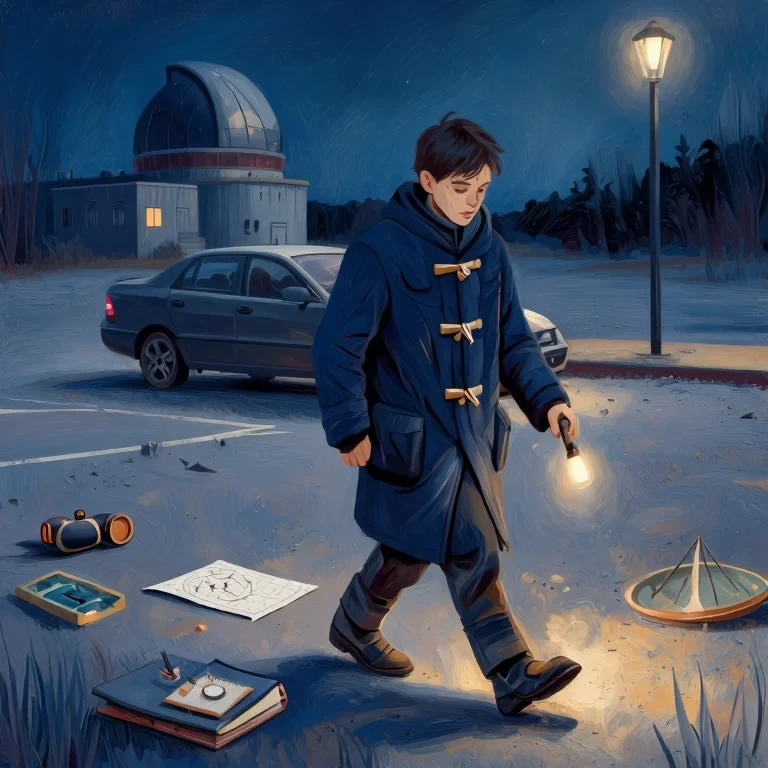
The last week of November in 1967 had weather you could see. Ben Whitlock was sixteen years old, and at half past eight every night he walked out across the car park to the chart room of the radio observatory on Ryle Road, wearing a navy-blue duffle coat his father had given him. The chart room held four hundred valves and had never once complained about the cold, which is a thing about valves.
The array itself was a field of two thousand and forty dipoles pinned into the turf in rows too close to walk between. It did not move and it could not. It made a beam about two degrees across, and the Earth turned underneath it, so a star climbed into the beam, sat there for eight minutes while it was measured, and then dropped out of the bottom again. At the far end of four hundred metres of cable the signal became two ink pens. What came down the wire was a voltage, and the pens wrote that voltage on a roll of chart paper one inch wide, running at rather more than two millimetres a second, day and night, for weeks on end.

Here is the size of the problem. In a good week the recorder laid down two hundred and twenty-four metres of that paper. Almost all of it was the sky being loud. The glow of the Milky Way is loudest along its own band, and the pen wrote the loudest nothing in great clumsy sweeps that repeated nothing at all. Nobody at Ryle Road could look at a chart and see a signal. They could only see a repeat, and a repeat is the one thing the noise never has.

Miss Bell was twenty-four years old and had the array, the recorder, the tapes and a job nobody could tell her how to do, which was to find in all that paper whatever the sky was doing. Ben's job was arithmetic and the tape. His father Albert ran the riggers, and there was nobody else on the staff who could be trusted with a long sum at half past midnight. “You will not read any of it,” Albert told him on the first night. “Nobody reads it. It comes off the pen wet, and by morning it is a tree.”
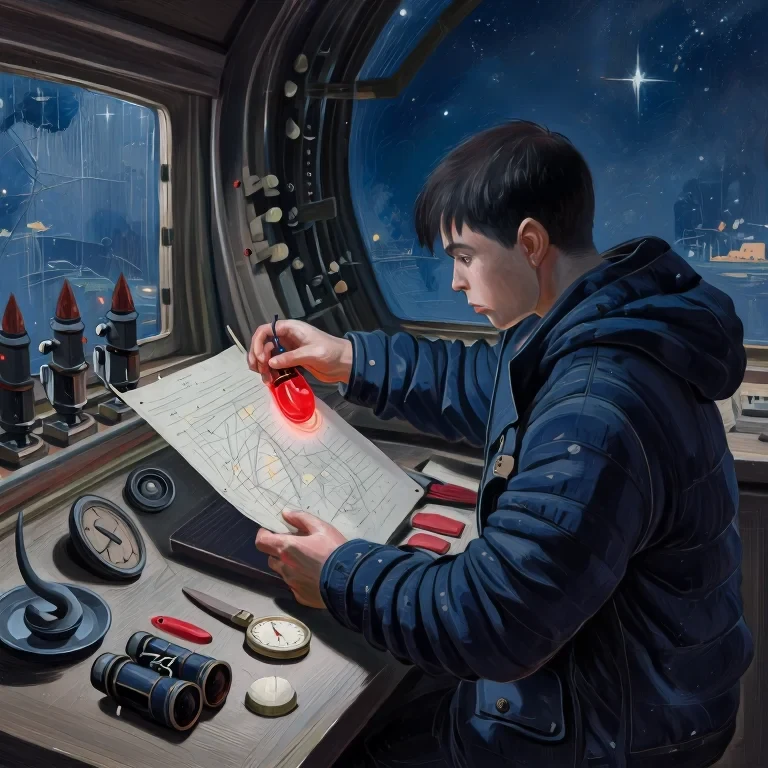
The trick was not to see the pulses. The trick was to put a great deal of paper on top of a great deal of paper. A panel of chart as long as the interval you suspected was cut with a scalpel held against a steel rule, laid over the panel before it, and taped at the seam. Do it two hundred times and you have a row of paper standing on the bench a hand's width deep, every panel stacked exactly over the one below. Noise has nothing to repeat, so two hundred wrong panels make a grey smear with no edges in it. A real repeat puts the same little stroke in the same place on every panel, and the smear turns into a picket fence.

Two hundred panels stacked also bury the noise under itself by about fourteen times, because a smear that averages down goes down with the square root of how many times you have averaged it.

Here is the part that took Ben most of November. The paper crawled along at rather more than two millimetres a second. Two hundred panels of a third of a second each is seventy-seven seconds of sky and a little over a metre and a half of paper, and for all two hundred panels to land on top of one another, the interval has to be right by rather less than a third of a millimetre over the whole metre and a half. A third of a millimetre of drift is about an eighth of a second of time, which is one part in six hundred. Your thumb is nowhere near good enough for one part in six hundred.

You judge it with a lens, a steel rule and the printed scale along the edge of the chart, and then you are still guessing, slowly, for an hour. And what you could not do afterwards was go back. The chart could not be read again once it was cut. Every panel came off a roll that was the only record in the world of what the sky had done on one night in November. Ben asked Albert whether a roll could be kept whole and stacked some other way, and Albert said there was a machine that could do it, on paper, in Cambridge, and it was not built, and the sky does not wait for machines.
The interval the array was watching that month came round to the beam in the small hours of late November. By the middle of January the same source would be arriving at ten in the morning in the rain, and Ben knew that because he had done the sum himself, and that was the night he understood the whole shape of the job. Eleven nights of small hours, and then nothing for half a year.

The first night he guessed one second and got a stack the colour of a road after rain. The second night he guessed five seconds and got the same grey. On the fourth he worked out why guessing was hopeless, which is that you cannot cut paper into panels of a length you have never heard of. On the seventh night the tape did something the paper had not.

Miss Bell had been recording the same voltage onto magnetic tape for weeks, for no reason anyone had ever explained to him, and there was a replay head and a loudspeaker on the bench in the corner. She ran a stretch of the tape at one sixteenth of the recording speed, which stretched a quarter of a second out on the sky into four whole seconds in the room, and the sky ticked.
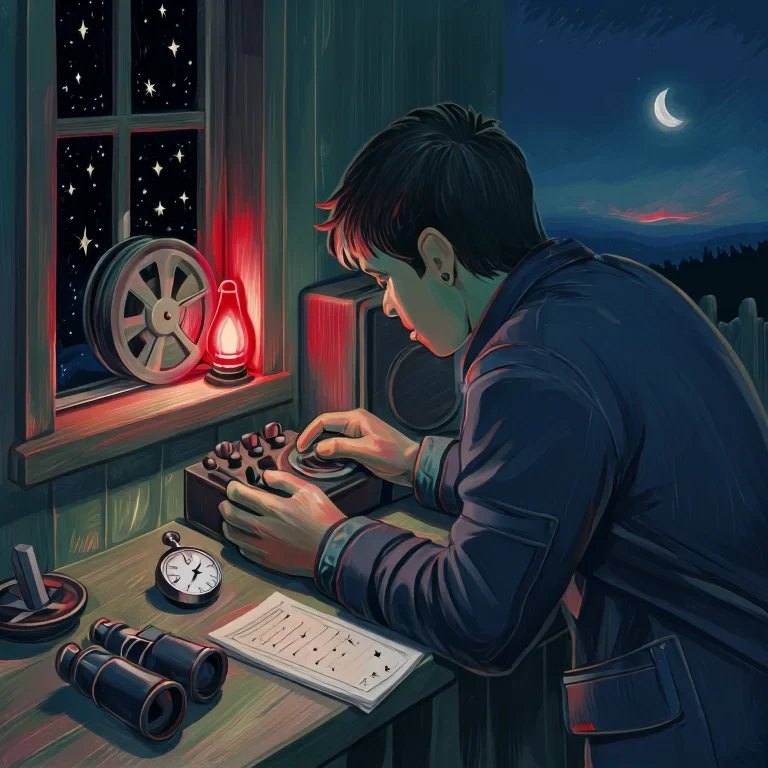
Ben had never heard anything like it. It was not a beep and it was not a voice. It was the sound a cold tap makes when a drop lands in the bowl and then, four seconds later, another drop lands, and then another, the same again. He put his father's wristwatch face up on the bench, started it on one tick, and stopped it on the twenty-first.

The number on the watch was a hundred and twenty-two seconds and a bit spread over twenty intervals, so each tick was a shade over six seconds, and six seconds divided by sixteen gave him three hundred and eighty-four thousandths of a second for something happening a third of a second at a time out on the sky. He wrote it on the back of his left hand in ballpoint and said it out loud, and Miss Bell wrote it on the sheet in front of her, which was a piece of news that the paper had not yet given them.

The pile came clean on the ninth night, and what made it clean was that Ben stopped trying to be clever. He left the trial interval at a third of a second, near enough that the marks sat within a line's width of one another, and slid panel after panel down the bench until the black marks dropped into a single column and stood up like the teeth of a comb. There were two hundred and eleven of them. None of them was blurred. What he noticed was not how small they were but that every one of them leaned the same way.

An electrical spike from somewhere in Cambridgeshire leans the other way every second one, and lightning leans the other way every time. This leaned the same way two hundred and eleven times, and then the run of source reached the edge of the beam and the marks stopped. And in the drawer, on the same night of the following week, at the same minute by the sidereal clock, the same thing had happened, because a thing fixed among the stars comes back to the same place after the same amount of turning.

She laid the night's whole haul out on the canteen table at breakfast with a plate on each end to hold the roll flat. Most of the marks lay inside a wide band that followed the Milky Way from one end of the table to the other, which is where the galaxy's own radio glow lies, and where there are more stars than anybody has bothered to name.

Then the question came, and it came to him, because he was the one with the scalpel. If the chart is the only record, she said, then what is in that drawer now is not a record. It is a strip of paper with tape on it. What is the interval? Not what you thought it was. What is it, in a form that somebody could check in fifty years without this room and without this telescope and without you.
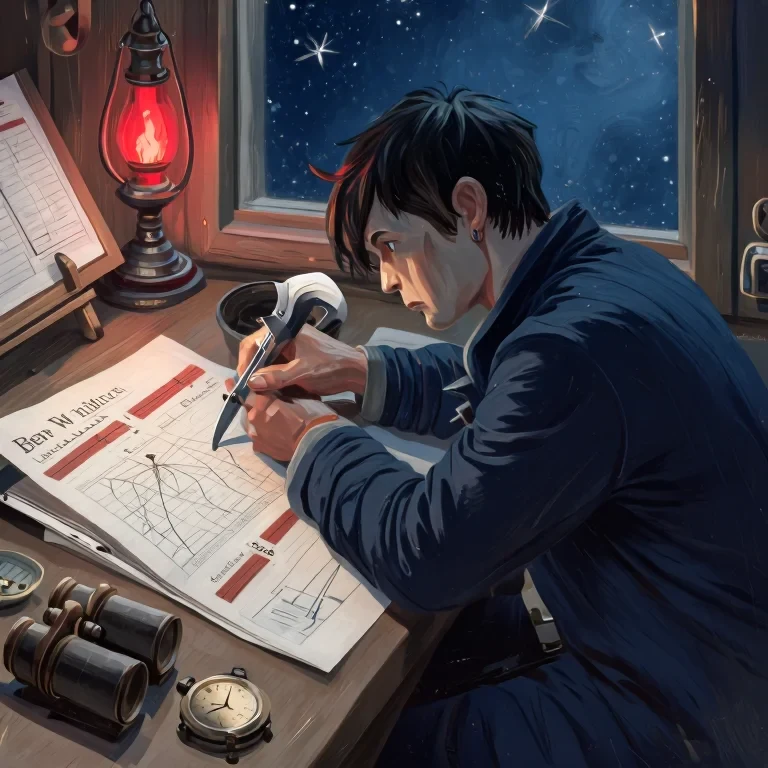
He had two answers and they were two thousandths of a second apart. The fold of the chart gave three hundred and eighty-six thousandths. The tape and the wristwatch gave three hundred and eighty-four. The chart was the better instrument, because the tape had run at a speed the machine measured once a month and the chart was ruled against a standard somebody had compared with a clock. He wrote three hundred and eighty-six thousandths on the sheet in front of her, in ballpoint, and put his own name beside it.
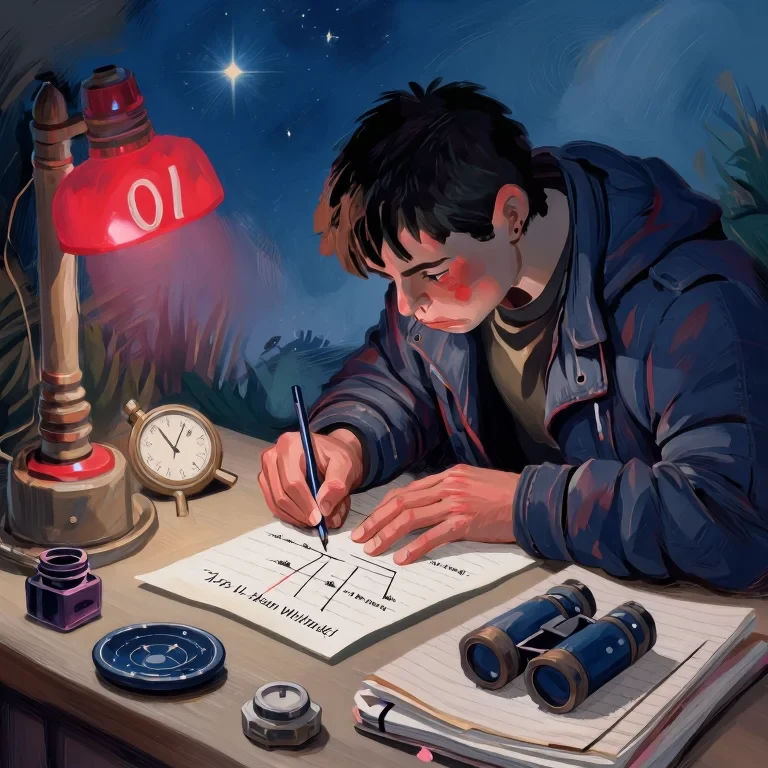
Then she made him write the other number as well. Both numbers, in the same hand, with the question written beside them, because a gap you have thrown away is a gap you cannot come back to, and the notebook is the only place either of them was ever going to exist. Albert signed the log for the roll of chart, which was his name on a piece of paper that could never be put back together. The name in the notebook was hers. Ben's name went beside the two numbers, and that was the whole of his eleven nights.

At ten past six he walked home down Ryle Road with the cold coming up off the fields behind him. In the front of his notebook, in the place where he kept the things he did not want to lose, he had three hundred and eighty-six thousandths, and under it three hundred and eighty-four thousandths, and between them two thousandths of a second, which is about one part in two hundred of the whole interval, and which nothing on that field had been able to separate.

She worked it out afterwards, with the good clock and a machine and a great deal more care than either of them had. He never found out which of his two numbers was nearer. Neither did anybody else for a long while, and the gap stayed in the front of that notebook, and it is still there.