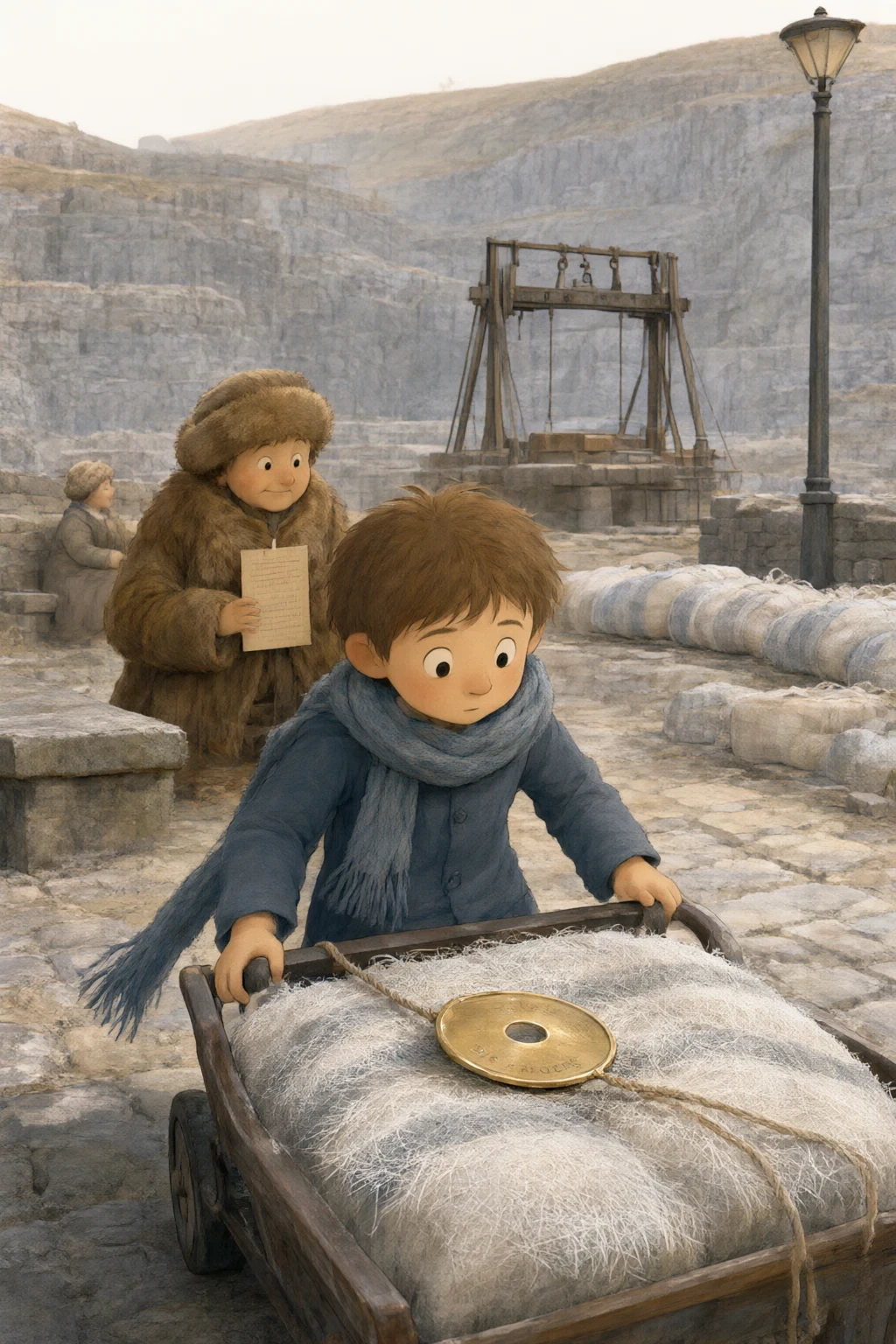
At the Frostgate you can buy a winter. Coen Halloway was twelve, and this was the fourth market his mother had let him out with a barrow. The barrows stood in a row along the granite setts, wrapped in sacking and striped with white rime-needle, a brass disc on a cord on top of each one. The sellers had grade cards on their chests, and the whole morning was done by reading numbers off one another. Coen said the rules under his breath, the way he said every number in this place, softly, so the numbers would be right.
“Read the disc. Say the number. Say it to the clerk. Do not say anything else.” Mother had said it at the door. She had said it four times. He went down the row. He stepped on the long end of his scarf, which was wound twice and tucked, and so long that it had to be stepped on. He got his breath back. Sixteen. The cold went through the sacking into his palms. It did not feel like cold from the air. It felt like cold from a place. He lifted the disc and turned it over.
It did not say sixteen. “Sixteen is the barrow,” he said. “So the number is sixteen.” The number was two hundred and six. Barrows are numbered to sixty. Grades are one, two, three, or outturn. Two hundred and six was neither.
He carried it to the stone pier, where Tav weighed the loads. Tav wrote the number in his book, and the seller read it back over his shoulder and nodded. Coen waited for somebody to say something. Nobody did. A wrong number ought to stop something. But a copy is not a mistake. It is a thing two people have agreed on, and once they have agreed, the first one is not there any more.
So he went and did small safe things, and they were all good, and that was the trouble with them. He tied the loose corner of sacking on barrow nine, because it would come off in the wind. He held up the side-lamp while a seller read his own disc by it. He counted the row three times. Fifty-nine, fifty-nine, fifty-nine. He helped an old man with a basket at the foot of the steps. The old man had a white beard and the tops of all ten of his fingers gone blue and shiny.
“I cut the fourth void on the hill with a hammer and a lamp,” he said, “and the numbers say the other thing, and the numbers are never wrong.” Then he warmed his hands at the brazier and looked up at the assay office window. Inside were the rail, and the Book, chained open on its frame. There was a notice on the rail. CHILDREN MAY NOT ENTER THE ASSAY OFFICE. He went as far as the bottom of the iron stair. Three times.
At the fourth bell the market broke up. Sledges took the barrows away two at a time. Barrow sixteen was still standing on the square with nobody’s name on it. There were three hundred and forty tokens in the Coldmark, and every one was struck into a brass plate and hung on the assay office wall, where the children could see them over the rail. He had read every one. A number like that was a person. It was the only kind of number here that was not a quantity. There were forty people at the gate and every one was busy. So he went up the iron stair.
The office was colder than outside. Nobody had ever explained that and he had never once believed it. Halla Rimewright sat at the far end in her coat. She was forty-seven and had been at that desk for twenty-two years. The thumbnail on her right forefinger was split on purpose, so she could turn a page without taking off her gloves. “Clerk Rimewright,” said Coen. “There is a barrow at the gate and the number on the disc is a token number.” She did not look up. She put two fingers on the page.
“Two. Zero. Six.” She wrote it on a slip. “That is not a barrow number.” “No, ma’am.” “It is not a grade.” “No, ma’am.” “It is a token.” She turned her chair. “Whose barrow is it?” “Sixteen is the barrow. Sixteen is first grade. It has been on the square since the sixth bell.” She said a number out loud before she said anything else, which was how she said everything. “Fourteen. Eleven. That is a difference.”
She turned the frame on its chain until the grade column came round to the light, and went down it with her split thumbnail. She stopped. “Two hundred and six is the first line of the season. It is in the grade column, not the degrees column. So it is not a measurement. It is a person, and that person is first.” “First at the gate?”
“First at everything. First is loaded first and paid for first.” She sat back. “Tell your mother that barrow sixteen is not to be moved, and that she is not to move it herself. A barrow of first grade is heavy and she is not a wright.” Coen got to the door.
“Coen. That number went through a hundred hands this morning and not one of them stopped, because a number that has been agreed on is not a mistake any more. It is a fact. Yours is the first one said out loud. Go on, before I think better of it.”
At the bottom of the stair, eleven old wrights sat in a line on a stone bench along the Guildhall’s south wall, out of the wind, where they had been since noon. Halla came down with a chalk stub in her hand and went along the line to the seventh one. The old woman had grey hair under a fur cap, one finger bent sideways and useless, and the look of somebody who has been cold on purpose for forty winters. “Two hundred and six,” said Halla. The old woman put her good hand flat on her knee.
“That is me. I have had that number since I was fourteen. My mother had it before me.” “It is on your barrow.” “And it is not in my void, is it. It is out in the square, on a disc.” “It is. So you have been sold.” Halla did not soften it.
“It will be warm by Candlemas, because there is no void under it to hold it, and a yard with no void under it is a yard of nothing. Whoever buys it finds out in the new year, and by then the loss will have your name against it, because the number is the only thing anybody reads.” The old woman looked at her two hands. “My son seals the Ostmark plate. Third generation. He thinks I should be proud.” “He should be,” said Halla. “That is a different matter and I have not the time for it now.”
She turned to Coen. “Bring me the slate. Then help your mother, because I am going to strike that disc and re-tally it, and after that it will be barrow sixteen again, first grade, out of a void that is actually there, and it will keep.”
They did it in the dark, the three of them, with a lamp. Halla struck the disc with a cold chisel, and two hundred and six came off the brass in a bright curl. She caught it in her folded hand, because a clerk does not throw away a number. Then she cut a new stamp out of a blank and stamped it herself. One, two, six, and a bar. She tied it on while he held the cord. The old wrights watched from under the lamp.
“Coen Halloway,” the old woman said. “Say it once more, so I can hear whether you read it right. When I was your age I could not tell a six from a nine, and it cost me a year.” Coen went down the steps and stood in front of her. “Two hundred and six,” he said. “That is right. Now you know what it is.” “It is you.”
“It is me. Not a yard, or a grade, or a thing you can sell twice. Me, and there is one of me, and that is the whole of what a number is in this place.” She put her good hand in her coat. “You read it out,” she said. “That is the job, then. The rest of it is just men writing it down.”