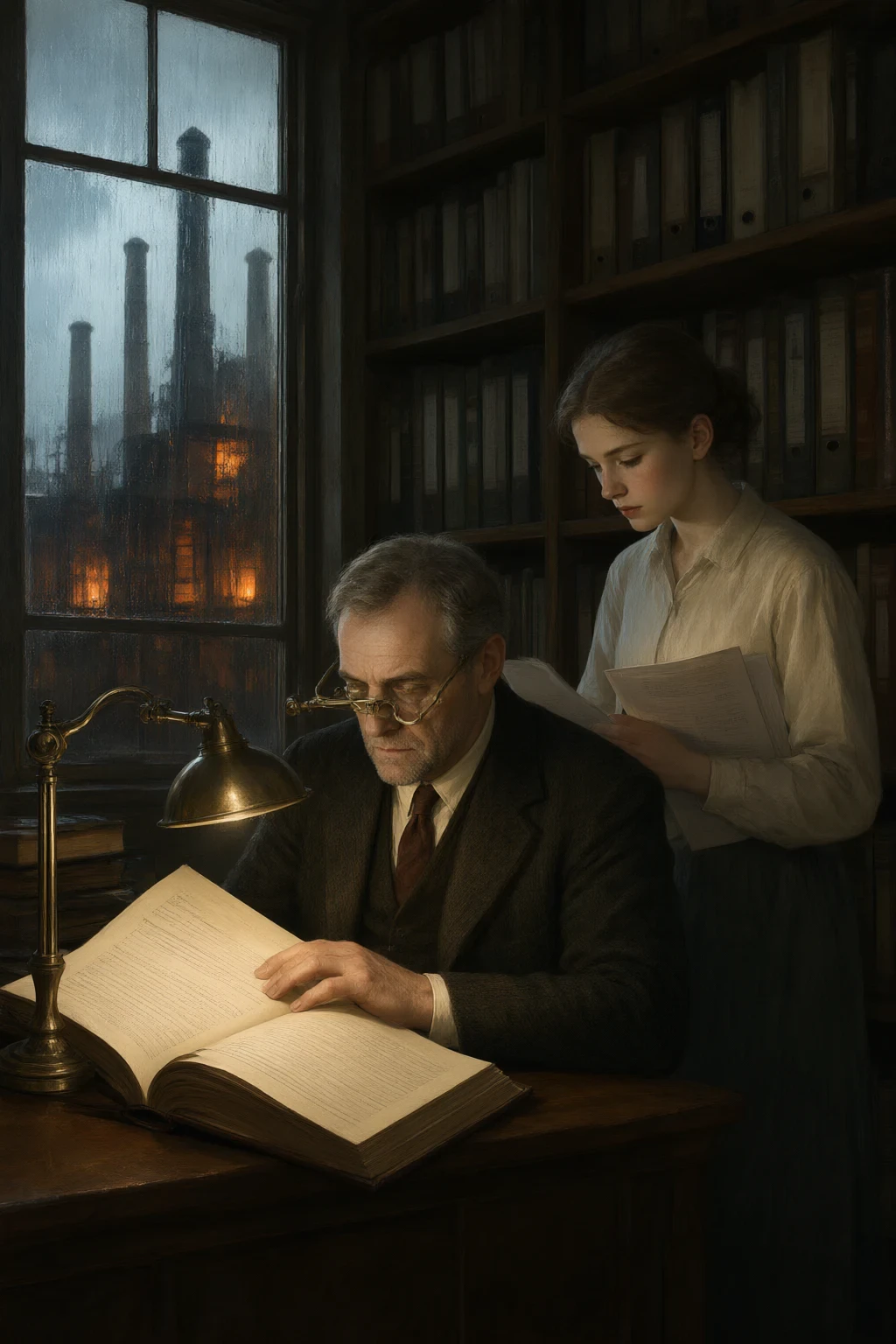
Aldous Crenn had been the casting clerk of Gethin Bell for forty-one years and in all that time he had never once read his book through, and the reason, which he could have given you in a sentence, was that he never needed to. A book is read in order by a person who wants to know what happened. A book is read against by a person who wants to know what to write. He wanted to know what to write, forty-one times a year, sometimes twice in a day, and to know that he ought to write it. The way to know that is to find the last time anybody had written it and to do it the way they had done it, and the last time is always about four pages back, and the four pages back are always in a different hand from the four pages back before that, and by the time you have gone back far enough to satisfy yourself about the form you have stopped being a clerk and become an antiquary.
The book was on the lectern at the north window because it was two hundred and ninety-nine years old and two hundredweight of leather and had to be carried by two people. It lay open at the day’s page. The page was ruled in eleven columns and had a cream colour that no paper in the foundry office could be got to match, and the ruling was in a hand, and the ruling was not any of the writing hands, because the ruling was done first and by somebody who had never written in the book at all and was therefore, in Aldous Crenn’s private accounting, the thirteenth. “The parish wants it certified,” said Ivet Trewin. “They always want it certified. That is what a parish is. It wants the roof certified.” “No. It wants the book certified. It wants somebody to say the book is a true record.” She was nineteen and she had been in the counting house eleven days and she had already learned the room’s silence, which was the one thing the room teaches before anything else, and she had learned it in the wrong order. “Nan Ilva says you are to write me a book of forms before you go.” “Nan Ilva says a great many things that are heat problems.” “She says you have three weeks.”
“I have three weeks,” Aldous Crenn agreed, “and I have not decided whether I am going to use them.” It is not a difficult thing, to know eleven hands. You do not know them by their letters, because a casting clerk writes the same three hundred words in a lifetime and the words do the identifying. You know them by what they do under pressure, and by the mistakes they make when a casting goes wrong, because a man who has a form in his head falls back on the form and a man who has not falls back on himself. The first hand is small and upright, writes the year in full, four figures, and has never been known; the parish has agreed not to look. It is neat to a degree that is almost aggressive, and in 1691 it entered a bell of nine hundredweight in the plainest English in the book, which has never been improved on, and every clerk has agreed that an improvement would be an improvement. The second is round and mercantile and keeps the long s, and in one entry in 1719 it has written a bell’s flaw and then, underneath, in smaller letters, has given the number of the house it came from, which nobody has ever struck out.
The third rules its own lines crooked, so that a decade of entries leans a degree to the right and a ruler along the top of an old page will give you the year to within two years. The fourth writes the year in capitals and everything else small, which is an affectation that lasted a generation. The fifth is left-handed: the t has no crossbar, every t, for nineteen years, so that the decade reads like a hand with a stammer. The sixth wrote the purpose in a different ink for no known reason, and it is the only clue to why the book was ever hard to lose in a fire. The seventh is Melton Ferrow’s, and Ferrow’s is the hand people mean when they say the book has a beautiful hand in it. It is a copperplate that got damp in the eighteen-sixties and never came back, so that the thick downstrokes spread and the effect on the page is a faint bloom around the heavier words. Ferrow also ran the bench assay at the north end of the shed floor, on a charcoal stove, on a firebrick, on his own time, for twenty-two years, and the assay he used for lead is the one Verity Ash had used in November, and neither of them ever thought about the other.
The eighth rounds everything and fills the page and got smaller and rounder as the years went on, which is the handwriting of a man who could not see past the end of his own hand. The ninth abbreviates. The tenth writes in a code of marks and a personal shorthand and has left no key, and in eleven years of that hand the book lost four words it has never had back, and the town has been describing those four bells by their weight ever since. And then the eleventh. “It is a good hand,” said Ivet Trewin. “It is a hand,” said Aldous Crenn, and pulled the reading arm down over the page, which was a green brass thing bolted to the desk at his eye height in 1919 by a man who has long since been overtaken by events, and swung the lamp on its arm until the light came up off the cream paper at an angle that showed the ruling, and put his cataract-yellow left eye to the left of the page and read the rest of it with the right.
Here is what he had done every day for forty-one years. You are given a thing that has happened. A bell has been poured. A moulder has cut a flaw. The pourer has said the number out loud. A ganger has a weight. You must enter it. He did not ask what to write. He asked when it had last been written, and he found it, and he copied the form of it, and then he changed the contents and left the shape alone. That was the whole of his method and it had never once been in dispute, and it is the reason the book is continuous, and it is the reason the parish trusts it, and it is the reason that when a thing in Gethin Bell has to be said in the book, Gethin Bell knows within the hour, because the book has only ever said what it has already said. And there is a limit to how many different ways a set of ruled columns can say a thing, and the town has reached the limit. “The book says, in the hand of Ferrow—” he would begin, and then he would stop. He did not trail off. He stopped the way a man stops when he has put a full stop in a place where a full stop is not yet due, and he would wait,
and the room would wait with him, because in forty-one years nobody in the counting house had ever interrupted him, and after a moment, two or three, or eleven, the sentence would finish itself in the room, out loud, in the voice of somebody who had learned from somebody who had learned from him. Ivet Trewin learned it in a fortnight. She had walked in with a milliner’s habits and no figures at all, and she had the best hand in the parish for a woman of nineteen and could rule a straight line with a straightedge and a dry throat, and what she had to learn was not the skill but the pause. “You do not know the answer to that one,” she said, on the eleventh day. “No.” “You stopped.” “There was nothing to stop for. There was nothing there to say. If I say it, it will be because I am putting a hand on something to see if it is solid, and if I put a hand on it and it is not solid, then I have made it up, and I would rather make nothing up than make a sentence up, because the sentences are what people believe.” “That is a very hard thing to be at your age.” “I am fifty-eight,” said Aldous Crenn. “It is not an age. It is a condition.”
The order came on the fourth of January, signed by the churchwarden and countersigned by the surveyor. It asked him to read the Casting Book entire and certify that it was a true record of the bells of Gethin Bell, and it allowed him three weeks, which was generous, and he understood within a day that it was not generous at all, because at the rate of the work he did, six entries a day, the book would take eleven months. So he read it like a book. That is the whole of the difference and it is the whole of this story. You put the lamp at an angle and you take your eye to the left of the page so that the ruling stands up in the light like the strings of an instrument, and you do not look for a precedent. You read. From the beginning of the volume, which opens in 1688 with a bell of eleven hundredweight for the chapel at Fennick Bridge, to the last entry of last March. It took him four days before he stopped being a clerk and five weeks before he understood why the parish had asked.
The first three days were the best days he had had in the counting house in a decade. The book is largely dull, and a man reading it for the first time at fifty-eight finds it a great deal better than a man looking for a form, and the early volume is full of a bluntness the foundry has lost. In 1704 a bell for the dead at Nether Corrie was entered as having the fault in the waist, and the clerk had written underneath, in the space for remarks, six words: this bell will not be hurried. It took him a day to understand that this meant the bell could not be rung fast to save time in a funeral, and that it was the only remark in three hundred years anybody had thought to make. By the fourth day he had got into the eighteen-forties and was moving at speed, and speed was a warning sign, and the thing that warned him was that he knew the entries of the eighteen-forties, because they were the ones he had spent his first eight years copying from. And in the eighteen-sixties he came to a hand he did not know.
March 1962. The Nether Corrie tide bell, nine hundredweight, moulded by Ivor Hodge at the lang bench and poured by Nan Ilva on the fourteenth. The entry was short. Aldous Crenn could see it from the door of the counting house, he said later, which was not true, but it was the kind of thing a man says to make the size of a thing land. ALDERSON, BRONZE, 9 CWT. FLAW NOT SHOWN. PURPOSE, THE TIDE. Three words he had written. FLAW NOT SHOWN. He had put the bell in the book, and the bell had come out of the sand, and the bell had gone up to the belfry at Fennick Bridge on the eleventh of June, and it had been swung once on a test and it had made a sound that everybody present had described afterwards, independently, in the same words, as a man hitting a post. He had gone down to the tower on the sixteenth and stood under the headstock and put his hand on the bell and felt the deadness come up the wood into his hand, and it was not a small thing.
It was the flattest, most complete nothing he had ever put his hand on, and everybody in the shed knew what it was the moment they saw him come back, and Hodge sat down on the lang bench and put his face in his hands and said that the ladder had gone the wrong way in the shoulder and he had cut for a seam and got a void, and there was no repair, and there was no recasting, and there was nothing to be done at all. And Aldous Crenn had to write a line about it in a book that had never had a line about it. He went round the problem for nine days. He tried the word dead and it did not fit, because dead in the book had a precedent, and the precedent meant a bell whose headstock had been taken out, and this bell had a headstock and a clapper and a rope and a wheel, and somebody was going to pull it, and what was going to come out was a dead thump that a child could feel through the floor and not hear. He tried unsound, and unsound had a precedent from a bacon merchant’s ledger in 1848, and the precedent was about a hog, and he was not going to put a hog in the casting book.
And in the end, on the ninth day, he wrote FLAW NOT SHOWN, because that was true and because it was the only true thing available that had not already been used for something else, and because he was twenty-nine and had not yet understood that a phrase you invent in a book is not a word, it is a form, and a form has no owner and no date and no author, and will be used by other men for other things for as long as there is paper.
The discovery was not dramatic and it took a fortnight and it was made entirely out of wording. He laid four entries on the counting-house desk, all in his own hand, all in the correct form, from 1946, 1962, 1971 and 1986, and all four contained, at the same point in the same column, the identical sequence of three words. 1946, the school, cast by N. Lowe, six hundredweight: FLAW NOT SHOWN. 1962, the tide, cast by N. Ilva, nine hundredweight: FLAW NOT SHOWN. 1971, the hour, cast by N. Ilva, one ton four: FLAW NOT SHOWN. 1986, a full cast for the market cross at Fennick Bridge, weight not yet taken: FLAW NOT SHOWN. “Four entries,” said Ivet Trewin. “That is not a change. That is a form. That is you being tidy.” “That is what I thought in 1962, in the eleventh year of doing it,” said Aldous Crenn, “and then I was wrong, and I have been wrong in the same direction four hundred times since, and it has taken a woman of nineteen with no figures in her head to make it visible by putting four lines on a table.” He put his thumb under the 1946 line.
“In 1962 it means the flaw is not visible in the bell. I wrote it that afternoon and I knew exactly what I meant and I could have told you the story. That is the one sense and it is the true one.” The thumb moved. “In 1971 it means the flaw was not entered, which is a different matter entirely, and I wrote that in a bad week and I meant the clerk after me to chase it, and he did chase it, and he never found it, and it is on this desk.” The thumb moved again. “And in 1986 it means do not ask me.” Ivet Trewin read the four lines four times. “They cannot all be the same three words.” “They are the same three words. To the letter, the same three words, in the same column, in the correct form, written by a man who has never in his life written a word without a precedent. And a person coming on them in 1990, which is a person, will take them for four instances of one thing, and will be wrong three times out of four, and cannot afterwards be told, because I have left no way of telling.
That is the price. That is the whole price of doing it my way for forty-one years, and I could not tell you what I paid, and you have just told me, and it is eighteen hundred and sixty pounds of nothing.” The 1971 entry is the reason he came to be afraid of what he had made, and he came to it on the eleventh of February, and it is the shortest line in the casting book. ALDERSON, BRONZE, 1 T 4 CWT, THE HOUR, FLAW NOT SHOWN. THE PURPOSE IS HELD OVER. The moulders had stopped work in the November of that year and the reason was never written down, and the hour bell was broken in the stopping, in the yard, by men who were striking, and it was a good bell and it hummed, and the town had counted the night by it for thirty-one years, and it lay in pieces and went to the lime yard on the Tuesday and was sold by the pound, and the parish put the money in the roof. There was no bell for the hours after that. There has not been one since. The school bell does the hours now, and everybody has been satisfied for fifty years, and the entry that says so is the last line Aldous Crenn ever wrote that nobody has asked him to explain.
He had needed a word for the thing the book had no word for, and the thing was this: a purpose can outlive the bell that was made to carry it, and the metal can be gone and sold and melted into a different bell in a different valley, and the purpose does not go with it, and if the book cannot say that the purpose survives, then the book has just lost a purpose, and the town has been living since 1971 on a purpose the book has never admitted to holding. He had gone round that one for three days as well. Held is in the book: the bell is held for the founder, meaning not yet rung. Kept is in the book. A purpose is not a fitting. A purpose is not a thing you can put in a shed and look at in six years’ time. So he wrote that the purpose is held over, and the phrase went into the book, and the phrase is now the commonest phrase in the parish, and nobody in Gethin Bell has any idea that it was invented on a Wednesday in the counting house by a man of twenty-nine with a cataract coming on in his left eye and no precedent whatever.
“You have invented two phrases in your life,” said Ivet Trewin, when they had been at it a fortnight. “Not shown. Held over. Is that all of them?” “That is all of them.” “No,” said Aldous Crenn, and stopped, and waited, and she waited with him, and he felt the room do what the room does. “No,” he said. “Hold on. There is a third, possibly. A thing in the register of cracked bells, 1981, where I used not shown, and I have never been certain which of my two senses I meant, and I am not going to look at it now.” “You will have to look at it. It is in the book. You are reading the book.” “I am reading the book,” Aldous Crenn agreed, “and there is a stretch of the nineteen-seventies that I have read very quickly indeed.”
On the twenty-second of February there were eleven days left and they took most of a day, and it was a waste of the eleven days, and neither of them would have missed it. Odo Marrack came up to the counting house without being asked, which he did perhaps twice a year, and sat down on the window seat in his black felt hat with his left hand two fingers short since 1971 and told them a story he had told a great many times. “I am not going to say this is advice, but,” he said, “if a town ever wanted to be heard, it should think very hard before it asked for a voice.” “In what sense?” said Aldous Crenn. “In the sense I have been saying for twenty years. A bell that would carry. Not a scream, not a scream an hour ahead of itself like your fire bell, which is a good trick and I have never had anything against it, but a plain carrying bell, so that a thing said once on the top stair in the Cloth Hall would be heard at Fennick Bridge and at Corrie and at the two farms on the far gravel.” “You have described that bell to me before.” “I have described it to everybody in this town before.” “To how many people?”
“To the parish, in the vestry, in the year seventy-one. To the last three founders. To the schoolmaster, who wrote it down, which was careless of him. To a girl on the tower stair, of all the possible audiences, which was a thing I could not resist.” Odo Marrack turned the hat a quarter turn on his head. “I cast it twice. The first one did not take the flaw. The second one I gave it, and it came out of the sand too light, and it was a good bell and it carried, and it was hung eleven months and then the whole shoulder opened, because you cannot give a flaw and cut a flaw in the same bell, and I had cut one as well out of sentiment, which is the one thing a founder has no business doing.” “That is the story you tell,” said Ivet Trewin. “That is the story I tell,” he agreed. “It has a light bell in it and a bad founder in it, and it ends with a bell in a field, and it is the best thing I ever did, and I have told it for twenty years and it has grown.” “Grown how?”
“In the telling. I cast two. I have been telling it for twenty years and I cast three, and the third is in Nether Corrie, and the third is the one that carries.” He got up off the window seat. “The third one is not a lie. That is what I would like understood. The third one is a bell that does not exist, and I have described it in this town so many times and so well that if anybody in Gethin Bell ever casts a bell to carry, that is the bell that will get made, whether anybody wants it or not.” Nobody in the counting house said anything for a moment, and the room did the thing it does, which is to guess at the sound from outside instead of having to be told it. “Twenty years,” said Aldous Crenn at last, “and about nine hundred people, and the same description, and no bell.” “No bell,” said Odo Marrack. “That is the beauty of it. You can say whatever you like about a bell that is not cast. Nothing binds it. I could describe a bell that took a coat of lead and had a coin in it, and it would be no consequence to me at all, and I should be able to tell you about that one on Sunday, if anybody wanted to hear it.”
The last form was the hardest, and it was hard for a reason that was in no way dramatic, and Aldous Crenn did not see it until the second of March. The forms were the thing he had been writing for. Every heading, every column, every phrase she was licensed to use, with an example of each taken from the book, in order, so that a girl of nineteen with a good hand and no figures could keep a three-hundred-year-old book in a four-hundred-year-old sequence without ever once having to have an opinion. Forty-one forms. He had them by the twenty-sixth and they were, as far as he could judge, entirely good, and every phrase in them had a precedent, and every precedent was a page and a year and a hand he could name. What the forms did not have was an entry for the two words he had made. Because a form is a permission, and if the permission ends at not shown, then not shown is a closed valve, and every clerk after him would use it for whichever of the three senses happened to be in his head on the day, exactly as he had, and the phrase would go on shedding meanings it did not have,
and there would be no way on earth to stop it, because the whole of his method, the whole of the only method anybody in that room had ever known, is to do as the last hand did. A book of forms with a closed valve at not shown is a book that has taken the two words he invented and put them back in a drawer and lost them, and a book that loses things is the thing he has spent forty-one years preventing. “The last form,” he said, on the morning of the second, “has to be the one about the phrases.” “All right.” “You will have to be told that they are not from any hand before mine.” Ivet Trewin stopped writing. “That is not a form,” she said. “You cannot put that in a form. Forms are for what a clerk writes into the book. That is a thing about the book.” “It is a thing about the book that a clerk is going to have to handle every week for the rest of her working life,” he said, “and it will be handled, and it will be handled wrongly, and the only available alternative is that it is handled wrongly by somebody who has been warned.” “Then it goes in the book.” “It goes in the book.” “It goes in the book proper,” said Ivet Trewin, “in the place where decisions go, because there is no other place where decisions go, and you have been putting decisions in the margins for forty-one years and there is a reason nobody has ever found one, and the reason is that margins are not read.”
He wrote it on the fourteenth of March, at the north window, with the reading arm down and the lamp swung over, and it took him the better part of two days because he could not find a form for it, which is the point, and which he had known would be the case when he began. It is not a long entry. It goes at the end of the day’s page, after the ruled lines, in the space the ruled lines have always left, and it is in his hand, and it is dated, and it says that the words not shown and held over were first written by the clerk A. Crenn in the years 1962 and 1971, that no hand before his contains them, that they were coined in the absence of precedent, and that the senses in which they have been used since are to be found in the entries themselves and not in the coiner. And the last line, which he wrote in the same hand and did not think about for four days, was: the writer of this line has no precedent. He read the entry twice, the first time as a clerk checking his work, and the second time as the eleventh hand, and the second time was a different thing and he was not ready for it.
For three hundred years the book had had eleven hands, and the eleven hands had all been anonymous inside the book, and the whole of the town’s trust in the book rested on that: nobody’s name was in it, so no hand could be praised above another, so the book was not the property of a family, so the book belonged to the bell. And he had put his own name in it, and the two phrases were his, and from the fourteenth of March in 1987 any clerk who came after him would be able to say, of a page in 1962: that is not a form, that is a man’s invention, and it was made because he could not find one, and that is why the sense of it shifts, and here is the man. It is not a scandal. He had braced for a scandal on the second of March and had lain awake on the first, and it is not a scandal at all. Nobody in Gethin Bell is going to mind that Aldous Crenn made up two words. What they will do is start quoting him.
He is a source now. He is in his own book. Everything he said in that room for forty-one years with his hand stopping in the middle of a sentence and the room guessing the end of it, all of it is now a man’s opinion, dated, signed, and available to be appealed from, and there is no longer any way in the world of putting a sentence into this book that somebody, somewhere, has not got a right to look at. “Sir,” said Ivet Trewin, “when you sign a thing like that, aren’t you giving up the last place where you were the only one who knew?” “Yes,” said Aldous Crenn. “Then why did you do it?” He turned the lamp back and put his left eye to the left of the page so that the ruling came up out of the cream, and looked at the entry, which was very good, and which had eleven precedents and did not need one. “Because the alternative was that I hand you forty-one forms with a closed valve, and you would spend your life filling it in with whichever of the three you happened to think of that morning,” he said, “and the day I retired they would say that Crenn had kept the book beautifully, and they would mean it kindly, and it would be in a leather book on a lectern, in a sequence of legible hands, unbroken.”
He put his hand flat on the open page, which he had never done in forty-one years, and which is the one thing a man may not do to a book of four hundred years. “And in a hundred years somebody who is neither of us will sit where you are sitting with a lamp at an angle, and read four lines, and take them for four instances of one thing, and be wrong three times out of four, and have no way at all of knowing that I knew, and that I wrote it down and did not say.” He took his hand off the page. “It is not a large thing. It is two words out of a hundred thousand. But it is the only thing in the book that anybody ever wrote down for no reason but that the next one should not be stopped.” He signed the forms on the twenty-eighth of March and gave the last one over the desk. “It is the only page in the book that is not a bell,” he said. “And the only page that tells you anything.”
“Yes. It is the difference between those two sentences, and it is the whole of forty-one years, and I have got it wrong for most of them and I have got it right at the end of them, and there is not a clerk alive who could tell you how those two things are reconciled, and that is what a book is.” Ivet Trewin copied the forms out fair in her own hand in the last week, twenty-nine sheets, and on the last afternoon she came and stood in the doorway with her hat in her hands and asked him the question she had been carrying since the fourteenth of February, which was not her question at all, and which was the moulder’s question, and which she had heard Tamsin Lowe ask on the shed floor in November and had been keeping, the way you keep a thing you have no use for and cannot put down. “So which is it meant to be?” Aldous Crenn put his hand out for the ledger that was not there. “Not shown or held over?”
“Any of it. The whole of the book. All of it.” She had a very good face for it and she had no idea she was doing it. “You are the only man in Gethin Bell who has ever looked at this book straight through, and you are going to be dead, and then nobody in this town will ever know, except the three of us, and one of us will be dead too.” He waited. It is his whole art, and it is the reason the room has trusted him since 1946, and he waited five seconds and then he waited a little longer, because she was right, and the sentence was going to arrive, and he wanted to hear where it came from. “What do I write,” she said, “the first time there is no word?” There was no sound in the room from outside at all. The counting house is the only room in Gethin Bell where the sound from the yard has to be guessed at, and he guessed at it, the rain on the wired glass and the tram on the wharf road, and the north window with the ledger open on it and the ruling standing up in the lamp. “You write that there is no word,” said Aldous Crenn, “and you write the date, and you write that you have looked, and you leave the rest of the line empty.” “Empty?”
“Empty. That is the entry. I have known it since March and I have not been able to make myself write it in the forms, because if I put it in the forms it becomes a form, and a form will be filled in, and the whole of what I am asking you for is that it must not be filled in.” He pushed the twenty-nine sheets across the desk. “And when they ask you in twenty years what the empty line was for, you will be able to say that it was for this, and that the man who told you could not finish it either.” “That is a bad answer.” “It is the only one I have,” he said, “and I have had forty-one years and a cataract and a very good lamp, and you may put it in the book that Aldous Crenn had nothing better, and that will be a precedent, and you may hate me for it for as long as you are in that room.”