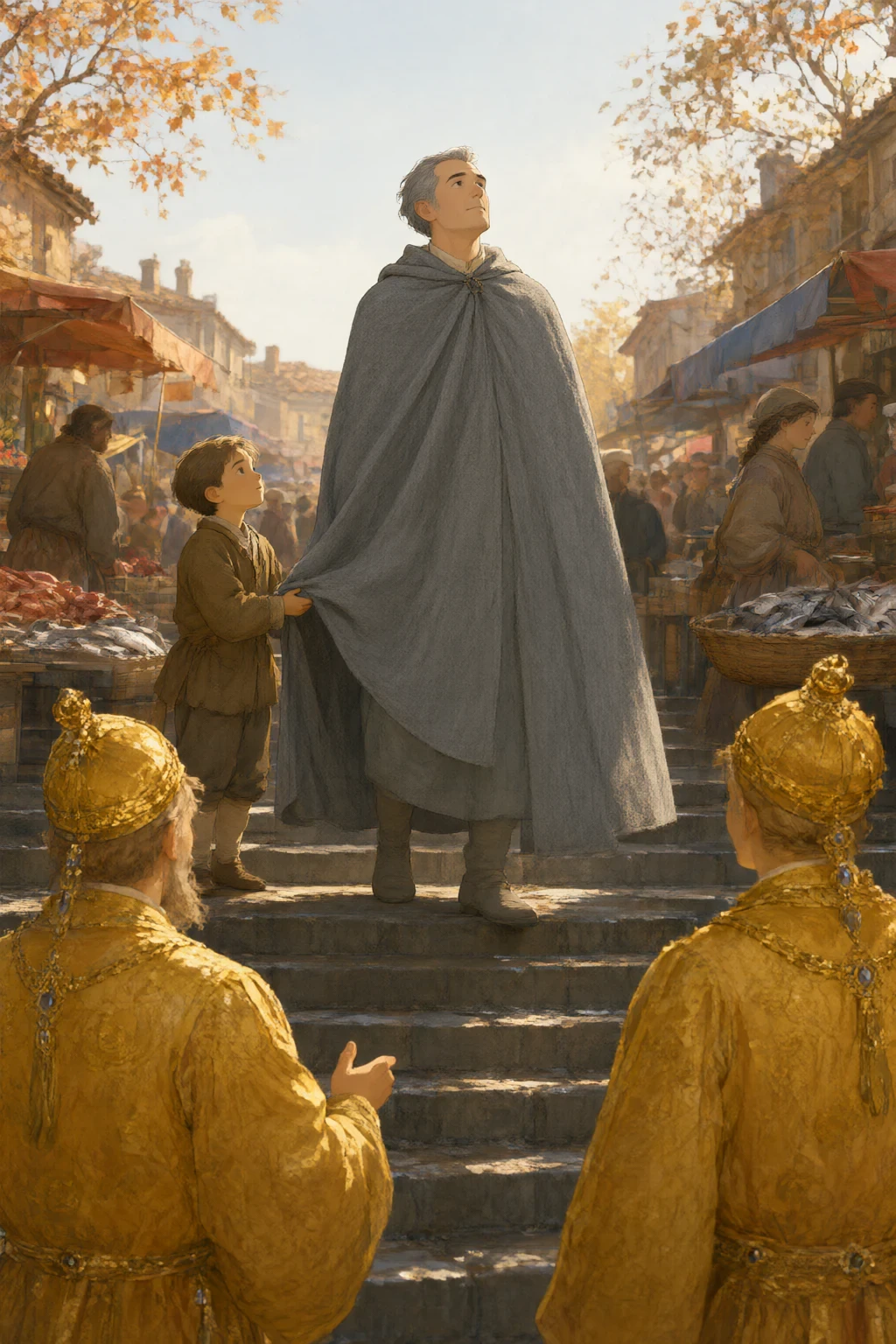
The city of Hallowen kept its weavers at the bottom of the hill and its court at the top, which was not cruelty exactly, only arithmetic. Cloth was heavy, and courts were dry, and the water came from the same spring but arrived in different buckets. Tam was eleven. His grandmother, Nana Verna, wove in the third stall from the kiln, and when the court sent down an order she was chosen, and she was chosen because she could do it and the others were going to refuse.
The order said: the finest cloth in the land, such that the Emperor's new clothes would be more splendid than anything the city had seen. There was a fee. There was a schedule. The guild wanted a date for the processional, and Nana Verna gave them one. "You will not need a loom like mine," the guild said, meaning: you will not be believed. "That has never stopped me," Nana Verna said.
She wove for eleven days. She used a thread the guild had never seen, spun from nothing anybody had ordered, and she told Tam only what he needed to know, which was that the cloth would not be beautiful. The boy was disappointed. He had expected gold. "It shows one thing," his grandmother said. "For whoever wears it. The thing they have most carefully not done. Not the worst thing. The one they have put aside and meant to come back to, and have not, and have said they would, twice." "Who chooses it?"
"Nobody. That is the trouble with it. If I could choose I would weave something about the mayor." She set the shuttle. "I cannot. It knows. And the weaver cannot argue with the loom, only listen to it." The cloth came off the frame plain, grey, unbleached, the colour of a rainy afternoon. It was beautiful the way a well-made tool is beautiful.
"Now the difficulty," Nana Verna said, "is that nobody in that palace will admit to what they see, and if the only ones who see are children, then it is worse. You will be the fit-bearer, because the courtiers will not touch it and somebody must. And I have one instruction for you." "I will say it plainly." "No," she said. "You will not say anything at all until the Emperor asks you a question. Not one word before. He must do the asking, or it is worth nothing and he will be angry and I will lose the fee." Tam promised.
The processional went down the Marrow Street and around the fish market, which is the part of the city everybody can see for free, and stopped at the foot of the court steps, because somebody in the crowd called out about the Emperor's new clothes, and nobody could tell whether it was laughing. Councillor Mallow and Councillor Grieve walked at the front, in gold, and they told the crowd what they could see, which was a magnificent cloth of the finest texture, and the crowd made the noise crowds make.
They were not lying. They saw a woven surface with a good shine on it, because that is what they had spent their lives learning to see. The Emperor came out. He was fifty-one years old and he looked tired, and his hair had gone white at the temples, and he did not look at his two councillors at all. He looked at the cloth. "It is grey," he said. "And it is not grey, is it." "Yes," said Tam. "Then it is not grey."
It was not grey. Across it, in threads the colour of ash and the colour of ink and a few threads the colour of rust, there were eleven panels, and each one held a thing unfinished, small and exact. The first was a gate in the north wall, sealed for eleven years because the tax on the water that ran under it was disputed and because opening it would mean saying who was right. The second was a granary that had been emptied in a bad summer and never refilled. The third was a bridge, with a name carved on it that nobody could read any more.
The fourth was a room in the palace where papers had been piling up for six years, and the papers were not on the cloth; the cloth held the shape of the pile. The fifth, sixth, and seventh were three doors in the poor quarter, all noted as being in hand. The eighth was a boy who came to the gate every morning with bread he had not been given, to watch. The ninth was a name, with no face beside it, and Tam, who had read a great many street notices, saw at once who it was, and looked away.
The tenth was the Emperor's own chair, with one leg shorter than the others, so that the court had laid a folded paper under it every morning for as long as Tam could remember, because the man who could have had it mended did not want to hear about it again. The eleventh was the empty half of the board at table where the man who brought the news used to sit, and the fact that nobody had asked after him.
The Emperor did not shout. He walked the full round of the cloth, once, with his hands behind his back, and the whole city was silent, and then he said it in a voice that carried exactly as far as it needed to. "It is a good cloth. Get me a plain coat."
The court said afterwards that the Emperor was naked, and that he had been tricked. Nana Verna, who was not there, was told about it and said, "He was dressed, and what he was wearing was a list. There is no trick in a list." He wore it. That was the astonishing part, and the whole city decided it at once and never stopped: he wore the plain grey cloth out of the north gate on the first cold morning of the autumn, and walked to the north wall, and had the gate opened in front of nine hundred people.
It took the winter. Eleven panels, and no panel could be hurried, because a hurried panel came back the next morning a little darker, which Tam found out by testing and told nobody about. The granary was refilled at the town's own cost, which took an argument with a merchant guild and a great deal of arithmetic. The bridge was repaired, and its name was found on a stone in a cellar and put back where it had been, and a schoolboy copied it out, and forty more schoolboys copied that out.
The three doors in the poor quarter were done by the Emperor, with masons, on his hands and knees, which is a thing a person can arrange to do and which matters more than it sounds. The pile of papers in the room was cleared, sorted, and answered, every item, and the man who brought the news was found, and he was alive, and he was working two towns over, and he came home.
Councillor Mallow swept. He had not swept in forty years and he was very bad at it, and he swept every morning, and the palace servants, who had expected to enjoy this enormously, discovered there was nothing enjoyable about it and swept too, because the alternative was watching him. And the chair with the short leg was mended on the ninth of February by a carpenter from the quarter, who charged one coin and would not take more, and said the third time they offered that the job was not worth more and they were only feeling bad.
The last panel went blank in March, the way a page goes blank when the story on it is finished. Nana Verna was at the loom in April, winding the new warp, and Tam stood beside her to learn the order of the heddles, which he was still getting wrong, and the palace cat Chalk was asleep on the beam, as usual, at the exact centre of the work. "There is one thread left in your panel," his grandmother said.
He looked at the cloth on the frame and saw it. It was small and it was at the very bottom, and it was him, turned away from her, at the guild boy, with the shop sign of a better tailor on his sleeve. "You have never once said out loud that you want to learn this," Nana Verna said. "Not to me. Not to the guild. Nine years, and you have asked me every month how much I earn and never once said the other thing." "No," Tam said. "I have not."
The last thread went out of the cloth, quiet, the way a held breath goes out of a person. Nana Verna did not look up from her work. "Right," she said. "Thread the shuttle. No, the other way. Yes, that." Below them on the hill the palace laundry was coming down the road in its usual cart, and this week it was coming down with a very particular basket, which was the one with the grey coat in it, and which the boy would have to wash on Monday, and which he already knew by touch.