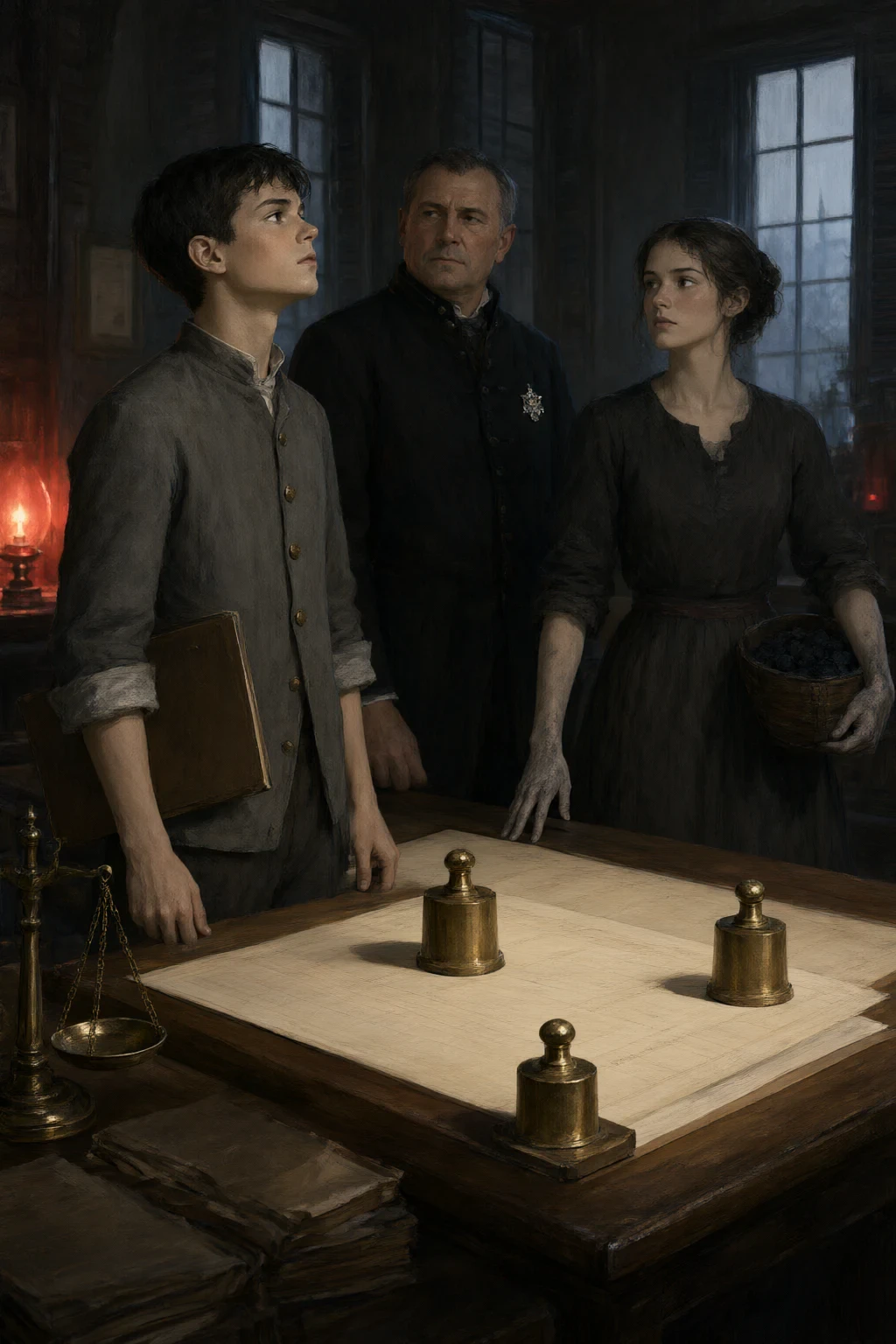
Odo Verrow learned to read a room by what had been eaten in it. The counting house at Vell smelled of wax, hot iron, and the cold dust that came off the north wing, where the great ledgers stood on their sides like sleeping animals. He was sixteen, and he was the junior copyist, which meant he held the wax, read the figures aloud to the men who decided things, and had his name written at the foot of nothing at all. The ball was set for the ninth of Frostmoon. Its purpose was a number.
"You should understand what is happening in this building this month," said Master Ivell, without looking up. "For eleven days the Crown will hold two hundred and forty guests, twelve musicians, a hall lit with six hundred candles, and a quantity of food I decline to name in front of you. Every one of those is a debt. In nine days a number becomes a sum, and after that this office is a different office." "Is the Crown celebrating something?" "The Crown is reducing a liability."
Vell had borrowed heavily in the year it had won a war it had not needed to win. The House of Ferran had lent the money, in coin and in grain, and had taken the customs of the harbour as security: every mark that passed over the quay, until the loan cleared. Nine years ago the Crown had tried to clear it and failed. Two years ago a court had ruled that the loan could never be cleared at all, because the loan had no end date, and a debt without an end date may be called in a lump whenever the creditor pleases. The House of Ferran pleased itself this month.
So the Crown had gone to work, and it had found the cheapest instrument it could. Duke Sabret Oln was thirty-four, unmarried, and held a stretch of coast that made the harbour customs taste better. The Ferran heir was nineteen, and had not been seen in Vell since her mother died. The Crown had a clear view of what that meant. If nobody knew where she was, then nothing could go wrong. "She will be produced," said Master Ivell, when Odo asked the question everybody asked. "She will be produced. That is not our department."
Odo's department was the notices. Every invitation in Vell was printed on the back of something else. The something else was the cancellation schedule, and Odo had been pasting those for three weeks, working the paste thin with his thumb, seating each sheet against the master's copy, because a schedule pasted crooked was a schedule nobody could read across a room, and there would be four hundred guests. He read one all the way to the end on the fourth evening, because he was sixteen, and nobody had told him not to. The clause sat at the foot of page two, in the small type, where the small type goes.
"Wherein the parties named are united in marriage, and the union is attested by the Concord of Sillan, the obligation of the debtor shall be discharged in full, and the security here devised shall pass, without further consideration, to the line of the creditor." So that was the ball. Not a party. A transfer of property, with dancing attached so that the witnesses would have something to stand still in front of. He copied the clause out longhand onto a sheet of practice paper. Then, being sixteen, he did what any boy with practice paper does, and worked out what happened if the parties named did not appear.
If the Ferran heir was not produced, no marriage could be attested. The loan would not discharge. The security would not pass. Which would leave the harbour customs belonging to the House of Ferran in law and forever, and would leave a port that Vell could not afford to besiege, freezing to nobody. The Crown had gone looking for a girl. Odo slid the sheet under his blotting paper, and went down to the kitchens to find out what they were feeding her.
The scullion at the great ash grate was seventeen, perhaps eighteen, in a grey dress, with the forearms of somebody who had been lifting wet ash since she was small. She kept her head down. She ate standing up and quickly, in the corner by the potato peelings, which Odo knew because he had counted that kitchen's fires twice a week for a year. He did not speak to her for six weeks. He counted her instead. Counting was his trade, and he told himself that the count was the point, because the ball's inventory was itself a legal document. At the end of the night two clerks would stand at the doors with wax tablets and write down who had gone through, and the number would matter to somebody.
The household ration roll hung on a nail in the kitchen, because that is where the ration roll hangs, and nobody in the history of kitchens has put anything else on that nail. He read it on the fourth bell, because he was a boy with practice paper and nothing else to do. It listed every mouth in the palace by name, by household, and by the drawer the cost fell on. Thirty-one in the scullery. Nineteen in the laundry. The dairyman's two. The under-footman's three. Fifty-second on the roll: Ferran, M., ashbearer. Fourth drawer's pension account. Odo read the line twice. Then he read the columns beside it, which were the rations drawn, and the drawer, and the quarter in which each was charged, and he did the sum slowly, because he was slow, and slow was how he stayed accurate.
Eleven years. Fifty-two rations a week, charged against an account that had been shut in the year the war ended. Not owed, as a debt. Charged, as a habit. The fourth drawer had gone on paying a pension into the mouth of the last person in the city with a standing reason to be angry, and nobody above it had once looked down to see where the money went.
He waited for her in the coal corridor, which is where the scullions went when they were sent for coal, and which was the darkest passage in the palace at two in the afternoon. "Marda Ferran," he said. She did not stop. She had a hod in each hand and had been hauling coal since before he was tall. She went three steps past him, then set one down and turned round. "I will not ask you to say anything," she said. "I will answer three questions. You may write them down. You had better write them down, because the fourth one is mine, and I will not say it twice."
Her father had signed the loan. Her mother had taken her out of Vell in a cart when she was eight, the year the Crown began looking for a bride, and had not come back. Marda had come back nine months ago, on her own, and had asked at the gate for the scullion's posting, because a scullion in the palace walks where she likes, sleeps in the warm room, is fed twice, and is not looked at. "Three," she said, when he had the answers written. "Now mine. What is the fourth drawer?" Odo looked at the page. "It has been closed since the year of the war."
"Then it has been feeding me out of a dead man's account for eleven years," Marda Ferran said, "and not one man in that building has ever asked where the money went. I am not a guest in this house. I am a line that never balances, and nobody above the line wants to look at it." She shouldered the hod and went back to the ash.
Duke Sabret Oln came to the counting house on the seventh day, which is not a thing a duke does, and he came alone, which was worse. He stood in the doorway holding his hat for some time before Master Ivell noticed him. "I have been told the date," Sabret said. "I have not been told the purpose." "Your Grace has been extremely careful not to be told the purpose," said Master Ivell, without turning round, "and that care is the only reason the instrument is still drawn. You are welcome. I will not make you say it aloud." "I do not want to marry her," Sabret said. "Neither does she," said Odo. Every man in the room turned. Master Ivell set down his pen, very slowly, the way you set down a pen when you are deciding whether the next thirty seconds can be survived.
"Your Grace," Odo said. His mouth had gone dry and he kept going anyway, which is the whole of what courage has ever been. "I have the totals. The Crown has promised a dowry of ninety thousand marks, of which twenty-two thousand is in the vault. The rest is an assumption. It is an assumption made by three gentlemen, and none of the three is a clerk. If we sign an instrument on an assumed value and the value is wrong, the instrument fails, and the Sillan report a false return, and the Concord shuts their ports to us for eleven years. The harbour is lost in a way nobody can argue back." Sabret Oln put his hat down on the table. "Then the instrument is a piece of paper that will break if anybody drops it." "Yes, Your Grace." "Then why is anyone still filling the ballrooms with candles?"
Because nobody had gone down to the customs returns, Odo said. Because everybody was looking upward, at the girl and the duke, and the whole machine had been designed to make them look upward. He had gone down. He put the nine years of returns on the long table, unrolled, and weighed down at the corners with the brass seal weights, and there it was, in the third column of every page, as plain as a road.
The harbour customs had never stopped. Vell was a busy port and the port was not closed and the war was over. Every quarter for nine years, the customs of Vell had been gathered and remitted north to the Ferran accounts. The security was paying out. All that time, the Crown had also been paying interest on the loan, in silver, out of the treasury, to the same house, in the same city, through a different clerk. "So the Crown has been charged twice," Odo said, "and paid once, and the difference has been sitting in the same accounts the whole nine years, and nobody compared the two books because the two books were in two buildings." Master Ivell sat down. It was the first time Odo had seen him sit down in the office.
"The surplus," said Marda Ferran from the doorway. She had come in with ash on her forearms and she had been listening for some time. "The surplus is mine by birth. I do not need a marriage to have it. I need a witness, and I need the Sillan to see the figures, and the Sillan will see figures." "They came to see a wedding," said Sabret Oln. "They came to see an instrument discharge," said Marda. "Their clerks are paid either way. Their clerks, I am told, are paid rather worse for weddings."
They cancelled it on the ninth day, which is the date it had been set for, which the Crown's sense of humour did not entirely survive. The third cancellation notice went up on the board outside the counting room, and the town read it standing up, because town reads boards. The first had said weather. The second had said health. The third said only that the Crown had discovered the hall was spoken for, and the hall was not, and everybody who had bought a dress understood at once.
Odo did not attend the reading of the final account, because clerks do not. He copied the settlement out instead, in a fair hand, and the settlement was this: the customs surplus of nine years, computed quarter by quarter, remitted north against principal over three years, the security returning to the Crown in full at the last remittance, the Concord witnessing the figures in the counting house on a Tuesday. Sabret Oln would attend as a witness to nothing whatever, because he was a party to an instrument that no longer existed. Marda Ferran would attend as the creditor's line, which was the only title she had ever needed. There was one more clause, and Marda wrote it herself, and Odo copied it, and it took the rest of a night.
The returns were to be laid open. The customs accounts of Vell, nine years of them, quarterly, with the columns shown, to be printed and posted in the market and bound into the public file, where any person might read them and add them up. "That is the price," she told him. "Not the money. The money is yours anyway; it is only mine by accident. I want it written down where my father's name is on it, and everybody can see what his house did with your harbour while your harbour was still earning for you." "It will make you unwelcome." "It has been making me unwelcome since I was eight," she said. "I would like it to be an inconvenience I chose."
The printing took three weeks and the whole of Frostmoon, and Odo sat in the cold room at the back with the ruled sheets and ruled them the same width as the customs columns so that the two could be read side by side, which was the only argument in the document and the only one he had. The Sillan envoys came on the Tuesday, three of them, in grey, with their own clerks, and they were disappointed in a way they were too polite to show. They stayed three days. They checked every column twice, they found one error, which was Odo's and which he had flagged himself in the margin in pencil, and they signed on the fourth morning in a room with no candles in it because the candles had gone back to store.
The last remittance went out in Highsun. The security came home. Sabret Oln went home to his coast, and the Crown sent him a letter of thanks that Master Ivell wrote in the third person and neither of them ever read. Marda Ferran did not go home, because there was no Ferran house to go to, and no name to spend, and no trade that would have her. She took a room over the counting house, at the front, and asked for a posting at the customs, and got one, and did it competently for years.
And the fourth drawer, which had fed her for eleven years out of a dead man's pension, was closed in the ordinary way at the ordinary time, with a line struck through it in ink, and Odo opened the new wage book for the second quarter of the year and copied out the household list in his small hand, the hand they had taught him, which was legible and unlovely and entirely without flourishes. Ferran, M. — customs, second grade. He inked the line. Then, because the office allowed a man one extravagance a year, and he had not spent it, he drew the rule under it very slightly steadier than the one above.