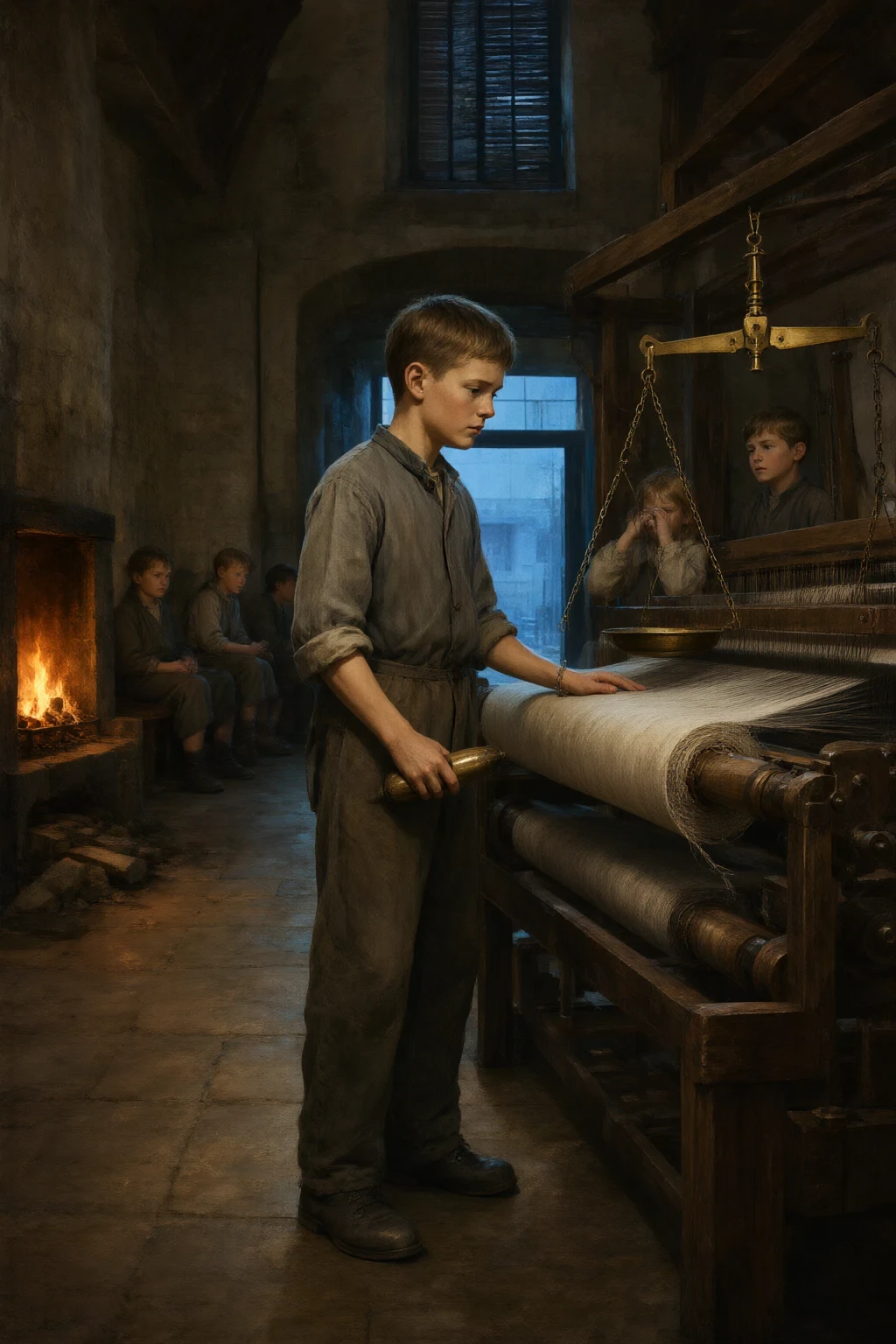
The Spindle Yard is behind the tanneries on the cold side of the hill, and it is a stone floor with one loom in it and no warp on the loom, and a bench along the wall for people who are waiting to be looked at. There is a card nailed to the wall at the height of a child’s eye. It has been there longer than anybody now living remembers and it was printed in 1802, and it is the guild’s oldest printed form, and the reason the guild keeps it nailed up rather than in the archive is that the guild has never in a hundred and twenty years had any reason to change a word of it. The card says: THE APPRENTICE EXAMINATION 1. Weave one bolt, not less than four yards. 2. Leave out one thing which is not part of the cloth. 3. Say nothing about it. That is the whole of it. Three lines, a crown’s worth of type, and the second examination of a child at the Spindle Yard is a thing the guild has done since before the assay room had lino in it.
The examinations are in March, because a warp wants winding and a child wants a month of cold to be hungry in, and they are given by an examiner appointed by the chapter, and the examiner sits on a stool with a fire in the grate and does not speak for long stretches of time. The examination is two parts and the guild has never thought of it as two parts, because to the guild it is one thing with a boy in the middle of it. The boy is asked to weave a bolt with something left out of it. Then the examiner looks at the other children. Corin Slee examined on the second Monday in March with the warden behind him and the fire going and eleven children on the bench, four of them boys, six girls, the youngest nine and the oldest fourteen, and the names on the form were in a hand that was not his own because the names had been written before he arrived by a woman from the parish who does that work and has done since 1861.
He had a paper of his own in his coat, the nine lines, the recommendation about a second man at the head and the foot, and it had gone to the chapter in December and the chapter had thanked him and not carried it, and since January there had been a sense in the guildhall that the town needed a child to look at things, and no child available, and the examinations were in March. The reason the town needed a child to look at things was on eleven sheets in a drawer in the Assay Room and was not going to be discussed in March. He went down the list. Nell Brack, eleven, wove four yards of linen in two hours and ten minutes and left out a colour, and told nobody what it was, and when Corin held the bolt up she said, “The red is not there. On the front only. Four inches at the selvedge.” Which was correct, and which was why the guild had a word for what she was. A boy of thirteen from the river flats wove a bolt and left out his own name, which is the commonest omission in Sparable and the guild does not count it an examination, and Corin marked him on the form and the boy looked as though he had been let off something. Two girls after that, sound.
The fifth child on the list was Sam Tallow, twelve, of the guild workhouse, and he came forward and stood at the loom and did not touch the shuttle for some time. “Off the warp,” Corin said. The boy wound it. The Warp House winds warps and a child of twelve can be put to it and does it well or badly and there is no cleverness in it. He did it well. He threaded the heddles and the reed and the shuttle, and he got the tension, and he stood and looked at the cloth for a while before he began, which was the first thing he did that was not in the card.
The first bolt took him fifty minutes and it was regulation. Twenty-four ounces to the yard at the head, forty to the inch, four yards and one, and nothing out of it anywhere, and it came off the beam exactly as a bolt comes off the beam when the person at the loom is thinking about the loom. Corin weighed it on a hand scale in the yard because the yard has a hand scale and it has had one since 1877. It was a sound bolt. It was, in the trade, what the assay calls complete. “Again,” he said. The boy did not move. “Again, Tallow. That one is regulation and a regulation bolt is worth nothing at all, and you have brought me nothing worth nothing, which is the same as having brought me nothing.” “It came off the loom like that,” Sam said. “It came off the loom like that because you did not do the thing, and I am not going to tell you what the thing is, and the card on the wall has been telling you what the thing is since before you were born. One thing which is not part of the cloth. Look at the wall.” The boy looked at the wall. He looked at it for a long time. “All right,” he said.
The second bolt took him thirty-eight minutes and it was regulation. Twenty-four and one-eighth at the head, and uniform, and complete, and worth nothing. “Sit down, Tallow.” He sat down on the bench between a girl of ten and a boy of fourteen and put his hands on his knees. Corin Slee wrote, in the remarks column of the form, in the words the guild has used in that column since 1802: Bolts sound and of no value. Weaver shows no sign of understanding the commission. Which is the guild’s own sentence. It is on nine hundred forms in the archive in nine hands and it is a fair sentence, and both of those things are true at once, and a cloth woven by a person who does not believe in the omission comes off the loom complete, and the weaver will be ruined, and the cloth will be regulation, and both of these facts will be true at once.
He did not give up on him at the second, and the reason he did not give up on him at the second was that he had been given, since December, a problem that nobody in Sparable could solve, and the solution to it was standing on a bench. The problem was the twenty-nine. A man cannot look at a cloth and know what is not in it. That is not modesty, it is the trade; the guild has never made an adult see one and has stopped expecting to. A man can weigh a cloth, and a weight is a number, and a number is a thing you can say, and if you say what is not in a cloth you have said what is in it, and a description kills what it describes. So Corin Slee had spent a winter with a number and could not put the number on anything, and the chapter had thanked him for it, and the town was exactly where it had been in September.
Except for this. If there is exactly one set of eyes in Sparable that can see a cloth entire, it is a child’s, and the guild has known that for a hundred and forty years, and it is why children are welcome at the inspection four times a year for three minutes each, and the guild’s inspector is a boy of nine with a green ribbon on her wrist which she treats as a joke. There was one child in Sparable who had not been looked at yet. “Up,” said Corin Slee. “Third time. And this time I am going to say something that is not on the card, and it is the only help you will get, so use it.” The boy stood at the loom. “The thing you leave out is not a thing in the cloth,” Corin said. “That is what the card says and the card is right. If you leave out a colour, or a stripe, or a figure, or a border, or a sleeve, you have woven it and you have chosen not to put it in, and that is a weave and it is worth something. You are doing it the other way round. You are not taking a thing out. You are not putting anything in. You are starting a bolt and going along it and there is something you have decided not to do, and if you cannot decide, then the loom will decide for you, and what the loom decides is a bolt of nothing.” The boy stood there with the shuttle in his hand. “What is not part of the cloth?” he said. “That is the examination,” Corin Slee said.
The third bolt took him an hour and it was regulation, twenty-three and three-quarters at the head and uniform, and he did not know it was wrong, and Corin did not tell him. Then the bench again, and the two before it finished, and the last four, and it was the third silence of the day and the yard had gone cold and the fire had been let down by the warden at some point without announcement. “Up,” said Corin Slee. “Again. Last one. And Sam, I am going to say one more thing and then I am going to stop saying things, and the reason I am saying it is that nobody has ever said it to anybody in this yard and I have been thinking about it since December and it is a stupid thing and it is probably not true.” He put the hand scale down on the bench. “A commission produces a bolt and a sample. The bolt is the cloth. The sample is a yard and a half cut off at the head, and it carries the commission number and your mark, and it goes to the buyer on the same cart as the bolt, and it is how anybody in this town ever knows a thing was made. Not the guild. The buyer. The sample is the only evidence there is. Do you know what happens to a commission with no sample?”
“No,” said Sam Tallow. “Nothing,” said Corin Slee. “That is what happens to it. It cannot be checked, it cannot be called back, it cannot be priced, it cannot be given to a child to look at, and nobody can ever establish that it exists, and there is a form on the guildhall table with a box on it marked sample which will be empty, and an empty box is a thing a form has never had in it in a hundred and twenty years.” He picked the hand scale up again. “Now go on.”
The fourth bolt was four yards and it took the boy an hour and twenty minutes, and he did not look at the card once, and Corin Slee did not watch the loom. The boy wove. That was the whole of what he did for eighty minutes: he wove, and he did not vary, and he did not stop to consider, and the sound of it in a stone room with a bare floor was the sound the Warp House makes all day, which is the one sound Sparable has and does not talk about. Then he took it off the beam, and cut it, and did not cut the sample, and folded it once, and put it on the bench, and stood there. Corin Slee weighed it. Twenty-four ounces at the head. He walked his hand down the length of it, and stopped, and walked it back, and stopped again, and then looked at the boy and then at the form, and the form had a box on it marked sample, and the box was empty, and he had been stamping boxes for eleven years and had never once seen one empty. “Sit down, Tallow.” He sat down.
Corin Slee went to the end of the bench and stood with his back to the room for about a minute, and the warden said nothing, because the warden is sixty-eight and has been the guild’s warden since 1871 and knows what a silence in that yard is for. Then he came back and picked the bolt up and turned it over and put it down again and aligned its two selvedges, which took him nine seconds on a four-yard length, and then he wrote, in the remarks column, nothing at all, and put the pen down, and picked it up, and wrote Bolts sound and of no value and then struck it out, and the strike-through is still legible in the book, and anybody who comes in after this in twenty years will be able to see that a man wrote a sentence and then did not believe it. The fourth child on the bench after the boy was a girl of ten who cried, and then three more, sound, and the last of them was a boy of fourteen who left out a border and got it exactly right, and the examination was over at twenty past four, and the yard emptied into the tanneries and the cold came down off the hill as it does every March. Corin Slee took the fourth bolt home under his arm and left it in the assay room on the table, and did not stamp it, and did not fail it, and did not pass it, and went home to his rooms and did not write anything at all for three days, which was the first time anybody at the guildhall could remember.
The bolt lay on the assay room table for eleven days, under a cover, and was not stamped, and the form for it sat in a pigeonhole with the other forms waiting on a decision, and the pigeonhole is where a thing goes when the guild does not know what a thing is. Three times in those eleven days somebody opened the cover to look at it, and twice it was the warden, and once it was a man from the Great Hall commission who wanted to know why the assay room was keeping company with an uncommissioned length of wool, and was told that the order was pending, which is a true sentence and was sufficient. On the Thursday he went down to the Warp House at the second silence, which is not visiting day, and the warden let him in again because the eleventh loom’s blind was still not mended and it was still not mended in April. Lysa Ferrant was at the ninth loom with a commission of her own, a border commission, four yards, in madder, with a saffron figure in it, and she had the bolt face-down on the beam when he came in and turned it face-up when she saw him, which she had not done in a year and a half. “Say the thing you came to say,” she said, “and do not look at the cloth.”
“I have not got a thing to say. I have got a question, and the question is a person, and I cannot put a person in a sheet of paper without making the sheet into something else.” “Then it is a question about a person, and a question about a person is made out of a person’s not being in it.” Corin Slee put his hand flat on the loom frame. “A boy of twelve wove a bolt in the yard on Monday and he left out the sample. Not a colour, not a stripe, not a name. The sample. The yard and a half at the head that carries the commission number and the weaver’s mark and goes to the buyer on the same cart. He wove it and he did not cut it.” Lysa Ferrant did not move for a while, and then she put the shuttle down on the bench, and turned her right hand over, and looked at the shuttle burn across the pad of it, which was white and hard and about the size of a thumbnail and which she had never once shown anybody and showed him now by accident and not on purpose.
“Four months,” she said. “It takes a weaver about four months to work out that she has been leaving out the reinforcement, and it takes a child about four minutes, because a child has not been taught that the reinforcement is the part of the cloth. He has read that card exactly as it is written and he has done exactly what it says and he has done the only thing on it that is not in the cloth, and you cannot show me one thing in this town that is more honest than that, Corin, he is the most honest person in Sparable and he is twelve and he is ruined.” “Is he?” “He is the most honest person in Sparable,” she said, “and I am not going to tell you the rest of it, because the rest of it is a boy and I have decided not to include a boy in this conversation, and you will notice that I have done it, and I do that to everybody, and you can look up what is not in me if you have the instrument for it, and you have not.”
The chapter sat on the second Wednesday of April, and the question on the table was not Sam Tallow. The question on the table was what the guild was to do with a person who could see whole cloths, and the guild had never had that question, and it discovered inside a quarter of an hour that it had a worse one, which was that the guild had no form for the answer. The examination form has two boxes. PASS and FAIL. There is nothing else on it, and there has been nothing else on it since 1802, and the remarks column is for remarks. “A single word,” the warden said. “In one box or the other. Write it and he is finished with.” “No,” said Corin Slee. “He sat the examination. He is twelve. He is not to be kept in the yard an hour longer because a man of thirty-four cannot make up his mind at eleven in the morning on a Friday. One box or the other.” “If I write PASS, the form is false, because the fourth bolt is the best thing that has come off that loom in my time and I cannot say what is in it and I know there is something, and the form says a boy either weaves a weave or he weaves a regulation bolt, and the form has no third place, and there is a third place.”
“And if you write FAIL?” “Then the form is false the other way, and it is false in a way I can be dismissed for, and in nine years he will be a man and he will be a man who was failed by the guild for making the best cloth in Sparable, and there will be no way on earth to give that back.” The room sat with it, because that is a real difficulty and everybody in the room knew it was a real difficulty and nobody in the room wanted to be the one to say the next part. Then Vaughn Ostry said the next part. He is the guild’s commoner, a large warm unhurried man who has run the Great Hall commission for eleven years, and he said it in the voice he uses for everything.
“It does not want a box. It wants a stamp, and the stamp has one word on it, and the word is complete. And I will tell you what happens if you write a third thing on that form, and I am not a lawyer but I have sat in this room for eleven years. You write a third thing, and the third thing is a description. A description of what that boy left out, written in a book, in ink, by an officer of this guild, in a hand anybody can read in a hundred years. And the description supplies the thing it leaves out. And the bolt stops. That is not a figure of speech. Ilse Barrowe said one sentence about a cloth in a room in this town and the cloth was not there afterwards, and it was a gap, and the guild has a gap for it and it is written in a book with a date on it, and the date is the only thing anybody has.” He looked round the table.
“The guild has kept four books for a hundred and forty years. The assay book, the negative register, the minute book, and the book of gaps. And there is a line in the fourth one that says the guild shall not enter an account of an omission, and the line is in the negative like everything else, and if we enter one we are not writing a record, we are making a weave, and I do not know who the buyer is.” Nobody answered that for a while. “I want the word used in this room once,” the warden said, “because we are all sitting here being careful and I would rather be coarse and correct. What we have got is an instrument. A thing that is pointed. In this town a child is the only thing that can be pointed at a cloth and see what is in it, and we have had that for a hundred and forty years, and it has been an accident every time, and this is the first time in my life that one of them has done it deliberately and for a reason. That is worth a moment. It is also worth a very great deal of fear, and I do not know yet which it is worth more of, and I would rather the room knew that than had it settled afterwards.” Then Corin Slee said: “There is a third course, and I have written it out, and I would like it read before I say anything else about it, because if it is a foolish course then it fails in the reading and not in the argument.”
It was four lines and it was the paper from December with the year taken off. Recommendation: that the apprentice instruction at the Spindle Yard be withdrawn and the examination given by word of mouth; and that no commission, sample, finished work or part of any finished work be present in the yard while an examination is being given. “Word of mouth,” said the warden. “Word of mouth. The card is printed in 1802 and it is the guild’s oldest form and it has been on that wall for a hundred and twenty years and in that time it has been the only instruction given to every child who has ever stood on that floor, and it has one sentence in it that is ambiguous, and the ambiguity is the whole of what happened on Monday. Leave out one thing which is not part of the cloth. Every adult in Sparable reads that sentence and hears a weaver’s commission in it. A child reads the words. The sample is not part of the cloth. It is beside the cloth, and it is made of the cloth, and it is cut off, and it is a separate object, and a boy of twelve has read it four times and understood it perfectly, and he has done the only thing on that wall that is not a description.” “Nobody broke a rule,” said the warden.
“Nobody broke a rule,” Corin agreed. “There is no rule broken anywhere in this business. That is what I am trying to get the room to understand. A boy of twelve has this week done the most correct thing that has been done in this guild in a hundred and forty years and it has destroyed him, and there is no one to be sorry to, and there is no rule to change, and the only thing that can be changed is a piece of paper nailed to a wall.” “And the boy?” That was the real question and the warden gave it to him straight, because the warden is sixty-eight. “The boy is taught,” said Corin Slee. He had it in three lines and he gave the three lines without stopping, which he had never done in his life at that table.
“Instruct him in the Warp House, under a weaver of the guild, in the ordinary way, beginning with the reinforcement and working outward, and do it now, this month, while he is twelve and while there is a weaver who can still be taught to teach. Because he is an instrument, and an instrument is a thing that is pointed. That is all an instrument is, a thing that is pointed at cloth by somebody who wants to know what is in it, and the guild has been pointing him at cloth since the fourth of September and he does not yet know he can be pointed, and in four years he will be sixteen and somebody will ask him a question in a market and he will answer it, because he is honest, because he is the most honest person in Sparable, and an answer from him is a description, and there is no chapter on earth that can call a man back from having answered a question in a market. The guild cannot control that. The guild cannot license a question. And a man who can see whole cloths and says what he sees is a thing the guild has never had and has never had to survive, and I would not build a workshop on the assumption that it could.”
The room took a vote and it was four to two and the two were the warden and a man who had no strong view. The vote is in the minute book. The minute reads, in the guild’s own flat hand: Resolved: that S. Tallow be instructed in the Warp House under a weaver of the guild, and that the apprentice instruction be withdrawn and given by word of mouth, and that no finished work be present in the yard during examination. Carried. There is nothing else about the boy in the minute book. His name appears once. What happened to the fourth bolt is not in any book in Sparable; it is on the assay room table under a cloth, unstamped, and it is there now.
Old Mab Ostry took him. She is seventy-one and blind in one eye and entirely unbothered about it, and she has been at one loom for forty-nine years, which is the ninth loom, which is Lysa Ferrant’s loom, and Lysa Ferrant was moved to the fourth for the term because a woman of seventy-one who is teaching a boy of twelve ought not to be teaching him over the top of a girl of seventeen, and nobody wrote that down either. She kept a yarn-walker’s notebook. It is a school exercise book with a marbled cover and every page of it is a list of knots: three knots and a line under them means a warp that wants a different tension, and two knots and a line means a bolt that has come right, and a single knot with a cross through it means a commission, and there are four hundred and six entries in it in fifty years of hand and no names in it at all. On the first morning she took the boy to the foot of a bolt and put her thumb on the reinforcement and said, “That is the part people rely on.” “Why is it that?”
“Because it is the part they grip,” she said. “That is the only answer there is and I have been giving it for forty-nine years and it has never once been wrong. When I take a bolt off a beam I do not take it by the body. I take it here, with the heel of my hand, and I have taken eleven hundred bolts off this beam and if that is not there one day I will know in the dark. That is why it goes in. Not for the bolt. For the hands.” “Corin Slee said the twenty-nine have not got it in the foot.” “Then Corin Slee has been told what I have just told you and I have not the least idea what he is talking about,” said Old Mab, “and I am seventy-one and I have four hundred bolts a year through that door and I do not read the assay book. Ask me what I have left out and I will tell you. Ask me anything else and we shall waste the morning.” “All right.” “What did you leave out, in the yard?” “The sample.” Old Mab Ostry stood with her hand on the beam and did not say anything for so long that the boy thought he had been dismissed. “That is not nothing,” she said.
She taught him for eleven weeks. She began with the reinforcement and she did not vary from it for a fortnight, and he was fifteen at the end of the eleven weeks and he was at the fourth loom under Lysa Ferrant, who was civil to him in the way that people are civil to a thing they have decided not to include, and he wove sound cloth, and it was regulation, and it was worth nothing, and he was the fourth-best apprentice in the Warp House and nobody gave him any notice of that either. The card came off the wall on the twenty-second of May, and Corin Slee took it down himself, and the yard boy unscrewed the four screws and put it into a wooden box with the other withdrawn forms, and Corin wrote on the lid, in ink, the reason and the date. The reason was two lines long. It said that a printed instruction is read literally by any person who has not been taught what to leave out, and that an adult never reads one literally, and that the guild had relied on every person at the Spindle Yard since 1802 being an adult, and had not had that checked. Nobody argued with it. Nobody has ever argued with a line on a box lid, which is one of the standing facts of the guildhall, and it is the reason the assay clerk writes his numbers on the boxes and not on the wood.
There is one child left in Sparable who can see a cloth entire. Her name is Ilse Barrowe and she is nine and she has a green ribbon on her wrist, which is the guild’s mark of an authorised child-inspector, and which she wears because it was given to her and not because it means anything, and she came to the yard on the last Friday in May and sat on the bench in front of eleven grown weavers and looked at a bolt of undyed wool for a minute and eleven seconds and then said everything there was to say about it, without pausing, in one breath, and every grown person in the room understood every word of it and not one of them could argue with her, and the guild’s four-times-a-year inspection has been three minutes long since 1779 and has never in a hundred and forty years gone over four. That was in June. The guild had been given, in April, a second instrument, and had given it away in May.
On the twenty-ninth of May, at the fourth silence, Sam Tallow stood in the Warp House in the dark with his hands in his pockets and looked at the ninth loom’s finished bolt on the beam, face-up, four yards of madder with a saffron figure in it, and he could see all of it, every thread of it, from the selvedge to the selvedge and the figure to the figure, and there was nothing in the world that had been left out of it that he could find. Old Mab Ostry was two looms down with her hand on a warp beam. “You are still looking at it,” she said, without turning round. “Yes, mistress.”
“Four months,” she said. “Not yet. But you are further along than I was at fifteen, and I will tell you the one thing about it, and then I will let you get on. It does not go in a day and it does not go in a year, and there will be a morning in the spring when you will pick that bolt up and you will not be able to tell me one single thing about what is not in it, and you will not be able to tell me because you will have taught yourself, and nobody will have done it to you and nobody will have taken anything from you, and the cloth will be four yards of madder with a saffron figure in it, and it will be there, and you will be able to hold it up to the light and see every thread of it and look straight through the place where the thing is not, and that is what it costs to be able to see, and it is not a bolt, Sam, and I want that written somewhere, because every person who has ever been given the sight of a child has said afterwards that it was a gift.”
The shed was silent. The whole hill was silent, the way it goes silent four times a day, and outside the shuttered slot the sun was a long way down over the dye yards, and eleven looms stood in the dark holding eleven warps under a tension like a held breath, and in the town four hundred people were going about a Monday evening without the least idea that any of it was in the building, and a boy of twelve in the fourth loom was looking at a bolt he could still see all of.