Hans's mother had a cottage with a debt on it, and the debt had a shape: it was the third winter of a seven-year mortgage, and the man who held it was not a man anybody in the village had ever been able to describe afterward, because by the time he came round the fourth time he had changed his coat. The cottage was nine miles from a town that Hans did not much care for, and it had a roof of good thatch and a well with a windlass, and the whole of it could be lifted onto a cart except the well, and the well was the reason his mother was going to be put out into the lane. Nobody wanted a well. Everybody wanted the field, and the field was not the security; the cottage was.
On the Tuesday before the fourth winter ended, Hans was at the hiring fair with eleven other boys, and a man he had never seen was standing at the third stump from the gate with his hands behind him, in a coat that was too good for the weather and under it a coat that was too good for the coat. "Here is a boy who wants a master," the man said, to nobody, in the voice of a man reading a list. "Here is a man with a house upon him and no way to hold it. Come here, boy." The boy came.
"Two things," said the man. "I will pay your mother's seventh year. Not the eighth. The seventh. And in exchange you will go to the crossroads, and you will sleep in the best room, and you will pay a penny for the room, and at some point in the night you will say a name. Any name. I do not care which. It is a formality. I want to see whether you are the sort of person who says a name when told to." "That is a very cheap thing to sell," Hans said, because he was fifteen and had been a swineherd. "It is a free thing," said the man. "Nothing has been sold yet. That is the entire point of the arrangement, and I would be obliged if you remembered the difference for the rest of your life."
The crossroads inn had a sign with a woman painted on it, and under the woman, in a small black letter, the words Frau Trude. The door was open. The taproom had a fire in it, a long table, and about nine people, and it smelled of the particular smoke of a room where a fire has been kept in for somebody who might not come. The woman behind the bar was perhaps fifty and had been beautiful in a way that had been expensive, and she was doing accounts on the back of a slate when Hans came in, and she did not stop. "A penny for the room," she said. "Up the stairs, second door. Mind the step." "My name is Hans." "Then it will be a penny either way. There is a name in the beam that I would ask you to leave alone, and I have asked two hundred people that and about forty of them have not been able to hear the sentence at all."
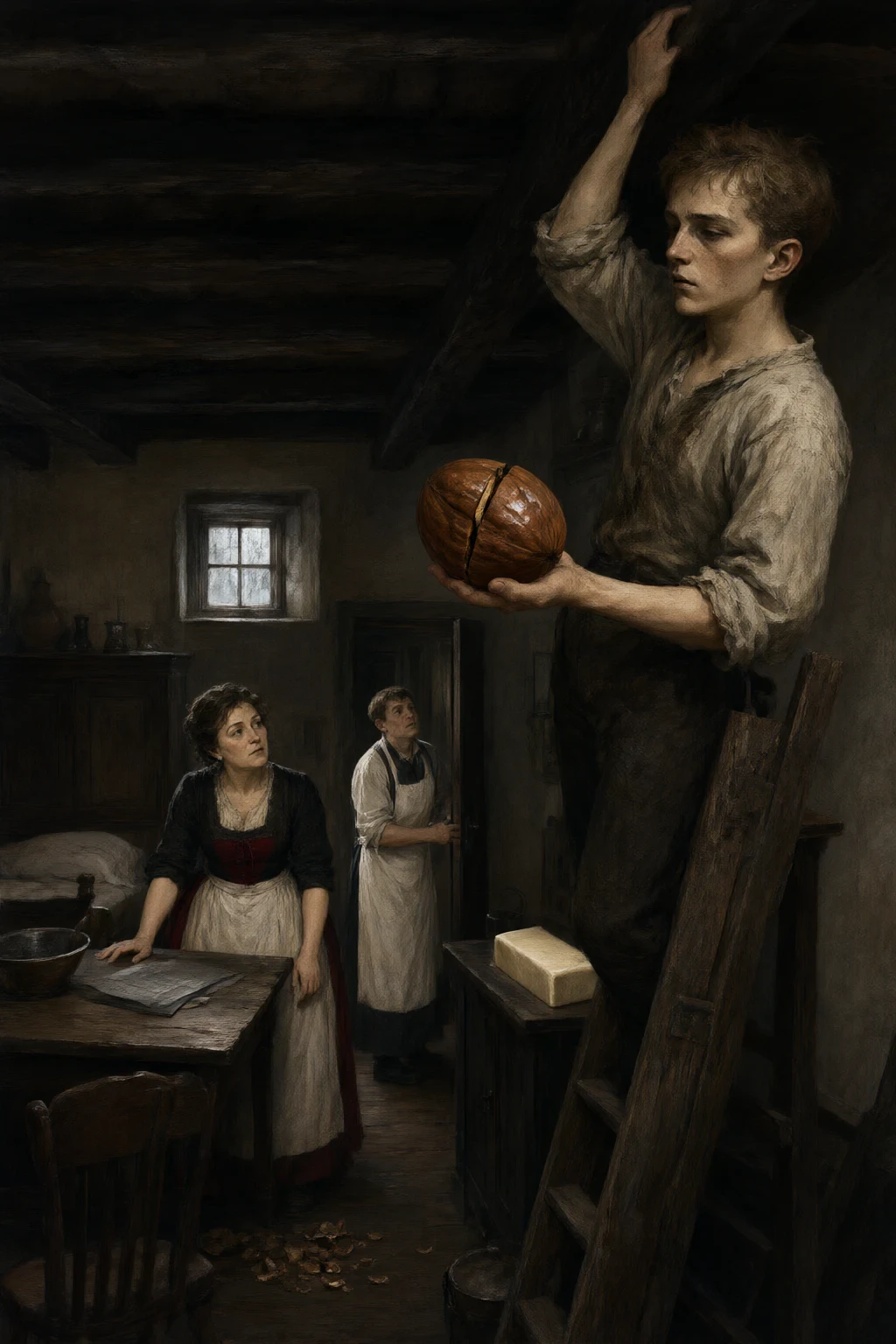
He was shown up by a boy of about ten who was paid, he later understood, in nothing, and who knocked twice and said nothing and went away. The best room had a low bed, a washstand, a fire that had been banked, and a ceiling of broad oak boards black with a century of smoke. And along the beam, wedged in a joint where two timbers had been married together, there was a thing Hans assumed at first was a knot, and then assumed was a decoration, and then understood, in the way you understand things late, was a walnut the size of a fist, shell polished to a brown shine by a century of hands. There was a bowl of them on the table. A dozen, and no two the same.
"Sit," said the girl who had come up with him, though she was not a girl, she was a man of forty in a cook's apron. "Sit and crack a nut. Everyone cracks a nut. If you do not crack a nut, you will sit up all night and you will hear the room." Hans cracked one. Inside, where the kernel should have been, there was a slip of paper rolled tight as a pipe stem, and on it, in a small neat hand, a sentence. He read it. It was not about him.
He cracked a second. The third one was about a woman in Flensburg who had wished for a house and got one and had gone on living in it for nine years being slightly wrong with her sister. The fourth was a debt of nine marks that had been entered in a good year and paid in a bad one. "Fascinating," he said. "They are the room's," said the cook. "The room keeps them. That is the whole entertainment and it is better than the fair." "What happens if somebody says the name?" "Then the room has him."
He said it at two in the morning because he was fifteen and could not sleep and had been counting the wall's shadows. He said Frau Trude into an empty room, once, in a voice nobody had asked him to use, and nothing happened for a length of time long enough that he decided it had not worked, and then the fire, which had been banked and nearly out, burned up in a single orange breath, and the walnut in the beam made a sound like a nut being cracked, and Hans's mother's cottage came clear in his head in a piece, all at once, with the exact figure of what had been paid and what remained: nothing. The seventh year, paid. The eighth year, never. Downstairs he heard a chair pushed back. Frau Trude came up with a lamp and stood in the doorway and looked at him, and she was not angry, and that frightened him more than anger would have. She looked at him the way you look at a wall that has begun to lean.
"Say it again," she said. "No." "Then you will not sleep, and neither will I, and the room will keep you both awake until one of you says it out of spite." So he said it again, and this time he heard how the room sounded when it had the name in it: a change of pressure behind the plaster, the way a room sounds when a door somewhere else in the house has been opened and left.
The Assessor came on the Sunday. He was not red and he was not tall. He was a thin man in a good coat with a clerk's ink on the side of his little finger, and he took the chair at the head of the table and asked for the book, and the book was the walnut: the Assessor put both hands round the shell and turned it, and the shell opened along a seam that Hans had not been able to find with his thumbnail, and inside it, instead of a paper, there was a whole room of paper: slips wound one inside another, packed in the shell like the segments of an orange. "Four hundred and eleven guests," said the Assessor, "since the widow took the name. Sixty-one of them stayed. Three of the sixty-one are still here. The house has never once been improved, because I do not improve houses. I keep them." "And me."
"You." He turned and looked at Hans properly for the first time. "You have said the name. You are entered. The entry is not a wish, boy, do not get that muddled, a wish is a thing I sell and I sell a great many of them, in this room and in every room with a name in it. A debt is not a wish. A debt is arithmetic. You have signed for your mother's seventh year and you have paid it, and the account stands closed and there is nothing more owed, and that is the whole of what I have from you tonight." "Then I can go home." "You can go home," said the Assessor. "You can also have the other thing, which is what everybody actually came for." And he named it: a fine house, and a wife who would be sensible, and a trade, and a road that went up. "I can do everything," said the Assessor, "except one thing." "What is that."
"Make a person good." He said it without any weight, the way a man says the name of a market he does not trade in. "I can give a man a fortune, a fool, a beautiful woman, ten years off a sentence. I have never once been able to make anybody good, and I have stopped resenting it. Come and see the fine house."
Hans read his own slip on the Monday, and that was the afternoon everything turned on, and he turned it by accident, because he was looking for his own name in the book to see how much it had cost. The Assessor had brought a fair copy. The fair copy was not the slip; it was a clerk's transcript, in a fine hand, on a single sheet, and it read very clearly and it said: The room may take what is signed, and may keep the guest for the term of the natural life of the guest, and may enter the guest's house thereafter, and may take from the guest whatever the guest has not yet received.
Hans read that four times. He was not a clever boy. It took him until the second reading to see the whole of the trap, and by then the fire was in and the lamp was low and he had it: may take whatever the guest has not yet received. A debt is a fixed thing. Everything the man from the third stump had ever wanted to sell him, the fine house and the sensible wife and the road that went up, was not part of the account at all. It was not on the account. It was the interest, and it was charged in advance, and nobody had told him, because nobody had to, because it was in the small print of the room's own keeping, which was the one thing in that building that could not be argued with. He went down and asked Frau Trude for the original. She looked at him a long time. "You want the walnut." "I want to know what I signed." "You have what you signed," she said. "In here." She tapped the bar. "I have kept this house eleven years because I could not read the paper, and a woman who cannot read a paper cannot be discharged by it. That is the whole of my arrangement."
He cracked his own walnut in the dark, at the table, with the heel of his hand, and it came apart along a seam he had not known was there. Inside was a slip in a different hand, older, the ink browned, and it was shorter than the transcript by a third, and it said: The room is bought with a name. The room may hold what is signed, and nothing else, and what is not signed the room has no right to, and the room is discharged when the account is read twice before a witness that cannot be made to want. Nothing in this room is a person's soul. No person is given. A debt is discharged by paying it, and a debt may not be enlarged after it is entered, and the room is a room and not a devil, and the room does not keep a man longer than the thing he owes.
Hans read it a second time because he had been told, and the second reading was the one that mattered, because the first time he had been reading for a way out and the second time he was reading for a way to be certain, and the difference between the two is the whole of what he was.
He did not run. He wants that understood, and he was asked about it afterward by people who made a great deal of it, and by people who made none. The account, it turned out, was not money. It was four hundred and eleven hours, one for every guest the walnut had ever taken, which is the room's own price for a name, and which the room had never once collected from anybody. It is a thing you can look at and understand, and Hans had eight months of it to go. The Assessor said he could pay it in coin, at four in the hundred, in the ordinary way, which is the way nobody with eleven marks can pay.
So he paid it in work. He carried water for the taproom until his shoulders went. He split the wood for the kitchen. He cleaned the shoes of nine guests who were not grateful and four who were cruel about it, and he learned the room's ledger, which is a real trade and takes two years, and he entered the night's takings without being asked, because the widow's hand was going, and because a boy who can keep a book is a boy who is not easily replaced. And while he worked it off, the room began to sell.
The room had been selling for a hundred years and nobody had ever noticed what it was selling, because a wish is small and a wish is cheap, and the room deals in a kind of penny. He found it in the beam, in the slips, when he could finally read the walnut at night. A boy of nine in Flensburg, 1783: wishes to be like his brother. A woman in Lübeck, 1791: wishes her husband would stop singing on Sundays. A carter, 1804: wishes he did not have to feel cold. Every one of them entered, every one of them granted, every one of them true. The room had never lied to anybody. That was the thing about it, and the thing he had got wrong in his first month, and the thing that Frau Trude, who had watched three hundred people sign their names in her house, understood before he did.
"You do not have to be good," she said, on a night in the fifth month, wiping down the bar. "You have to be accurate. Those are different trades and this house only ever offered the second one." "What is the difference?" "You can be bad and pay for it," she said. "You cannot be good and charge anybody for it. I have had eleven years to work that out and it is the only arithmetic I have got."
On the last night the Assessor came without being sent for, and he was in a temper, and he said the thing that undid him, which was not a threat. "You have not paid it in coin. A debt is a debt. I can take the coin or the account, and I have offered you the account because I am reasonable, and now you are going to stand in my best room and read a piece of paper to a nut." "No," Hans said. "I am going to read the account out twice, in front of a witness that cannot be made to want. That is the discharge your own slip provides for, in your own hand, and there is no clerk in this kingdom who can set a fair copy beside it and call the two the same, because the copy is a copy and that is the original, and a room is bound to what is written and not to what is said."
The room was very cold. The Assessor stood with his hand on the walnut and did not take it away, and did not open it, and did not do anything at all, which took a long time, and which was the only violence in the story that anybody can honestly describe. Hans read the account out. It was four hundred and eleven hours, and there was not one hour in it that had not been worked, and he had checked the column twice before he began, against the slate, against the widow's hand, in a room where nobody had ever been got wrong on purpose. He read it a second time. The walnut opened along its seam, which it does when a thing that has been keeping an account for a hundred years is at last agreed with, and the slips inside it lay out flat and wide like the rings of a cut tree, and Frau Trude put her hand flat on the bar and let it stay there. "There," said the Assessor. "Discharged."
"Yes," Hans said. "And the room is a room, and not a devil, and it does not keep a man longer than the thing he owes. So the account is closed, and the name goes with it, and you may take your name and go, and I would take it up the road and not open it on the way." The Assessor went. He took the walnut's paper with him, all four hundred and eleven slips, folded into his coat in a bundle that made the coat hang wrong on one side, and he did not touch the shell, because the shell was a nut and a nut cannot want anything, and there is no clause in any room in any country that lets a man take a thing that does not want to be taken.
Frau Trude had been married, and had bought the house in an unlucky year for a price that was too good, and the price had been a name, and the name was the sign. It came down off the board in the spring and there was a mark of a woman on the boards where the letters had been, ghosted in a brown that no amount of scrubbing took off entirely, and the inn went on being an inn, and it was a bad inn for a long time, because there is a great deal of trade in that country in rooms that can be got to, and after eleven years of it there was not much left.
The beam stayed. The smith took out the whole of the middle joint and put in a length of iron, and it was the correct thing to do, because a beam is a beam, and oak is oak, and the walnut had been in there since before the widow's time. It is a strange thing to be told that the warmth in that room for a century came out of a nut. They cut it out on a morning in April, two of them, and Hans took it down himself because the others thought it was going to break and he wanted to see. It came free with a sound like a small bone. There was a clean pale rectangle in the oak where it had been, oval, a little darker at the edge, exactly the size of the thing, and on the top surface, which had been pressed against the roof for a hundred years, there was a shine the shape of a thumb.
He washed it in cold water and set it on the sill in the best room, where the light from the south window came in winter, and where the plaster had a square hole in it about the size of a hand, made in 1804 by a hand that had come out of the wall to offer a guest a stick of juniper and never went back in. Nobody stayed at the crossroads that winter, or the next. In the third spring a carter put his horse in the stable for a month and did not ask what the room was called, and the widow let him stay, and the walnut stood on the sill through all of it, and it did not open.