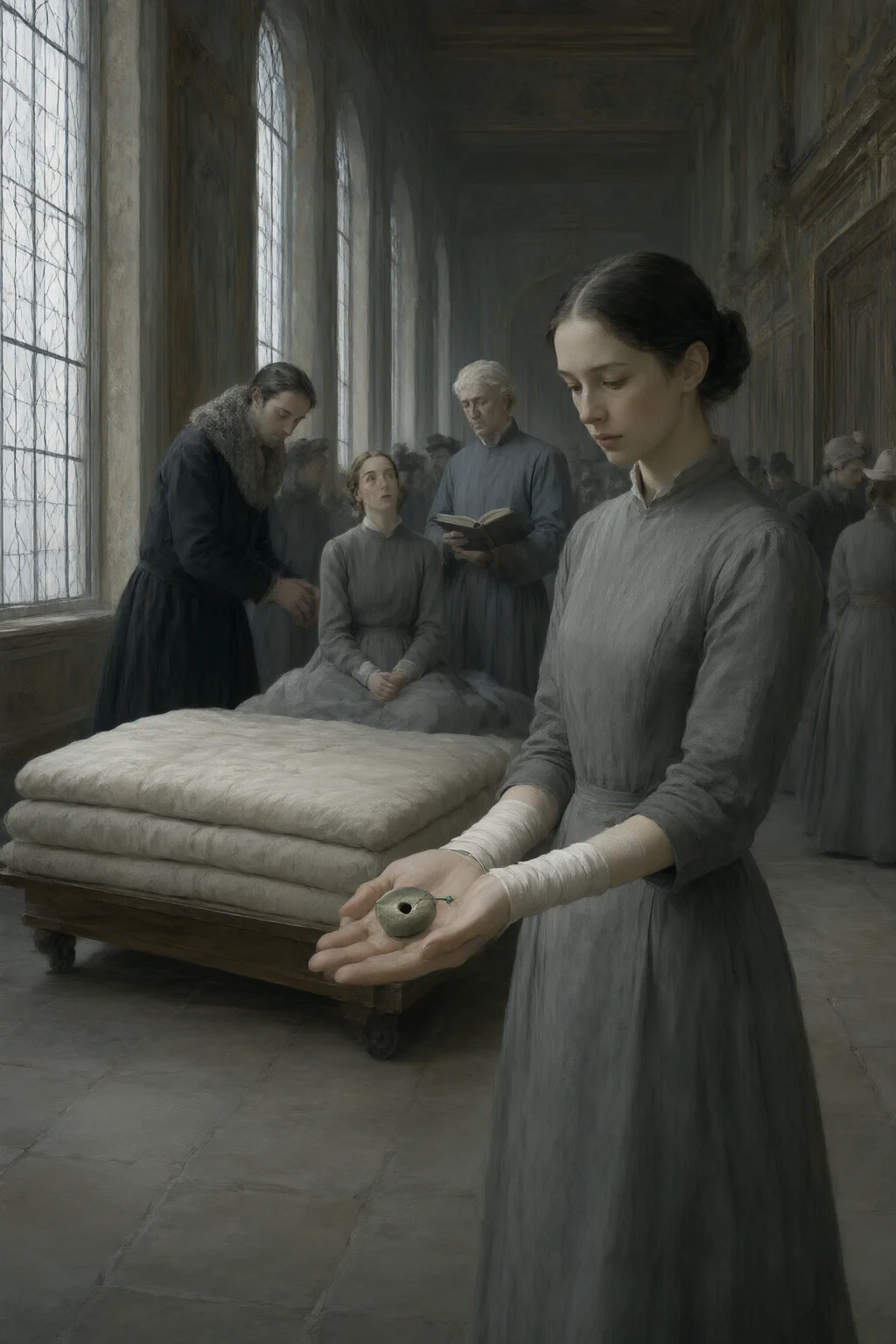
The pea in the Test Bed of Vaude was one pea. Ilva Renn knew this because she had put it there. She was nineteen, a bed-clerk of the third rank in the Office of the Chamber, and her name had stood in the rota of linen-changers for six years, which meant that on the morning of a Test she came before dawn and did the work nobody else was allowed to do. She counted the mattresses, turned them, beat the dust out of the linen cases, and at the depth the rota gave she put in the pea. Forty-one mattresses. The rota said fourteen. The pea sat between the fourteenth and the fifteenth, four fingers down from the top, in a place no one would think to look. That morning, in the long gallery of the Winter Palace at Riem, two hundred people had come to watch a young woman fail to sleep.
Princess Sabra was twenty-six and had spent the previous evening reading, which Ilva knew because the Registrar reported that Her Highness had asked, in a level voice, for the bed's service record: every linen change, every depth, every Test in a hundred and four years. The Chamberlain declined to produce it. The record of the Test was not a public instrument, which was true in the way a locked door is a wall. The procession went up at ten. Sabra came last, in white, her hair bound. The Test Bed was wheeled out on its low platform: a wide plain bed, forty-one mattresses inside, the whole succession of Vaude resting on a stack of wool and horsehair the Office had been re-covering since the year 0.
Chamberlain Halvard Ost was fifty-eight and had held the office for twenty-two of them, and he had the low unhurried voice of a man who has never had to raise it. He read the form of words that had not been read aloud in a hundred and four years, in the present tense, which nobody had done before and which he did now because the tense was no longer in dispute. "His Majesty lies under proof. If the sovereign sleeps and wakes, the household is honest, and the crown is confirmed in the body. If the sovereign sleeps and wakes and feels nothing, the household stands accused, and the crown returns to the Council, which shall make provision." "Have you heard the form?" he said to Sabra. "Do you accept it?" "I accept it."
Ilva stood against the wall with her hands folded and her face empty, which is the face the Office teaches. She knew what happened next: Sabra would lie down on the stack and lie awake all night, and at dawn come out with a courteous expression and say nothing, because there is no form of words for I slept badly and my back hurts. At noon the Princess was shown in, and the Chamberlain asked her the only question that had ever been asked in that room. "Did you feel anything?" Sabra considered it with an attention that made the gallery shift. "I felt the bed," she said. "It is a very well-made bed." The Chamberlain inclined his head. In eleven years of Tests he had learned that the answer was never going to arrive, and that the room only ever needed the sentence.
"Then the household stands accused," he said. "By the form, the crown returns to the Council. By the practice of a hundred and four years, and by the consent of the realm, the crown remains where it lies." "Wait," said Sabra. "I have not been told one thing. Where was the pea."
The gallery went quiet in the particular way a hundred and four years of practice had made possible, and the question sat there being extremely reasonable. "You will be given nothing further today," the Chamberlain said. "The Princess is tired." "I am tired," Sabra agreed. "I am also the only person in this room who knows nothing, and that is a strange position for a sovereign at twenty-six." The Registrar of the Chamber, a small dry man named Fen Toller who had served three sovereigns and outlived all of their opinions, said: "Highness, the pea is placed by the Office of the Chamber under the salt rota. The rota is not a public instrument. It has not been one since the Long Winter." "Then somebody should make it one," said Sabra, and left the gallery.
Ilva had shaken her head. Later, alone in the linen store, she worked out that she had shaken it because she did not want to be the one who told the truth about the wrong depth, and that this was not loyalty to the Office, and that if the Office had asked she would have said it. The rest of the crown's machinery would be assembled later, by better people, out of exactly this material.
The Office of the Chamber was on the ground floor of the East Range, in rooms that had been stores and remained stores. There were forty-one people in it, all appointed, all removable by the Chamberlain alone, all paid out of a warrant the Chancellor had tried to cut. Corin Hale was the Salt Keeper, seventy-one, and had kept the book for fifty-two years. The book was the rota: a bound register, calf over boards, one line for every Test since Aveline the Second, one hundred and four lines, in eleven hands. Each line gave the date, the sovereign, the linens, the number of mattresses, and the depth. "Depth fourteen," said Ilva. "Every year since the Long Winter." "Eleven depths in the first thirty years," said Corin Hale. "Then they narrowed. It is a question of what a body can plausibly fail to notice. Too shallow and she feels it and the Council makes provision. Too deep and the searchers dig and find it in the wrong mattress, and the Office is accused of planting it."
Ilva looked at the column. Fourteen, nine, twenty-two, six, thirty, eleven, seventeen, fourteen, twenty-six, eight, thirty-three, five, nineteen, twenty, twelve, fourteen, fourteen, fourteen, fourteen. "There is a pattern." "There is a distribution. The Office learned to distribute. No depth is used twice within nine years, because a queen who remembers the year she failed at a depth and is told to fail at it again will have opinions, and queens with opinions are expensive." "Who chose the depth this year?" "I did. From the distribution. At twenty-two she would have had to lie on her back and breathe shallow. Princess Sabra breathes like a cooper. She would have found it at nine and not slept at all, and we should all be looking for new employment in the spring." "One hundred and four sovereigns," said Ilva, "and not one of them felt it."
"Two," said Corin Hale. "Aveline the Second felt it, and a child of the old royal house, a girl of perhaps five, the year before Aveline, who was not a sovereign at all and whom nobody entered. The entry says the child would not lie still. I do not know what she felt. I have had fifty years to decide in and I have not decided."
She was made Keeper of the Salt Book on a Thursday, and the making took nine minutes. The Chamberlain received her in the panelled room behind the East Range, the last of the afternoon going gold through the tall windows, the fire too large for a room that size. He had a way of putting a document down in front of you and leaving his hand on it, so that you waited for him to lift the hand. Ilva waited. She had been taught that too. "Corin Hale is retiring. His eyes. He did not want me to tell you he had already been to the oculist." "He is seventy-one." "They are seventy-one." The Chamberlain lifted his hand. "The appointment is mine. You will have the Office's salary and the whole of the crown's data in a room of your own. It is not a great honour. I want to be exact with you, because you are nineteen and people have not been exact with you yet."
Ilva said nothing. She had learned that the Chamberlain's conversations were like the depth column: what was said meant less than what had been left out on purpose. "You put the pea at fourteen," he said. "In October, for the Solstice bed, you also put it at fourteen, and it is Solstice again. The distribution is a matter of the Office's reputation and not of any woman's sleep. Do you follow me?" "Yes, Chamberlain." "I am going to tell you the thing I have never told a bed-clerk," he said, "once. You will not have guessed it. Then we go back to the rota." He sat down, which he almost never did.
"I have never felt a pea. I have been forty-one years in the Office. I have laid the bed myself eleven times, put the pea in with my own hand, and lain on it afterwards with the quilts up to my chin, waiting, like a fool, for a pea. Nothing. I believe the pea is a good pea, and that it is doing nothing at all except being extremely small in a very large bed." The fire shifted. "I have continued the fiction for twenty-two years because the alternative was tried, in the Sixty-First, and it produced four claimants and nine months and a river with names in it that I will not say aloud. I was not yet Chamberlain then, but I carried the writs. I do not know how you weigh a river. I know I can weigh a winter, because I sign for the coal." "Chamberlain—"
"You asked me, in the gallery, through a wall, where the pea was." He held out the warrant. "I am not angry. I want you to understand my position. I hold the Test. The Test is the crown. There is no other instrument. If the Test is a fiction, the man who administers it is the sovereign, and the fields, the granaries, the courts and the poor of Vaude are administered by me, and no one may hold that office by accident, by inheritance, or by belief. Which is what makes it unbearable, and why I have not given it to you yet." "But you are signing my appointment." "To the book. The book is the whole of it, and I have no power over the book, because the book is the record, and the record is what nobody in this palace is allowed to be trusted with. You will keep it better than he did, and no better, and that is the entire ambition of the position." He put the pen in her hand himself.
The Salt Charter was on vellum in the north vault, four hundred and six lines of small competent writing from the year of the founding, and it took Ilva nine days to find the sentence she wanted, because it was in the schedule and not in the body. The body established the Test, its depth, its linens, its witness, its consequence. The schedule, at clause ninety-one, dealt with the household. "And if the sovereign shall find and declare the pea, blind, in the bed, before the witnesses, then shall the household be known honest, and the crown shall stand confirmed in the body of the sovereign, and the crown shall not return to the Council."
Find and declare. The sovereign. Blind. In the bed. The charter did not say feel. It said find, and it put the finder in the sovereign, and it made the crown stand "confirmed in the body of the sovereign," which six hundred years of reading have taken to mean the sovereign's blood, when the only sense is in the person of the ruler, and no other. The Test had never been about feeling. It had always been an audit. The oldest purpose of the pea was that a sovereign who cannot find the thing you hid in his own bed cannot know what you have done to it, and that a household which can be audited at a moment's notice by the person it serves is a household that behaves.
And the officer of the household was the Chamberlain. The Test had been a test of the Chamber from the first clause to the last, and it had been read backwards for six hundred years, and the backwards reading had made a soft thing of it: a princess with a sensitive heart. The country had a soft thing in it, and the soft thing was the belief that the sovereign's body could be searched.
The memorandum of the Sixty-First was not in the vault. It was in the Registrar's standing file, in a plain grey wrapper, kept by three generations of the Office, which was the most damning document Ilva ever held in her hands. It was six pages, dated the eleventh of Frost, signed O. Vey, Chamberlain, and written in the flat, tired hand of a man doing sums at three in the morning.
> To the Council of the Realm, concerning the Test. > > I have administered six Tests and my predecessor fourteen, and in none of them did any sovereign feel the pea. I will say the truth once. If I am not supported I will go on as I have done, and this letter will be burned. > > The succession of Vaude is a fiction. It has been one since Aveline the Second, and it has served the realm, and I propose that it be continued by the Council's own authority rather than by a form of words nobody believes. > > The reason I write is that a woman called Sabra was found dead at the foot of the Test Bed, and it was a fall, and the finding of the Council has been that she did not feel the pea. There is now a rumour in the lower city that the sovereign who fails the Test is killed. There is now a crowd outside the East Range, and no one who will take the bed.
> > If the Test is declared a fiction, four houses will produce claimants within a month, and the Council must choose between them, and a Council that chooses is a Council that has a party, and the levies will be raised against it, because that is what levies are for. I saw what the Four Houses did in the Fourth Winter. I carried the writs. > > I therefore propose that the Council take the succession by its own hand, and that the Office of the Chamber be confirmed in the administration of the Test in perpetuity, so that the succession is held by a man who has a warrant and a salary and a granary schedule and nothing whatever to gain by it, and not by a person who might be a fool or a martyr. And then, at the foot of the sixth page, because he had reached the bottom of the sheet and had still not stopped:
> I do not believe I have done the realm a kindness. I have moved a decision out of the hands of a family and into the hands of a department, and the department will keep it, because the department is where I am, and I am the department. There is no virtue in what we have done here. There is only a room in which it is harder for anyone to do a stupid thing, and I have put myself inside it, and I would like to be thanked and I would like to be left alone.
She took it to Sabra on a Monday. The Princess read it standing up, twice, and gave it back with her thumb and forefinger as though it were wet. "My grandmother held this crown by consent for thirty-one years," she said. "I was a child when they told me it was a humiliation. It was not. It was a decision, made once by a person who knew what the alternative was, and then made again every year for thirty-one years, which is the actual definition of a crown." "You mean to continue it."
"I mean to hold it. There is no one else, and the coal is not going to move itself. But I am going to do one thing, and I am not doing it out of generosity." Sabra turned round. "Clause ninety-one. The sovereign shall find and declare the pea. It has been in the charter for four hundred years and no sovereign has performed it since Aveline, because to perform it you must admit the Test is a search, and the person who admits it is the person being searched. I want to be searched, in the gallery, with the Council watching." "They will not be shocked," said Ilva. "That is the difficulty. They will be bored. They have all been told it is a pea." "Then they will have to work for it," said Sabra, "and so will I. I shall be twenty-seven next month and I have no idea what I am doing, which I understand to be the traditional condition of the office."
It took eleven weeks to arrange, and the arranging was harder than the Test ever had been. Under clause ninety-one the sovereign might summon the officer of the linens and require of her the declaration: find the pea, blind, in the bed, before the witnesses, and declare the depth. Sabra's Council tried to have the clause read as superseded and was defeated on the strength of a Fourth-Winter precedent the Council itself had always found embarrassing. The Council met on the ninth of Snowfall in the long gallery, and two hundred and eleven people came, because nobody could think of a reason to stay away. Sabra lay down on the bed in a plain grey gown with her hair up, and said, "The witnesses may come. The bed-clerk of the Office of the Chamber, of the third rank, is required."
Ilva came in from the side door, and the whole gallery turned, because everyone in that room had known her since she was thirteen. She was wearing the Office's dress, grey and close, with a strip of linen bound round her right hand, as the Office bound the hand of a clerk about to put it into a stranger's bed. She went to the side of the bed. She put her bandaged hand in at the top, between the quilt and the pillow, which was the worst place for it, because the side of the bed is where a hand goes when the top is already warm. One. Two. She drew the top mattress toward her, and did not look at it, and put her hand under the second, which was the one with a repaired corner, because a repaired corner is the thing you can find without seeing. Three. Four. Five.
She was not thinking. There was nothing to think about. She had re-stuffed this bed in October with her own hands, counting the layers as she went, and the only thing her hand had to do was walk down a road it had walked before. Six. Seven. The gallery made no sound at all. The apprentice, holding the book in both hands, told a colleague afterward that it was the loudest silence he had ever stood in, and that people who were not in the room believed he had a gift, and that he was glad nobody who was not in the room had been right. Eight. Nine. Ten. Eleven. "Thirteen and a half," said Ilva Renn. She unwound the linen and held out her closed fist to the Chamberlain, who came forward, because it was the oldest clause in Vaude and the only one anybody had ever obeyed.
He opened her hand. There was a pea in it: grey, round, about as old as the charter, with a hole in it from the year the Charter of Weights was ratified, because they had threaded it on a cord then to prove it could not be swapped, and had kept threading it on the cord ever since. It had been dried and kept in a tin since, so that for four hundred and six years it had not been a fresh pea at all, and nobody had known, and nobody ever would find out. The gallery was very quiet. Then a hundred and fifty people who had not believed and were not going to be told made the sound a crowd makes when shown a thing it has already priced. "Four hundred and six years," said Sabra, sitting up. "It has been in a tin." "Yes, Highness." "Then the Test has been a very old pea on a very large bed, and my family has lost a hundred and four good nights of sleep to it, and I would like that written down somewhere that is not the Register."
The fiction survived. That is the part that is not in the songs, because the songs are not written about this. The Council sat again on the eleventh of Snowfall and found "that the practice of the realm is established, and that no change to the practice is expedient, and that the crown continues to be held by the consent of the Council." The Charter stayed where it was. The forty-one mattresses stayed. The depth column stayed, because a rota that shows the same depth four years running is a rota the Queen's grandmother would have noticed. The law about the granaries and the levies and the poor was not touched at all, because nobody in Riem wanted to be the person who had touched it, and because the man who touches it is wrong when the rivers come. Sabra reigned for thirty-one years, and never once slept a full night in the Test Bed, and had a second bed made and put in her own rooms, and used it, and let it be known that she used it.
Ilva Renn kept the salt book for thirty years. She was the only clerk in the Office who could still do it, and that was the statutory qualification, and no one ever said so to her. When the old Sabra died she was made Under-Chamberlain, and when the young Sabra was crowned she was made Chamberlain, because there was nobody else, and because the Office had a precedent. At the end of her second winter she took the pea tin off the Registrar's shelf and set it on her own desk, in the room with the door that locks. It was a common grey garden pea, dried hard, with a hole in it and a green string through the middle. On the last day of the year she ruled the line for the Test of the coming spring, and she wrote the depth in pencil.
She wrote it in pencil the way her predecessor had and the way hers would, because the rota was recopied every year and recopied on purpose: a rota written in ink is a document, and a document in a clerk's hand can be read afterwards as a confession, whereas a rota written in pencil is a plan.