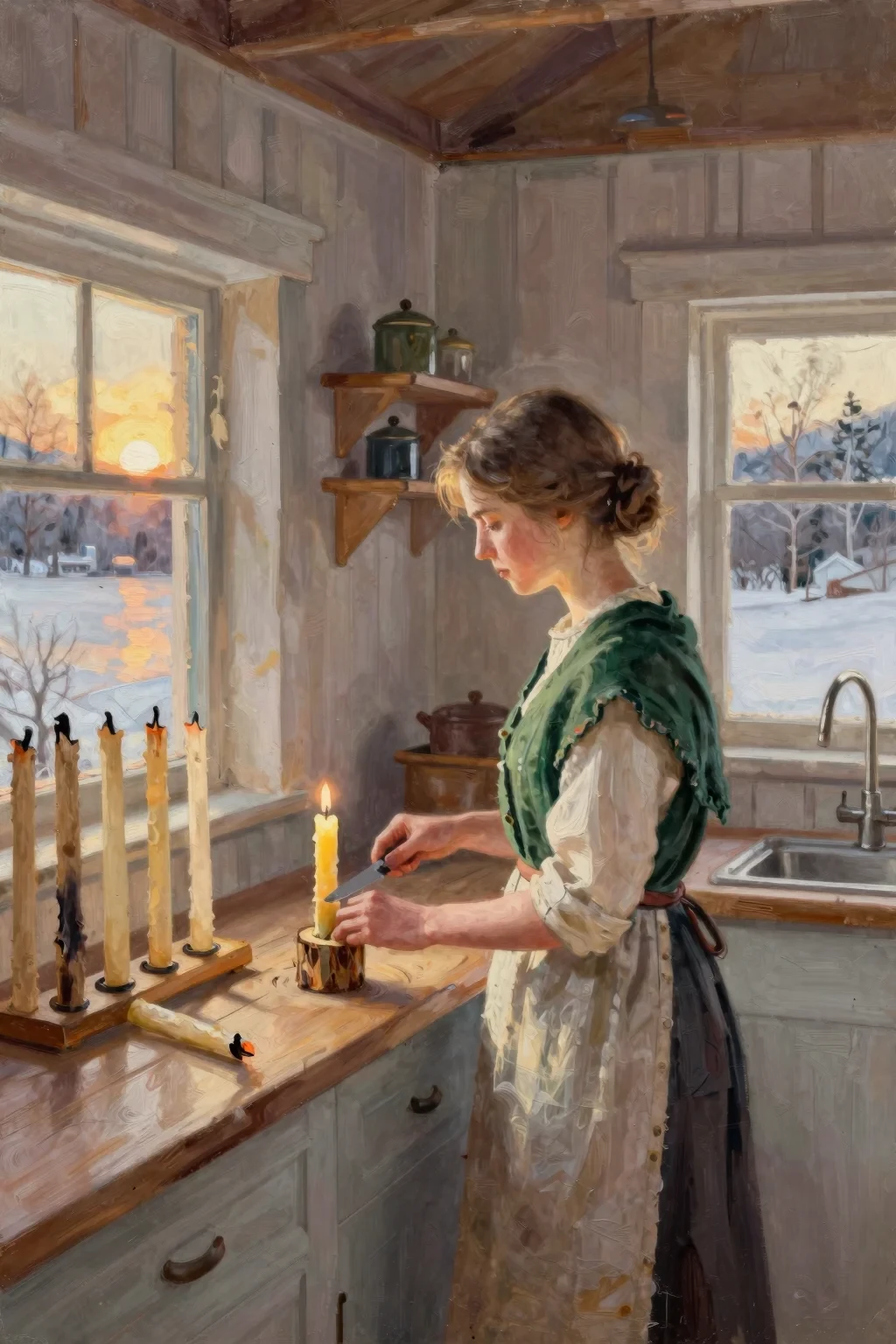
The custom at Solbakken is older than anybody now living on the farm, and nobody there can say where it came from. The custom is this. A guest who comes to a house and will not give a name may be sat at the hearth and given a guess. You may not ask such a guest anything. You may only guess. A guest answers to what it truly is and never to what it claims. And the hearth allows eleven guesses. There is a rack on the sill with eleven candles standing in it, and no candle is lit on a night of guessing. A wrong guess does not end the evening, but it ends one of the eleven. The guesser takes that candle out of the rack and lays it face down on the hearthstone, and it is not lit in that house again that year. The eleventh guess is the door. Right or wrong, the guest stands at the eleventh and goes out, and is not asked back. That is the whole of it.
Sora Halvard was nineteen and had been sent when it mattered four times, and everybody in the valley would rather have her in the room than say anything at all in front of her. She read hands. Not faces. Faces were useless, because a face has been trained since a child was six to hold still while somebody above it is deciding. A hand is never trained, because nobody watches a hand while they are being talked to. The hand of the man who sat down at Solbakken on the eighth of December was clean. That was the first thing. There was no dirt under the nails and they were cut short, and there was no ink on the side of the little finger and no chalk and no soil and no wax and no needle-pricks in the pads and no cord-mark across the palm. Sora looked at the hand a long time before she looked at anything else, and everything else in the room was useless. He had said three things when he came in, and all three of them were false, and she could not prove one of them, which is the normal condition of a guest.
He said his name was Torvald. He said he was going up to Hovda. He said he would sit a while and then go on, and he said it in an even voice, the voice of a man who has been asked nothing and has offered everything. He was somewhere between forty and fifty, and tall and thin in the way of men who are thin as boys and then stop. His coat had been mended twice, at the shoulder and in the back, and both mends were good work. His boots had been resoled, and only the heels. The coat smelled of nothing, and most coats smell of something by the second hour. That one smelled of outside air and of a dry place, and Sora went through the possibilities of a dry place for a while and came back with nothing. They put him in the chair by the hearth with his back to the wall. Sora's mother had already put a plate in front of him, and her mother, Signe, who had been at three of the four guessing nights, put her own plate down on the bench beside the fire and did not eat from it.
Nobody asked him a question. That was the hard part of the custom and always had been. A woman wants to know, and it is not a thing you can put down and leave where it is. Twice in the first hour Signe opened her mouth, and both times her daughter-in-law's hand went flat on the table, and both times the old woman shut it again. Sora sat down opposite him and looked at the clean hand and did not speak for a long while.
Her grandmother had told her once, in the year before this one, that everybody makes the same mistake and it is always the same mistake. “You will want to guess what he has done,” said Signe. “Not what he is?” “Whatever he has done, he has done it already, and it is finished, and it is nothing to you. And if you guess at it and you are right, you have taken a thing off him and you will not put it back.” “Then what do I guess at?” “What he is,” said Signe. “And not what he has done.”
Sora guessed the first time at the end of the first hour. “You have a brother in this parish,” she said, “and you have not been near him.” He did not move. That was the sign. A wrong guess leaves the guest exactly as it was, and it is such a complete nothing that you can hear the room. Sora took the first candle out of the rack and laid it face down on the hearthstone. The second she guessed in the next half hour, on the ink. “You have signed something,” she said, “and it was a paper with more than one name on it, and you are not sorry about it.” Nothing. The second candle went down on the stone. The third was the boots, and it was the guess she had expected to win on. “You have come off a season at the works at Fald.” Nothing, and this time she heard her mother draw breath. Signe had said nothing at all when the boot guess was going, and Sora had not understood until the candle was face down that Signe's silence had been the verdict.
The fourth was the cup. He had turned it once on the table so that the handle stood away from him, and she had watched him do it, and she had thought about it for forty minutes. “You have hurt somebody,” she said. “A man. Long ago, and it was not in a fight.” The fire popped. The room went quieter than it had been all evening. Sora sat with her own guess in the air and heard her mother's chair, and understood that she had said it in front of the room, and understood too late that it had been the first guess in four years that had made anybody afraid. The candle went down.
After the fourth she went out to the byre to work the fifth out where the wind was quiet. Her mother had not spoken for an hour, and through the wall Sora could hear her move a cup and put it down and move it again, which she did when she was counting something. “You have a child that is not yours,” Sora said, when she came back in. “And you are the one raising it, and you are not its father, and you have never told it.” Nothing. Fifth candle. “Your mother is your wife,” she said, for the sixth. “There is a woman at your farm who has been telling everybody for thirty years that you are her brother.” Signe made a sound. It was not a word. Sora decided later that it had been the beginning of the warning she had been given, and that she had chosen not to hear. Sixth candle down. The seventh took longest and was the one she was proudest of afterwards, in a way she could not defend.
“You have come for one reason,” she said, “and you have not come to give it, and you have not come to take anything, and you will go without saying why you came.” Nothing. Her mother's hand went flat on the table again, and the whole table had held its breath and let her go on. The eighth was the coat, which smelled of paraffin and of beeswax that people carry on them for three weeks and cannot get out. “You have buried somebody.” The ninth was the way he had looked once at the corner of the room. “You were in the byre at Solbakken the night the west barn burned, and you watched it, and you have not said so out loud, and you came tonight to see whether this house still has a way of making people say things.” Nothing, and he took his hand off the table while she was saying it, which she was not sure she had seen. The ninth candle went down on the stone, and two were left in the rack.
The tenth was the one her mother had been holding all evening, and Sora spent it because there was nothing in her head left but the price of wool. “You are from the county,” she said. “You have a paper and you are going to Hovda to serve it, and this family has four weeks of grain in the top bin and no lawyer.” The room went quiet in a way that was different from the other nine. Sora's mother put both hands in her lap. Her aunt sat down on the step without taking her apron off. And Signe, who had not moved for two hours, turned her head and looked at her great-granddaughter with an expression Sora had never seen on her and did not understand until years afterward. The tenth candle went down on the stone. Then there was one candle left in the rack, and nobody spoke, and Sora understood, sitting in a warm room with a full plate in front of her, that she had one guess left and had to spend it on the thing she actually knew and could not look at.
The plate in front of him had not been touched. He had turned it once so that the food faced away from him, and she had not understood that either. She had been reading his hand for five hours. The hand had told her nothing, and she had filled the nothing in nine times, and every one of the nine fillings had been a thing Sora believed about people and not a thing she had read in the room. She looked at the hand again. It lay on the table, open, palm up, with nothing in it. “You have nothing,” she said. She did not raise her voice and she did not add anything to it, and what she said was not a name and not a trade and not a crime. What she said was: “You have nothing at all. There is nothing on you and nothing behind you, and you have not come to say anything and you have not come to take anything, and you have not done one thing in your life that you would not say out loud in this room if anybody asked you.” And the guest answered. That was the sign of a right guess, and there is no other sign. He said, “Yes,” in the same even voice he had used at the door, and then he said, “My name is Birk Sand.”
He stood up at the eleventh guess, because the eleventh guess is the door, and he did it without haste, and he put his hands behind his back for a moment in a way that a boy does when he has been told something at a table. “Thank you for the food,” he said to Sora's mother, who had not eaten either. Then he was gone up the lane, and the eleven candles were standing in the rack on the sill, unlit, and somebody began to talk about the price of wool. Sora sat where she was.
What Sora could not get past afterwards, and what she never once said to anybody, was how fast they all came back. Her aunt had the fire up inside four minutes. Her mother was saying before the door had shut that there had been a man from Hovda about a boundary in the spring and that she had always thought this one looked like him. Her uncle found the road at once, because a man going up the lane in a good coat in December is going to the mill at Hovda. Somebody put the kettle on. Somebody said that it was nothing, that there had never been anything. And they were right. Every word of it was true. Nothing had been taken and nothing was owed, the top bin still had four weeks in it, the year would come in the same as any other year, and there was no bailiff on the lane and no paper and no man from the county. That was the relief, and Sora sat in the middle of it and could not put a name to it. It was not gratitude and it was not fear and it was not quite shame.
What it was, and she worked this out over about a year, was the shape of a house that has been told there is nothing in the room. Her mother kept glancing at the door. Her aunt went out at midnight, stood at the gate, came in, said the lane was empty, and went to bed. And nobody asked her what the eleventh guess had been. Not out of tact. They did not ask because they did not want to be told, and because a guess that comes right is a different sort of thing from a guess that comes wrong, and nobody can be pleased about one and not sorry about the other. Sora was the one they send when it matters, and that was true that evening, and the fire was up and the year was safe, and every face in that room was turned away from the one thing she had learned in it.
The candles came down in the morning, and the eleven stubs were cut off and laid in a row on the shelf above the hearth, unlit, because no candle is lit on a night of guessing, and there were older rows of them behind, going back a long way. Sora walked up the lane at eight in the morning with the sky going grey and the cold coming up off the ice. She had guessed eleven times and been right on the eleventh, and nobody in that valley would have doubted her now, and she had won, and she felt that she had taken something out of a house with no way of putting it back. She said out loud, once, halfway up the hill, the name of the man, to hear what it sounded like. Then she stood a while in the wind.
Her grandmother had told her to guess what he was, and not what he had done, and she had done even that. He had come to say nothing and to take nothing, and she had said so aloud in front of five people, and the rule had let her say it, and the rule had not been put there for him. It had been put there so that a person could sit in a warm room and be left alone. A man who will not give you his name is telling you something, and there is no right to make him say it out loud. And a guess that comes right is not always a gift. Sometimes it is only a thing you have to carry by yourself.