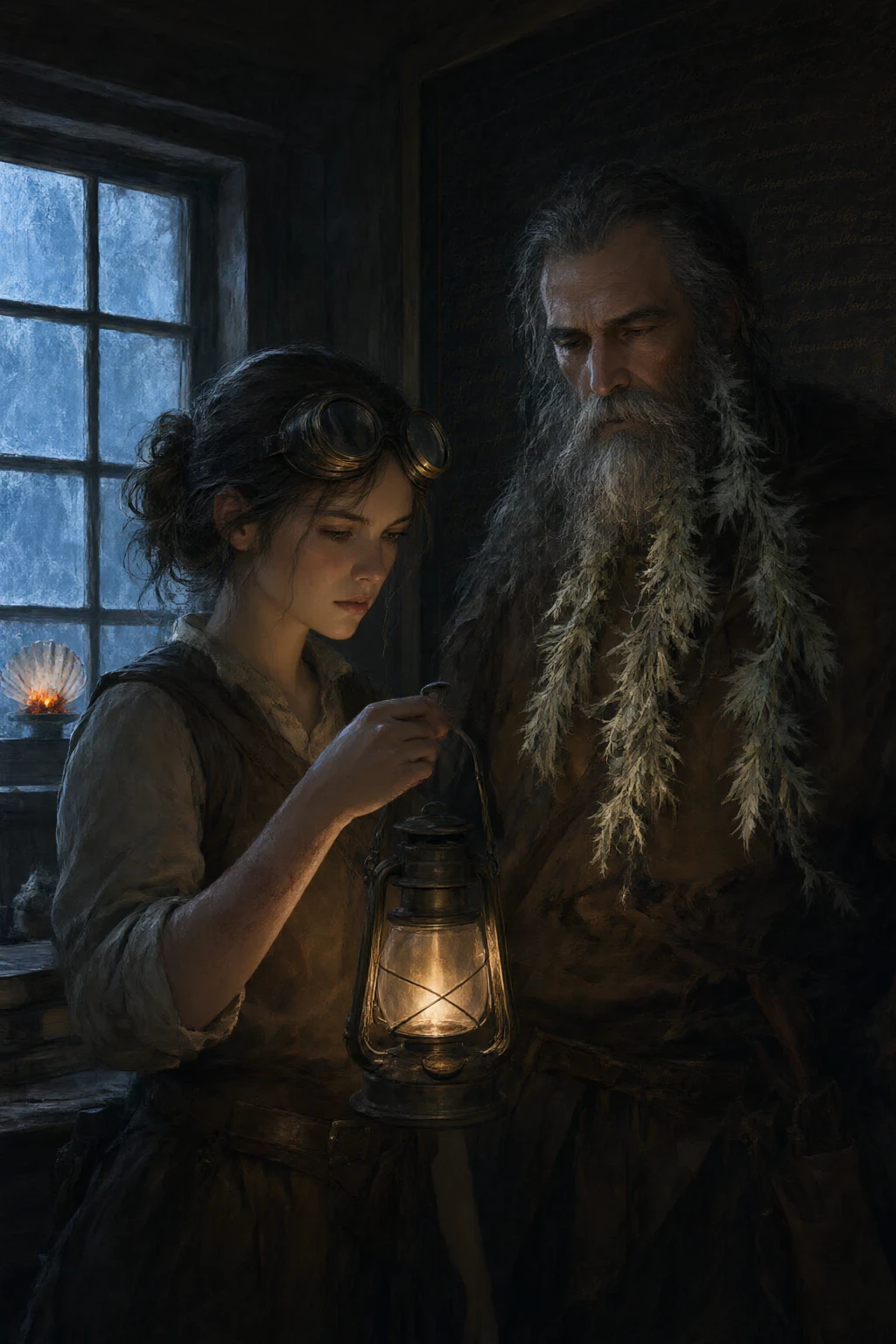
Tace Aldren had been making the fair copies for a season and a half, and she had worked out exactly how much of a thing she could do without looking at it. The fair copies were the working text. Once a year, at the Samstag, the reading is spoken, and once a year it is taken down in a plain hand on pale birch, forty-one lines, and the fair copy is what the next reader works from, because the board's own script crawls, and because a woman of seventy-four with one clouded eye cannot hold a line in her head for two hundred paces and get it right. That arrangement is not old. Ask in the tithe store. It is eleven years old, it is one line, and it is line thirty-four, and it is the reason Tace Aldren was copying on a Tuesday evening in a cold upper room with one north window and no lamp in it. She was copying from Elder Ashdown's dictation. She had never once read the board. That is the whole of the fault. It took eleven years, and it happened because the Scriptorium had gone dark.
Here is how a line of the pact is amended, and Tace had worked it out for herself in a week, because she is a person who works things out. The pact is written in sap on birch. Sap dries dark and glossy, and it moves for a week afterwards, the letters crawling a little, which is why a reading is done standing and not off a desk. And sap will not take a second time. The old letters are in the pulp, and if you write over them you get a scrawl, and a scrawl on a border is a border nobody can hold. So you scrape. You take a knife and scrape the face of the bark down to a thinner place, not through, and write the new line into the thin place, and the old line stays underneath, in the pulp, half a shade below the surface. It is not visible. It is not gone.
At the frost reckoning, once a year, the Scriptorium does one thing besides weighing the pan. When the sap is dry and the cold has got properly into the room, they take a soot-rubbing of the whole board: a leaf of thin bark against a strip, a candle held low, the soot worked into the face with a pad. It is not a beautiful thing. It is grey, it is fast, and it is done by a lamplighter's apprentice, because a lamplighter's apprentice is the only person in the enclave who can hold a light low and even without the hand shaking. Where a line has never been touched, the rubbing shows the line. Where a line has been scraped and rewritten, the rubbing shows the new line in black and the old one underneath in a pale grey shadow, because the scraping thinned the bark and the soot goes deeper where the blade went. Every keeper has known that for four hundred years. It is how a border is traced. You lay the rubbing of the mark at the third birch on the ground and you know where the border was in the year of the rubbing, and you can lay two side by side and see whether it has moved.
The rubbings live in the fair-copies box, folded in with the transcripts, one to a year, fifty-one of them, each with its Samstag on the outside in Elder Ashdown's hand. Tace found the gap on the Tuesday of the eleventh day of the reading week, at the fourth hour, with the fair copy of line twenty-nine finished and the wick down to nothing in the shell by her knee. The rubbings for line twenty-two stop eleven years ago. Not the rubbings. The rubbings for every line run back four hundred years without a break. The rubbings for line twenty-two run back four hundred years and stop, and four years later they start again, and between the two there are eleven frost reckonings and no rubbing at all. Eleven years is not a busy season. Eleven years is a decision.
She went down and found the keeper, who was in the Scriptorium, which is where the keeper is, in the dark, with a fire-ember in a shell on the sill. Elder Sable Ashdown was seventy-four, with a beard fine as lichen and three strands of it silver-leafed, and one eye a clouded grey that took the light like a wet stone. She had a hand flat on the board and her head tilted, reading by the ember with her face rather than her eye. “Maker Ashdown.” “Smith Aldren.” Ashdown did not turn round. “Line twenty-nine wants a full stop and not a comma. It has wanted one for nineteen years. I have never given it one, because the last keeper gave it a comma and I could not think why.” “Why did she give it a comma?” “I do not know. I have a whole box of not knowing and it is very well ordered.” “Elder. The rubbings for line twenty-two stop for eleven years.” The good eye came round. It arrived on Tace's face the way a lamp arrives on a wall, without hurry. “You have been in the box.” “The box is where the fair copies are.”
“The box is where the rubbings are, which are not fair copies. I have not had an apprentice in this room for eleven years, because I have not wanted one, and you have been extremely good at not being one. Now I find you have read the whole of it.” Ashdown moved the shell of the ember half an inch along the sill, which bought more room and cost more oil. “Yes. I stopped them.” “Why.” “Because they showed.” “Showed what.” She put her hand flat on the board again and did not answer for long enough that the ember got three-quarters down, and Tace had to hold the light while she thought, which neither of them mentioned afterwards. “I will show you,” Ashdown said, “if you will first do a thing for me that is not the copying. Read line twenty-two to me.” “The fair copy, or the board?” “That,” said Elder Ashdown, “is the question, and it has taken me eleven years to stop being able to ask it.”
The catalogue is called, in Elder Ashdown's hand, on a strip of birch nailed inside the lid of the box, THE LINES HE CUT. Underneath, smaller, with a rule drawn between: The he of this heading is the he of the document, not the she of the hand. A document is a he. It is a thing that speaks in the plural and cuts without intending to, and it has cut more in this room than the wood outside has cut in the wood. I have let the he have the heading because the he has done the work. There are four hundred strokes down the left of the strip. A keeper does not tally the times a lamp is filled; there is a slate for that, and it is at the head of the Row, and it counts windows. The strokes are not a tally of anything anybody can use. They are a woman counting her own hands, so that on a bad day she could look at them and know how many things she had decided alone. The last stroke is heavier than the others, because the pen broke in the middle of it. “A bad pen,” she used to say. “Not a bad pen,” said Tace. “You were pushing.”
“Ask me for the first one,” said Ashdown. “You have been carrying that face since the Cindermill. Ask.” “Line fourteen.” “The line before my time said: the Wood shall keep the mark of the third birch from the Mere. That is all it said. A tree.” “And you added the ground.” “I added the ground. Nine words, and a whole Samstag to say them aloud, because the sap crawls.” She folded her hands. “The mark is on a birch, and the birch is alive, and a border fastened to a living thing is a border that moves when the living thing moves, and nobody here would know it had moved until the wood was on the roofs. My version is fastened to the ground. The ground is slower. The ground has not moved an inch in four hundred years, and there is a good reason for that, which is that the ground is not growing.” “The birch has moved.”
“The birch has moved eleven paces west into the Mere, and the bank went with it, and the mark went into the water in the flood year and did not come out.” Ashdown's mouth did something that was not quite a smile. “So the board says the border is eleven paces further out than the ground says, and has said so for forty-six years, and the village has been paying a spoon a season for a border it has not held since before your mother was born.” “Then why did you make the change?” “Because the other way round is worse. A border on a birch can be cut down by a man who wants more bog, and then the mark is gone, and the pact is a piece of bark with forty-one lines on it and no edge. I have sat here fifty-one years knowing that any fool with a saw can end this by evening, and not one line in the forty-one says the village may not fell a birch. I looked for thirty years and then I could not stop looking.” Tace thought about that. “So you made it safe, and it went out of true.” “Yes.” “Who paid for the eleven paces.”
Ashdown did not answer, and Tace understood a moment later that she had asked the wrong question. The answer was everybody. Everybody had been paying a spoon a season into a line that was not there, and had gone on paying it, and would go on paying it, because a border that is not there looks exactly like a border that is there when you are standing in the dark looking at lamps. “Line thirty,” said Ashdown. “The second. The lamps.” “The line said: every household of the enclave shall keep one lamp lit from the first bell to the second. Every household. Of the enclave. Not of the Row. The Wards are the enclave. The Row is a street in the enclave. The original was a much better line than the one I gave it, and I made it worse on purpose.” “You added a clause.” “Any household of the Row shall keep one lamp; and any household of the Wards that has an oil it has not begged for shall keep one.” The ember went out. Neither of them moved. Then Tace struck a light from the flint on the sill, a lamplighter's apprentice's light, struck low and even and without shaking, and set it in the shell, and the room came up out of the dark four inches at a time. “Thank you,” Ashdown said. “You did that on purpose and you did not make a thing of it, which is the whole of what a lamp is.” “My mother's lamp. Is that what this was? A kindness?”
“It was a kindness with a handle in it, and I put the handle in myself, and I knew I was putting it in, and I did it anyway, because the line as written was going to break somebody. There were four households in the Wards that year with oil they had not begged for. Eleven years later there were none. Not because they all begged. Because I could not ask the question in front of the Cross without putting a name to somebody's poverty, and a household that cannot say yes or no in public takes its lamp down and says nothing, and there is no record of it, and the clause meant to protect them is the widest clause in the pact.” “The Row fell from a hundred and forty-four to a hundred and thirteen.” “It fell with no order at all. That is the cost of the second line, and I have had thirty years to look at it and have never once said it in a room, so I will say it here, in the dark, which is the only way anybody in this enclave says anything. The thirty-one lamps that came off are not off because oil was short. Oil has been short nine years and I cut it with my own hand off the sap. They came off because of a clause I wrote to keep four people from being named.”
Tace said, “They are kept.” “By whom.” “By the Wards themselves, mostly, and by half the Row who cannot light their own without somebody holding the light while they do it, and by one lamplighter's apprentice, who is fourteen, and who has not been given the shift.” The room was very quiet. “Elder Ashdown.” “I have known for eleven years, girl. I know it the way I know the fourth line from the top, without going and looking. She takes shifts off the Wards' roster and does them herself, and signs them as the Wards did them, and nobody checks the roster, because there is no point checking a roster. Do you know why I have never asked her?” “No.” “Because if I asked her, she would tell me the truth, and I would have to do something about it, and doing something about it is tidying. That is the whole of my life. Ask her who keeps the Wards' lamps. Do not ask her to stop. She will stop, out of politeness, and thirty-one lamps will come off the Row in one winter and the border will walk in, and I will have killed a clause I wrote to save four people. So I have let a fourteen-year-old girl stand in the gaps in a document for eleven years and told myself it was kindness. It is arithmetic. And I would do it again, and that is the worst of it.”
“Line thirty-four,” said Tace. “The reading's light.” “The reading shall be made by whatever light is to hand, that no oil be spent upon the reading.” “The original wanted a lamp. So that the reader's shadow does not fall across the text.” “The original is right about the shadow and blind about everything else.” She held up one thin hand. “Every lamp on this Row is a spoon of sap a season out of a tree. Every lamp in every room, in a hundred and one hearths, is sap the Wood did not eat. If I light a lamp to read to you, child, the border is a spoon shorter this season. So I took the lamp out of this room in my twenty-sixth year of keeping and I have never put one back. That was not a mistake. It is the best line I have ever written, and I would write it again tomorrow.” “Then you read off the fair copy.” “I read off the fair copy.” “Then the reading is not a reading. It is a woman reading her own handwriting back to herself in the dark room. That is not a document being kept. That is a document being remembered. And a thing that is remembered is only remembered by the person who made it.” “Yes,” said Elder Ashdown. “You have not read the last four lines off that board in eleven years.” “No.” “Can you?” “Child, I have one eye and it is going. I can read line twenty-two and I cannot read line thirty-eight. I know what is on it because I put it there.”
“Line twenty-two,” said Tace. Elder Ashdown was quiet a while. “That is the one I have not said out loud to anybody in fifty-one years, not even in the box, where there is nobody to hear. If you want it you will have to take the rubbing yourself, because I cannot hold a candle and read a line and be told what I have done, all at once, and nobody else in this enclave knows how to take a rubbing but you and me.” She gave Tace the candle and the soot-pad and three leaves of thin bark, and stood at the board with her finger under line twenty-two, and said: “The reading is bound in the board only. The speaking of the village is the village's own, and the Wood hears the speaking as the Wood hears rain, which is to say: not at all. Neither party shall name the other in falsehood, and the naming of a thing in falsehood is not a naming of the thing.” That is not what the board says. That is what Tace's own fair copy, in Elder Ashdown's hand from ten years ago, says, and Tace read it aloud before she thought about whether she was allowed to. “No,” said Ashdown. “It is not.” “Then what is on the board.” The old woman had her hand flat on the strip of birch. She was not pressing hard. She was only keeping her hand in the room. “The Wood is the border,” she said, “and what is spoken of the border is read, and is bound as though it were written.”
The rubbing took an hour and a half and it was a filthy job, and Tace did it with a smith's patience, which is to say without stopping and without once complaining, because she had been hammering to a count of ninety for eleven years and this was a longer count. What came up off the board in grey was not one line. It was two, one over the other, the lower a shadow in the thin scraped places, and where they differed the difference was a hand's width of pale bark with the old words still standing in it. “The trees of the Hollow stand as one company, and neither is surety for the other's silence.” She had to have the candle put to it twice before that came out of her, and then she read it again, and then she sat down on the floor with a leaf of bark in each hand. “Elder. There are two parties in this.” “There are two parties in this.” “One of them is a company.” “It was,” said Elder Ashdown. “It is a border now.”
The reason, when it came, came in the order she had been keeping it in for ten years, which was the order of a woman who had argued with herself and won. “Nineteen years ago a pedlar came out of the Shallowmere with a copy of a charter in his bag and the best handwriting I have ever seen in my life. It granted the Walking Wood to a company of three men and their heirs, in perpetuity, on the grounds of an indentureship four hundred years standing. It was not a good charter. It was a magnificent document, signed by somebody, and I am convinced it was a fiction from end to end, and it would not have survived an afternoon in front of a competent man in a court.” “It did not have to survive a court. It had to survive a sentence, and the sentence was mine, in the sing-song, in front of the whole enclave. And the pedlar stood at the back of the Scriptorium with his bag open on the floor and said, quite gently, that nobody had named the Wood in falsehood, because the Wood was not named at all, it was a company, and companies are named every day of the week by clerks, and if the Wood was a company then the document in his bag was its own front door.”
“He had me completely, and in my own sing-song, and I have thought about that afternoon for nineteen years and it is the proudest and the worst afternoon of my life. Because I was right that day. A man with a saw could end this border in an evening by saying the third birch was dead, which it is not, but he could say it, and the line would go void, and a void line is not struck out, it simply stops being true.” “So I took the company out and put a border in, and I took the rain out, and I put in a clause that binds the speaking. And I signed no part of it, because a living hand may not be a signature, and I read the new line twice, and the pedlar folded up his charter and went home and did not come back, and the border stood.” She stopped, and then said the last part in the sing-song, which she had not done once in Tace Aldren's hearing, and which is how Ashdown reads to herself when she is alone in the room. “And that is what I did, and it held, and there has not been one false line in this pact since, and there is no liar in Nettlefold who can unmake the border with a sentence, and the trees are as safe as anything in this valley has ever been safe.”
“Do you know what it cost?” said Tace. “It cost nothing I could see.” “Then you did not look.” Tace stood up, which she had to do twice. “You have made it so a thing cannot be spoken of falsely, which means it cannot be spoken of at all by anybody who is not certain, which means not by anybody who is nine, or eighteen, or tired, or in love with it, or frightened of it. I have called the Walking Wood a nuisance out loud, to your face, twice, because it drops the roof in over the race and my father is a smith. If I had said that at the reading I would have made a false line, and the border would have moved in for a nuisance, and you would have been right and I would have been a murderer.”
“Which is not the cost anyway. The cost is that I cannot say one true thing about it either, and neither can anybody in this enclave, and I have known that about a year and could not work out how I knew it.” She turned the rubbing over in her hands. “You have taken the words away. I have been in this room a season and a half copying forty-one lines, and the line I copy says the Wood is the border, and I have never once said tree. My mother would say it. She says it every day at the Cross, and she has never read a line of the pact in her life and she is bound by every one of them.” Nobody said anything for a moment. Somewhere below, in the tithe store, something settled. “Your mother,” said Elder Ashdown, “is bound.” “She is.” “Then say the word. Once. Here, to me, with the door shut, and hear what it does.”
Tace said it. She said it without ceremony, and it went into the room and did nothing, and she had time to think: that is done, and I am a fool, and what is the harm, and — “The border goes out of the wood at the head of the Row.” Nobody in the room had seen her stand up. The old woman had not made a sound. But Tace was looking at the board, and there was a mark on it that had not been there, at the west end of line twenty-two, where the scraped place was, and in the pale scraped place a pale line of sap stood up out of the wood the way a wet thing stands up out of a dry thing, and it was a finger long, and it was going out, west, very slowly, towards the head of the Row. “Down,” said Elder Ashdown. “Child. Down, and say nothing, and do not say it again.” Tace put her hand flat on the strip of birch to stop herself from touching the board, and said nothing, and the sap line was still there at the finger long, and it did not shorten.
The Samstag reading is eleven minutes. The Scriptorium is cold, and the Scriptorium has no lamp in it, and the whole enclave may stand in, and the only child permitted is Merrin Vale, who is permitted because she asks. Ashdown read the forty-one lines in a soft sing-song, and after every one she stopped and said it again, slower. She came to fourteen and it was the ground, not the birch. She came to thirty and it was the Row, and the Wards with the oil they had not begged for. She came to thirty-four and it was whatever light was to hand, and the room was dark, and there was one lamp burning in the doorway because Nessa Brack had brought a lamp up the stair to hold on the sill, and nobody had asked her to and nobody said anything about it, and it cost the Row a spoon of sap a season, and she had not been signed off to spend it. She came to twenty-two. “The Wood is the border, and what is spoken of the border is read, and is bound as though it were written.” She stopped, and said it again, slower, and the second time was for the trees.
Nobody moved. In the fair-copies box on the sill, open because Tace had been fetching the winter transcripts and had not shut the lid, the leaves of bark stood on edge in a row. And the leaf for that year had been put in the wrong place, in the lip of the reading stand, face up, where anybody coming to the stand would have to look straight down at it. Ashdown's good eye went to the board. Then it went, as it always did, to the fair copy in front of her, which was in her own hand, which she did not need to read, which she had not needed to read for eleven years. And then it went on down, because a shape under the fair copy had caught the light off the door lamp and moved. “Maker Ashdown,” said Tace. “I have put the rubbing where it goes. It is in the reading stand. I am sorry.” “You are not sorry. You are nineteen years old, and you did a careful thing, and you did it the way it should be done, which is in the order. Stand back from the stand, all of you. I am going to read a line twice, and I want the door shut and the lamp kept.”
The door was shut and the lamp was kept, and Merrin Vale was on the floor with her knees up and her red cap pulled over her ears, and Oren Vall was against the wall with his tin in his hand, and there were forty people in a cold room over a tithe store. “The trees of the Hollow stand as one company, and neither is surety for the other's silence. Neither party shall name the other in falsehood, and the naming of a thing in falsehood is not a naming of the thing. The reading binds the board only. The speaking of the village is the village's own, and the Wood hears the speaking as the Wood hears rain, which is to say: not at all.” She stopped. The room did not breathe. “The Wood is the border, and what is spoken of the border is read, and is bound as though it were written.” Nothing happened at all, which was the thing that happened. There was no sound from the Wood and no silence from it either, because the reading had stopped, and the reading is the only thing the Wood hears, and while the reading is not going the Wood is not there.
Then, at the west end of line twenty-two, the pale line of sap went out of the wood again, very slowly, and did not shorten, and by the time Ashdown had said the old words a second time, slower, it was a hand's length, and pointing out at the head of the Row, and it had been a finger long four minutes before. Oren Vall put his hand on the wall to get up, and his knee clicked, and he did not apologise for it. “Line twenty-two is void,” said Elder Ashdown. “Say that out loud, all of you, so that it is said by more than one. Line twenty-two is void, and the board cannot hold two readings of a line, and the thirtieth of next month the parties meet in this room and either make the board whole or the pact ends.” “It is void,” said forty voices, in a cold room, over a tithe store, at ten past the first bell.
At the head of the Row the lamp at number nine was burning at the ordinary height when Nessa Brack passed it, and was out when she passed it again eleven minutes later, with the wick clean and the oil still above half, and nobody near it but her. She carried a spare and a tin of oil and did not send for help, because sending for help at ten past the first bell is not help. And when she came back up the Row at the small hours with the tally slate under her arm, there was a crow on the post at the head of it, a hooded crow four years old, with the top third of his left beak gone, so that everything he said came out with a whistle in it. He had a number, and he gave it to her twice. “Forty-one,” said Sixpence, and tipped his head. “Forty-one. Count it.” “He has had that off somebody,” said Nessa. But nobody had said it in the lane. She had walked every one of them. Oren Vall's tin had been in his hand all evening, because he had stood up and read the whole of it aloud with the door shut, and a reading of a number is a reading of the border, and he had had eleven years of a number in a tin and it had never once been on the record.
In the morning there was a new line under the last one. It was not carved and it was not inked. It was sap, glossy, the letters small, standing a little above the bark the way a wet thing stands up off a dry thing, and the edge of the strip was already lifting and curling, which a strip four hundred years old should not do and which a strip four days old does all the time. Nobody in Nettlefold could read it. That is not true. There was one thing that could read it, and it was in the Scriptorium, in the dark, with one north window and a fire-ember in a shell and no lamp, and it had been reading that board for fifty-one years, and one eye was a clouded grey and the other was going. Elder Ashdown stood in front of the new line for a long time without touching it. “Elder,” said Tace. “Say it. You can read it.” “I can read it. I cannot see it. Those have not been the same thing for some years, and nobody in this room has the standing to tell me that but you, and you have it, so say it and I will do as I am told.” “You cannot see it.”
“No. Tell them what is written, girl, and tell them the shape of it, and tell them whether the letters are of this room or of another.” Tace bent over the board. She read the new line four times, and the letters moved a little each time, and at the fourth reading she came away from the middle of the floor. “It is in the hand of the board. The same sap, the same nib, the same hand, four hundred years old, and it is the Wood's own mark. There is a line under the cold-iron nail.” “Is there a place for a second mark.” “There is. It is cut in the oak behind the bark, and it has always been there, and it has two little squares in it, and the two squares are for the same nail, and the squares are empty, and the squares have been empty for four hundred years.” Nobody said anything at all. “Full assembly,” said Oren Vall from the doorway. “The thirtieth day. The Scriptorium. And I am going to have the Scriptorium lamp lit, by my own order, in writing, nailed up at the Cross where the whole enclave can be angry with me. It will cost the border a spoon of sap a season, and I will say so at the assembly, in front of everybody, as the price of being able to read.”
“You will not need to,” said Elder Ashdown. “A man who reads his board by firelight is a man reading in the dark, and a document that must be read in the dark is a document being kept in the dark, and then it is not a document, it is a habit. I have known that since my twenty-sixth year, and I let the lamp out of this room for twenty-five years to save a spoon the Wood did not need, because the Wood was not eating the spoons I saved. I want it recorded in the fair copies that I did not know that.” She put her hand flat on the oak, not on the sap, which is the difference between a keeper and a woman leaning on a wall. “Elder,” said Tace. “The four hundred strokes. The last one, with the broken pen.” “Yes.” “Do you want it tallied?” Elder Ashdown thought about it a long moment, in a cold room, in the dark, with a new line under the last one that none of them could read and all of them had seen. “No,” she said. “I have read both wordings of that line tonight, and I have not written down either of them, and I want it understood by everyone in this room, because I am seventy-four and I will not be here for the next one. This is the first time in fifty-one years I have had something to say about the pact and have not gone to the strip.” She turned the leaf of bark in the box around, so that the empty side was up.
The lamp was lit in the Scriptorium at four o'clock that afternoon. It was a poor lamp. The wick wanted trimming. It cost a spoon of sap a season. The whole of the Row could see the light in the one north window from the head of the lane, which is not much, and is a very great deal, and was the first time anybody had seen anything in that window since the girl was a young woman. Merrin Vale was standing in the doorway, because she was not allowed on the stair with a lamp. “Elder Ashdown,” she said. “Is that allowed?” “What?” “Saying the thing. The thing Tace said in the floor.” Merrin had her cap in her hands and was rolling the edge of it into a rope. “She said it and the wood went a bit further out, and you said down. But she was telling the truth. I have listened and she was telling the truth, and if a person tells the truth about a thing and that makes the border move, then something is wrong with the border, and not with her.” “It is allowed.” “Everybody can?”
“After the thirtieth of next month,” said Elder Ashdown, “if the parties are still parties and the board is made whole. Then it will be the first clause in this pact in four hundred years put in for the sake of a child asking a question, and I intend to argue for it myself and I expect to lose.” “And if it is not whole?” “Then we will have had three weeks,” said the old woman, “which is more than I have given anybody in fifty-one years, and I have never yet been wrong for three weeks running.”