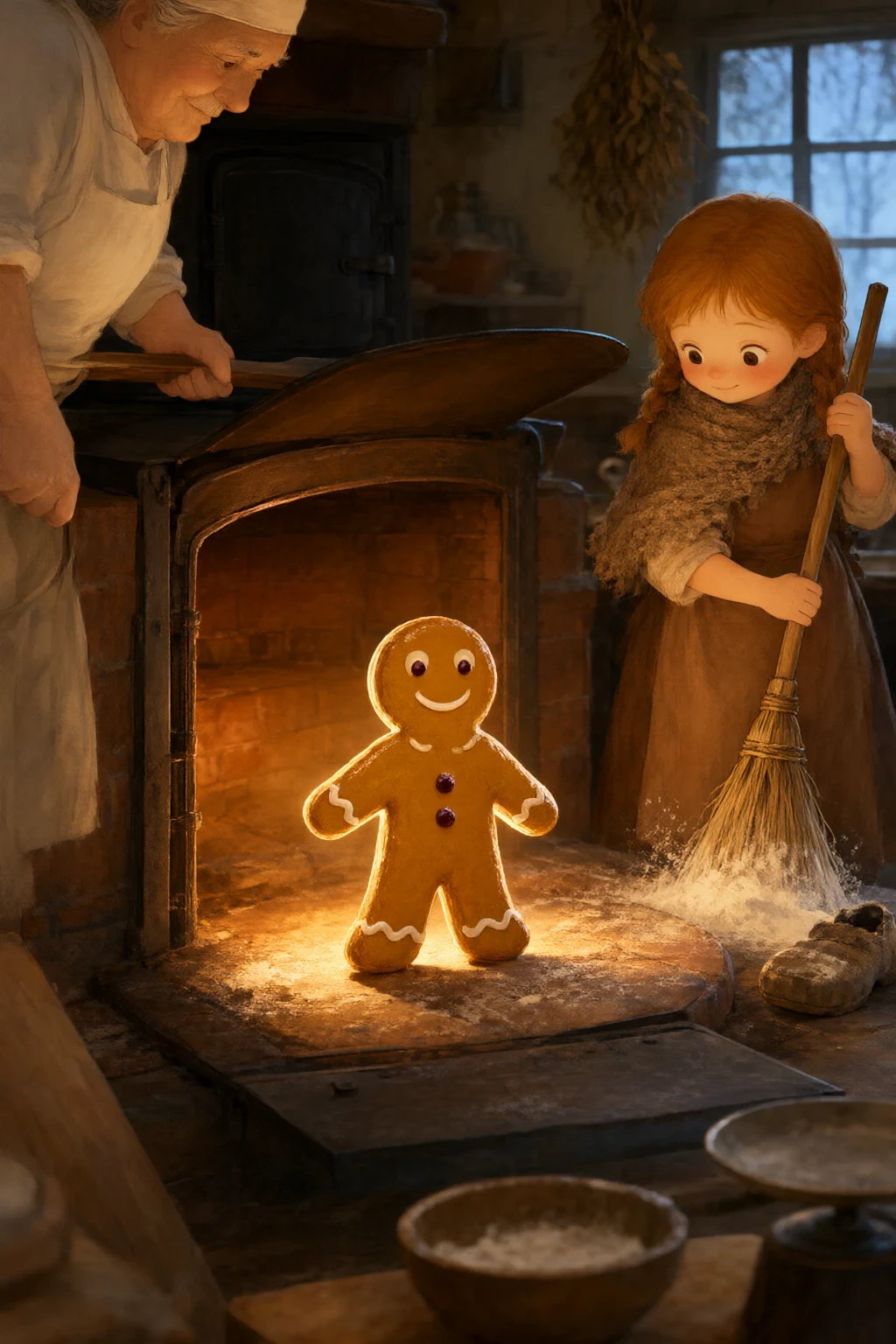
Halfdan baked gingerbread men every Wednesday. The oven in his bakery was old and wide and low, and when the door was shut it made a sound like somebody settling in for a long sleep. Halfdan built the fire, and came back, and opened the door, and the bakery filled up with a smell so sweet that people walking past slowed down and stood there.
Nellie swept the flour. That was her whole job, and she did it well, and it took most of the morning. She was seven. She swept in long strokes from the back of the room to the front, and she did not look at the gingerbread men while they were cooling, because Halfdan had told her not to, and because she knew she would want one.
On that Wednesday there were eight gingerbread men on the rack. Halfdan put them in paper sleeves and gave seven of them to a boy with a cart, and the eighth to Nellie. "You will take this to Mrs. Vinge," he said. "And you will not eat it on the way." "I would not," said Nellie, who would have. Mrs. Vinge's house was full of a good smell, and nobody in it was hungry. They had had a pie for dinner. The gingerbread man stood on the shelf in the parlour and listened to a whole evening of people being careful with themselves.
The two children came in after supper. They did not eat him. They walked round him twice. "Isn't he funny," said the girl. "He is a man," said her friend. "He is a funny man." They went out. The gingerbread man stood on the shelf until the fire went out of the grate.
The next day the woman put him on the table, because the table looked nicer. On the third day the man who lived there put him back on the shelf, because he did not like sweets and did not want to look at one. Nobody had eaten him. Nobody had said anything unkind. He was simply still there, and everybody had a reason.
That night he walked to the window and climbed onto the sill and down the drainpipe into the yard and out into the road. He was a good walker. He said so to himself, and it was true. He could go over a wet stone and up a bank and along a fence without stopping. What he could not do was decide where he was going, because every house on that road was a house where he was dinner, and every one of them would be polite about it first.
He got as far as the mill before his knees began to go soft. The cold gets into gingerbread the way it gets into a wet stocking. He sat down on a stone in the road and put his hands on his knees.
A crow was on the gatepost. "Are you looking for a house?" said the crow. "I am looking for a house that will not eat me." "There are a great many of those," said the crow. "None of them are houses." A cat came out of the mill yard. The cat had belonged to a cook, and the cook had a very good idea what a gingerbread man is for. He got up behind a cart wheel and stayed there until the cat had gone to look under the door instead.
Then he sat down again in the road, and this time he said it out loud, because there was nobody else to say it to. "I do not want to be a supper," he said. "That is all. That is the whole of it. I do not want to be a supper."
The frost came up out of the ground about midnight and found him, and the frost was not careful with anybody. By morning he was stiff as a board from the tips of his fingers to his shoes. He could not walk. He could not bend. He sat in the ditch by the gate with his arms out, exactly as he had been baked. A girl with a rope in her hand stopped. "Have you had a very bad night?" she said. "I have had a night," he said.
She picked him up and turned him over and looked at him the way you look at a thing that somebody has left out in the weather. "You are stiff," she said. "Yes." "Have you a name?" He thought about it for a while, which took a moment, because he was a biscuit. "I do not know," he said. "I think I am new." "Then you are Crumb," she said, "because I have been eating crumbs off my sleeve all morning." And then she said, "I am Nellie, but that is my name, so you may have it if you like." She tucked him inside her coat, up against her side, and ran. He could feel her getting warm.
The road back to town took an hour and a half. The farm dog met them first, and he did not stop for a long time. "Is that a bun?" said the farm dog. "No," said Nellie. "That is a person going home." The dog considered this. He could smell the cold and the flour on him, and the mill, and he knew the smell of the bakery. He stopped barking, and then he walked beside them all the way to the blue door, which nobody in that town needed to be told the colour of. The miller's boy came out of his gate and shouted, "You have lost something!" "I have not," said Nellie. "Thank you for telling me."
Halfdan was carrying a sack of flour when he saw her at the door. He put it down. He looked at the gingerbread man standing on her coat sleeve, still holding the exact shape he had been given in the oven, arms out, one leg forward. "You," Halfdan said. "Yes," said Crumb. Halfdan stood in the doorway a long time.
"You want to go home," he said. "Then you have come to the wrong house, and the right one, both at once, and I do not know which of those I am going to be about." He picked Crumb up very carefully, in two hands, the way you would pick up a bird. "My oven is cold this morning. An oven cannot be hurried into being hot. It has to be brought up slowly all morning like a temper, and you go in at the end, not the beginning."
Nellie came at four o'clock, the time she always came, and swept the flour, because there was flour to sweep. "May I make one too?" she said. "You may make six," said Halfdan, "and you will make four of them too flat, and we will eat those four at once, which is what they are for." Halfdan built the fire. The oven came up slowly all morning, and the new gingerbread men went in at noon on a long peel, and they came out brown and shiny in eleven minutes. Crumb went in last, for a single minute, to warm through.
He stood in the mouth of the oven with his arms out while it was hot, and then Halfdan carried him to the middle of the hearth and set him down on the warm stone, in the one place where the fire would keep him all winter without burning him. Every morning after that, Halfdan carried Crumb to the middle of the hearth and set him down on the stone, and Crumb stood there with his arms out while Nellie swept the flour, and nothing at all happened, and he slept very well.