Market day was the first Thursday after the first hard frost, and Perrin Vole stood in the middle of the Chart House courtyard with a slate in both hands. He was fourteen. His coat was four sizes too large and he had rolled the sleeves four times. One boot had a hole in the sole, so the stone was very cold under his left heel. His nose was red and chapped across the top. “North-north-east,” he read. “Down the grail off the Washing Steps. Hard, and getting harder.”
Nine hundred people stood in the yard with their jars and their shawls and did not say a word. That was the rule as well. You did not talk over the reading. The wind came then, the way it does, and it pushed at the slate and lifted the hem of his too-big coat. And out past the north wall, in the middle of it, something in the colonnade said one clear note. Perrin kept reading. “Steady now. No gust behind it.” The yard stayed quiet.
The note came a second time. It was a small one, high and clean, like a spoon drawn round the rim of a glass. It did not stop when the wind stopped. It hung in the air after the gust had gone, the way a smell hangs. Nobody else looked up. Nine hundred people were looking at his slate. Perrin said, “South by west now, and easing.”
He got through the whole thing without reading a word twice. When he finished, the yard was quiet for the length of one breath, and then it was a market again, and everybody pretended they had not been listening. But he had heard one. And it had come on the second gust.
“Fourth of Frostmonth,” said Ione Sarrack, before she said anything else, which was how she said everything. “And no.” She sat at the long table with her right hand up inside her sleeve and chalk dust on the pads of her fingers. Her coat was buttoned to the throat with three ball-shaped black buttons, and her long grey plait was pinned in a coil on top of her head. “Boy-tuner,” said Perrin. “A note came out of bay five.” “Bay five has six bells in it.”
“Six bells, one note, and it came on the second gust both times. I can show you the gust.” Ione looked at the slate. Then she stood up and struck the little hand-bell on the table with the side of her fist. Nothing happened. Not a whisper. It is the plainest thing in Vesset Grail, and it makes no sound at all, and they keep it because it is useful for nothing and therefore believed. “A living hand cannot ring a bell,” she said. “And the wind?” “The wind was in my hand. I read it out.”
“Bay five, then. Go and find it. Come back and tell me which bell. Do not put your hand on any of them.” “Write it where it stands?” “Write it where it stands.”
The Pillar Walk runs a kilometre behind the colonnade, with a low wall on the valley side and a black iron rail on the other, and no window in Coldrow looks out onto it. Perrin went the whole length with his cheek near the rail and his hands in his sleeves. Green glass dust lay on the flags, and the low sun came through the pillars in narrow bars with the dust turning in them. The first gust came and every bell in the colonnade moved a little, the way a coat moves.
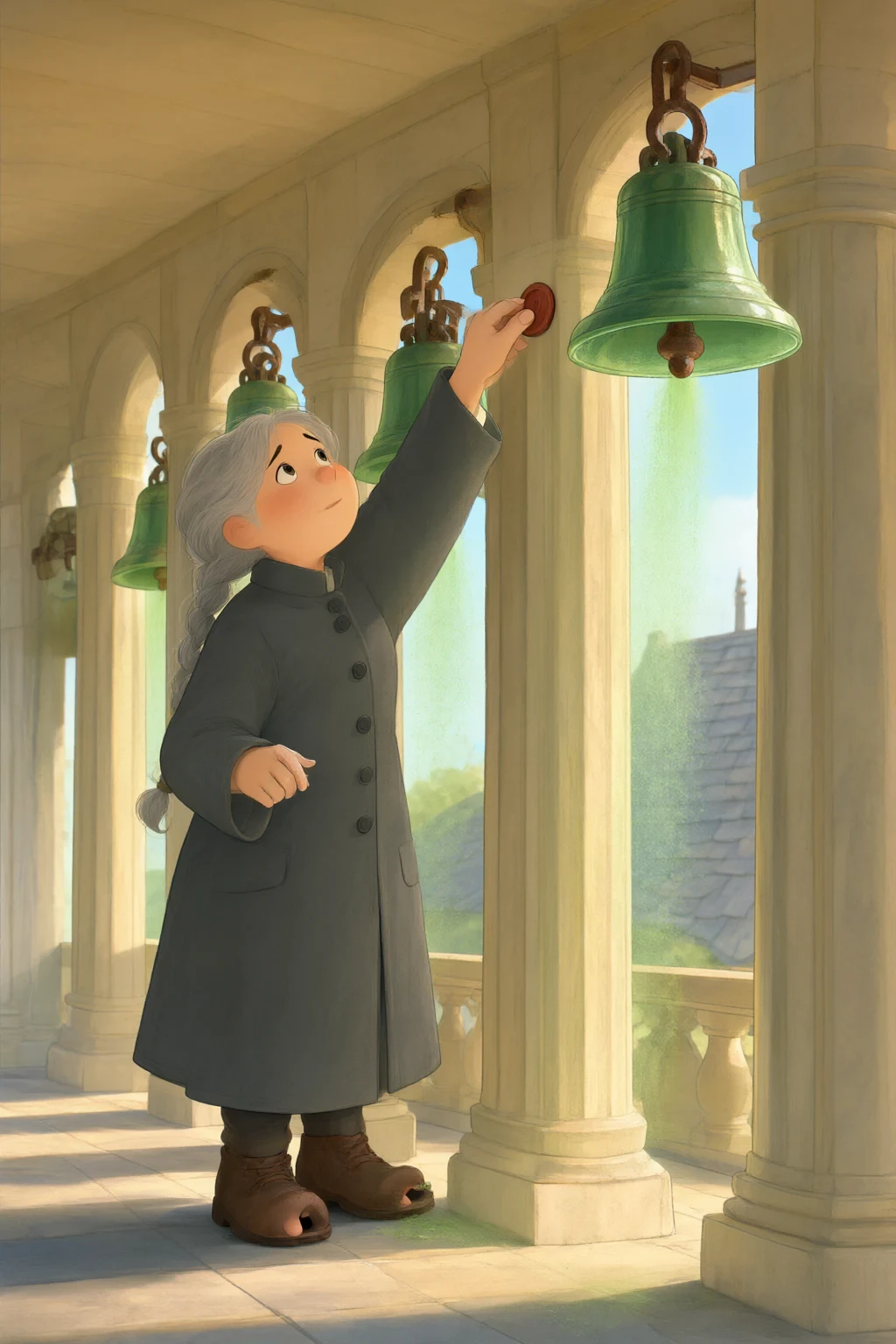
The second gust came, and one bell in bay five moved with the rest and further than the rest. He went to it. It was pale green and as tall as a man, hung on a rusted iron yoke between two fluted pillars. Its lip was slightly thick in one place, the way a bell is where the glass was gathered too hot. There was a disc of lead on the crown, up where nobody could reach it, punched crooked.
He dug a knob of sealing wax out of his coat pocket and pressed it up against the lead, because a runner is only useful if he is ready. The letters came up white on the grey wax, turned the wrong way round and plain as anything. TAM SIKE. Perrin read it twice, then stopped himself. In the schoolroom he had read that saying a name three times alone in a place like this was a promise, and the colonnade was the same sort of place. He wrote the bay and the bell on the back of his hand in chalk and went to find the head tuner.
“Fourth of Frostmonth,” said Ione, “and the twenty-second bell of the fifth bay, and the name on the crown is Tam Sike.” She did not put it on the rota. She wrote it small in the margin, and then she read both lines aloud, once each, which she never did. “Is there a Tam Sike?” said Perrin. “There is. Eleven years old. She sits by the window because the window is warm, and she is on the school list of the living, because Master Roke reads it out on Mondays.” “Write it where it stands,” she said, and put the chalk down, and dusted her fingers against her coat, which did nothing, because the chalk never washes off.
He found Tam Sike in the front row with a jar of hedge honey in her lap and her feet not quite reaching the floor. “I have something to tell you,” said Perrin, “and I have told nobody, so I am telling you.” She waited. “There is a bell in the fifth bay with your name on it.” She thought about it. She was eleven and she took a moment over things. “Is that bad?”
“I do not know. But you are alive, so somebody wrote it in the wrong place, or somebody got the shape of your voice by accident. A bell only holds one note. It cannot say your name. It just says the shape your mouth made, when the wind fits.” “It does not know me at all, then.” “No. It has only your shape.”
And she held out the honey jar and said he had gone red in the face. The honey tasted of smoke and cold stone, like everything in Coldrow, and it was the best thing he had eaten all week.
After that Perrin went back to the Chart House, because the rota does not wind itself, and the wheel is his after dusk whatever else is happening in the valley. He took the handle and turned it, the way he had turned it three hundred times. It did not squeak. He stopped. He turned it again, all the way round. The wheel went round. The ratchet took up. The great rusted drum that holds the hemp line turned with it, smooth and silent as a wet stone.
Perrin stood with his hand on the handle and worked it out, fast, because everybody in the valley has worked it out at some time and nobody ever says it aloud at the table. You pay for hearing. One sound goes out of you and it does not come back and nobody tells you and there is nothing to be done about it. He had heard a bell. He had heard it as a person. He put both hands in his sleeves and stood there a while.
Then, because a habit is a habit and his was humming, he caught himself doing it and he stopped, and he put a hand over his mouth. The wind was still up. He could hear the bay five note going along the colonnade, and it wanted an answer from him the way a note always does. Asking a bell a question is what people do when they have nothing to lose. Perrin took his hand away from his mouth and left it at his side.
He did not hum it. Not that evening, and not the next one, and not ever, and the wind can blow down the length of the Vesset Grail for four hundred years without getting that note out of him. He went home through the larch-shingled lanes with the silent wheel behind him, and he did not tell Tam Sike either, because she was eleven and there was nothing she could have done. A bell that can only say one note, and cannot say anything, is not a thing to be frightened of. It is a thing to be careful with.