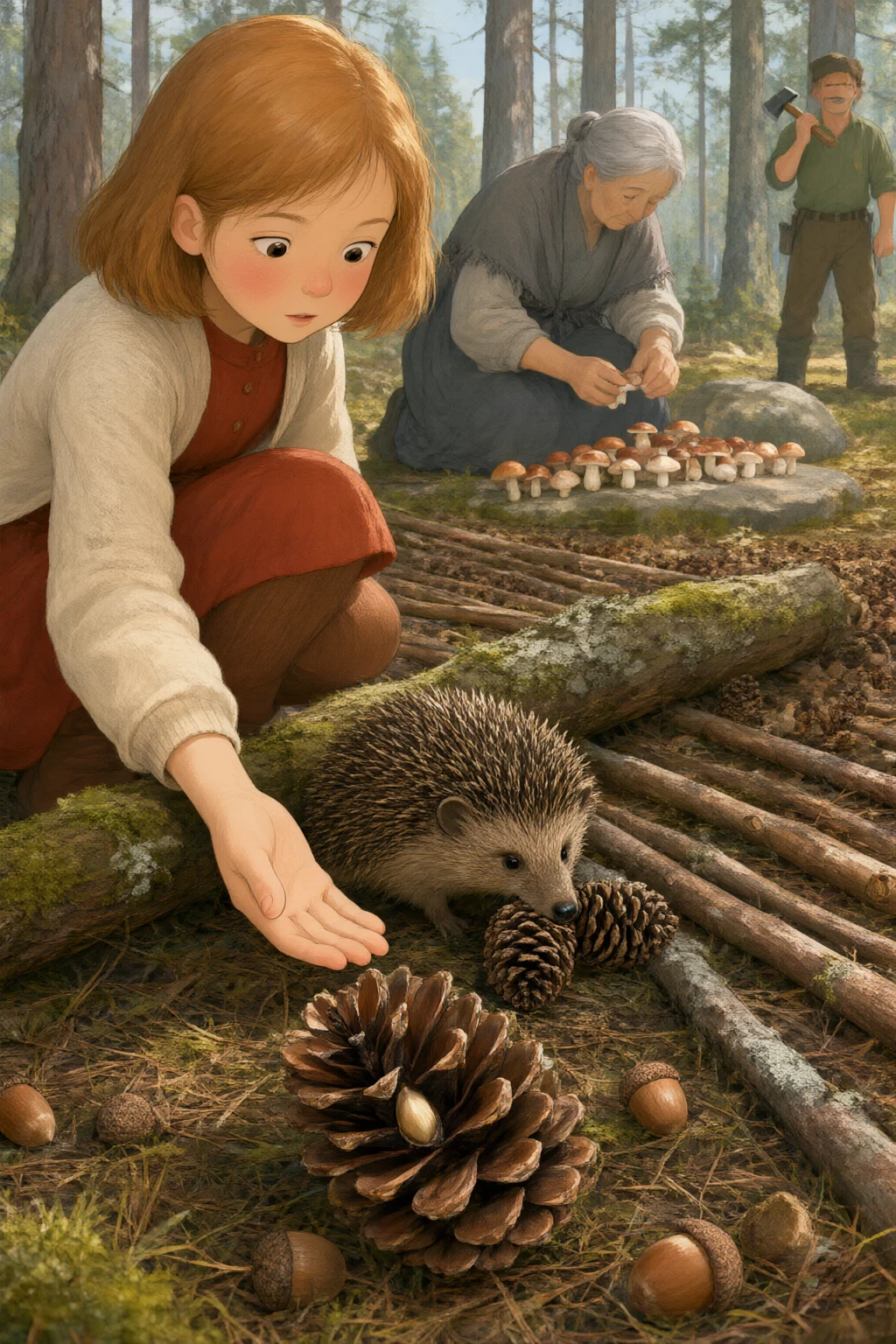
The wood above the village was untidy. That was what everybody said about it. There were dead branches lying in the leaves. There were mushrooms coming up through them. There were pinecones, hundreds of pinecones, and a cart-track going nowhere, and a lot of things that had simply fallen off other things and stopped. Marta, who cut wood, said the wood was a mess. Her husband said the wood was a wood. The schoolmaster said the wood was doing what a wood does, which is to have things in it. And then something came out from under the leaves and began to tidy it.
It was small and brown and it had a face like an old button. It came out from under the biggest dead branch, and it put its nose against the branch, and it pushed, and the branch did not move. Then it went round to the other side, and pushed again from the other direction, and the branch went over onto the path with a noise like a chair being knocked over. That was the first thing the hedgehog moved that anybody saw.
Hanne saw all of it. She was nine, and she was supposed to be gathering kindling, and instead she was standing still. The hedgehog came back and pushed the branch again until it was off the path and into the bracken. Then it went to a stand of young pines and came back with a pinecone in its mouth, and then another, and then another, and it carried all of them away too. "He is taking the wood," said Hanne's grandmother, when Hanne told her. "Where is he taking it?" "To the clearing," said Hanne. "Have you asked him where in the clearing?" "No." "Then go and ask him."
Hanne went and asked him. The hedgehog was standing on a fallen log with a pinecone at its feet, looking at her. "Where are you taking them?" said Hanne. The hedgehog did not answer. It picked up the pinecone and went off into the bracken at a run, and Hanne followed, and the run ended in a place Hanne had never noticed, a soft green hollow in the middle of the wood with a fallen log lying across the front of it. The pinecones were already there. Dozens of them, pushed under the log and into the moss. "It is a store," said Hanne. "You are storing them." The hedgehog went away and came back with another one.
Hanne's grandmother had a book with flat wide leaves in it, and she put it on the table and turned a page and said, "Look at that." It was a pine cone, drawn very large, and every scale of it was drawn with a small flat seed inside it.
"That is the whole trick of a pine cone," she said. "It is a parcel. All those seeds are packed in and shut up, and they wait there for two years before they decide the weather is worth it. When the cone falls it is not litter. It is a cupboard with the door left open. And nobody can eat them, and no animal can get at them, until the cone opens and the seeds fall out of it. A squirrel can carry one away. So can a hedgehog. So can a girl, if she is asked to help." "And the branches?" said Hanne.
"The branches are wood," said her grandmother. "Do you know what people want wood for?" "Fence posts," said Hanne. "The field by the mill keeps letting the goats through and Father keeps making a new fence and it never stops being a new fence." "Post and rail," said her grandmother. "And mushroom caps, you do not eat, you dry them in the sun and keep them till winter, and every one of them is still a mushroom in August instead of nothing at all."
So Hanne went up the hill with a basket and a piece of chalk and did the sorting. The dead branches in one row. The mushroom caps on the biggest flat stone in the wood, where they could be seen and not trodden on. And the pinecones left exactly where the hedgehog had put them, under the log, in the moss, and none of them moved. The hedgehog watched her do the first row and then it started on the second. Marta came up on the second day with her axe over her shoulder. "You are making a bonfire," she said. "No."
"You are taking the wood out of my wood." "No. I am putting it in a row so I can count it. There are one hundred and nine. They are for the mill field fence. You may have them when they are dry." Marta stood and looked at the row of branches for a while. "There is a hedgehog in my wood," she said, "and he is more use than I am."
The pine seed was planted in the second week of April, in the hollow, by Hanne and by the hedgehog, which would not let anybody near the moss until it had been done, and which then sat on the log and made a noise like a kettle for the whole afternoon. Eleven came up. Eleven green lines of needles out of brown ground, in a row, in the dark under the log, where the frost could not get at them.
Hanne counted them twice. Then she counted them the next day and found the same number, and went down the hill to tell her grandmother, who said, "Write it down. You will not remember in the autumn and nobody will believe you in the spring." Hanne wrote it down on the page with the flat leaves, in pencil, and put the date beside it. Then she went back up the hill, because on the way there she had seen three more pinecones lying under the bracken by the path, and the hedgehog had not been up to the hollow since the day before.
She picked them up. The hedgehog met her halfway and took them out of her hand one at a time, and went on ahead, and Hanne followed him down the row, and counted the green things, because counting was what she was for.