Since the twenty-second of December the lamp office has kept a paper on the press, and the paper is a minute, and the minute is two paragraphs long, and it was made by a man who had read a transcription of an answer in a day book and had not slept on the night of reading it. The minute says: that at any double occupancy the clerk shall read the whole of the entry at the double door, in the hearing of all persons present, from the volume and not from a copy; and that the constable shall remain at the standard until the light is given; and that the relief shall be entered the same night or on the next morning; and that the figure at the foot of the form shall be entered from the attendance and not from the printed rule. The printed rule at the foot of the form is this: the light to return to the holder within a space of eleven minutes. Eleven minutes has been printed on that form since 1861. The file contains a note that in 1861 a clerk attended one and wrote down what the clock said. The file contains nothing else. The minute of the twenty-second of December says the printed rule is not authority, and says that a clerk who has no attendance from which to enter a figure shall enter what she has, and shall not enter the printed figure, and shall not leave the line blank. Hettie Rowntree wrote those two clauses. She wrote them at her desk on the twenty-third of December, and she has not been asked about them since, and no double occupancy has come to this office between then and the ninth of February.
The ninth of February was a Tuesday and the wind was west-south-west, half a gale by the harbour, and the glass yard is on the point forty yards from the corner at the bottom of Wharf Street, and there is a line of sight from the yard gate to that corner that nothing in the town has ever been built across. Aubry Vell had been in the yard since three. The ninth lamp’s glass had gone on the Saturday with the rest of the west side of the ring ward, six chimneys in one blow, and there were four hundred and eleven lamps in Ninehook and two hundred yards of wall with the wind on it, and the ninth lamp was the busiest lamp in the town and had been burning with an open top since Saturday night. There were three blowpipes going in the yard. The glory-hole was out and the annealing oven was banked. The light from the glory-hole came out of the yard gate and lay across the wet stones of the corner in a long orange bar, and stopped at the base of the standard, and the standard has a ring on it at the height of a man’s chest, and the ring is polished into a hollow the shape of a grip and nothing else.
The lamps were lit at four bells in the winter. The ninth lamp was lit. The eighth lamp on the wall, ninety feet up the quay, was lit, and was burning at what a lamp on the wall burns at, and the ninth was burning at a quarter of it, and has burned at a quarter of it since 1889. The constable of the night patrol came at six bells and eleven minutes. The corner at the bottom of Wharf Street is the busiest corner in Ninehook and on a Tuesday in February at six bells it is the whole of the town’s evening in one place. There were two hundred people on it. The chandler’s on the north side has an awning out and a hundred and forty feet of it goes up and down with the wind and the sound of the canvas on its stanchions is louder than the sea. The fish shop on the south side is shut at five and its shutter is banging, and the lamp on its wall gives a good light, and the men of the corner stand under the fish shop’s lamp and not under the ninth.
Iven Pyle had been to this corner eleven times and had written the same report eleven times. He came at six bells and eleven minutes because he had come early on purpose, and the notebook was in his coat, and the lamp that was not police issue was in his coat, and he had read the transcription in the day book on the second of January and the printed form in the press on the eleventh, and the reason he had come early on purpose was a thing he had put in his notebook on the eleventh in four words. A different report. There is a rule about a standing flame and it is the fifth rule and it is the only one of the ten that a constable can be made to act on alone. A flame with no lease is an accident. An accident in Ninehook is put out within the quarter hour by whoever gets there. A flame that has stood upon a standard with the light in it and nothing behind it is a flame with no lease, whatever the register says against the lamp, and the quarter hour runs from the first person to see it, and it is not a matter of report, and it does not wait for a clerk.
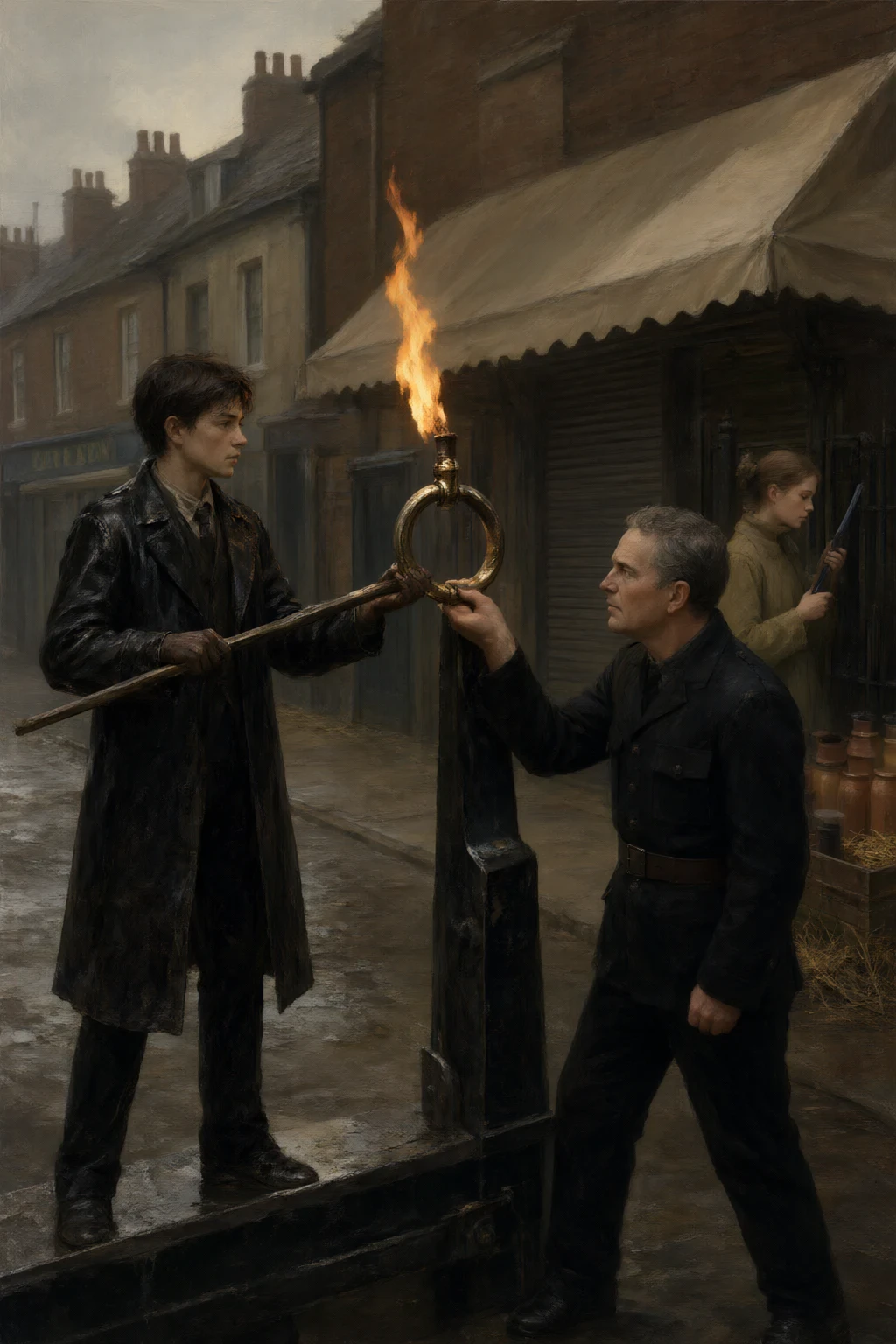
The ring on the ninth lamp is empty and the flame is standing and the quarter hour has begun, and there is no man in Ninehook at six bells on the ninth of February who is more nearly the man who gets there than a constable with a notebook, and Pyle had been in the passage between the two chandlers with a sight of the seaward side of the standard for the better part of a minute before he went out into it. At six bells and eleven minutes he came down Wharf Street and the wind was at his back and there were forty people at the corner and the ninth lamp was burning a quarter of what it should and a boy was at the base of the standard on the seaward side with a taper-pole held flat in his right hand. Pyle stopped. The boy was on the far side, where the wind is, and the ninth lamp is on the near side, and the halo of the ninth lamp is nine feet across and it does not reach the far side of an iron standard. “That your round, boy?” “Cliff round, constable. Forty-one down, forty-two to the store. Six bells, the round is a quarter behind.” “Nine hook of Wharf Street. Second lamplighter?” “Fourth, constable.”
The boy is sixteen and his name is Wren Alsop and he has a scorched left thumb from a taper that blew back off the sea in November and the skin of it is white and tight, and he keeps the taper-pole in his right hand because of it, and he has never told anybody at the glass yard or the office or the cliff round why. The lamp on the ninth lamp was standing. That is the word this office uses and it is not a figure of speech. The flame in the ninth lamp came off the wick and stood up in the chimney and stayed there, the same height, the same size, not leaning, not guttering, and the light it threw was on the near side of the standard and on the wet cobbles of the corner and nowhere else, and it had nothing behind it. Pyle looked at it. Then he looked at his own watch, which is a good watch and keeps the best time in Ninehook, and then at the ring, and the ring was empty, and then at the corner, and the corner was full of people at six bells on a Tuesday in February, and there was no man in the ring anywhere on the corner of Wharf Street. He went to the ring and put two fingers in the hollow and it was cold. Six bells and fourteen minutes. Then he went up the corner into the mouth of a passage between a chandler’s and a chandler’s, and got a sight of the seaward side of the standard, and there was a boy there with a taper-pole in his right hand and his left hand in the hollow of the ring.
The boy was not holding the ring. The boy had his left hand in it in the way a person puts a hand on a thing when the thing is the only thing within reach and the wind is on the other side. Pyle wrote in the notebook: present, a lamplighter’s boy, of the cliff round, left hand in the ring at the standard. He did not write the name, because he had not asked it, because a constable does not ask a lamplighter’s boy his name at six bells on a Tuesday. Old Perrin Oll had walked the ring ward for forty-one years and had given it up in the autumn and could not remember the number of it. He went out most evenings. That is not an illness and it is not a habit; it is the fact that a man who has walked two hundred yards of wall at the hour of lighting for forty-one years has a body that expects to be on the wall at the hour of lighting, and there is nothing to be done with a body of that kind except to put it on the wall. He is seventy-eight. He has a bad left shoulder from a hawser and a hand that has closed around a taper-pole grip and stayed closed, and nobody can see that who is not close to it, and the constable was not close to it, and the clerk was not close to it, and the boy was not close to it. He was at the corner at six bells and four minutes, which is the same as six bells and four minutes, and he had come from the harbour office, and the state of the sea was a running swell from the south-west with spray on the point, and he gave the state of the sea to a man who had not asked for it. The ninth lamp was standing.
He had seen it stand twice in his life, in 1889 and in 1897, and both times he had been the man whose hand was in the ring, and both times he had been the reason, and he had never in thirty-one years told anybody that he had been the reason, and he had made a sentence about it in 1889 which he has been working on ever since and which is one clause short. He put his right hand in the hollow. The brass was cold. It was colder than the iron of the standard, which is the coldest thing on that corner in a westerly, and his hand went to it the way a hand goes to a thing it has gone to four million times. Six bells and eight minutes. In 1897 the light came back to his hand at the ninth lamp and he was forty-nine and he put it out with his own taper within the quarter hour, and the corner was cleared, and nobody wrote anything, and the ninth lamp was dark for a fortnight, and in the fourteen days he walked the wall every evening at the hour and did not know why, and after the fourteen days the light came back to the ring on its own and not to him, and he has never told that to anybody either.
What he remembers of the ninth of February is not the lamp. It is that his hand was on the ring and the ring was cold at six bells and eight minutes and that a boy came round the standard at some point after that and stood on the other side of it, and that the boy was there long enough for Perrin Oll to think, in his own way, which is slowly and about something else, that the wind had come round. The light did not come back to his hand. It went to the other side of the ring, and the right side of the ring went cold in his hand, and he took his hand out of it, and he has said since that this is the third time and the first two were his own fault and this one was not, and he has not said whose it was.
Aubry Vell saw the ninth lamp stand from the yard gate with a crate of straw at her feet and a blowpipe in her hand, and she did not go out, because a girl of thirteen who goes out onto a corner in a half gale at six bells on a Tuesday is a girl who has been sent out onto a corner. There are two journeymen in the yard with her and neither of them will stand at a gate in this wind, and the best hand at the pipe in the yard will stand at a gate for two hours. The crate is at her feet with the straw tied down in four places and the chimney in it standing up out of the straw at an angle, and the run of the glass is even and the wall is even and the joint is clean, and it is a good chimney and it is four days cold and it wants a lull and the yard has not had a lull since four bells. The ninth lamp is a hundred and forty feet from the yard gate at an angle, and from the gate the flame in the chimney is a small hard orange point in a large dark frame, and the halo in the salt air is a cone, and above the cone there is nothing.
She is not looking at the ninth lamp. That is the thing about her and it is the only thing about her that is difficult to explain to an office. She is looking at the standard, because a standard with no glass on it is a piece of iron in the wind with a flame on the top of it, and the setting of a chimney is done from underneath with a left hand and a hook and a lump of wet newspaper, and she is watching the standard and not the lamp, and what she sees when the flame moves is that the flame moves to a place on the standard where a glass would have to be. She watched it stand. She was waiting for a lull to set the chimney, and there had been no lull, and a lull at that point comes in about four minutes and goes in about one, and she times a lull by holding her breath because the wind on the point makes breathing audible, and she had been holding her breath and counting since six bells and two minutes. The flame did not move for a long time and then it moved.
It went to the left of the standard. It did not go up and it did not go down. It went to the left of the standard, where the ring is, and the left of the ring is the side the wind is on, and it stood on the left of the ring with the rest of the chimney going dark, and the light on the corner of Wharf Street came back up to a half and stayed at a half. Aubry Vell put the blowpipe down in the straw, which she should not have done and which cost her a set of hands for a week, and she watched a lamp on a corner of a street in a town of four hundred and eleven lamps give half its light back. She did not think anything about it. She picked the blowpipe up again and turned a scrap of glass in her hand to see whether the mouth of the chimney had a run in it that she had not seen, and there was not, and she put the glass down and picked up another.
Hettie Rowntree was forty yards from the corner at six bells and fifteen minutes and twenty seconds, in the front room of the Custom House, with volume one open on a deal table, and the double door behind her, and the slate on its ledge inside the door with a stick of chalk on its string. She had the reading ready. She had had it ready since the twenty-second of December, because the minute of the twenty-second of December is two paragraphs long and one of them is hers, and she had known since the ninth of February at breakfast that this would be the next one, and she had not said so to anybody, and she had not sent anybody word, and the constable had come at six bells and eleven minutes without being sent by her. She had had an hour and a half to send a boy to the constable and did not, and the reason is on the second paragraph of the minute of the twenty-second of December in a hand that is hers. Sending for the constable is not interfering with an attendance. Sending for the constable is putting a man in a passage and taking eleven minutes off it before it starts, and she knows the figure on the form is not authority and she knows it is the only figure anybody has, and she did not send.
She walked down the quay at ten to six with volume one under her arm in a leather strap, and the quay was full, and a man at a stall called her by a name that is not her name and she did not stop, and at the double door she put the strap over the back of a chair and opened the volume and put her finger on the fourth line of the first leaf, which she had been able to find with her eyes shut in about two seconds for nineteen years. The door is off the quay. It is four feet six inches wide and it has a step down of nine inches and it is the only door on the front of the building and it is not the door the town comes by. The sentence is cut into the lintel and the chalk marks are under the sentence, and she stood with her back to the wall beside it, because the wind is out of the south-west and the door is on the north side of the opening. She read.
The entry for the ninth lamp is the longest in the register. It begins on the first leaf of volume one, in a hand that is not the hand of 1841, and it runs to the leaf of the ninth of October 1889, and between the two there are forty names, and the crossed-out parts are read by clerks as standing, and there is a struck clause in the conditions of the first leaf that has been struck since 1853, and it is read out. The forty names are read at the rate a name is read and not at the rate a name is spoken on a quiet day in a warm room. There is a date against every one and the dates run from the fourteenth of March 1841 to the ninth of October 1889, and eleven of the forty are crossed through, and the crossing-out is part of the standing, and in the margin of the twelfth the same man is written twice because a clerk made an error in 1871 and corrected it inside a month. The reading is nine minutes and forty seconds long. Hettie Rowntree knows that to the second because she has read this entry, or a part of it, aloud in this office more times than anybody has counted, and the length of a thing you have read four thousand times is the one length you have never had to think about.
She read it out at the door, standing, with the volume in one hand and the other hand on the frame, and she read it exactly as it stands, and she gave the crossed-out parts, and the corner is forty yards down the quay and the wind was taking the sound in irregular pieces and bringing the rest of it. The last leaf of the entry is the ninth of October 1889. Perrin Oll, of the harbour wall, by handing-on of the ring at the standard. Witnessed: the name of the clerk. And the name of the reader. She read the date. She read the hour. She read the term. Then she read the first leaf, from the beginning again, and the term of the first leaf is this, and she had read it in an office to a boy in October with a cold candle on the stand, and she read it now in the open air with the wind on the page. Let to the reader of this entry, and to no other, for so long as he be the man who is not already holding.
They were all read to. That is the finding of the ninth of February, and it is the whole of the finding, and it took four people to establish it and none of the four will agree on the order of it. Pyle was at the ring. Perrin was at the ring. Hettie was at the door, and the sound of her voice came down the quay in pieces for the length of the entry, and Aubry Vell heard all of it from the yard gate and would have said under oath that she heard every word of the conditions. The boy was on the seaward side of the standard with a taper-pole in his right hand and his left hand in the hollow, and he was not at the door, and he was forty yards from the door with an iron standard in the way, and the wind was on his side, and the halo of the ninth lamp is nine feet across and it did not reach him. He heard the first of it and then the wind took the rest of it, and what came down the quay in pieces was a woman’s voice reading a list of men’s names, and he counted two of them because that is what he does, and he counted them in order, and the forty-first is a name he knows because he has counted it before, and after that the voice came out of the wind high and clear and he did not know what it was saying and he did not stop holding the taper-pole flat in his right hand to keep it out of the water.
The relief was made at six bells and twenty-five minutes, and the constable’s watch is the instrument of record and it is a good watch and it keeps the best time in Ninehook, and by it the light stood upon the standard for eleven minutes, from six bells and fourteen minutes, and returned to the ring in the hand of the boy. Eleven minutes. Pyle said the number to himself and did not write it, because the form has eleven minutes printed at the foot of it and a number that agrees with the print is a number that a man will not write down, because he will think that he has read it off the print, and it is the only figure in this business that a constable has ever had reason not to write down. He took the page out of the notebook after that and folded it in three and put it in his coat on the left, where a man puts a thing he means to use, and he did not enter the report, and the office received no report from the night patrol on the ninth of February. He has the eleven reports. They are in a box at the back of a drawer in the lamp office and the box is not locked, and he has read all eleven and has compared them, and the comparison closed.
The eleven reports are the same document. Same nine lines, same order, same words for the weather, and the eleventh of them was written in the November before last and says that the light was not given, and says the same thing about the glass, and the fifth of them has the word apparently in it, which the sixth does not, and he put the word in himself and cannot account for it. Eleven attendances, and the interval is not in any of them, because in eleven attendances the interval was the thing a man stops writing down, and the reason a man stops writing it down is that the figure is on the form and every clerk and every constable in this town has read the figure off the form at some point in their lives without noticing that they have done it. He had written eleven reports on this corner and this is what the first two of them say, and he can recite them, and the word eleven is not in either. Attended the ninth lamp, Wharf Street corner, at the hour of lighting. Found the lamp burning. Found two men in the ring, names not obtained. The light was not given. Lamp put out. Office notified. Ring left in the standard.
Perrin Oll was asked, twice, in the office, in the fortnight, and he gave the same answer both times, and neither answer contained a number. The first answer was: the corner to the harbour office, and the harbour office to the second standard, and the second standard to the ninth, and the sea was a running swell from the south-west with spray on the point, and it was at the hour. He was asked how long it had been. “It is the length of that,” said Old Perrin Oll, “and you want it in minutes, and I have never had it in minutes, and I have the tide in my head instead, and you will have to do with the tide.” The second answer was the same, with the tide. He was asked, twice, whether the flame had ever come back to his hand. “Eighteen eighty-nine,” he said, “and eighteen ninety-seven, and this one. Three times. I have been at that ring four million times and the light has come back to it three and I was at it every time.” He was asked, twice, who else had been at the ring. He gave the state of the sea.
Aubry Vell was asked, once, and she answered before the question was finished, which is what she does. “That was a hard one to see and it is not a hard one to do,” she said. “I was holding my breath. You do not want my number. I began at the boy, because I was watching the boy and not the lamp, and he came round that standard before your constable was round the chandler, and he came round it and put his left hand on the ring and stayed there, and the light went to his side of it. So my beginning is before yours and it is not the same event as yours, and there is no use putting them in one column.” She was asked to give the number. “It is four minutes longer than yours,” said Aubry Vell, “and I have a mouth that can be measured, and that is all I have got, and I will not have it written down, because when it is written down it is an attendance, and it is not an attendance, it is a glass man on a gate counting her breath while a lamp in a street does what it likes.”
The office was shut on the tenth of February and stayed shut a fortnight. The fire was not let out this time, because the minute of the twenty-second of December says the register is not to be carried out of the building, so the fire was kept in and the room was worked in at the top with the coats on, and the register lay open on the desk from the tenth to the twenty-third, in the cold part, and a clerk could not hold a pen in that part of the room after four o’clock in the afternoon. The corner was dark for the fourteen days. The men of Wharf Street put a board across the front of the standard on the third day and went round it, and one hundred and forty people a day went round it, and not one of them wrote anything down, and the office was shut. The cliff path was not affected. Two hundred and eleven standards, unlet, lit by hand at the hour by a lamplighter’s boy with a taper-pole and a box of matches, and neither the taper nor the box is a lease, and the quarter hour runs every night of the winter at two hundred and eleven places and has never once been exceeded, and the round went on through the fortnight exactly as it goes on through everything, and the boy was at the top of it on the ninth of February and at the bottom of it on the twenty-third and did not come to the office in between, because there was nothing at the office for him to come to.
They came in one at a time, because they were all working, and because an office will not have four people in it. The constable came on the eleventh and stood in the room and did not sit down, and Hettie Rowntree read him the entry of the first leaf, and the reading is the office’s practice after the twenty-second of December, and he wrote nothing, and he was there eleven minutes and went. Perrin Oll came on the twelfth and could not read and did not pretend to, and Hettie Rowntree read the whole of the entry to him from the first leaf to the last, and the marginal entry was made in the clerk’s hand at his direction and marked as made at his direction, and that is the second time that line has been used since the twenty-eighth of December. Aubry Vell came on the fifteenth and did not want to come and came, and stood at the end of the desk with a piece of glass in her hand and turned it over while the entry was read, and when it was read she said, “That is a lamp on a corner and I have a chimney for it in straw and it is four days cold and the wind has not dropped, and if the glass goes on that standard another week I will be the man who let it go, and there is nobody to write it down against.”
The four of them did not agree and the office did not press them, and the office is the office. The finding is this. Four persons were read to. The light was given to one of them. Which one is not in any attendance, because the attendance is the slate, and the slate is at the double door, and the door records the persons who came within the hearing of the door, and the person to whom the light was given was forty yards from the door on the seaward side of an iron standard with the wind on his side and his left hand in the ring. Hettie Rowntree wrote that down in the working sheet, in these words: the light went to the reader, and the reader was the reader at the ring. Bede Sallow, who had come in from the letting on the twentieth and had not been in the room on the ninth of February at all, and who was the clerk who had asked a lamp a question in December and had not slept on the night of reading the answer, read the working sheet and said one thing about it. “Then the entry wants a name and the attendance gives you four and the light took one, and you have one line.” “I have one line.” “You will have to leave it.” “I will not leave it,” said Hettie Rowntree.
On the eighteenth of February, in the shut office, with the fire in and the register open on the desk, the constable of the night patrol and Bede Sallow and Hettie Rowntree attempted to put the ninth of February in order on a sheet of ruled paper, and the sheet is in the file, and it is the only sheet in the file with figures in it that were not copied out of the register. They began with beginnings, because that is what a clerk does, and there are four. Perrin Oll’s right hand went into the hollow of the ring of the ninth lamp, and the brass was cold. Six bells and eight minutes, and he is the only one of the four who can give a time to the second, and he gives it in a round and not in a clock, and the round is the corner to the harbour office, the harbour office to the second standard, the second standard to the ninth, and no clerk can convert it. Aubry Vell’s boy came round the seaward side of the standard and put his left hand in the ring, which is before the constable came round the chandler, which is before six bells and fourteen minutes, and which is not in any of the four accounts as a beginning of anything.
The constable put two fingers in the hollow of the ring and the ring was cold. Six bells and fourteen minutes. The first figure on the sheet, and the only figure on it that is a measurement. Hettie Rowntree began to read. Six bells and fifteen minutes and twenty seconds, from the fourth line of the first leaf, and the length of it is nine minutes and forty seconds, and it is the one figure on the sheet that is not a figure of the interval. There is one end. The light was given to the reader at the ring at six bells and twenty-five minutes, and that is the constable’s watch, and he would give it as a watch and not as a bell, and the difference between a bell and a watch at the end of February in this town is about a second and a half. They had the sheet. It ran from six bells and two minutes to six bells and eight minutes to six bells and fourteen minutes to six bells and fifteen minutes and twenty seconds, and it ended at six bells and twenty-five minutes, and there was no version of it on which the four beginnings were the same beginning, and the difference between the first and the last of them is thirteen minutes and twenty seconds, which is more than the whole of the interval. That can be true of four honest people and is not a thing an office can enter on a form. “You have eleven minutes on the sheet,” said Bede Sallow. “You have had eleven minutes since six bells and fourteen minutes. It is the figure on the form.” “It is the figure on the form because it is the figure on the form,” said Iven Pyle. “I have a watch and I did not stop it and it is eleven. I have written it nowhere. Write it nowhere.” “The line is not to be left blank.”
“The line is not to be left blank,” said the constable, “and the report is the constable’s and the report is not written, and that is the whole of what I have come to say, and I will not say the rest of it here, because the rest of it is that I do not know when the eleven minutes began, and a man who does not know when a thing began does not write the report.” And after he had gone, the clerk asked the other clerk for the cliff-path book, because the boy on the seaward side of the standard was a boy of the cliff round, and the cliff round is the one round in this town that is written down. The ninth of February is on the leaf for the second week of the month. Two hundred and eleven standards, the hour, the state of the glass, and the name of the man who walked it. One name, and it is the name of the ninth lamplighter of the cliff round, and beside it, in the state of the glass column, in the boy’s own hand, is the state of the glass of every standard he touched, and the forty-first is a tick.
And the two hundred and eleven standards of the cliff path are in the register as unlet, with the eleventh of October 1861 on all of them, and an unlet lamp has no lease and no holder and no entry, and a boy who has read the register is not in it, and a boy who has read the entry of the ninth lamp is not in it either, and the register has no column for a person who was on the seaward side of a standard with his left hand in a ring at six bells on a Tuesday in February, and there was no proposal to make one, and nobody in that room on the eighteenth of February made one.
The register was opened on the twenty-third of February at nine in the morning and the relief was entered, and the entry is this, and the hand is Hettie Rowntree’s, and the register does not adjudicate and did not notice. Ninth lamp. Wharf Street corner. Double occupancy, the thirteenth. Attended by the constable of the night patrol. The light stood upon the standard. The reading was had at the double door from the volume, in the hearing of all persons present, which is the minute of the twenty-second of December. Ring set in the standard. Office closed the fourteenth day. Lamp dark from the ninth to the twenty-third of February inclusive. The name of the holder at the relief: four persons were read to, and the form has one line, and the line is filled. It is filled with three names, because the slate is at the double door and the slate takes the names of the persons who came within the hearing of the door, and the slate on the ninth of February had three lines on it in the morning of the tenth, in a hand that is ink-blue, and the three lines read: I. Pyle, constable. P. Oll, of the harbour wall. A. Vell, of the glass yard. There is no fourth line. There is a fourth person, and the fourth person is the clerk, and a clerk is not on her own slate, and no rule has ever been made about it, and there could not be, because a slate is a list of the people who were in the hearing of a door and the clerk was the door.
That is what the name line is, and that is all it is, and it is in the register on the twenty-third of February at nine in the morning, and the register does not adjudicate. And then, below the name, the figure. The foot of the form carries a printed rule and the rule carries a figure, and the figure is eleven minutes, and the minute of the twenty-second of December says the figure is not authority and is not to be entered from the print, and that a clerk who has no attendance from which to enter a figure shall enter what she has. There was no attendance of the interval. There were four answers and no two of them were of the same thing: a constable’s watch, a round, a held breath, and a leaf read aloud. The office entered what it had. It had the reading. The line at the foot of the form was already full. The last entry of the volume stood on it in the hand of the man who recopied the register in 1853, a word and not a name, the word this city uses for the next person, and there are four pages in this register where that word is written out in full and every one of the four is in the press under glass, and there is no column beneath it, and no column was made, and a clerk writes where there is room. So the figure is at the foot of the page, under the last entry, on the twenty-third of February, in the hand of Hettie Rowntree. Nine minutes and forty seconds.