There have been four discharges in this century and the roll keeps them in a column of their own, which is not a column of covenants and is not a column of money, and which has four lines in it and no headings and no rule above it, and the four lines are these. Item. The eleventh of March, 1804, in the seventh stand, the holder of the seventh stand said, I take less, and a covenant of the year 1798 was discharged. Item. The second of September, 1841, in the second stand, the holder of the second stand said, I take less, and a covenant of the year 1839 was discharged. Item. The nineteenth of October, 1978, in the fourth stand, the holder of the fourth stand said, I take less, and a covenant of the ninth of March, 1873 was discharged. And the third of those four is the one the fourth stand’s holder entered in a fair hand with no witness against it, and which a clerk in the fourth week of October, 1895, established against the copy by the glass of the fourth stand, and which is the reason the roll now keeps the column at all, because before October it did not keep it, and the four lines are the column, and the column is dated to the last of them.
A covenant in Coldhay is discharged by performance, or by expiry, or by the lender accepting less. The first two are ordinary and happen weekly and are entered in the ordinary way by the ordinary hand, and a man who has a covenant performed against him thinks nothing of it and is right to. The third requires the lender to say so out loud, in front of a witness, in the lender’s own house, and it is the single most dangerous act available to a person in Coldhay, and the reason is not the law and is arithmetic: a lender who says I take less cannot unsay it, and the covenant it discharges cannot be brought back, and the lender has given away the only thing the lender had, which was a claim, and a claim is worth nothing and is worth everything, and the difference between the two is four words spoken in a room with a roof on it.
The holder of the sixth stand instructed the clerk on the ninth of December, in the market, in the open, where nothing binds anybody, and the instruction was one sentence and was delivered in the flat voice of a man reading out a weight. “The covenant of the sixth of November, 1886 is to be discharged, and I am the lender, and the discharge is mine to make and I will make it in my own house, and I want it in the roll before the summer.” The covenant of the sixth of November, 1886 stands thus in the roll of the first stand. In the first stand, the holder of the first stand gave a term, which was, that the byre strip and the hard ground above it, being the first stand’s holding in the first stand, should be the sixth stand’s for the term of one year. The holder of the first stand was asked to complete it and did not. It is the third line of the form. Every open covenant in Coldhay has those same three sentences at the end of it, and there are eleven of them standing at this date, and nine of them are nine years old or more. “Before the summer,” said Ivo Colm. “Before the summer.”
“That is between the fourth of June and the twenty-fourth of June. It cannot be the fourth, because the fourth is a market day, and a market has no roof, and the awnings are wool. So it is one of twenty days, and you will tell me which, and I will tell you that the town will spend four months on it, and that you have not asked the town, and that the town cannot be asked, and that this is the fourth discharge in a hundred years and there is no practice and there is no form and there is only the ten rules on a sheet of 1871.” “Then the town will spend four months on it,” said the holder of the sixth stand. He was sixty-nine years old in the December and had held the sixth stand for twenty-three years, and in the row he is called the sixth, and has been since 1861, when the stand changed hands and the name of the last man had stood in the register for two different men in nine years, and the row settled on a number and has never gone back.
The charge is six pounds a year against the byre strip and the hard ground, and it has been carried since 1886, and the register carried it in 1895 at fifty-four pounds, and it stood at sixty pounds on the first of June, 1896, and it is the only money in the register of Coldhay that has never once been asked for by anybody. That is the part that has to be understood before anything else, and it is the part nobody in Coldhay can get past for eleven weeks. A charge in the register is a claim. It can be sued on, sold, mortgaged, and carried into a sale of the strip, and a man whose strip is charged cannot sell the strip, and the holder of the first stand has not been able to sell the byre strip and the hard ground since 1886, and the byre strip is the best building ground on that side of the wall and the quarry company has offered for it twice. The lender has never asked for the money. That is not generosity. A lender who sues on an open covenant gets the strip, and an open covenant is one that was never completed, and a covenant that was never completed has no date of performance and no term running and no end, and a court in this county will not make one out of it, and everybody in the row knows it, and it is the reason a sum of sixty pounds has sat on a strip for ten years with nobody collecting it. So the sixth stand has had a claim it could not enforce for ten years, and the first stand has had a charge it could not lift, and between the two of them they have arrived, by arithmetic alone, at the only door in Coldhay that opens from the wrong side.
The row is seven houses in a line with their backs to the town and their fronts to the nine-foot wall, and there is no corridor in any of them and no spare room, and the seven are the only houses in Coldhay that can be called as a house. The calling was held on the fourteenth of January, 1896, in the kitchen of the first stand, and it was the first calling in Coldhay since 1831, and the town turned out to a house, which on a Monday is not done, and the wall was between the row and the market and the market could hear nothing and saw nothing, and the seven came. The rule of a calling is that all seven must come, and each must answer for their own holdings, and one may not answer for another, on any grounds, including love. The holder of the third stand offered, before the clerk had the book open, to answer for the sixth stand, which had a cough and a bad night, and the reason he gave was that he had been coming through that house’s door for thirty-one years and could say what was in it. The clerk put the rule to him exactly as the rule has it, out loud, in a kitchen, with a witness in the room, and he knew what he was doing and he did it anyway, and there were five people in that kitchen and every one of them heard the question and every one of them heard what it cost. “No,” said the holder of the sixth stand.
The book of the calling is a single sheet and a column of answers, and it is kept with the roll and not in the press, in a wooden box on the shelf under the window, and Ivo Colm read the answers in the order of the houses, and the first answer is the first answer anybody has given in a calling in sixty-five years. First stand. The holder of the first stand: nine acres and the byre strip and the hard ground, and a charge of six pounds the year standing since the sixth of November, 1886, and the byre strip not to be conveyed. Second stand. The holder of the second stand: four acres, and the north end. Third stand. The holder of the third stand: nine acres, and no charge, the charge of 1864 having been struck in the register on the fourteenth of January, 1896, and one pound the year for a room, which is a licence. And then the fourth stand, and the fifth, and the sixth, and the seventh, and the answers are all in the same form, and the row listened to its own arithmetic being read out, and nobody in the kitchen said anything at all, and the fire in the first stand was the only fire lit in that house in ten years and it was lit and it was not let out, and Brannic Sallow fed it while the clerk read, because a man can do two things at once in his own house and cannot do three.
The first month was the lender’s, and the lender’s month produced nineteen findings and eighteen of them were negative, and the nineteenth is the one the town will remember. Finding one: the words must be said under a roof, in the lender’s own house, in front of a witness. Findings two to nine fix the three terms of that sentence and expand them. The witness must be awake, of an age to know what is being said, and not one of the two parties. The lender’s own house is the sixth stand, because a house in Coldhay is a house with a hearth in it, and the sixth stand has one hearth, and the hearth is the thing that makes the house, and the sixth stand has no corridor and no spare room, so the room with the hearth is the room where the fire is, and the fire is the only fire in that house. Finding ten: the words must be said out loud. A writing is not a saying, and a nod is not a saying, and a man who writes I take less on a slip of paper and hands it across a table has not discharged anything, and the roll of 1804 and the roll of 1841 and the roll of 1978 all say spoken and none of them says written.
Finding eleven: the lender may not be prompted. A word supplied by another person is a word spoken by that other person, under that other person’s roof, and binds that other person’s holding there for a year, and the third stand’s nine acres are not what anybody in this business came to bind. Finding twelve: the lender may not sit down, because a man who sits at a table puts his hands on the table, and the table is where the witness’s hands are, and an account of hands with two sets in it is an account of nothing. The lender may not hold anything, for the same reason. The lender may not drink. The lender may not begin with anything, including his own name, including the day of the week, including the word covenant, because everything he says before the four words is a term of something, and there is nothing on that table for a term to attach to. The lender may not say the four words twice, because a first saying discharges and a second saying is a speech. And the nineteenth finding, which is the finding the town will remember, is this: the lender may not rehearse.
The rehearsal question occupied eleven days and nobody in Coldhay had ever asked it before, because nobody in Coldhay had ever wanted to do this before. A word spoken under a roof with a witness is a covenant, and it binds the speaker’s holdings in that house for one year from the day, and it does not care in the slightest whether the speaker meant to make one. So if the holder of the sixth stand stands in his own kitchen and says, out loud, in front of a witness, I take less, then the covenant of 1886 is discharged on that day, in those words, and it does not matter in the slightest that it was a practice, and it does not matter that the witness was his brother, and it does not matter that he said it to a lamp, because a lamp is not a witness and a brother is, and a man who says a thing in his own house to a person who is awake and is not the other party has discharged a covenant.
The lender has four words. He has not said them. He has one of them ready most of the time, in the sense that a man of sixty-nine who has been thinking about four words for ten years has them ready, and a man with four words ready in a house with a hearth in it is in the most dangerous position any person in Coldhay can be in. “If I practise it on a Monday,” he said to the clerk, in the row, in the open, “in the open, where it is worth nothing.” “It is worth nothing in the open. It is worth nothing in the market, in the yard, at the quarry, at the wall, and on the grass. It is worth nothing in any of the forty-one houses in this town that are not the sixth, and it is worth something in the sixth, and the sixth has a hearth, and you are the holder of the sixth.” “Then I shall not practise it.” “You shall not practise it,” said Ivo Colm, “and you will understand that there is no form of the words, and that if you want to know whether you will say them correctly there is no man in Coldhay who can tell you, and that you will find out on the day, in the room, with the witness there, and that this is the arrangement and it is the whole of the arrangement.”
The second month was the borrower’s, and it was the month in which the town discovered what it was actually doing. The holder of the first stand is Brannic Sallow. He has held the first stand for forty-one years and has outlived four covenants and has been asked the same question seven times in ten years and has answered never, and a man who is asked seven times and answers never is not being careful, and is holding a covenant open by refusing to complete it, and the open covenant has been accruing at six pounds a year since 1886, and the fire in that house has not been let out since the year the covenant was made, and it is in the census photograph and the district survey photograph and it is in neither, because nobody has ever asked about the fire, because everybody can see the fire. The second month’s finding is the shortest and the coldest of the nineteen and it is as follows: the borrower is not required.
Rule seven requires the lender to say so out loud, in front of a witness, in the lender’s own house. It does not require the borrower to be there, and it does not require the borrower to be awake, and it does not require the borrower to say anything, and it does not require the borrower to want it. The covenant of 1886 is the lender’s to discharge and the discharge is the lender’s gift, and a gift needs a giver and a roof and a witness and nothing else at all. Which means that the man who has been carrying sixty pounds on a strip he cannot sell for ten years is not to be asked for anything, and is not to be thanked for anything, and is not to be present for anything, and the four months of examining this act are four months in which the whole apparatus of Coldhay is turned on a man who is not in it. The town did not like that and said so, in the row, on the grass, in the open, over eleven days. “He should be there,” said the holder of the second stand. “He cannot be there.” “He is the man it is about.” “He is the man it is about and the law does not want him in the room, and if he is in the room and awake, then whatever anybody says to him is a term of something, and if he is in the room and asleep, then nothing said to him is a covenant and nothing he does is heard by the house, and the safest man in Coldhay tonight is a sleeping man in a kitchen.”
The town asked Brannic Sallow what he wanted, on the nineteenth of February, in the first stand, and he was asked by Halla Dree, who asked it in the exact words she was asked and waited for the exact answer, and the row knew about it before the end of the day because the row knows everything in eleven feet of grass inside a week. “What do you want,” said Halla Dree. Brannic Sallow looked at the fire for a while. “I want to be asked,” he said. “Once more. In front of a witness. And I want to be able to say the words.” The words of a completion. To say them is to complete the covenant of 1886, which is to take the byre strip and the hard ground for a year, which is to have no charge on them at the end of the year, which is to have the strip for nothing at all, which is the whole of what a lender wants and not one thing that a borrower wants. The holder of the sixth stand was asked whether he would put the old question one more time, in his own house, in front of a witness, and he was asked it by the clerk and it took nine minutes and the answer was no.
The reason was given in the roll room, in the cold, with the four lines of 1902 on the desk in front of them. A question asked is a term given under a covenant, and a term given under a covenant attaches to the covenant, and the covenant of 1886 is open, and a term given under an open covenant is a term given under an accrual, and the accrual would begin again on the day it was asked, at six pounds the year, and the discharge could not then be made in the same house in the same year without the two acts being confused, and the whole of the fourth discharge in a century would be a paragraph instead of four words. “That is not an answer,” said Brannic Sallow. And then nothing, for a very long time, and the fire was fed, and the four words were not rehearsed, and the summer came.
The third month was the witness’s, and the witness is the holder of the third stand, and he is the only one of the seven who can read, and the town chose him in eleven minutes and without a vote, and the choosing was done on the ground that a witness is a person awake, of an age to know what is being said, and not one of the two parties, and that the fourth of those three things is a matter of law and the first two are matters of the household, and that the third stand’s holder has a household in which nobody has slept in the room in front of the fire for ten years, which was tested, and the fifth stand’s holder has a household in which a child sleeps four nights a week, which disqualified the fifth in the plainest possible way, because a house with a sleeper in it is a house in which nothing is certain, and the sixth and the first are parties, and the second is a house with four covenants in it in one year and a chair nobody sits in, and the seventh cannot read, and the fourth was asked and said that he did not wish to. The third stand’s holder is Tam Kelder. He is forty-seven. He narrates a covenant as it is written, word by word, and cannot be stopped without becoming unpleasant, and the third month’s first difficulty was this. In the second week of May, in the sixth stand’s kitchen, the holder of the sixth stand was reciting the covenant of 1886. He was not saying the four words. He was saying the covenant, the old one, from memory, out loud, in a low voice, standing, with his hands at his sides, to himself, because he had done it every day of the four months as a way of being certain of the four words, and there were two people in that kitchen.
Ivo Colm stopped him. It took a minute and a half and it was unpleasant, and it is the only recorded instance in the boundary rolls of a clerk intervening in a room that was not a reading, and it went in as a memorandum, and the memorandum says that the reciting of a covenant under a roof is a performing of it, and a performing of a covenant is a making of it, and a man who recites a covenant in his own house to two people who are awake has made a covenant, and that the two people in the kitchen were the witness and the clerk, and that the clerk is a person who is awake and is not a party, and that the witness is a person who is awake and is not a party, and that therefore the covenant of 1886 was recited in the sixth stand on the ninth of May, 1896, by a man who is the lender, in his own house, in front of two witnesses, and that it bound the sixth stand for a year from the ninth of May, 1896. Which it did, and which Ivo Colm entered in the register on the tenth, in the same column, under the same rule, without comment.
And that is where the four months turned over, and the turn was not dramatic and nobody saw it happen, and it was this: a lender who recites the covenant of 1886 in his own house has not discharged it, because the covenant of 1886 is the covenant, and the four words are the discharge, and a recitation is not a discharge, and a recitation binds the sixth stand for a year, which is a real cost, and the cost is six pounds a year against the sixth stand’s own holding, entered in the register on the tenth of May, 1896, and carried since. So by the middle of May there were two charges: one of sixty pounds on the first stand, which the lender wanted lifted, and one of six pounds on the sixth, which the lender had put on himself by being unable to stop his mouth, and the second one is a covenant of the ninth of May, 1896 which runs a year and is discharged by expiry on the ninth of May, 1897, and it is a thing the town will still be able to read in forty years, and it is the only entry in the history of Coldhay that was made by a man reciting a covenant to himself in his own kitchen.
The fourth month was the man who was asleep, and the man who was asleep was the holder of the first stand, and the whole of the fourth month came out of nine minutes on a Tuesday. They had met in the sixth stand’s kitchen on the twentieth of May, at eight in the evening, the three of them and the clerk, to settle the wording, which is to say to establish that there is no wording, and the holder of the first stand was in the room because the holder of the first stand is in that room four nights a week and that room is the only warm room in the row and he goes where it is warm. At twenty past eight he was asleep in the chair by the fire. Not dozing. Asleep, with his head forward and his hands on his knees, and the fire in the room and four men in the room, and Ivo Colm wrote in his memorandum, exactly as the memorandum stands, that the holder of the first stand was observed to be asleep at the hour of twenty minutes past eight and continued to be asleep, and that the hour of nine minutes was taken from the clock on the wall of the sixth stand, and that the clock was eleven minutes slow against the clock at the chapel, and that the finding does not depend on the nine.
Then the question, which the clerk put in the row on the twenty-second in the open, where it is worth nothing to say, and which he put to the town because it was not a question for a house. Does the borrower have to be awake? It was examined for nine days in every room in Coldhay that has no hearth in it, and the answer came out of the ten rules on a sheet of 1871 in nineteen minutes, and the answer is no, and the answer is no for a reason that is duller and worse than anybody expected. A sleeper is not a witness. Nothing said to a sleeping person is a covenant, and nothing said by a sleeping person binds anybody, and nothing done in a sleeping house is heard by the house. The borrower is not a witness. The borrower is not a party to the discharge, because a discharge is not made between two people; it is made by one of them, and the one who makes it is the lender, and the making of it requires a lender, a witness, a roof, and four words, and the borrower appears nowhere in the sentence, and the whole of the nineteenth finding of the first month and the whole of the second month come to the same line, which is that the borrower is not in the act. If the lender had said the four words at twenty-one minutes past eight on the twentieth of May, with the borrower asleep in the chair, the covenant of 1886 would have been discharged, soundly, in law, and nobody would ever be able to say otherwise, and the boy who was asleep in that chair would not have been asked anything either.
Which left one difficulty, and it was the only real difficulty in the four months, and the town found it on the thirty-first of May and the lender found it on the first of June, and it is this. The lender is going to say four words in a room, and in that room there is going to be a chair, and the chair is the warm chair, and the warm chair is the chair the borrower sits in, and a man who has spent ten years not being able to sell a strip is going to want the borrower in the chair. And if the borrower is in the chair and awake, then the lender has four people in the room: himself, the witness, the clerk, and the borrower, and the borrower is a party to everything else that has ever been said in that house, including the covenant of 1886, and a word addressed to a man in a chair is a word said to a man, and rule two is in play, because consent given under a covenant is a term of that covenant, and the borrower has been asked seven times and has answered never, and a man who is asked an eighth time in a warm room by the man he has refused nine times may say something.
And nobody in Coldhay would be able to tell afterwards whether the thing he said was part of the discharge. So the finding of the fourth month is this: the borrower will not be in the room. It was put to the row as a question, and the row took eleven days over it, and the objections were made by the second stand and by the clerk, and the objections were all good, and the second stand’s objection was the best of them, and it was this: you are deciding that a man may not be in a room in his own row, and the reason you are deciding it is that he might say thank you. And the answer to that was given by the holder of the first stand himself, on the sixth of June, in the open, in eleven feet of grass, to a row that had assembled without being asked, and it was eleven words, and the clerk wrote them down afterwards from memory and checked them against nothing, because there was nothing to check them against, and that is the only entry in this business that rests on a man’s memory of his own mouth. “Then leave me out of it,” said Brannic Sallow.
The night before, four men were in the sixth stand’s kitchen at four in the morning, because the sixth stand’s holder had found that he could not sleep in a house he was going to stand up in, and a girl of nine came in with a shawl over her nightdress and her hands bare, because the fifth stand’s back room is four streets and a wall away and she had been awake since two and had come the whole way without making a sound, which is a thing she does, and which is why nobody in that house ever knows she is there. She asked whether the fire was going to be let out, in a very clear voice, and nobody in that kitchen could answer her, because an answer is a word under a roof and a word is a term of something and there was nothing on that table for a term to attach to, and the four men sat in a warm kitchen and let a child ask a question and said nothing at all, and she went away, and Ivo Colm put it in the margin of the fourth sheet in the smallest hand he has, and it reads: asked by the ninth, at four in the morning, and not answered.
The day was the twenty-fourth of June, and it was not a market day, and the sixth stand was swept on the Monday before, because a house with a hearth in it that is going to have something said in it is swept on the Monday, and this is not a rule and is done in every house in the row. The glass of the sixth stand is a pane of the door and it is not old, and the house has kept it the way every house in Coldhay that has kept a glass for any length of time has kept it, without knowing what it was keeping, which is that whoever goes out with a hand on the latch wipes the pane at the height of their own face with the heel of that hand, once, and not twice, on the way out. The lender came in at four in the afternoon. The witness came in at ten minutes past four and put both hands on the table and left them there, which is how a witness is told from a person who is merely present, and which is the whole of the difference between a witness and a man in a chair.
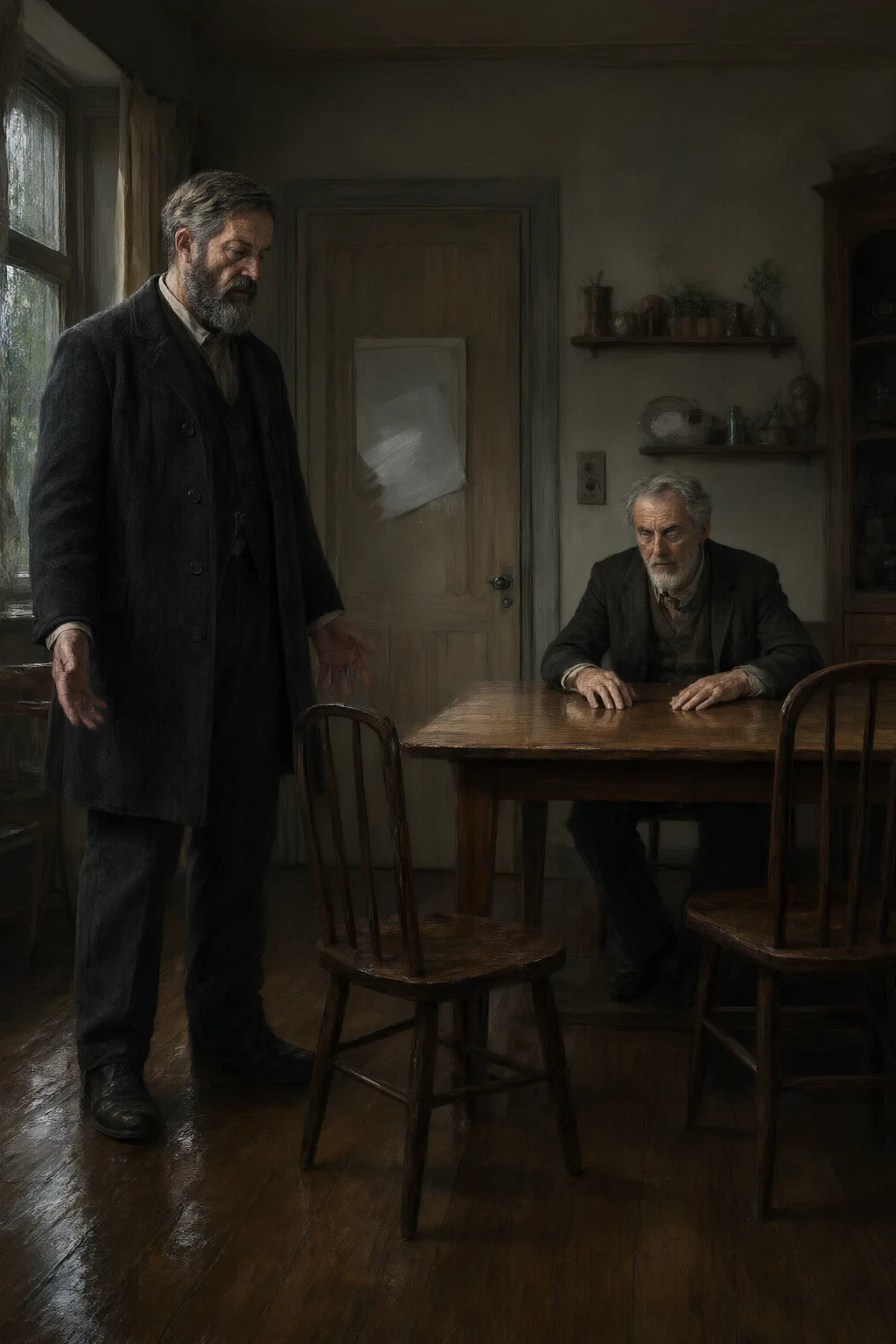
Ivo Colm was in the room. The clerk is a person who is awake and is not one of the two parties, and the town had examined him for a fortnight in the first week of June and had entered a memorandum that the clerk might be present and might not witness, and that if the clerk witnessed then the roll would have a witness and a copy and no hand, and the roll is the copy and the glass is the account, and the account does not need a second witness, it needs a reader. Nobody sat down. There were two chairs in that kitchen and neither of them was used and the fire was in and the weather was wet. The holder of the sixth stand looked at the witness’s hands, and not at the witness’s face, because nineteen findings had established that the witness’s hands were the evidence and the witness’s face was not, and then he said, out loud, in his own house, in front of a witness, with his hands at his sides and nothing in them: I take less. Four words, and then the room, and the clock on the wall of the sixth stand which is eleven minutes slow against the clock at the chapel.
The covenant of the sixth of November, 1886, made in the first stand between the holder of the first stand and the holder of the sixth stand, is discharged. It took four seconds and there is no other account of it and there was no second reading and no repetition and nobody in that room said a word afterwards, and the whole of the four months was spent on four seconds, and the four months were not a preparation for the four seconds. The four months were the work and the four seconds were the signing of the work, and Ivo Colm said that afterwards to the press in the roll room, and wrote it in the margin of the fourth sheet, and the margin is where a clerk puts the things that are true and not law. The glass was read on the twenty-fifth, in the house, in the presence of two holders, and the clerk read and nobody spoke, and the reading took four minutes. The sixth stand’s glass holds what was said in the sixth stand, and what was said in the sixth stand on the twenty-fourth of June, 1896, is four words and the sound of a chair that nobody sat in, and it holds the date in the corner of the pane in the manner of a man marking a gate-post, because the holder of the sixth stand went out onto the step afterwards with a hand on the latch and wiped the pane at the height of his own face, once, and not twice, on the way out, and nobody in that house has ever asked him why he does it. The two holders were the holder of the third stand and the holder of the second stand, and the second stand’s holder stood with her back to the wall, and read the whole of it aloud in her own kitchen afterwards, once, to herself, in the exact words, and then did not do it again.
The entry went in on the twenty-sixth of June, and it is the fourth line of the column of four, and the column has no rule above it and has never had a rule above it. Item. The twenty-fourth day of June, 1896. In the sixth stand, the holder of the sixth stand said, I take less, and the covenant of the sixth of November, 1886 was discharged. Witness, the holder of the third stand, both hands on the table. The glass of the sixth stand has been read and is not silent. The charge of sixty pounds is struck and the byre strip and the hard ground are free to convey. The covenant of the ninth of May, 1896, recited, is not touched and expires on the ninth of May, 1897. And then, because he had read the previous entry exactly and had waited, and because on this occasion the previous entry did finish itself, Ivo Colm wrote a fifth line, which is not in the column of the four and is in the column of the four, and which he entered in the hand of 1896, and which is this. Item. That the discharge of this date was made in one house and recorded in another, and that the hand that made it and the hand that kept it are two hands, and that neither of them is the hand of 1804, or of 1841, or of 1978, and that the glass is the account and the roll is the copy, and that the copy is good, and that the glass has been read, and that on the twenty-fifth day of June, 1896, for the first time in a hundred years, the two agree, and that this is the whole of what a roll is for.
There is nothing for the borrower to do. That was the finding of the second month and it is the last of the findings, and it is the one the row found hardest to put down. A term can be withdrawn by the person it was given to, in the same room, alone, unprompted, and out loud. The covenant of 1886 has no term in it that the borrower ever gave, because the borrower never gave anything, because a covenant is completed by the answer and the holder of the first stand has answered never, seven times, and so there is no consent of his in the covenant and there is nothing for him to withdraw, and a withdrawal asked for, hinted at, or obtained in company is not a withdrawal, and nobody in Coldhay was going to ask him for one, and nobody did. The town waited anyway. It waited the way a town waits, which is not by watching and is by everything else: the market on the Monday, the gates, the wall, the eleven feet of grass, the doors of the seven houses, the sound of a barrow. The byre strip came back into the register on the twenty-ninth, and the first stand’s holder did not sell it, and did not offer it, and did not go to the quarry company, and the quarry company did not come, and the strip is there.
On the fourth of July, at eight in the evening, the holder of the first stand went into the kitchen of the sixth stand, alone, and the door does not lock anywhere in this row, and he was in there twenty minutes, and nobody in the row knows what was said in that room because nothing was said in that room, and he came out and went back up the eleven feet of grass to the first stand and shut his own door, which is the only door in the row that anybody has ever shut. The fire in the first stand was let out on the twenty-second of July, 1896. It was in every census photograph and every district survey photograph and it had not been out since the sixth of November, 1886, and the man who let it out was not Brannic Sallow, and the men who let it out were the holder of the third stand and the holder of the seventh stand, and neither of them gave an order, and the reason there was no order is that there was nothing to order, because a hearth is not a covenant and a fire is not a witness and nobody in Coldhay who understands the ten rules on a sheet of 1871 can say a word about a fire.
It took two hours and eleven minutes. The row came out of seven houses into eleven feet of grass in the rain to watch a fire go out, and the second stand’s holder stood in her apron with her hand on a hearthstone that came out of her pocket and went back in four times in a minute, and the girl from the fifth stand was awake at four that morning, as she is on most mornings, and was told none of it, and the girl of eleven was at the tithe barn on the Monday after and asked who the fire was for, and was told it was for nobody, and did not think that was an answer, and asked again, and was told again that it was for nobody, and turned her hat up a third time. And in the roll room above the tithe barn, on the green-black ink, in the hand of 1896, the book does the last thing that a book in Coldhay can do, which is to say what happened, in the order in which it happened, in the room where it happened, with the house it happened in, and the witness, and the four words.