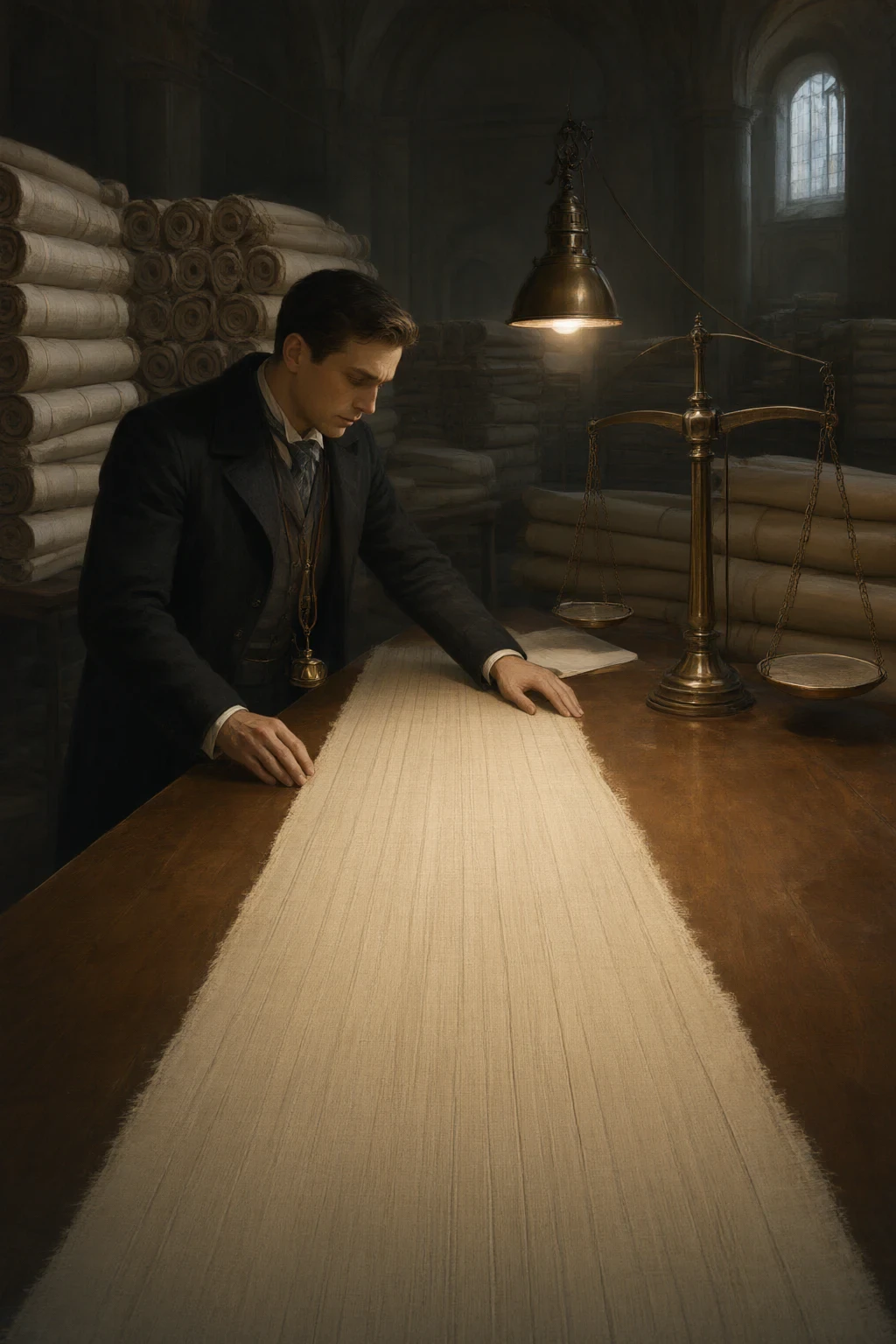
The Assay Room is on the ground floor of the guildhall, on the north side, where the hill turns its cold shoulder to the town. It is the only room in Sparable that anybody opens a window in. It has brass in it and lino and a beam scale with a quarter-ounce poise, and a table eleven feet long with a hundred and forty numbered lines ruled into the top, and four hundred bolts a year go down that table and come off it with one word on them. The word is complete. A complete cloth is a regulation cloth. Regulation cloth is heavy, honest and worth nothing at all. It is the law. It is what the assay says. It is what every shop in Sparable sells, and what the guildhall hangs on its windows, and what the Warp House uses for its light blinds, and what the four hundred bolts a year are for. Corin Slee stamped it four hundred times last year and could not, if you put it to him squarely, name the last one that passed him that he would have called good.
He is thirty-four. He has a brass stamp on a lanyard he has never once put down, not to eat, not to sleep, not to swim, and he has the habit of aligning the two selvedges of a bolt before he will look at it, which takes him about nine seconds on a twelve-yard length and which the whole guildhall has learned to wait out. He gives a number, a tolerance, and a recommendation, in that order, whatever is asked of him. The window was open on the fourth of September, and the air that came in had the dye yards in it, because it had been a south wind for three days, and Wenna Pike’s indigo reaches the guildhall whenever the wind is kind enough to carry it, and Corin’s windows are shut every summer between the first of June and the last of August by a standing order he has never once challenged. He had a hundred and forty lines ruled into the table and a hundred and forty days in front of him, and the first bolt of the four hundred was on the table, and he aligned it.
Order 411 was eleven yards of undyed wool, four feet two inches, for the Warp House, for the light blinds on the eleventh loom, and it came off the second loom on a Tuesday in the fourth week and it looked like every other bolt that has ever been on that table. Weight per yard at the head: twenty-four and one-eighth ounce. The order said twenty-four, with a tolerance of three either way, which is a tolerance of a yard in fifty-one and has been the guild’s tolerance since 1802, and Corin Slee has stamped four hundred bolts a year against that number without once asking where it came from, because a number you do not ask about is a number you can defend. Twenty-four and an eighth, inside, comfortably, at the middle of the band. He wrote it in the weight column of the form. He wrote the width. He wrote the sett, forty to the inch, with a glass and a steel rule, at one yard from the head, where the form says to take it, because the form has said one yard from the head since before he was born. Then he weighed the foot, because the beam scale takes a hook and he was in no hurry, and the foot came up at twenty-two and three-eighths. He looked at it for a while.
He did it again, hooking the far end, letting the beam settle, and it came up the same, and then he weighed the quarter and the three-quarter, and they were twenty-four and a quarter and twenty-four and one-eighth, and then he weighed the foot again, and it was twenty-two and three-eighths, and he weighed the second yard in and it was twenty-four. He wrote all four figures in the margin of the form, because the form has one weight column and he had four numbers, and then he sat back and did the thing he had wanted to do for some years, which was to be handed a bolt he could honestly fail. There was a difference of one and three-quarter ounces a yard at the foot of a bolt of uniform wool. That is three and a half ounces of cloth over two yards. It is a small thing. It is also, as he wrote in the margin, a thing, and a thing that is not there cannot be seen by a man who weighs the head.
The first thing he did, and he would say afterwards, looking back, that it was the only thing that mattered, was to try to prove himself wrong. He took the bolt off the table and carried it to the window and looked at it against the light, all eleven yards, twice, and there was nothing in it. There was a very slight thinning at the foot where the light came through a shade paler, which is what four hundredweight of undyed wool does at the end of a warp, and he had seen it on a hundred bolts and never once written it down. Then he ruled that out. He weighed six other bolts off the second loom, one yard from the foot, four and a half, nine and a half, thirteen, and the differences were under a quarter ounce, and the loom was not doing anything to its second hundred yards that it was not doing to its first.
Then he took the yarn book off the shelf and went back through the entries for the second loom for the year and read off the lots, and the lots were good lots, and the 411 was wove off lot 88, and 88 came off the same downland clip as 402, 415, 419 and 430, and of those only 411 was light at the foot. It was not the yarn. It did not have to be a fault at all, and he wrote that down too, with the date, and the sentence was: the four lots are common to the 411 and to three sound bolts, and one fault in the yarn would have to have found one bolt out of four in a fortnight.
Then the weather, which was the explanation that had killed two of his predecessors’ complaints in his first year, and he was aware of it and looked for it honestly. Wet wool is heavier, not lighter, so a wet bolt cannot make a foot light; but a dry bolt out of a cold shed, warmed in a warm room, can be light at the head and true at the foot, and the assay room is the warmest room in Sparable because of the gas. He took nine yards off the foot of 411, cut them into foot-long pieces, and laid them on the shelf by the beam for two days, and weighed them, and the figure came back at twenty-two and three-eighths, and it did not move a sixteenth.
Then the hour. Because the town goes silent four times a day and the silences are the times the weavers change shift, and a man coming off a night shift at the first silence and a man coming on at the second do not work the same, and there is a guild rule of long standing about what may be woven after the second bell. He went back through the 411 and the sixty-one other own-order bolts he had in front of him and set the days and the hours against each other in a column, and the light feet were not on the change shifts, and they were not all on one loom, and they were not in one month, and by the twentieth of October he had three columns and a rule and a hand that had begun to shake slightly and had to be steadied against the edge of the table before it wrote.
He was auditing himself, not the town, and the difference is the whole of it. Because the assay clerk is not the weaver, and cannot see what is in it or not in it, exactly as a man who has not been taught what to leave out cannot see it, and the only instrument the town has for looking at a cloth is a child, and children are welcome at the inspection four times a year for three minutes each. So the assay does what the assay has always done: it measures. And what it measures is a bolt against an order, and the order is a weight and a width and a sett, and a bolt that answers the order is complete, and a bolt that does not is not, and the stamp is the last act of a process that has nothing to do with seeing. Corin made a sheet. Eleven columns, and a hundred and forty lines, and it was the ordinary form with four weight lines added under the one, because the ordinary form takes one weight and he wanted four, and a bolt is uniform, and one weight should be enough, and there was no reason whatever to take four. Station one at one yard. Station two at four yards. Station three at eight yards. Station four at the foot.
He ran them all through. One hundred and thirty-eight bolts in a hundred days. Seventy-eight of them on the guild’s own order: the Warp House blinds, the guildhall screens, the Mending House curtains, the Great Hall hangings when a length wants replacing, the covers off the drying frames, the assay room’s own table cloth, the wool for the guild’s hand bell. Sixty of them out of the shops, taken as controls because a shop bolt is the commonest thing he ever sees and if his method was wrong it would be wrong on those first. Fifty-nine of the sixty shop bolts held to a quarter ounce from end to end. Fifty-eight of them held to a quarter of an ounce. One was a good half ounce out at the foot, and it was a good half ounce out at the head, and it was an eight-and-twenty-ounce bolt from a lot of cheap alpaca that had come in damp, and Corin wrote it down as a sound bolt with a heavy head, and he was right. Twenty-nine of the seventy-eight own-order bolts came up short at the foot. One and a half ounces to one and nine-tenths light of the third station, on every one of them, and never more than two, and never at the head, and never in the middle.
Twenty-nine in a hundred days. Seventy-eight own-order bolts in a hundred days. The assay does four hundred in a year across two hundred and forty working days, and the guild’s own order runs to a little under two hundred a year, and the arithmetic put the number of town-cloth bolts a year that answered that question at seventy or thereabouts. He sat with that for a day and a half and did not believe it for most of it. The guild permits four weaves of two in a year. Four. Each holding a thread, each able to stop the other, each of them entered in the negative register with a weaver and a buyer and a date, and there are four in any year because there have never been five and the book has a column for it. Seventy or thereabouts of the town’s own cloth in a year could be a cloth with something left out of it, and the guild allows four.
The Warp House takes visitors on Thursdays and gives them three minutes. Corin Slee went down on the Thursday of the sixth of November, at the second silence, with a bolt of his own over his arm, and he was not a visitor, and he was let in because the warden knows his face and because the eleventh loom’s blind was still not mended. Lysa Ferrant was at the ninth loom. She is seventeen and she has a commission and she is the youngest weaver in Sparable to hold one, and she has a shuttle burn across the pad of her right hand which she does not bandage and does not mention, and she turned a finished bolt face-down on the cloth beam before she looked at it, which is not a regulation act and which Corin has twice written up and twice withdrawn. The shed was in its dry dark, cool, and the warp threads were under a tension that had the feel of a held breath, and eleven looms stood down the length of it in a row, and it was the only room in Sparable where a person is paid to look at nothing. He put the bolt on the inspection table. He showed her the four figures, head, quarter, three-quarter, foot, on a sheet he had copied out twice in case the first was his own hand.
She read it the way she read everything, which was exactly, and then she put the sheet down. “You have weighed a bolt four times,” she said, “because one weight will not tell you whether a thing is in the cloth, and then you have weighed sixty shop bolts to see whether four weights is normal, and it is not normal, because a shop bolt is woven by a weaver who is being paid by the yard and is thinking about the yard.” “Yes.” “And the twenty-nine are the town’s.” “They are the town’s.” “Eleven looms,” she said. “You said it. Not one loom. All eleven. And every one of them light at the foot and none of them light anywhere else, and the difference is a small thing, Corin, it is a small thing, and a man who leaves out a small thing on a big bolt is not hiding anything, he is just leaving out a small thing.” “Who does that?” She turned her shuttle over in her hand and set it down again.
“I will tell you what the foot of a bolt is for,” she said, “since you are asking. The foot is where the reinforcement goes. Four yarns doubled, the last two yards, so that the cloth is strong where it is handled, because the foot is what a weaver grips when she takes the bolt off the beam, and the foot is what a buyer grips when he rolls it, and the foot is what goes into the pail at the wash. Four yarns doubled over two yards, that is one and seven-eighths ounce a yard on undyed wool at twenty-four. I know the figure because I set it in the first commission I ever had and I got it wrong twice and had it corrected by a man from the guild who did not know why he was correcting it and told me so.” Corin Slee looked at the sheet. “So the twenty-nine have no reinforcement in the foot,” he said, “and the assay stamps them complete, and the stamp is correct, because the stamp answers the order and the order does not mention the reinforcement.” “The order does not mention the reinforcement because you cannot write it in the order,” Lysa said. “You would have to say what is in it, and then you would have said it.”
The assay does not see the cloth. The assay weighs a weight, and a weight is a number, and a number is a thing you can say. “No,” he said. “That is the whole of my finding. In a hundred days I have twenty-nine and I cannot tell you what is in them, and I have told you what I think is not in them, and if I write down what I think is not in them in that document, then I have done the thing to them that every description does.”
He took the bolt back up the hill and the air on the stair was the smell of the yards and he shut the window behind him and then opened it again because the room was worse. On the second of December he did the last of the falsifications, and it was the one that mattered, and it was not about cloth. He went down to the dye yards in the middle of the afternoon when the sun is on the frames and the whole north side of the town is roaring with wet wool drying, and Wenna Pike was on the third frame with a bolt of saffron over her shoulder, and her hands were indigo to the second joint and had been for nine years. He did not ask her about the twenty-nine. He asked her something much smaller, and he asked it carefully, because he had worked out by then that this town does not answer a large question and answers a small one exactly. “What is the weight of a colour?” Wenna Pike stopped what she was doing. “Say that again.” “The weight of a colour. In ounces. I want a figure.” “There is no figure for that.” “I know there is no figure. I want your figure.”
She looked at him for a while, the way people in Sparable look at a person who is going to be sorry later, and then she said: “Cold madder at an inch is a stone and a half. Madder two-inches over white is nine-tenths of that. Woad over woad, deep, is a stone and a quarter. Indigo three-times over is two and three-quarter stone and it goes on lighter the more you go, so the fourth is two and a half, and then you are in the cold end and you might as well not go again. Saffron, two stone. Anything with iron in it, three stone and more, and iron is the heaviest thing I put in a vat and it is the only thing that will not let go of a fibre once it has it.” “That is a table of weights.” “It is a list of things I have weighed for nine years against a specification written in the negative,” Wenna said, “and yes. It is a table of weights.” Corin Slee put the sheet in his hand where she could see the last line of it, which was a line of twenty-nine numbers, and he did not say anything at all, which in Sparable is a recognised form of asking. She read the numbers. She read them a second time, which nobody does for a number that means something.
“All of them are cold madder,” she said. “At the foot. Not in the body.” “That is not a colour.” “It is not a colour, it is the ankle of a colour,” she said, “and it is the colour you get when you do not put a thing in twice that the ground has got in it once. You cannot get it with a second dip. There is no dip for it. You have to not dip it.” She turned the saffron bolt over on her shoulder and looked at the end of it, the way a person looks at a thing they have been looking at every day for nine years. “My own specification for that lot says the foot is to be entered twice and the body once, and it has said that since the year I was eighteen, and I have never once asked why the foot is entered twice, and you know why, Corin, you know exactly why, and you have come up here in the wrong coat to tell me about it.”
The hundredth day was the thirteenth of December. The audit was on nine sheets, and it was finished on the ninety-first, and the remaining nine days had been spent on the conclusion, which took longer than the finding. The sheets had the hundred and forty lines and the eleven columns and the four weight stations and the settle and the loom and the yarn lot and the weaver’s initial, which is all the assay has ever known about a weaver, a single letter put in a box so that a bolt can be found again if it wants to be. Sheet ten was the arithmetic: two hundred and forty working days, four hundred bolts, seventy-eight own-order in a hundred days, twenty-nine light, so a hundred and forty years of the guild’s own cloth, and the estimate of seventy a year against the four the guild allows. Sheet eleven was the note he would be asked for, and he wrote it on the eleventh of December in the morning, in the room with the window shut because it was the ninth day of a north wind:
A bolt may be uniform in weight at one yard from the head and not uniform in itself. The assay form takes one weight, and the reason it takes one weight is that a regulation bolt is uniform throughout, and that reason holds. The town’s own cloth does not hold it, on twenty-nine occasions in a hundred days, and the difference is one and a half to one and nine-tenths of an ounce a yard at the foot, and I am able to say that a thing is not in the cloth and I am not able to say what is, for the reason set out at sheet six, and the reason is the guild’s own, and it is that a description supplies the thing it leaves out. Recommendation: that no bolt entered on the guild’s own order be stamped until a second man has weighed it at the head and at the foot, and that the form be amended from one weight to four. He read it eleven times. He changed nothing in it. He wrote it out fair on the thirteenth, and signed it, and dated it, and put it in the guild’s minute book, and the minute book is kept in the Assay Room because the assay room is the only room nobody lies in, and the entry went in under the date and under his own name.
Then the guild was told that the assay clerk had a paper for the chapter, which is not a thing that happens, and which happened, and the chapter met on the second Wednesday. They asked him four things. He answered four things in the required order. “How many?” Twenty-nine. In a hundred days. Seventy or thereabouts in a year. “What is the tolerance?” One and a half to one and nine-tenths of an ounce a yard at the foot, station against station, and the guild’s own tolerance is three ounces a yard against the order, and a bolt that is one and nine-tenths light at the foot is inside the guild’s tolerance and has been since 1802, which is the finding, and the finding is that the guild’s tolerance is a good tolerance and the guild’s form is asking the wrong question of it. “Which bolt?” “I can give you the order numbers. All twenty-nine, on sheet ten, with the loom, the yarn lot and the station figures. I cannot give you a bolt.” “Why not?” “Because they are not identifiable.” The room did that thing a room does. “Corin,” said the guild’s warden, “they are your own bolts. You weighed them. You can put your hand on any one of them.”
“I can put my hand on any one of them,” Corin Slee agreed, “and in ten months or in ten years there will be a bolt on that table with one and nine-tenths of an ounce a yard missing from the foot of it, and I shall be the man who weighed it, and you will ask me what is in it, and I shall not be able to tell you, and neither will you, and the reason I cannot tell you is the reason the assay has not been able to tell you for a hundred and forty years. Tolerance: one and a half to one and nine-tenths. Recommendation: a second man at the head and the foot. It is nine lines. I have put it in the book and you may have it in the morning.”
What he did that afternoon, alone, in the Assay Room, with the gas on at four o’clock in December, is the part he never entered anywhere. The Great Hall hangings go through the assay. There are eight of them, north wall, in order, and the ninth’s place is a length of unhemmed raw warp with a small brass label on it giving a date and nothing else, and every nine or ten years a length of the eighth wants replacing because the moths get into a wool that hangs in a cold room for a century. Order 118, nineteen yards, undyed, for the north wall. It had come down in August. It was in the stack. It was in the stack because the new one had not been woven and the old one was not yet returned, and it was the only one of the twenty-nine that Corin Slee had personally weighed, and weighed twice, and had put his hand on. He knew what was not in it. He had known since the eleventh of September. He was the only person in Sparable who knew, and the knowledge was in him alone, and there was nothing whatever in the world that pointed at it.
A thing left out by one person alone is invisible only to that person. Weavers are not permitted to attend their own daughters’ weddings in a room they have worked in, and the reason is that you cannot look at a thing you have made a hole in and see it as the rest of the room sees it, and the guild has never written a longer reason than that and has never needed to. He was not a weaver. There was no rule for the assay clerk. There was a form, and a stamp, and a lanyard, and a hundred and forty lines ruled into a table, and an amendment he had written himself and could not get through the chapter because nobody wanted to weigh a bolt twice. So Corin Slee did what the guild does, which is to write it down. He took the first page of a new assay book, and at the head of it, in the space where the standing orders go, he wrote: The assay clerk does not attend in the Great Hall from the thirteenth of December until the order 118 is settled. And then he put the date under it, and signed it, and put the book in the drawer, because the guild has no procedure for a clerk who has excluded himself, and it did not require one, because he was the one excluding.
Old Mab Ostry was at the top of the guildhall stair at four o’clock, on her way out, with a hand on the rail, counting as she came. “Two hundred and forty-one,” she said. “There are two hundred and forty-three rails.” “There were two hundred and forty-three on Thursday,” said Old Mab Ostry, “and somebody has taken one off the second landing, and I would like to know which of us did it, because it was not me, and I have been at that loom since six, and I would not have stopped for a rail.” She went down. Corin Slee stood in the cold room with the stamp against his chest and the number he had brought in with him in his coat pocket, folded in four, and it was twenty-nine, and every one of the twenty-nine was a person in that town who knew something about a cloth and was not permitted to say it, and one of them was a boy of seventeen at the ninth loom who had set a reinforcement once and been told by a guild man that he did not know why he was correcting it. He put the number back in his pocket and shut the drawer and blew out the gas, and the room went to the colour of a Tuesday in December at four o’clock, when the whole of the sheds stood silent at once and Sparable, for about a minute and a half, was perfectly, entirely, and provably complete.