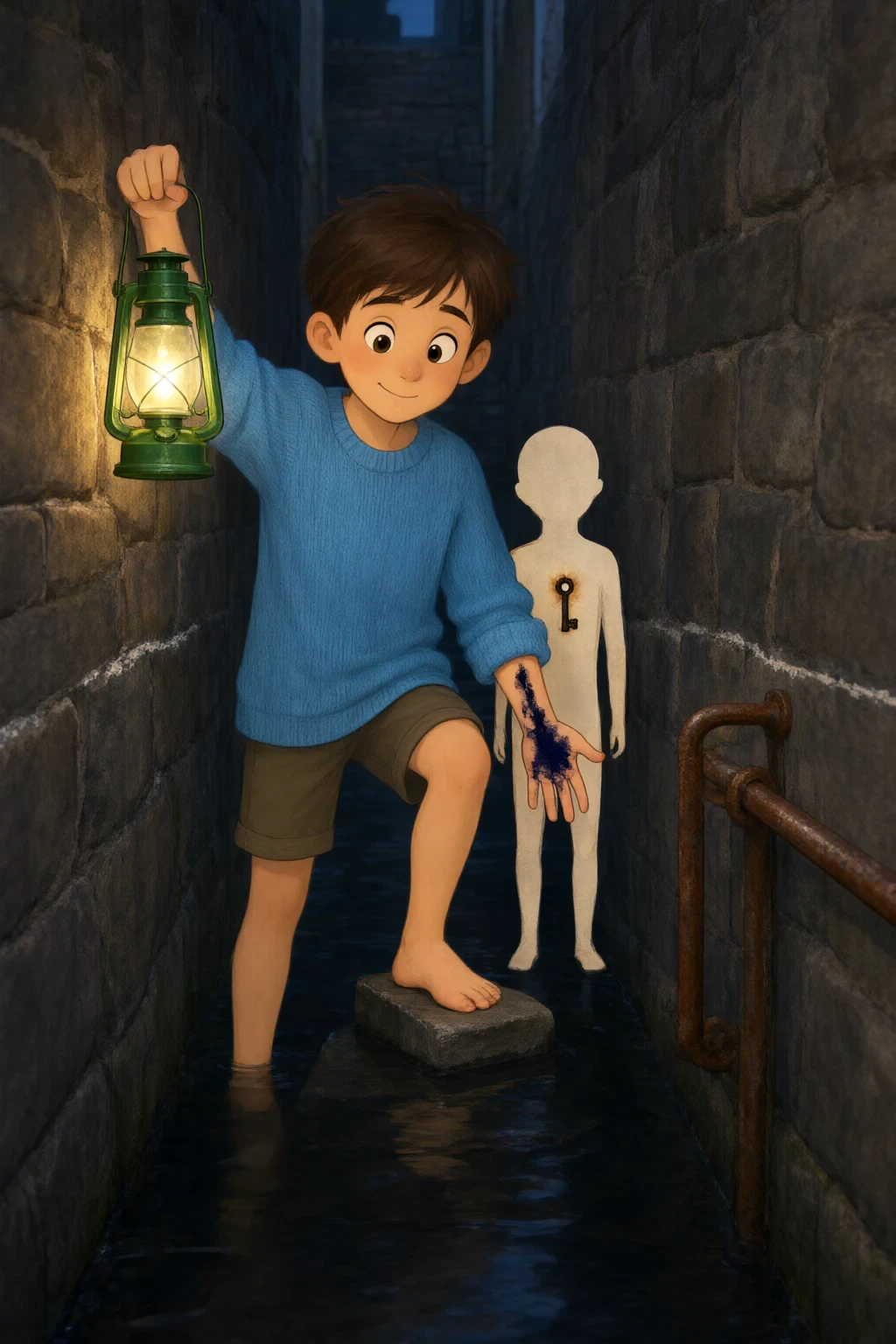
“Now then,” said Anja. “Sit down. I will tell you this once, and you will not like it, and then I am going to bed.” They were in the Servery on the seventh night in the last of the lamp oil, with the sea working at the stilts and the water climbing the seven shallow steps in the dark. Niko stood, because he reads standing up, and the green book was on the scarred amber table, small and dry and shut.
“There is a Higher Stair,” said Anja Roe. “Not the stair you came up. Another one. Every seventh night this building puts one step somewhere in itself, and in the morning it is not there, and nobody has to do anything about it. That is how the Library makes keepers.” “Why does it take a step?” said Niko. “Because a keeper has to know where the floor is. Now then. This is the part you will not like. This year the step is not appearing on a stair. This year it is appearing in the Spine.” “In the dark.”
“In the dark. In the flood. At the quiet hour, which is the hour after the last bell and before the light, and nobody is meant to be walking in it.” “How many has it put in this year?” “Six,” said Anja. “Six seventh nights, six steps, and every one of them gone by morning. Tonight is the seventh seventh-night. Tonight it puts down a seventh one, and the seventh one is the step that makes a keeper.” “Then I will be here at the quiet hour.” “No,” said Anja, “you will not.” She put her gloved hand flat on the table beside the green book, and did not touch it. “Ink dries. Go on.”
Wick was waiting at the bottom of the stair with his boots off. Niko found him in the dark, in the standing water under the mud Shelf hatch, a boy-shaped outline of pasted wet pages with a small keyhole burned black in the middle of his chest. “Found you,” said Wick. “Good. Book.” “I am not a book.” “Shelf,” said Wick. “Me. Shelf.” They had been at this for weeks. Niko had salted a shelf in the Stacks and set a card on the front of it that said WICK, and Wick had sat on it all afternoon, and at dusk he came off it and stood on the boards with the water still on him, not falling, exactly as always.
Niko had wanted to ask him properly, to say it out loud and mean it. He had got as far as “Will you—” and then stopped, because Anja had told him the rule in the spring and he could not unhear it. Ask a person to be a book and the Library accepts, and the first price is the voice. An asker never speaks aloud again. So he had not asked. And Wick had not become a shelf. And they had both gone on exactly as they were. “Right,” said Niko. “The quiet hour. Do you know when it is?” “Water,” said Wick. “Tells me.”
The quiet hour came at the wrong end of the night. Niko lay on the floor of the Nests and listened to the bells stop one by one as the readers went to bed, and then to the building settle, which he had never heard before, a long low sound like a ship coming off a mole. He got up. He got his boots. He did not wake Ilsa, and he was careful about that, and he thought about it afterwards a great deal more than he thought about most things.
Wick was in the gutter of the Spine with the water round his knees, and the water was coming up the corridor in a long sheet, and it was black, and it did not reflect the lanterns. “It is in here,” said Wick. “Where?” “Cold,” said Wick. “Here. Cold.” Niko put out his hand. The water was the same temperature as the water on either side of it. That was the step. A cold flat place in the middle of a flooded corridor, no harder than any other stone, and no bigger than a boot.
They took it, and then it was not under Niko’s boot. He nearly went into the water. Wick caught him by the arm with a hand that was cold and damp and paper-thin, and it held. “It moved,” said Niko. “Moves,” said Wick. “Every hour.” So the seventh step walked the building all night, and Niko saw all of it, because the lamp he had unhooked from the Servery was the only light in the corridor. It was in the Spine. It was at the foot of the Stair, up the Stair for nine steps, and then it was not.
It was under the low door of the Press, where the ink stones are and the floor is always damp, then in the gutter by the Numbers Room, then on the second tread of the Verandah stair with the whole flat lying west of it like a floor made of black glass. They followed it into the Atlas Room, and there it stopped, and Niko nearly laughed, because the Atlas Room is the one place in the building with a level floor.
It was in the wall. That was all. A cold place in the wall at the height of a boot, and the great globe on its brass meridian stood a foot away from it, not touching. “It is not a step here,” said Niko. “It is a step pretending.” “Every room,” said Wick. “Its own. One each.”
At the third hour they were in the mud Shelf, and the water was to their chests. The mud Shelf is the lowest room, unnumbered, opening onto the flat through a wooden hatch, its shelves standing in two inches of silt. At low water it is the finest reading room in the world. At the turn the water reaches it first and last, and on that night the oldest and wettest books in the Library were off their shelves and swimming in the dark going nowhere, the way a flock of sheep goes nowhere. “There,” said Wick.
Niko could not feel it. In the Spine he had felt it because he had been standing still with his hand in the water. Here he put his hand on a shelf and the water was only water. Wick did not touch the shelf at all. Wick turned round twice, the way a dog does, and then walked three paces into the dark with his hand up, and stopped, and said, “Here. Cold. Here.” There was a step. Under the water, on the silt, at the foot of the shelves, it was already there, cold and flat, and the silt had settled over it in a thin skin. “Then you get on it,” said Niko. “You get on it,” said Wick. “You. Not me.”
Niko had been thinking about that for two hours, and the reason was not a good one. The seventh step makes a keeper, and it would not be a step on a stair for anybody this year, because Anja had said it never was any more. If nobody took it, the Library would put down the same step every seventh night until the sea took it back, and one day it would find a person standing on it and have made a keeper without anybody choosing. That was the thing he could not stand. It was not noble.
It was only that he could not sit in a building for a year and wait to be made something by a floor. He took his boots off and set them on the silt, because salt would eat them and his mother had not got money for new ones. He put his foot on the step. It was no harder than any other step. That was the whole of it. The same stone as the seven steps outside, the same cold, the same nothing, and it took his weight the way a step is meant to, and it did not rise, and nothing opened, and no voice came out of the walls. What happened was the water.
The water in the mud Shelf moved away from him. Not much. It drew back off the step in a slow ring, the way water draws back off a stone in a river, and where it drew back there was dry black stone in a perfect round hole in the sea. And on the far side of the ring, Wick changed.
The water that stands on a boy made of pasted wet pages and never falls off came off him all at once and went away down the silt with the tide, and left him standing there, thin as a library label, and dry, and shivering, and entirely himself. He looked down at his own hands. Niko, who asked questions out loud and never waited for the answer, said, “Are you all right?” Wick opened his mouth. Nothing came out. His hands went up and down once, twice, and he looked at them.
He was quiet the whole of the walking out. Niko would have given anything he had to hear the paper-rasp again, three words and no more, the way Wick said everything. What came instead was silence, and it was not a punishment. Wick had not been asked. Wick had been given, and a gift costs nothing, and a gift that takes your voice away is not a gift, it is a hole. “Water,” said Wick at last. “Not me.”
They came up out of the hatch together into the last hour before the light. Niko carried the lamp. The whole building was asleep, and the sea was going out, and the gutters had gone pale with the coming of day, and the tidemark stood on every wall in the grey, level as a ruled line, a finger’s width higher than the week before. Niko stopped in the middle of the Spine and put his hand flat on the wall.
There was a cold place in the wall at the height of a boot. There was a cold place in the stair wall, and one in the Press, and one on the second tread of the Verandah stair, and one in the Atlas Room where the floor is the only level floor in the building. Seven of them. He could feel all seven, the way a man can feel a room behind him with somebody standing in it. He would be able to feel them in the dark, in any room, for as long as he lived, and there was nobody to ask whether that was a gift or a job, because Anja was asleep and Wick had nothing to say.
He got to the Porch. He got his boots back off the silt and put them on. The green book was in his coat, and the last page was warm, which he noticed because it was the one thing in that building that should have been cold. He opened it. Every page before the last was still blank. The last page had one line on it in a hand he knew better than his own.
He stood in the doorway of the Tide Library in the first light and read it, and the water went out across the black flat all the way to the whale ribs, and the gulls started, and the bell in the empty iron cradle hung silent over the water.
Anja read the line twice, standing, with the sun coming up behind her and her hood still pushed back where it had been since before Niko was born. “Ink dries. Go on,” she said. “Now. Here is what I have to tell you, and then I am going to bed.” She told him four things, in order, and she told them once. That she had known the step would end in the mud Shelf, and had let him go, and had gone up to bed. That a keeper is a person who is allowed to know where the floor is.
That the green book is not one of theirs, and that the Quire will take it in the morning, and the spindle lamp will go over it, and the salt will go on it, and the last page will be left exactly as it is, because a line in a person’s own hand is that person’s own hand, and the Quire does not touch that. And that she had been a keeper for thirty-four years without knowing what a step is for, and had never taken one, and that the building has been putting one down every seventh night for three hundred years, patiently, waiting for somebody it could put one under. Then she went to bed.
Perran Hesk came up the stone at nine with his spectacles on their green string and his satchel under his arm, and he was very pleased with himself, because a thing written down properly is safe. “Six steps, seventh night, mud Shelf hatch, second hour of the quiet hour,” he said, writing. “I have the hour to the minute. Now then, where is the borrower’s book for last night? I want the term in his own hand.” “There is no borrower,” said Niko. “There is always a borrower.” “There is no term. He did not sign.”
Perran’s chalk stopped. It is a small thing to see a man stop, but Niko had been watching faces in that building for two years. “Who came in?” said Perran. “None of us. Nobody came in.” Niko was about to say more, and then he stopped, because Perran had gone the colour of the wet sand. “Wray Imbrie.” “He said the term?”
“He did not say a word. He had his coat on and the red scarf and he went out through the Porch in the dark, up the seven steps and across the flat to the Ridge Road.” Niko thought about it. “He did not sign anything. He never signs. He says say the term and I will sign, and then he waits for you to finish the sentence, and he waits a long time.” Perran put his chalk down very gently on the sill.
“Then somebody else has been writing his term for him,” he said. “And I have been writing it down.” “He is not in it,” said Niko. “I put his line through myself on Tuesday. The slate is bare.” “Then the slate is bare because somebody wants it bare,” said Perran Hesk, “and that is not a thing I can write down.”
They sent a runner up the Ridge Road to Greyhaven at noon, and she came back in the wet, and Niko read the answer standing in the Porch doorway with the grey water going out past his boots. BORROWER IMBRIE LEFT HIS BED BEFORE DARK. HIS LANDLORD SAYS HE PAID TO THE END OF THE QUARTER YESTERDAY IN COIN, WHICH HE NEVER DOES. HE TOOK ONE THING DOWN FROM THE SHELF BEHIND THE DOOR AND LEFT IT ON THE TABLE, AND IT WAS A SLIP OF PAPER WITH A BORROWER’S NAME ON IT, AND THE NAME WAS NOT HIS.
Niko sat down on the third step, in the wet, with the green book in his lap and Wick beside him, dry, and thin, and shivering in the first wind off the flat. Wick leaned on him. That was all the credit he took. Niko put an arm round a boy made of pasted wet pages and held him while the sun came up over a hundred miles of black sand, and neither of them said a word for a long time, because there was nothing yet that words would do.
Then Niko said it out loud, to nobody, the way he says everything. “But who decided that it should be me?” And the building did not answer, the way it never does, and the seventh step lay somewhere in the dark under his boot, and was no harder than any other, and was already gone by morning.