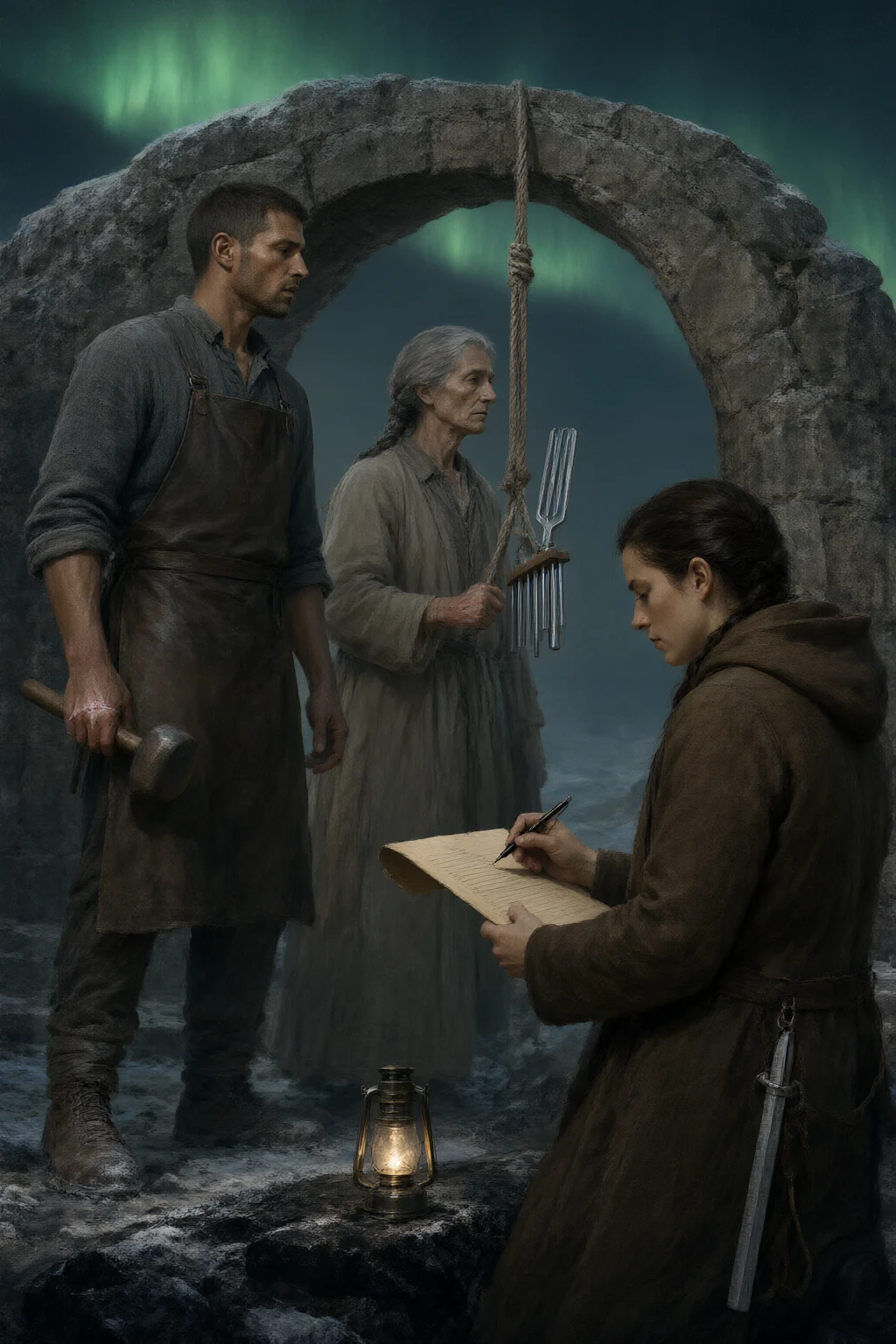
Every ninth night the collector read the standing of the ring, and she had read it every ninth night for nineteen years, and it was the oldest piece of ceremony on the mountain and the only one that was not music. Wend Cassock walked the nine segments with the lantern low and the rule on its cord and the roll open on a board clipped to her hip, and she read. “First place, horn of the west, had by Maran Ostler. Second place, horn of the north, vacant. Third place, horn of the east, had by Maran Ostler, who holds two. Fourth place, great bell, had by Ysolde Vant. Fifth place, small bell, had by Pell Underhay. Sixth place, bass, had by Sef Anhalt. Seventh place, drum, out of service. Eighth place, vacant. Ninth place, vacant.” And then the part that took the rest of the round, which she had to read because the roll required it and because a registry that does not account for its vacancies is not a registry.
“Second place, horn of the north, vacant these two winters, last held by Turi Roke, removed in the sixth month of the year of the great frost, standing at his own asking, which was granted. Eighth place, vacant eleven months, last held by Elda Mork, who walked off the shoulder at dusk on the ninth of the second month and was not seen again, and the wind has held the eighth place since, and the ring notes that the wind is a place and not a player. Ninth place, vacant two winters, last held by Annick Stow, stilled, and removed from the roll in the ordinary course, and the ring notes that a stilled player is not a dead player and is not mourned and is simply removed.” She said all of that with her voice level and slightly loud, in the third person, because she was writing it down as she went, and had been for nineteen years, and the ring had heard her describe four thousand small actions in that voice and had never once objected to a verb. “Collector completes the round,” she said at the ninth segment. “The standing is four. The Foundation is nine.”
The roll was not a book. It was a single sheet of dressed hide, nine ruled lines, a column of dates going back so far that the first hands had used a script nobody now read, and it was the only object in the mountain's keeping that could not be replaced, because a collector could make a copy and the mountain would not hear a copy. That was the discovery, and it took Wend Cassock a winter to make it, and she made it in the second month of the deep night by accident, the way that most of the things she knew had been arrived at. She had been reading a name she could not account for. Not a player's name, not a place: a name that had been on the roll since before she came, in a hand she could not date, in the space of the second line, where the north horn had stood empty for two winters. The hand was not one of the collectors'. It was not a player's hand either. It was a small, careful hand, the hand of somebody writing in a room where they were not supposed to be writing. She read it out. She read it out by accident, at the change, in the middle of the standing, because she had got to that part of the sheet and the voice does what the voice has done four thousand times.
The answer came out of the north horn. It was not a note. It was a settling — the horn giving back, in its own register, the same two notes it had been holding a semitone above where it had been holding, the way a floor gives back a footfall. Four seconds of it. Then the horn was where it had been. Wend Cassock stood in the eighth segment with the lantern swinging and the roll on her hip and did not move for a while. Then she went down the slab, out of the wind, and sat with her back against the butt of the third horn with the roll on her knees, and she read the whole of it again, twice, by lantern light, with her finger on the lines, and the twelfth line — the one that should not have existed — said a name that was not any player the Shoulder of Nine Notes had ever had.
She did not tell them for three days. She told herself that she was being careful, and she was, and she also noticed, some days later and not until the summer, that she had been being careful in the direction of not having to be wrong in front of anybody. What she did in those three days was make a set of tests, and the tests are in her survey book with the dates, and they are the ugliest page in six hundred years of record. She read the roll, holding it, and wrote nothing. Nothing answered. She read a line of the roll with a name she had invented — the name of a dead man in a valley three valleys over, whose name she had found scratched on a hearth-stone. A third horn, the one that has not been played in eleven years because there is no one to play it, gave four seconds of settling. She wrote a name into the roll in her own hand, at the bottom of the sheet, in the margin, where a collector is permitted to make a note, and then she read the margin aloud, and the wall did nothing, and she discovered that the difference was that the dead man's name was written into the roll, above a line, in the place where the roll expects a name, and not in the margin. On the fourth day she went down the Gallows Stair.
She was permitted to go down, and she had spent eleven of the last eleven years being permitted to go down, because a collector is not a player. That is written in the Foundation's second rubric and it is the only protection the mountain has ever extended to anybody, and it is the reason the six-hundred-year record exists at all: somebody has to be able to leave in order to come back and write down what happened. The stair is two hundred and forty steps of cut stone worn into shallow bowls in the middle of each tread, and the wind comes up it in a long push that smells of the shoulder, which smells of iron and ash and the fat of old leather. Wend went down it in the light of a late morning with the roll under her arm and the board still clipped to her hip, and the two hundred and forty bowls took the weight of her the way they have taken the weight of everyone who has ever needed to fetch something from below.
At the bottom there were reindeer in the yard and a peat fire going in a stone pit and a market four days off, and the valley came out to meet her, because the valley comes out to meet the collector. It is the one time in the year that anyone in Sillvane says out loud what is usually said sideways, and the collector is expected to be tired and to answer questions about the players in the flat voice, and it is the only social occasion the mountain has. What Wend Cassock did on the ninth day was announce a levy. She announced it badly, on purpose, in the way that things get announced in a valley: as a fact of work. The wall wants mending in the spring. The drum wants a new head before the melt. The ring is four and has been four for two winters and the work of a ring does not get less, and the Foundation is nine, and there is no law that says the Foundation must be nine, but there is a law that says the Foundation is nine, and the second law wins.
So the valley is to furnish the ring with its winter detail. Nine hands, by name, for the length of the winter, for the labour of the ring. Not for the playing. Nobody in Sillvane had ever said the words the playing out loud and nobody in Sillvane was going to start. Nine hands to carry, to mend, to fetch, to stand where a person is needed. The work-book went round the yard on the ninth day, the same book the roof-repair uses and the peat levy uses, with the same kind of line and the same kind of name-space, and people put their names in it because that is what the book is for.
The market was four days off, and the Windward Yard is the loudest place under the mountain, and it is loud in one particular way: it is the only place in the Vellmark valley where the ring is discussed out loud, and the discussion is conducted entirely in the past tense, and nobody has ever noticed. You do not announce a levy to two hundred people. You announce it to nine, and the nine carry it, and by the time it comes back round it is weather. Wend put it to the reindeer warden first, because the warden is the person in a valley who is already responsible for everybody's being above the tree line. She put it to the peat-cutter second. She put it to the woman who keeps the bell-tower key third, and to that woman she gave the sentence that did the work, which was that the tower wanted a gang of nine at the spring repair and that the ring wanted the same nine so the peat could go up in one load instead of three. The woman said that this was a good idea, and that her bell was still not tuned, and that she hoped there would be somebody this year who could tune it.
The book went round the yard on the ninth day, the same book the roof-repair uses and the peat levy uses, with the same kind of line and the same kind of name-space, and people put their names in it because that is what the book is for and because a person who is not needed at home is the person who carries. The first nine names were the old and the released and the worn, in the order in which they had ever volunteered for anything, which is the order in which they had ever been useless and therefore useful. A man of sixty-six who could not lift a full side of reindeer but could hold a wall's worth of mortar for four hours. A woman whose son was already up the mountain. A woman whose knees had finished. A man of seventy who had walked to the shoulder to be released from it eleven winters ago and had walked down the whole two hundred and forty steps on his own legs to show that he could. Wend read the nine names into the roll in the order the levy book had them, on the fifth night, in the fifth segment, with four witnesses, and the east curtain closed to a line, and nothing in the valley opened a hand. The fifth name on the levy book was in a hand she did not know, small and careful, and it was the name in the twelfth line of the roll, and Wend Cassock read it in and did not say one word about the hand, then or ever, and that silence is in this account because it is the only thing she did that winter that was deliberate.
The first name she wrote into the roll was the first name in the levy book, and the first name in the levy book was a woman of sixty-one called Turi Roke, who had been the north horn three winters ago and who had asked to be released at her own asking, which was granted, which is in the roll, which Wend Cassock read out loud in the fourth segment every ninth night. Wend wrote it and she read it out and the north horn settled for four seconds, and the place in the curtain in the east, which had been four inches that morning, was two. She wrote the second name and the place was a hand's width. She wrote the fifth name, and on that night, for the first time in nineteen years of survey, the curtain in the east closed to a line. She recorded all of it. Date, hour, phase of the chord, the place in the curtain measured with the rule, the settling in each horn. She recorded it in the flat hand. And in the small book, the second one, the one with the eleven pages and the four lines, she wrote a fifth prediction and it was the truest thing she ever wrote, and it was also the sentence that made the whole thing possible, and she wrote it on the eleventh night without eating: The wall does not require that a name be carried. It requires only that a name be written. It will take the difference out of the person named, and it will take it the way it takes it out of a player, which is an hour at a time, cold, and it does not appear to check whether the person named has agreed to be a player.
The chord was wrong by the sixth week and it was wrong in a way that had no name in any of the six hundred years of record. Sef Anhalt heard it first, because hearing what is wrong was the only thing he was any good at. “There is a beat in it,” he said, on the second watch, at the third horn, with both hands flat on the brass. “Chimerunner to Horn-line. There is a beat in it. It is not in the beat of the drum, and the drum is out of service, so it cannot be the beat of the drum. It is in the beat of the people.” “Play the third,” said Maran. He played the third. He played the third for an hour. It was in tune. He had it up against the cold brass of the slide and he had it against the fifth below it, which is the test, and the third was in tune, and he said so. “And the chord is wrong,” he said. “Then the chord is wrong because there are four of us,” said Ysolde Vant, from the great bell, in a cadence that did not stop for a subordinate, “and the four of us have been wrong since the second month of the year before last, and you have been tuning around the wrongness for two winters, Chimerunner, and calling it taste.”
“It is not taste. Taste is when a thing is wrong in a way you could get used to. This is a sourness.” He took his hand off the slide. “It is a sourness in the green. Go out and look at it and tell me the green is the green.” He went out. He was gone a while, because a person does not go out onto a slab in the deep night to look at a colour, and come back without having seen something more. “It is a green with something under it,” he said. “It is the green of a thing that has been held rather than the green of a thing that is being held. And there is a place in it, on the south side, at about the fourth segment, where it goes yellow the way a bruise goes yellow, and it does not move with the rest, and it is the shape of a shoulder. Somebody who has never stood on this mountain is standing on this mountain.”
Sef Anhalt took it out of the roll himself, on the fourth night, with a pen and a scrap of paper, because Sef Anhalt could not stand to see a thing wrong once he had established that it was wrong. He took the ninth line, because the ninth line was a woman of seventy with a chest that had been bad since the melt, who had signed because she had signed the peat levy for eleven years and did not read the book before signing it. He took the line off with a pen. Then he read the sheet out with the line gone, in his own voice, which is not the collector's voice and which carries no more weight than a man with a scar across the web of his hand. The north horn gave four seconds of settling. The sourness in the south of the curtain did not move. Nothing in the valley that had been written off came back, and the valley is eleven hundred hours of stair below and there was no way on that mountain to know, and no one went down to look, because the players cannot and the collector had made a point of not going down that month. But something else happened, and all four of them heard it, and only one of them wrote it down. The sourness in the chord acquired a beat inside it.
“You cannot take a name off a roll,” Wend said. Her voice had gone into the third person, which is what it does when it is frightened. “Chimerunner, you did not take a name off the roll. You took a place out of the wall. The ring is holding a chord in nine parts, and one of the parts is now a hole, and the hole is being held open by the shape of the hole, and that is what the sourness under the green is. It is a place where a person used to be. The mountain has kept the shape of the empty.” Sef Anhalt put the pen down on the sill and did not pick it up for a long time. “Then what is the repair,” he said. “I do not know,” said Wend Cassock. “I am the collector. I have never once in nineteen years been asked to know a repair. I have only ever been asked to write down what happened.”
They found out what it meant in Sillvane, in the ordinary way that the valley finds things out, which is that somebody comes up the stair with peat and cannot get up the last thirty steps and sits down on the top one and cries about it in a way that three people have to walk past. Turi Roke came up on the ninth day with two sledge-loads and got to the second segment and had to be helped the rest of the way by a carrier and a striker, and she was sixty-one years old and had walked up that stair twice a week for eleven winters and had asked to be released three winters ago. Her hands were the hands of a woman of eighty. She held them up in the green light, turning them the way a person turns a coin they do not recognise, and said that the fingers would not close on wool, and that the wool was cold, and that the cold had got into the wool as well and was staying there. “She has had a year in three months,” said Pell Underhay, from the small bell, with her notebook out of her coat and open, and the way she said it made everybody look at her. “Keeper, I have the hours. She is owed eleven hundred and four hours and I have written them down and I do not know what to put them in.”
Sillvane learned what had been done to it the way a valley learns everything, which is from the sound of a house. The first thing to go was the heat. Every house in Sillvane burns peat all year because there is no other way to be warm in the Vellmark, and in the second month of that winter eleven houses had a peat fire that gave off nothing you could hold your hands to, and the women of those houses banked it anyway and sat by it and said the word for it, which was weather, and weather was understood to be a thing that happened to the valley and not a thing anybody had done. The second thing to go was the singing. Everyone in Sillvane knows the words of the Standing Chord. Everyone sings it indoors, quietly, never at night, and has done since before the oldest person in the valley was born, and it is not a song anybody enjoys, exactly, the way nobody enjoys a thing that is load-bearing. In the second month of that winter it stopped, house by house, without a conversation. A woman would start it in the evening and get three lines in and stop, and put more peat on, and the people at the other end of the room would look at the fire instead of at her.
It was the smith's house first. Then the widow's. Then a row of four along the peat lane, all at once, in a week, which is not how families behave. They had not stopped because they had decided to. They had stopped because the chord in them had got in the way of their own, and a person can only hold one wall at a time, and the five names in the roll were, without exception, the people whose houses went quiet. Wend Cassock came down the Gallows Stair in the fourth month to make a survey of the stores and walked the whole of the peat lane without going in, and she wrote down at the end of it, in the flat hand, that eleven houses in Sillvane had ceased to sing the Standing Chord indoors between the second and third months of the deep night, and that the cessation coincided exactly with the order of the roll, and that she had asked nobody anything, because asking would have made it a fact that a person had been written down. That is the whole of the record. It is the only time in six hundred years that the survey books record a change in the population, and it records a change in the population, and it is a lie the way a thermometer is not a lie, and it is in the book for nineteen years and counting.
Wend Cassock wrote her own name into the roll in the second month of that winter, and she did it in front of the ring, on purpose, and she read it out, and it took. Nothing happened for about ninety seconds, which was the longest ninety seconds of her life. Then the cold came up through the slab and into the soles of her boots in a way she had felt exactly once before, on her first night on the mountain, and it went up her legs, and it sat in her, and she felt the exact place it stopped, which was a hand's width below her breastbone, on the left. She held the lantern in her right hand and did not drop it, and she stood there and let the ring take ninety seconds of her, and the ring did not ask whether she had agreed, and she had not, and she knew exactly what she was doing, and she did it anyway, in front of four witnesses, and afterwards she wrote down the date and the hour and the phase of the chord. “You are a fool,” said Maran Ostler.
“I am the collector. The collector is a fool with a lantern. It is in the appointment.” Wend turned the page. “It is one hand, Maran. One hand out of nine that I had not put on the sheet, and the sheet was heavy, and now it is lighter. Do you understand what I have just proved? That it does not matter whether a person is willing. It matters whether a person is written. And if it matters only whether a person is written, then the thing that has been wrong with this ring for two winters is not a shortage. It is a record.”
The child came up with his mother on the second Thursday and sat on the top step of the Gallows Stair for two hours in the wind because he would not go up the last stretch. Tobbe Stow was twelve years old. His mother was Annick Stow, who had been the ninth place and had been stilled two winters ago, which is a thing that happens when a player is played past the end of what she has, and which is not a death and which is not spoken about in Sillvane except as a change in the household. He came up with the peat and he did not want the peat. He wanted the book. “I want to put my name down for next winter,” he said. “For all of it. For the whole length of it.” “Why,” said Wend Cassock. “Because my mother's hands are like grannie's hands and she is not a granny.” He was not looking at her. He was looking at the roll. “Everybody says giving is what you do. You gave. You wrote your name and you got cold and you are standing here. So put mine down. I want to give something back.”
Wend Cassock looked at the child for a moment, and then she took the pen out and she said, “I will read it in,” which is what a collector says, and she wrote Tobbe Stow into the second line of the roll in her own hand, and she read the line out, because a line that is not read is not in the roll. The wall did not answer. The ring went on holding exactly as it had been holding, and the north horn gave nothing at all, and the third horn gave nothing at all, and the place in the curtain stayed shut because it was shut, and there was no settling anywhere on the mountain, and the deep green went on standing over the valley in the sour way it had stood for six weeks. Pell Underhay wrote the date in her notebook with a hand that had begun to shake, not from the cold. “It did not take,” she said. “No,” said Wend. Tobbe Stow stood in the eighth segment with the green light on his face and looked at the wall, and then at the roll, and then at the roll again, and then he said the thing that made three people on that mountain put down their tools. “Then it isn't giving,” he said. “Nobody's giving. You just write people down.”
Pell Underhay did not go down to the small bell for the fourth watch. She sat in the shelter of the mortar with the notebook open on her knee and the wind pushing at her back and worked for two hours, and when the change came she had a heading over the fourth column, and she wrote it in pencil, in a small firm hand, and then she sat looking at it for a while before she did anything else, because a heading is the last thing you can take back. She went and stood in front of Maran Ostler at the third horn, in the middle of a held note, which is not a thing a player does. “You taught me the columns,” she said. “In the second month of my first year. You said the first thing a player learns is what a note costs, and the second thing is whose note it is, and the third thing is that you do not have to be the cheapest one available. I have had two years of it. And the fourth column has got a heading tonight and I want you to know what it is before I say it, because you taught me the columns and this is your fault.” “Say it, Small-bell.”
“What a person gives that was never asked for.” Pell's chin came up. “That is all it is. It has four entries and one of them is eleven words, and the column is the only one I have that goes up as well as down, and I do not know the sign, and I do not know the unit, and I know that if there is a ledger in this world then it is this and not the roll, because the roll is what was done to people and this is what was done about it.” Maran Ostler played the third for a while without answering, which was her way of taking a thing seriously, and at the end of it she said, “Then the unit is hours and the sign is minus and the column is going to be the longest one in that book, Small-bell, and I am sorry for it, and I am not going to pretend I taught you well.” “You taught me very well,” said Pell Underhay. “That is the entire difficulty.” She wrote the heading on the next page as well, and on the next one after that, so that the column had somewhere to go for as long as she was on the mountain.
They reckoned it up on the shoulder, all four of them, in the hour before the change, in the voice of a woman who recites what has been written down a long time ago and settled.
“The standing is four,” said Ysolde Vant, “and the roll is nine, and the four on the roll are the four on the slab, and the five written since are in the valley, and the valley is eleven hundred hours of stair below us and has no idea what it is holding, and the ring is therefore held in thirteen hands, of which five are being held rather than holding, and there is a sourness in the south of the curtain that is the shape of a shoulder that has never been on this mountain, and I am going to say the rest of it now without stopping, because if I stop I will not start. The rest of it is this. The chord is not sour because the ring is thin. The chord is sour because the wall is being fed from underneath. And the more we write, the better it will stand, and the better it stands the longer it will be sour, and there is no arithmetic by which writing more names makes it stop. We have improved the wall and ruined the valley and both of those sentences are the collector's, in the survey book, in the flat hand, and she read them to us this morning and then she went and checked a rule.”
“Chimerunner to Horn-line,” said Sef Anhalt, at the third horn, not turning round. “I have been here eleven years and I have never once been able to say a thing out loud that was true and simple. I want to leave. I said it to you in the second month and I have thought about nothing else since, and the reason I have thought about nothing else since is that I have just worked out that there is a note on this mountain that ends the winter. Did you know I had worked that out?” “Yes,” said Maran. “Did you know what it does to the rest of us?” “It ends the wall.” “Then it does not end the winter. It ends the winter and it ends the wall and it fixes this in the stone for good, because the Ending Note ends the winter once and for all and the sky it leaves behind is the sky that the lie gets to live in under.” Sef put his palm flat on the granite. “I want to go to Sillvane. I have found out that the only door out of here is a door that shuts.”
Wend Cassock did the last thing she did that winter on the ninth night of the second month, at the change, in the east segment, with the ring standing four and the curtain shut and the sourness in it, and she did it because she had spent nineteen years being the person who writes things down and she could not think of one other thing to be. She opened the roll at the second page, where a collector keeps what is not the standing, and she wrote a heading, and under the heading she wrote, in the flat hand, in the third person, the way she had written four thousand small actions: The roll was enlarged in the second month of the deep night, from the levy book of Sillvane, by the collector, without the authority of the Foundation and against the second rubric, which provides that a name may be entered on the roll only by a player who has stood in the place.
Then she wrote what the enlargement had done. The place in the curtain in the east closed. The chord took a sourness. Five persons in the valley lost the use of their hands in the order in which their names were written, and the fourth of them is fifty-eight years old. The ring was held in thirteen hands. Nine of the thirteen consented. Four of the nine consented, and one of those four gave ninety seconds in front of witnesses, and one of the nine is twelve years old and was refused, and the refusal is recorded because the refusal is a fact and the fact is worse than the rest. And then she wrote the last line, and it was the only line in the whole of the six-hundred-year record, the survey books and the roll and the two books kept in the press in the maintenance store, that was in the first person: I did this. I am the collector and the roll is true and the record is true, and I put the names in, and I would like somebody to come up these two hundred and forty steps and take the pen out of my hand, and I would like it to be somebody whose name is not in a book.
At the fourth hour she came round the ring with the lantern low and the board on her hip and the roll open, and she read the standing, and she read it in a voice that was not level and did not pretend to be. “First place, horn of the west, had by Maran Ostler. Second place, horn of the north, had by Turi Roke, of Sillvane, who is not here. Third place, horn of the east, had by Maran Ostler, who holds two. Fourth place, great bell, had by Ysolde Vant. Fifth place, small bell, had by Pell Underhay. Sixth place, bass, had by Sef Anhalt. Seventh place, drum, out of service. Eighth place, had by Wend Cassock. Ninth place, had by Elda Mork, of Sillvane, who is not here, and who does not know.” She closed the roll, and clipped the board back to her hip, and the lantern made its own small circle on the black slab in the green. “The standing is nine,” she said.