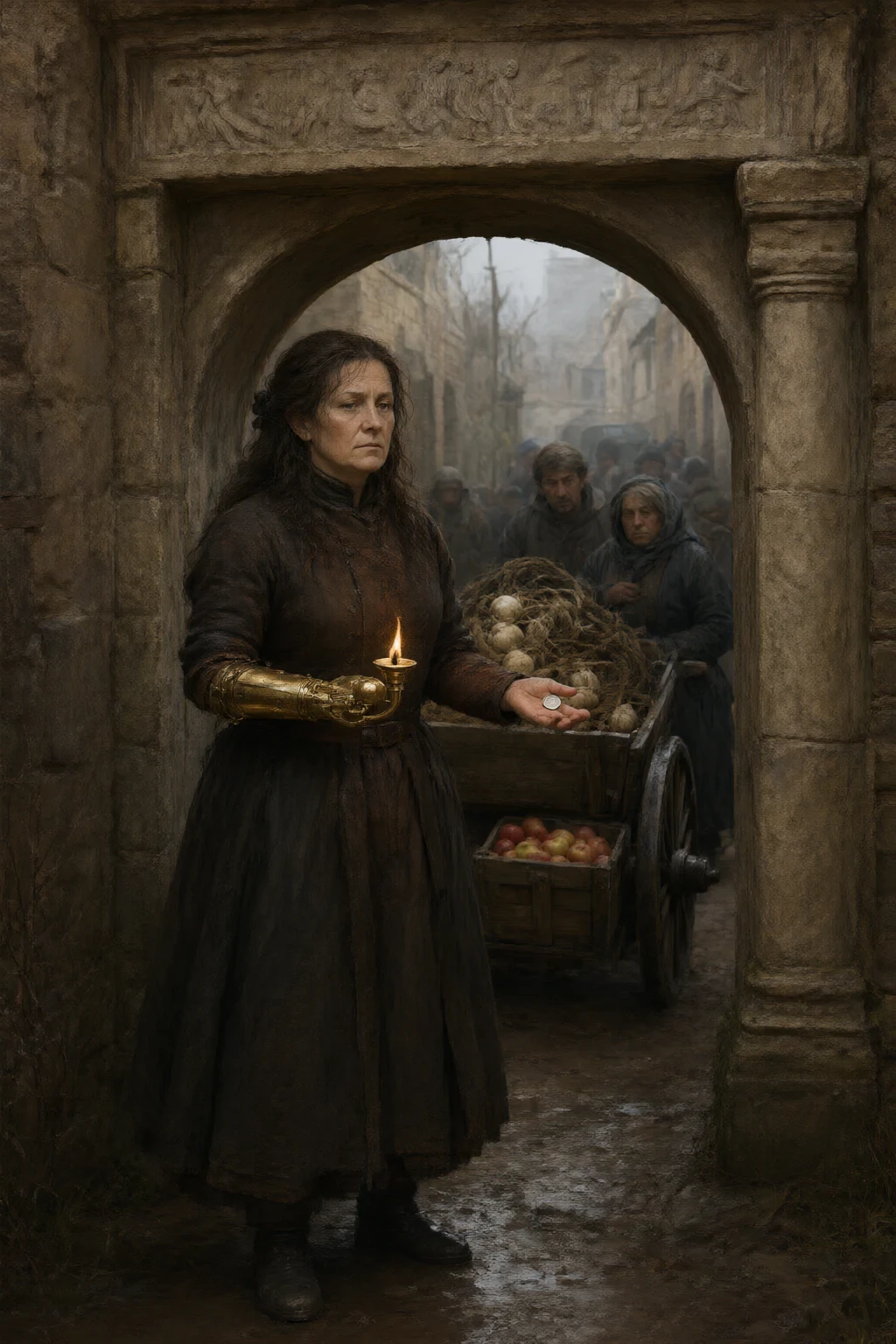
Cresset Ombre had a mark on the lamp. Not a mark the Court knew about. The brass ring of the Hall lamp is wagon-wheel wide and hangs from the silvered pine on a chain with no hook, because a hook would be a nail and this building has no nails, and the ring turns a little every night as the draught comes off the water and the frost works at the glass. There is a place on the inside of the ring, at four o’clock, where the metal is not quite as dark as metal is everywhere else, and Cresset had put a short white chalk line there in the spring, and every eighth night since, in the small hours, when the palace is asleep and honest, she had wiped the ring with a cloth and put the chalk back. The chalk had moved down. The first time it moved, she had blamed the frost. The second time she had blamed her hand. The third time she had written the date on the lamp-stand where the brass goes into her arm, in a hand so small that only she could read it, and the fourth time she had done nothing and gone to bed. Since the ninth hour of the great cold, which came four days after the Salt Bridge had been told true in the Hall, the flame had been the length of a hand.
Names go off the roll in a particular way. They do not fall off. They are removed by a Keeper, at the top of a working morning, with a reason entered against them, and the reason is always the same. Unaccountable. Cresset had signed four of them this season. Two before the great cold, two after. A scullion out of the west stair, twenty-two winters, missed by nobody for a week. A lamp-trimmer whose whole office was a pair of snips and who had been in the building for thirty-one years. A woman who folded the linen on Tuesdays, whose name had been on the linen list in a fair hand and off it again in Tallow Merrick’s. And on the ninth day of the cold, the fourth. The roll is the Court’s roll. It is nine hundred years of names in three registers, and it is kept in the Vault, and the Keeper is the only person who may write in it, and a name may only come off the roll when the flame has shortened, because the flame is the light the Court is kept in, and a name is a claim on that light, and there is not enough of it. Cresset had signed all four. She did not tell the Queen, because there is no procedure for telling the Queen, and the Queen is nine hundred years old and has been the Court’s oldest customer since before the third register was opened. She had told Grist Bellweather, once, in the mill, and the miller had put his hand flat on his hopper and said, “Then the lamp is eating the stories faster than we tell them,” and Cresset had said nothing, and Grist had looked away, and had offered her broth.
The test takes forty minutes and she has done it four times, and the fourth is the one that finished it. She works at the sill, in the dark, with a hand-lamp shuttered to a slot, because the Hall lamp is the thing being tested and a test needs only one light at a time. The first object is a coin out of the third gallery. Ordinary, thin, warm from the tray, a story about a woman who mended a fence. She sets it on the sill. The flame leans over towards it. Not much. Two inches, perhaps, and it holds there as long as she watches, and it goes back when she takes the coin away, and it is not a draught, because the draught goes outward and this comes inward. The second object is a husk. She has four hundred of them in a sack and she takes the best one, the clean rim, the two hundred and two, the one Tallow Merrick will not have spoken of badly. The flame does not move. She holds it there a full minute. She puts her face close enough to feel it. Nothing. The third object is not coin. It is a bead, glass, blue, from the neck of a woman in the market who was at the gate in the autumn and paid for nothing because nothing was for sale. Nothing. Not a lean. Not a flicker. The flame does not so much as acknowledge that there is a bead on the sill of the Hall lamp.
Then she tells something to the empty Hall. She stands in the disc. There is no one in the dark at the edge of it, because it is the fourth hour and the whole of the Court is asleep, and a story told to nobody is not a coin, and she has known that since she was thirty-four years old and a different Lampwright. So she says a true thing out loud in the Hall of Telling, standing in the light, with nobody to contradict her. It is about her own hand. It is a small true thing and it mints nothing at all, and no coin falls into the tray, and the flame does not stir, and she says it again, louder, to be fair to herself, and it still does not stir. And then she goes and gets a coin, and the flame leans. The rule is the first of the nine and Cresset Ombre has broken it once in nineteen years of tending, and the penalty for breaking it is a ring of dead air about the width of a coin hanging in the Hall where it happened, swelling, waiting to be paid for in a true story. She did not break it. That is the thing she keeps coming back to at four in the morning with her heart going. She has not broken it. She has proved it. A coin will feed the flame. A husk will not. A bead will not. A true thing with nobody listening will not, because it is not a coin, and the flame does not read. The flame is fed by coin.
Here is what the Court has been told, in the Hall, in the ordinary course of business, nine hundred years running. The flame in the Hall lamp is made of truth. It is the one mercy in a cold building. It is fed by true stories, and true stories are the only thing the Court is for, and so the Court’s light is the accumulated light of nine centuries of honest telling, and that is why lying is impossible here. And the truth, which Cresset has known since the winter of the year she was thirty-six, is that the lamp was lit by a coin. That is all. There is no longer sentence and there has never been a longer sentence. A coin was minted, in the Hall, in the first winter, and the coin was the Court’s own name, told aloud by four people to four other people, and the flame leaned at it, and the four people watched it lean, and they drew the obvious conclusion. It is not surprising. They were four people in a cold building. They were wrong by one word. The light of this palace is the currency of this palace.
Cresset has had that sentence in her mouth for nineteen years and has not said it, because she swore an oath on the night she was taken on, and the oath is specific, and she has kept it to the letter: she has never said the question, what the flame is made of, to another living person. She has said the words to the lamp. She has said them to the frost on the inside of the glass. She has written them on the brass of her own arm in a hand two millimetres high, and then wiped it, because brass takes the chalk and holds it, and the brass is joined to her bone, and the bone is not the sort of thing you can swear a thing on and then un-swear it. She has sworn, and the swearing is eating her, in the specific and mechanical way that all unsaid things eat the person holding them.
“Flame is at a hand’s span,” said Cresset. She said it in the Hall, at the ninth hour, in front of the whole Court, standing in the disc because that is where the Lampwright stands, and then she said the rest of it, which she had not intended to. “Nine hundred years, and I have watched it every eighth night, and the chalk is on the ring, and I will show anybody the ring.” Tallow Merrick had a tray in her arms and did not put it down. “Four hundred and six, dull,” she said, to the tray, not to the room. “Very dull. Two hundred and eleven, dreadful. Nine, and I mean properly nine.” “Tallow.” “Four names off the roll this season,” said Tallow. “I signed them. Nobody has signed four in a season since the year the mill flooded, and that one is a lie, and I have never been able to decide which.” “The flame is fed by coin.” The Hall is stone, and the Hall had gone the way a Hall goes when a Lampwright says the flame is fed by coin. Marrow laughed. He was at the back, on the cold boards, in a cloak with two sleeves eaten out of it, and his shadow on the wall had one finger too many on it. “That is a coin in somebody else’s pocket,” he said, “— and that is a coin in somebody else’s pocket,” said the Fool, delighted, “and I have been saying that for four hundred years.”
They spent the morning on it and it was the worst morning the Court has had since the famine, and the reason it was the worst is that everybody was right. Cresset was right that the flame does not read. Cresset was right that a coin will feed it and a bead will not. Cresset was right that the Court is therefore burning its own currency, at one remove, in a closed room, on itself, and has been doing so for nine hundred years, and that this is why the flame is the size of a hand: the Court has not minted a good coin in ninety years and has been living on husks, and husks are chalk. And Tallow Merrick was right about the other half of it, which nobody wanted to hear and which she said anyway, out loud, in the middle of the floor, with her ledger under her arm. “If the flame eats coin, then the Court is burning its own account of itself,” she said, “and it cannot stop, because the account of itself is the only currency it has, and it is worth nine. So the light of this palace is being made out of the cheapest thing in it, and every year it is thinner, and this is not a mystery. This is an audit.” “Would you have a Court that burned strangers?” said Nim Ollowan, from the edge of the disc, thirteen years old, with a strip of unspun silver thread round her left wrist, re-knotting it. “Would you have a Court that burns nobody at all?” said Tallow Merrick.
It was Hessa Dole of the market who broke it open, and she did it the way she does everything, which is by standing in the queue at the Upper Gate with a basket of apples and refusing to move. She is thirty-four and she sells apples at the gate twice a year, and the guards check every traveller’s palm for coin because nothing leaves without paying, and she has stood in that queue for sixteen years and has watched the Court buy. “They do not buy anything,” she said. Nobody had asked her anything. “They do not buy anything,” said Hessa Dole again. “Sixteen years. They come out with a tray and they stand at the arch and they look at the carts, and then they go back in, and every year I bring two crates and sell nine apples to people who have come from further than I have, and not one of you has ever put a coin on my crate.” “They are not permitted to,” said Tallow Merrick. “Nothing outside the Hall is bought with story. The gate accepts coin and only coin.” “Then mint one,” said Hessa Dole, “and buy my apples, and tell me what the light in your window is for.”
She was let in. That is the part nobody expected: she was let in, because she had a basket, and the guards at the gate are not the Hall, and the Hall is a lamp and a disc of light. She stood in the light and looked at the flame, and then at the chalk line on the inside of the ring, and Cresset watched her find it, because everybody finds it, and everybody then looks at the Lampwright, and Hessa Dole did not look at Cresset. She looked at the mark on the brass where it goes into Cresset’s arm. “You have written something on your own arm,” she said, “and you have wiped it off, and it is still there in the brass, and you have been standing under that mark for nineteen years.”
Here is the motion Hessa Dole made to the Court of the Hollow Court, and it is worth setting down entire, because everything after it is a consequence. She said the Court was standing in a queue with everybody else and refusing to open its purse, and the reason it could not open its purse was that the only true things it had were about itself, and its own account of itself was worth nine. She said the truth about a person’s own life was the only currency in the world that was not made of the person’s opinion of themselves, and there was an infinite amount of it, and it was standing in the mud at the gate of this palace waiting to be told, and every word of it would feed the lamp, because the lamp did not care who said it. She said the Court had four hundred and eleven years of strangers’ gossip in its Vault and nine years of its own, and that the exchange had been going the wrong way for a very long time. She said the Court should stop minting.
The objections were not the objections anybody expected and they are worth having. The first was rule eight. Nobody’s story may be coined while they stand in the Hall, awake and unconsenting. It does not merely fail. It burns, and the mint rings like a struck bell in every room of the palace until the teller goes back and pays it. Hessa Dole had a crate of apples and a face like a wet road and she had understood that in the first ten minutes. “Right,” she said. “Then they are not minted.” “Then there is no coin,” said Tallow Merrick. “Then there is no coin,” said Hessa Dole, “and the lamp goes out, and that is the end of it, and I have said my piece, and I am going back to my crate before the light goes.” The second objection was the Queen. She had not spoken. She was at the far end of the dark, in a chair that had been a chair since before the Hall was the Hall, and she had her hands on her knees, and they were the colour of thin glass, and there was a point this morning when Cresset saw the flame reflected in them, and the reflection did not move with her head. “If the mint is closed,” said Queen Ysandre the Long-Waited, in a formal beautiful cadence, “then this Hall is a room with a table in it.” “Yes, Your Majesty,” said Hessa Dole. “Then I should like it known,” said the Queen, “that I have been eating in that room for ninety years, and that the food is grey, and that I would have gone on.”
The Court voted at the third hour of the afternoon, four to one, and the one was Cresset Ombre, and she voted against it, and then she went on tending the lamp. The motion carried. The first mint under the new arrangement was struck on the second night after, at the ninth hour, by Nim Ollowan, who was thirteen, and who was extremely bad at it and extremely careful. The tale was the tale of a rope. A woman called Hessa Dole had, at the gate, in the mud, in the ninth hour of a night in the late autumn, told a true thing about herself to a man who sold rope, who could have contradicted her and did not. The true thing was that she had come to this gate sixteen years ago with one crate of apples and a debt, and had sold the debt in the first year and had been selling apples on the other side of it ever since, and had told nobody, and had told it to a rope-seller at four in the morning because she had nothing else to say. The coin came out of the mint warm, and heavy, and the raised shape on its face was a knot. And it went into the tray, and Cresset took it, and she carried it to the sill, and she set it on the brass, and the flame of the enormous Hall lamp leaned over towards it the way a dog leans towards a pocket.
She had a mark on the lamp, and she wiped the ring with a cloth, and she put the chalk back where it had been, and she measured, and the chalk was a finger higher than the night before. It was the first time in nineteen years that it had gone up. It went up a finger, and then a finger and a half, and then it stopped, and it did not go up any more for some days, and it did not go down, and in the end of the second week it stood where it had stood in the spring, two fingers below the great mark. The great mark was not where it had been in her father’s time. This was above the place it had been standing when the four names came off. Cresset did not tell anybody that for a week. On the eighth night she told Tallow Merrick, in the Vault, in a voice with nothing in it at all. “It is two fingers from where it was,” she said. “Not one. Two.” “Two fingers,” said Tallow, and put down the cloth, and did not say anything else for some time, and then said, “Then I was wrong about the audit.” “You were not.” “I was, Lampwright. I was wrong about the audit,” said Tallow Merrick, “and I have been wrong about it for thirty-one years, and I would like it entered that I was wrong, and I would like it entered by somebody who is not me.”
It was Nim who worked out the rest of it, and she did it in the way she does everything, by saying the extra true detail. They had minted four coins in the first week. Four strangers, four true things, four people who had been asked. The flame had risen a finger and a half and stopped. “On the ninth night,” said Nim Ollowan, “Hessa Dole told it again.” The Hall went quiet in the particular way it goes quiet, which is to say it did not go quiet at all, it went worse than quiet. “She did not,” said Tallow Merrick. “She did. She told it in the Hall, to me and to the Queen, and I was the one who could have contradicted her, and I had checked the gate ledger and the thing she said about the debt was true to the halfpenny, and I stood there and did not open my mouth, because I was thinking about apples.” “It mints nothing,” said Tallow. “It is the same coin. It is the second time. It will come out at half, and it will feed the lamp at half, and in a year it will be a husk, and then the whole thing is finished and there is nothing in the Vault worth a lamp.” “No,” said Nim Ollowan. “And then—”
And she stopped, the way she always stopped, which was immediately before, and everyone in the Hall had learned over three years not to breathe at that moment. “And then it came out at one hundred and nine,” said Nim, “and Cresset’s chalk went up a finger and a half, and the coin is in the tray, and it is the same coin.” “The same coin,” said Tallow Merrick. “That is not possible. I have four hundred husks in a sack and every one of them is a story that got told twice.” “It is the same coin because it is not a second telling,” said Nim Ollowan. “A second telling is what we do. We say it to a room that has heard it, and the words go thin because nobody is listening, they are only waiting. That is why the Salt Bridge went to nine in four hundred years, and why the founding is worth nothing, and why the Queen has been eating chalk for ninety years.” “Then what was last night?” “She came back,” said Nim. “She came back on purpose, and she stood where she stood the first time, and she said the same words, and the only difference is that this time there was somebody in the room who had heard it, and could have said no, and chose to be there anyway. That is not repetition. That is somebody coming back. We have never had one. That is the whole difference between a husk and a coin, and it is not a difference in the story. It is a difference in the room.”
Here is what Hessa Dole had understood at the Upper Gate in the mud, and what nobody in this palace had understood in nine hundred years, and it is not a large thing and it took an apple-seller to say it. The Court had been mining itself. For nine hundred years the only true things in this building had been true things about the people in it, and the people in it were the same five or six people, and they had told their own stories to each other until the stories had nothing left in them, and then they had told each other other people’s gossip. The gossip was true, and it belonged to somebody who was not in the room and had never been asked, and the Court had been spending other people’s lives on its own light for six hundred years without the least idea that this was what it was doing. Which is the whole of it, and the reason the Hall is called a Hall and not a court, and the reason the Court has never once in nine hundred years had a name for what it is. The lamp is not fed by truth. The lamp is fed by somebody saying a true thing to somebody who could contradict them. That is the exchange. That has always been the exchange. The coin is the receipt. The Court has been burning the receipts.
Nobody went to see the Queen for six days, because the Court does not go to the Queen; the Queen is the Court’s oldest customer, and customers are not visited, they are served. Nim Ollowan went on the seventh day, because she was thirteen and because she had been the one who said the thing about the second telling. She came back and said that the Queen had asked a question, and that the question had to be put to the Hall, and that the Hall would not like it. The Queen had asked to be told about. Not to be told something. About. She had said, in a formal beautiful cadence, and Nim had written it on the back of a mill order because she had nothing else to hand, that she had been described for nine hundred years and had been asked nothing, and that she would like to be asked. And that she was aware of the hour and of the hour’s cost, and that rule seven was a rule and would be paid in her body, and that she was not going to pretend she was brave about it. “They will not do it,” said Nim. “I have told them. Tallow says there is no precedent. Cresset says there has never been a royal mint in the Hall. Grist says have you eaten, no, sit, there is broth.” “Then the motion is that it be done,” said Nim Ollowan, “and I will put it, and you will all vote against it, and I will put it again.”
It took the Court four days to get there and it was the ugliest four days in the history of the building. Tallow Merrick’s objection was arithmetic and it was correct. A royal coin minted from a true account of nine hundred years would be the largest object the Vault had ever held. It would buy, at the standard rate, the whole of the Court’s winter. And a Queen may not spend a coin from her own story, so the entire winter would sit in somebody else’s hand, and the Keeper would have to sign it out, and there is no tray for that, and Cresset Ombre was not going to lose a second tray in one season. Cresset’s objection was the flame. “It will be the largest coin this Hall has ever had,” she said, “and the flame has not eaten properly in ninety years, and it is two fingers down, and if you put nine hundred years of the sovereign truth in front of a flame that has been living on husks, then I do not know what it does, and neither do you, and I will not have a lamp out from under me in a building with one lamp in it.” And Hessa Dole, who had no vote and was not leaving, said the only thing anybody said that moved the room. “It is not the biggest thing that lamp has ever eaten,” she said. “Somebody in this building told it about the fox.”
The Queen told it herself, which was the part that had to be arranged. She could not be told about, because telling requires somebody else to stand in the disc, and the only person in the building who could be found to do it was a Court that had been describing her for nine hundred years without once asking, and every one of them had a version of her, and every version was better than the woman. So the Queen stood in the disc of light, at the ninth hour, on her own feet, nine hundred years old, and told her own life, out loud, to a room that could contradict her, and consented to it in the same breath, which is the only way it can be done. She was very bad at it. She gave the date wrong twice and had to be corrected by Tallow Merrick from the register, in front of everybody, and the second correction was the one that got her, because she had given the year she was crowned and the year she was born, and the Crown has never once agreed with the Vault. “And then it was— well,” said the Queen. “It was something. I have lost the rest of it. I have lost the rest of most of it. I told four hundred years of other people and I cannot tell you what I did on a Tuesday.” “Your Majesty,” said Tallow Merrick. “That is not a story. That is a condition.” “Then it is a condition that happens to be true,” said the Queen, “and I have been the condition for nine hundred years, and I should like, once, to be the story.”
The coin came out of the mint at the fourth hour of the morning and it is in the Vault, in a tray, in a nest of felt that Tallow Merrick made out of a glove. It weighs more than a hen. It is the colour of a wet coin. The raised shape on its face is a hand, and it is not a hand reaching out, and it is not a hand taking, and it is a hand with the fingers slightly apart, lying flat, the way a hand lies when it has been put down on a table and is not reaching for anything. And the flame leaned at it, and Cresset Ombre marked the ring, and wiped it, and marked it again, and the chalk was a finger and a half above where it had been that morning. Rule seven was paid in the Queen’s body, in the Hall, with the whole Court standing at the edge of the disc watching and nobody able to do a single thing about it. Nine hundred years happened again, once, inside her.
Nobody describes it afterwards in detail. The scullion who had left in the spring said that the Queen made no sound at all, and that her hands went first, and that they went white and then went the other colour, and that a smell came off her like a lamp turned down too far, and that Cresset Ombre stood in the disc with her brass arm held out and did not touch her. Nine minutes. Afterwards the Queen could put her hand flat on the ledger and could not read a line through it. She was, for the first time in ninety years, entirely opaque. “I am obliged to you all,” she said. Nobody knew what to do with that, and Nim Ollowan, who was thirteen, said, “You are not, Your Majesty. We were the ones doing it. You were the one paying.”
The last coin of the Hollow Court was spent at the Long Table on a Friday, three days before the table was taken up, and it was spent on bread. It was the Queen’s, and a Queen may not spend a coin from her own story, so Cresset Ombre took it to the rim of the table in her left hand and laid it down. It went across the rim. Grist Bellweather put out the loaf. Not the grey one, not the chaff, not the flour ground out of four hundred years of worn-out tales in a stone mill. The one at the back of the sideboard under the vinegar, which is the last of the real flour, kept for a day when the Court has something true to say, and which he has kept, by his own account, since before he came here. He cut it. There was enough for nine and there were four. The Long Table was cleared on the Tuesday, in the afternoon, in the flat cold light from the tall glass. Forty feet of dark oak, laid for nine for as long as there has been a Court, with a sideboard of bread and salt and stew and vinegar along one wall.
Grist Bellweather took it up in sections at the joints, which he had known about for twenty years and had never said, and the sections went out by the north door and down to the mill on a handcart, and the mill is a mill, and everything gets ground, and that is not a threat, it is a description of a mill. “The top of it is a table,” he said, to nobody. “The rest of it is four hundred years of somebody being honest in a room. Have you eaten? No. Sit.” Marrow had never eaten at that table. That is the fact of the matter and it is not a small one. A coin has to be minted to buy a meal, and Marrow could only tell lies, and a lie mints nothing at all, so in nine hundred years the one person in the Hall that everybody wanted to listen to had never had a hot dinner, and he had never once mentioned it, and everybody had been entirely comfortable about it for four centuries, and it had never occurred to anybody, including him, that this was a thing you were allowed to notice. He ate. He ate slowly, and out of the flat end of the loaf, and he did not say anything, and at the end of it he wiped his mouth with the back of his hand and looked round the table at three people who had eaten with him for four hundred years. “That is a coin,” he said, “in somebody else’s pocket.” “There is no coin,” said Cresset Ombre. “No,” said Marrow. “There is not.”
Tallow Merrick closed the books on the last night, alone, in the Vault, with a lamp and a cloth and the cold coming off the shelves. The Hall closed its accounts at zero. Assets, nothing. Liabilities, one Queen, one miller, one apprentice, one Lampwright, one Fool, and a cook who has been dead or absent for ninety years and whose name is not yet asked. She wrote it out in her small neat hand and she did not blot it and she did not put it in the large tray, and she read it twice and it was the same both times. Then she wrote, underneath, because the column wanted closing and there was one entry left in it that had never been carried, and had been sitting in the margin of a season’s return since the auditors came and went. The entry said: one thousand and forty-one meals, and one true thing told and overheard, and the whole of it received by the Crown, and payment standing in the name of Wenna Sallow, of the ninth of the third register, whose name is fallen and whose hand is identified, and whose name is not yet asked. She wrote it into the body of the ledger, in the right-hand column, in the ordinary place, on the ordinary line, where anybody coming up that stair in eleven years would see it in the ordinary way and would have to decide about it in the ordinary way. “There,” she said, to the Vault. “In the column. Where it goes.”
It did not add up, and Cresset Ombre did not sleep, and at four in the morning she went up through the mill with the last of the change in her hand, because the change does not go on a rim and does not go into a ledger and is not, in the end, money. The change from a coin the size of a hen is small. It is the part of a life that was not spent, and it weighs about as much as a button, and it is warm. She went down the lane past the mill and out under the arch at the Upper Gate, where the lintel is carved with the flat relief of every story the Court has ever been told, worn to smooth illegibility by nine hundred years of weather and of people looking up. The guards have inked thumbs. The queue was nothing at that hour. There was rain, because it is always the late autumn here, and the wind came off the water and worked at the back of the neck. There was an old woman at the bottom of the lane with a hood up, who had been coming up this lane twice a year for longer than any of the gate guards had been on the arch, and who set things down on steps and went away again.
Cresset had read the hand on the mill wall and the hand on the ledger and the hand in the third register, and it was the same hand, and it had been the same hand in three places for ninety years, and nobody had ever once asked. She did not ask either. It was four in the morning and she had a button in her hand and she was not going to open the whole of that at the gate of her own palace with two guards standing there. She put it in the old woman’s hand and said, “From the Court. It is the change. It is not owed and it is not asked and it is yours, and I am sorry that it is ninety years late, and I am not going to explain it here, because it is raining.” The old woman closed her hand on it. She did not open it, and she did not look at it, and after a moment she said, in a voice that had been setting things down on steps since before the gate was built, “Then that is the end of it, then.”
The Ash Garden behind the Hall has never been tended, because there is nothing in it to tend. Pale ash-grey plants with papery leaves, growing out of the silents: a fallen coin, a wasted day, a lie told for a laugh. Nothing in it is poisonous and nothing in it is beautiful. In a wind the leaves sound like a room where people are saying nothing at all. Cresset went out into it on the last morning, before the ninth hour, with the shuttered hand-lamp, because she had one job left and it was this. There were more of them than she had known. She had been counting the ones over the Hall, where the Fool had made his, and there was one at the north end the width of a coin that had been hanging in the finest story in four provinces for a season, and there were six under the eaves where the Court told each other things it had made up for the pleasure of it, and there were two in the gate arch, and one in the Long Table room. She stood among them with the lamp shut almost all the way. A silent can only be paid by a true story told on the spot, by a person who consents. There were nineteen years of secrets in that garden and four centuries of jokes and six days of the Salt Bridge, and she was one person with one burnt arm, and she was not going to do it in a morning. She took out the chalk.
Cresset Ombre has a mark on the lamp, and she has had it since the spring, and every eighth night since she has wiped the ring with a cloth and put the chalk back where it was. The mark has not moved since the third week of the ninth telling, which is to say it has moved, because it is the only flame in nine hundred years that has been fed by anything other than the Court’s own account of itself, and it is up a finger and a half from where it stood in the spring, and two fingers below the great mark, and the great mark is going to have to do. The Court’s charter allows the Hall to keep one flame. It does not say what the flame is for. That clause has been read four hundred times by four hundred people and every one of them has read in the answer they wanted. It does not say the flame is fed by truth. Cresset does not sleep. Cresset cannot afford to.
But on the last morning she slept, which she has not done since the winter she was thirty-six, and she slept in the room off the Hall where a woman whose arm is a lamp-stand keeps a chair and a blanket and a slate on which she has written down, in a hand two millimetres high, the whole of what she knows and could not say. And on the last morning, the mint was shut, and the tray was empty, and the Long Table was gone, and the Ash Garden was full of holes, and the Hall lamp burned, one clear steady flame, over a hard-edged pale disc of light lying flat on a plank floor. And there was nobody standing in it. Nobody had to be. That had been the answer for nine hundred years, and it had taken an apple-seller with a crate and a thirteen-year-old with a bad habit of saying the extra true thing to work it out at four in the morning in the last week of a season that nobody in this palace will ever be able to date exactly, because there are no longer any rolls.