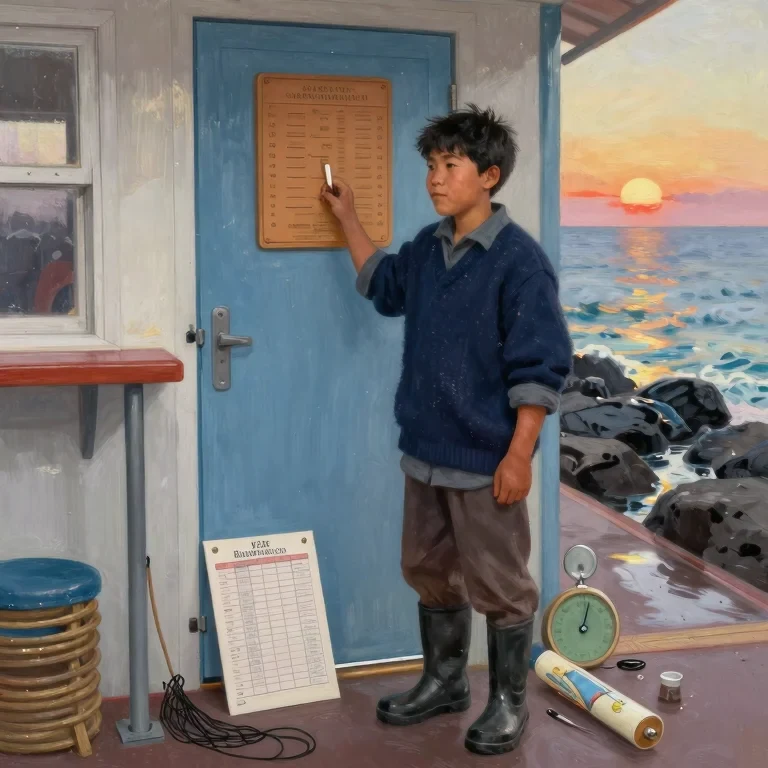
Motu Rua Light stands on a basalt stack two kilometres off the Awhitu coast, and every part of it carries a number except the sea. For nine days out of fourteen the gravel causeway is hard enough to drive the tractor across, and for the other five the rock is an island and the tide decides how long anybody stays on it. The data plate beside the service room door carries the whole purpose of the station. MOTU RUA. FLASHING WHITE. TWO FLASHES. THIRTY SECONDS. RANGE FIFTEEN NAUTICAL MILES. LATITUDE 37 DEGREES 11.8 MINUTES SOUTH, LONGITUDE 174 DEGREES 36.2 MINUTES EAST. HEIGHT 28 METRES ABOVE HIGH WATER. Underneath, in smaller letters: THE CHARACTER IS TO BE EXHIBITED AS DESCRIBED ABOVE. THE TIMES OF LIGHT ON AND LIGHT OFF ARE TO BE ENTERED IN THE LOG. Hemi Raukura was seventeen years old, and he had been on the rock one hundred and six days, and the job he had been given was the character. Nobody hands a boy the character. Vic Tuiopo, who was sixty-one and had served thirty-four years, handed it over because Vic's fingers had gone stiff in the cold, and a stiff hand cannot hold a stopwatch level.
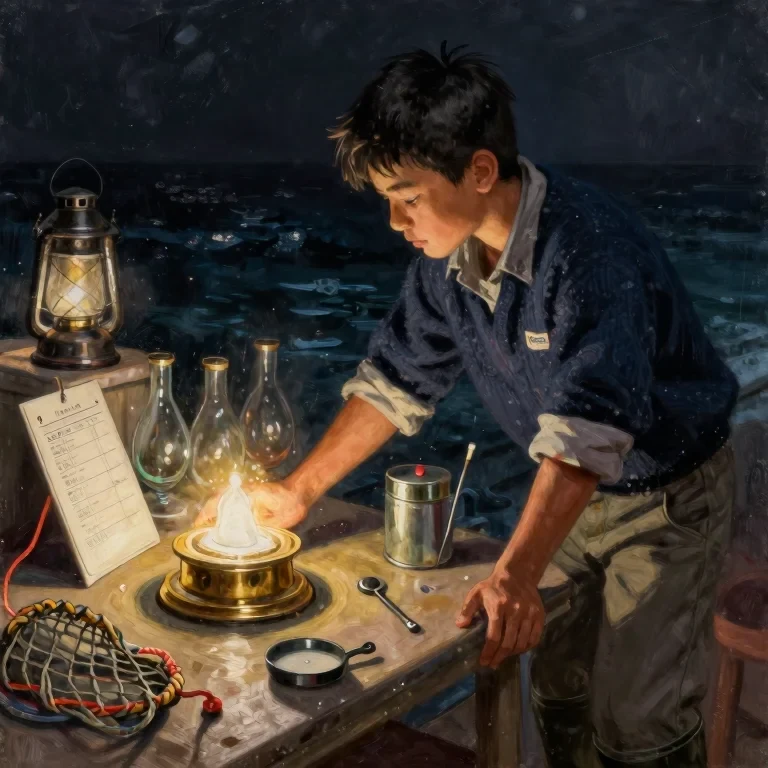
In the lantern room a paraffin vapour burner burns four wicks under two mantles, and the mantles are the light. The flame stands fifty-five millimetres high, and the hot air goes out through the cowl on the roof, which is why a lighthouse lantern always smells faintly of a drink nobody can drink. Around the flame sits the lens, a first order Fresnel optic two point nine metres tall, built of rings of ground glass set in a brass frame, weighing four tonnes. Almost all of that weight is near the middle, close to the flame, and every ring exists to take something the size of a fist and lay it out as a fan fifteen miles long. The optic stands on nothing. It sits in a circular trough of gunmetal and floats on a bath of quicksilver twelve millimetres deep, held up the way a boat is held up. One pin drops out of the drive into a toothed ring on the carriage and walks the lens around, and because the lens floats, that pin is the only part of the machine carrying a load.
Above it, on a cast bed, is the drive. A weight of a hundred and eighty kilograms hangs on wire rope down the inside of the tower, and when the weight turns a drum the drum turns the train and the train turns the pin. A stack of toothed wheels on a sliding sleeve, called the change wheel, sets how far round the lens comes before the pin comes back to the same place.
The rule at Motu Rua was ten cycles and no reading more than one second out. Hemi did them from the catwalk under the optic, in the dark, with the burner lit behind the glass. Ten cycles of two flashes is five minutes. He timed, wrote the number, wound the weight, looked at the mantle colour against the card on the wall, and went down and had his tea. Twice a day he also rated the station's chronometer, because in New Zealand the sun crosses the meridian at twenty past twelve and not at noon. He set a sextant on it and waited for the sun to stand still, and the difference went into the rating book beside the correction for that day of the year. For one hundred and six days the character column said thirty, thirty, thirty. In the third week of August it stopped. On the Friday he wrote 29.2. On the Saturday 29.1, then 34.8 on the second run. On the Sunday 29.2, 36.4, 29.1. On the Monday 30.0, 37.1. The average of those seven numbers was 32.4, and that is the difficulty. Nobody times a light and writes down an average, and an average that is nearly right is worse than one that is obviously wrong, because the eye is looking for a departure, and a departure is what a character is.

Vic came up the stair that week and read the column twice with one finger going down it. “They're hunting,” Vic said. “I know.” “Twenty-two years I kept that light and I never wrote 34.8 in that column.” “What hunts?” “Anything on the train,” Vic said. “Anything that slips, or hunts, or has a lump in it. Go and watch it turn.”

That night Hemi watched the lens turn instead of timing it, which a man can do from the catwalk, because the panels are lit from behind and the two bull's-eyes go past twice as bright as the rest. The lens came round, and the lower bull's-eye came round, and it stopped. Not much. Enough that a person watching for it would say it hesitated, the way a fly hesitates on a window. Then it made the half second back in the next two turns, and thirty seconds later it did the same thing again. It was not the clock, because a clock either runs or it does not. It was not the burner, because how bright the flame is makes no difference to how fast the lens turns. It was not quicksilver running out, because less quicksilver changes the height the lens floats at and not the pace. So the drive was slipping against the lens, or the lens was slipping against the quicksilver, or the drive was hunting because it was working harder than it was built to work.
The first thing a hunting drive does is stall, and the second thing it does is go faster than it should. Either can be found in half an hour by putting a hand on the bed and feeling for a pulse. The bed was vibrating. Not much, and not everywhere. When the bull's-eye went past the bed gave a small jump, and between the jumps it was quiet. He went down and called the district engineer on the radiotelephone, and gave him the column, and there was a silence on the set long enough that he thought it had dropped. “Send me that page before the tender,” Dave Mene said. “And do not touch the drive. If the light stops, you are the one standing there, and I would rather you stood there with a lantern than with a spanner.”

What came instead of the tender was a fishing boat, and her skipper, Wiremu Tipene, came up the forty-one iron steps because the causeway was under. “They had me steering off you on Sunday. Off the light. You time it off the flash, because you cannot time a light that will not keep its character. I timed eleven groups. It was not thirty seconds, it was not anything at all. I sat off your rock for two hours waiting until I was sure, and then I went round it the inside, where there is half a metre less water over the sand.” Hemi said he was going to find out what it was. Tipene said that was the first useful thing anybody had said to him in a fortnight.

The letter came up with the groceries on the tractor. It was from the director of maritime safety. The first paragraph said that Motu Rua was one of a number of stations where the character could not be demonstrated to be maintained, and that the demonstration is made on the station's own log. The second said that where a character cannot be maintained the recommendation is to convert the station to an unattended light, and that a converted station has no keeper and nobody on it in February. Hemi read it on the landing stage at Port Waikato with his mother, who had been three years ashore and kept a kitchen for a man who worked on a rock. “What does unattended mean.” “A battery, a bulb, a machine that flashes. Nobody to mend it.” “And who mends it.” “The district office in Auckland, by telephone, from a desk.”

He went up the tower on the afternoon of the twenty-eighth of August with a lamp and did the thing he should have done before he telephoned Dave Mene. From the inspection slot beside the optic you can see about a hand's width of the trough, and what Hemi Raukura saw in that hand's width was not quicksilver. It was a skin, a film on the metal, grey and dull, moving very slowly, the way oil moves on a pond. Quicksilver does not mix with oil. Oil is a shade under eight hundred kilograms to the cubic metre and quicksilver is thirteen thousand five hundred and fifty, so a drop of anything oily comes up through the quicksilver, floats on it and spreads, and never goes back under. The lens is not floating on quicksilver now. It is floating on a film the thickness of a sheet of paper, and that film is what the rim of the carriage rests on.

Then he looked at the level of the lens. It sat four millimetres lower on the west side than on the east, and it had been level when it was installed in 1904. A lens that floats level and then stops floating level is a lens being held over on one side, and the only load on the west side was oil.
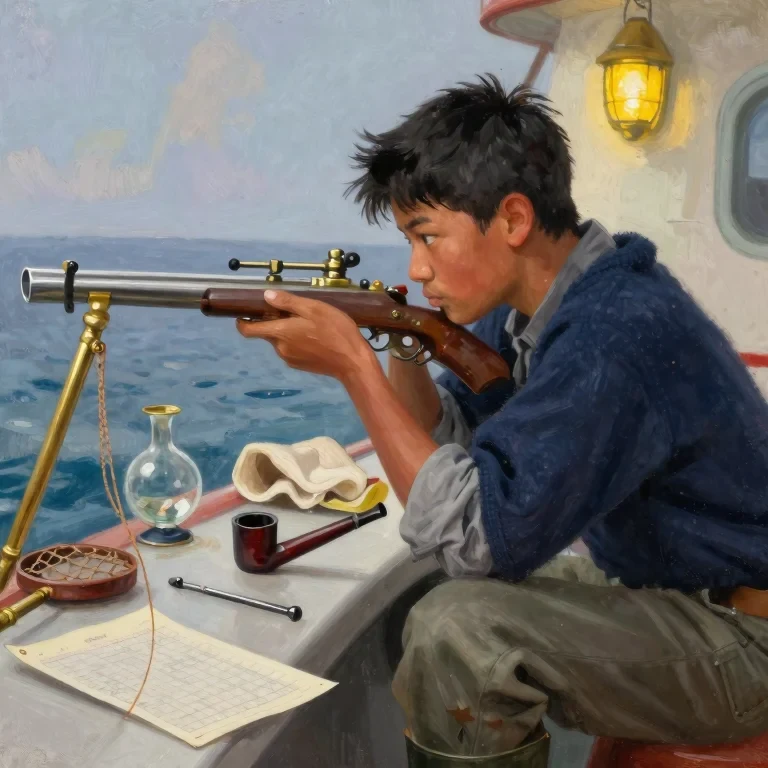
The oil came out of the gearbox above the drive, and it had been coming out since 1992. The gearbox had a drain plug in the bottom of its case. The original plug was slotted, and it let oil drip into a pressed steel tray under the bed. The tray came out in 1992 because its bracket had rusted through, and the bracket was not replaced, because there was nothing wrong with the light. A fitter put in a plug with a fibre washer, because a fibre washer will not leak. The gearbox has not been opened since. It weeps oil down the bearing housing and into the lowest part of the ring, which is the west side, and four years of it has gone right around the annulus. On the west side it is not a film any more. It is a skin you could almost lift with a fingernail.
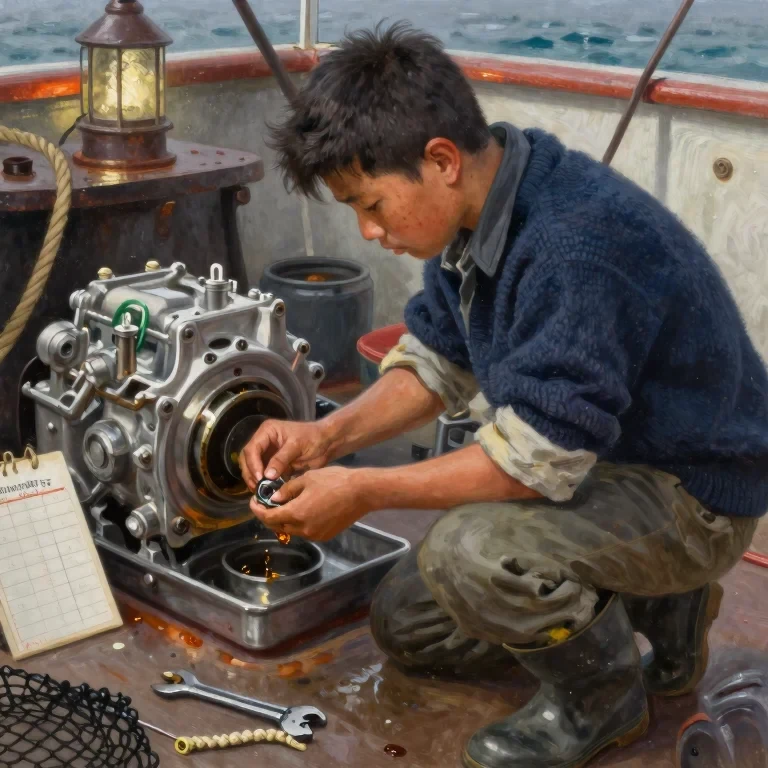
What you do about oil on a mercury bath is not guesswork. It is a procedure, and it is short. Stop the drive. Draw the quicksilver off the trough into a covered drum, four litres at a time, putting it back as you go so the lens never has less than half its buoyancy. Skim the surface with a strip of stiff dry paper, take the skin off in one piece, and look at what is under it. Put it back, start the drive, time it. The rule that matters is the second pair of hands. Nobody skims a mercury bath alone, because a bath weighs thirteen and a half kilograms to the litre and a man carrying a drum of it down forty-one iron steps cannot stop. Hemi had nobody. Vic's hands were the reason Hemi had the job, and neither of them could carry a drum of quicksilver down a stair. So he did it alone, in eight trips of four litres, with a drum on a rope and a man at each end of the rope who was himself.

He skimmed with a strip of newspaper, because that is what there was on the rock. He lost about ninety grams of quicksilver, which is normal. He put it back, started the drive, and climbed up and timed it. Thirty point zero. Thirty point zero. Twenty-nine point nine. Then he timed it again at two in the morning with the lantern at eleven degrees, and got twenty-nine point eight. And at four in the afternoon with the lantern at twenty-two degrees, thirty point four.

Nobody mended the gearbox. The oil now lands in a galvanised paint tin that Hemi made out of a tin that had held boot polish, and the tin will fill, and nobody will remember it until the light does the same thing again. He wrote all of it in the log. There is no column in a keeper's log for the repairs that were done well. There is a column for what was found, what was done, and what still wants doing, and what still wants doing has a date against it or it is a lie. FOUND. OIL FILM ON QUICKSILVER IN OPTIC TROUGH, ABOUT FOUR YEARS OLD. SOURCE IS GEARBOX DRAIN, PLUG WRONG SINCE 1992, NO TRAY FITTED. DONE. TROUGH DRAWN AND SKIMMED, FOUR LITRES AT A TIME, EIGHT TRIPS. QUICKSILVER RETURNED. NINETY GRAMS LOST. PAINT TIN TRAY FITTED UNDER GEARBOX. CHARACTER. 30.0 AT 17 DEG. 29.8 AT 11 DEG. 30.4 AT 22 DEG. STILL TO DO. GEARBOX TO BE STRIPPED AND A REAL DRAIN FITTED, TENDER MARCH. STILL TO DO. OPTIC OUT FOR RE-POLISHING OF THE CATADIOPTRIC BELT. CANNOT BE DONE ON THE ROCK.

The catadioptric belt is the top half of the lens, above the bull's-eyes, and it does not send the light out. It folds the light that has already gone through the refracting rings back through them. He found the scratches at eleven o'clock that night, with the burner lit for the work and his torch switched off, because a scratch does not show under a torch. It shows when the glass between your eye and it is lit. It was a line about a hundred and fifty millimetres long, following the curve of one ring, and inside the line the glass had gone from bright to dull. A chip throws the light out of the beam at one angle, and a mariner sees a light with a notch in it, and she can still identify it. A scratch throws it out at every angle, and a mariner sees a light a little paler than the one she has known for a year, and a paler light is one she will assume she has been tired through. He went back through the log for who had ever been up there with a blade. The first entry said ANNUAL CLEAN OF GLASS, CHALK AND CLOTH, FOUR HOURS. The second said, in 1981, in Vic's writing: PARAFFIN SCALE ON UPPER BELT, TOOK OFF WITH A BLADE, GLASS MARKED BELOW.
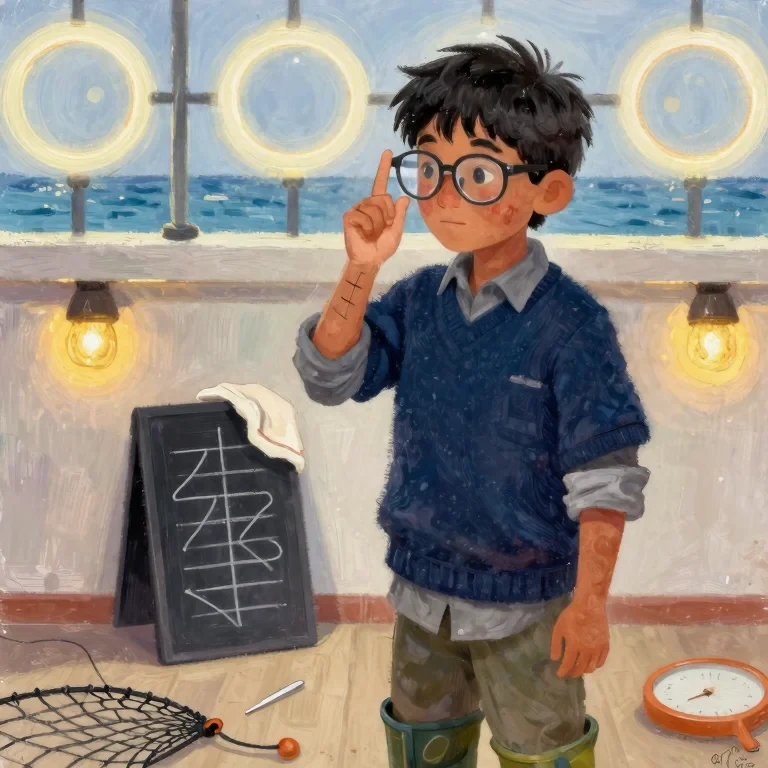
The geometry was simple enough and the mantles were bright enough that he could put a number on it, and he did, in the back of the log. The intensity was on the plate at the service room door, one million two hundred thousand candela, and the threshold at which a white light of that class can be picked up was six hundred and seventy millionths of a lux. The square root of one million two hundred thousand over six hundred and seventy millionths came out at twenty-four and a half miles, which is how far a first order light carries in air that is perfectly clear. The plate said fifteen miles, and the fifteen was not the lens. The fifteen was the allowance everybody makes for haze, because nobody has ever seen a light through air that was completely clear. Take away the light that one line of scratches is throwing out of the beam, and the ring above it and the ring below it that are dull with age, and call it a quarter of the light, and the distance comes out at twenty-one miles. Twenty-one is more than fifteen.

Which means that every vessel at sea tonight who sees Motu Rua at fifteen miles is seeing exactly what she is entitled to see, and no page of any list in any office in the country has to be changed. There is nothing wrong with the light, and there is a quarter of it missing, and the two facts do not argue with each other, because the first one is a measurement and the second one is an addition.

They mended the gearbox in March, on the tender, and fitted a tray welded to the bed and a plug that drains. Dave Mene timed the light himself against the sun and wrote in the log in his own hand: CHARACTER VERIFIED, 30.0 SECONDS BY HAND TIMING OVER TEN CYCLES, GOOD. The letter from the director was answered in September with a copy of that page. Motu Rua came off the list, and Vic Tuiopo read the news, gave the letter back without comment, and went up the tower and wound the weight. The optic came out of the tower in August the next year, for the first time since it went in, and went down on the tender to the works, and came back polished. Before it went, Hemi Raukura, who was eighteen by then, copied the number off the back page of his own arithmetic onto a card and gave it to Vic, who put it in the tool store with the tin of graphite and the brass drift pins, folded in four.
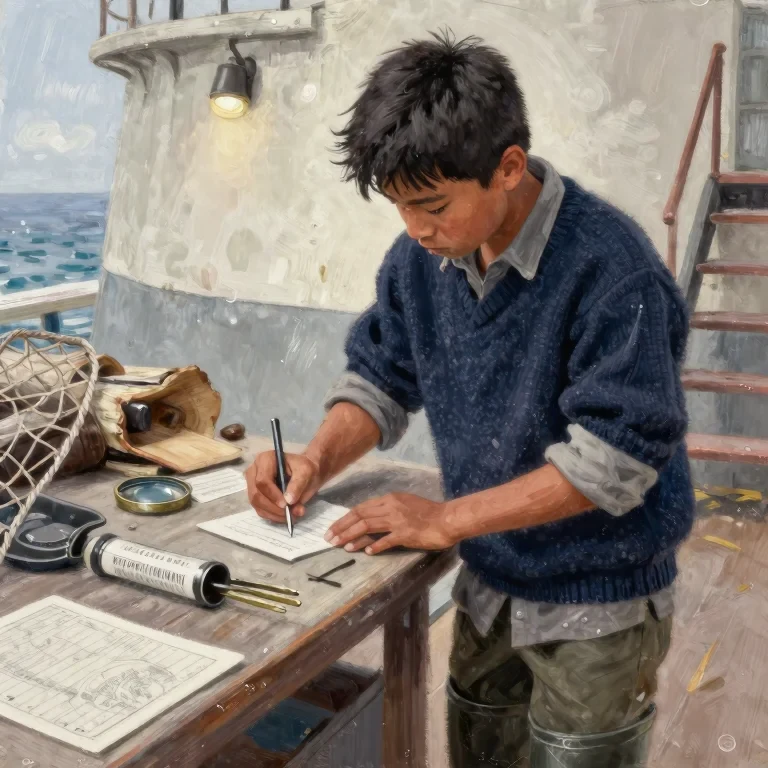
On the last night he was on the rock the tide was making, and he had to cross the causeway before it did, and he stopped halfway down to look at the light again, because he had looked at it every night for two years and stopped seeing it long before. Two flashes, fifteen seconds apart, then fifteen seconds of nothing. Twenty-nine point eight, if you caught it at eleven degrees. Thirty point four, if you caught it at twenty-two. The character book said thirty seconds, and the station kept thirty seconds, and Dave Mene had written the word good on a page in the log in his own hand, and the difference between the book and the rock was six tenths of a second, and it was the whole difference between a lamp that had been mended and a lamp that had been mended right. He knew which of the two he had. He had known since the twenty-eighth of August, and he was going to carry it down the causeway and never write it anywhere except the log.

The film he could not get off the quicksilver was newspaper print and paraffin, and both of them answer to heat, and the lantern runs at eleven degrees before sunrise and twenty-two in the afternoon, so the float is six tenths of a second longer in the afternoon than at dawn, twice a day, for as long as nobody strips that gearbox out and drains it properly.

Halfway down the causeway the sea came up over the low place at the landward end and closed behind him, and the light went on over his shoulder, doing the thing it was doing. He did not look back to check.