Corrie Deane had a form for it. Every resident of Doss County who was living somewhere the county did not want them living had a form, and the form had a box on the front for the parcel number, and a box on page two for the date of the order, and a box on page four marked NOTICE OF INTENT TO RELOCATE, and a box on page nine for the receiving facility, and every one of those boxes was in the wrong place, which is how she knew that in 1994 the county had had this form designed by somebody who had never once had to fill it in.
She filled it in eleven times in nine years. All eleven had gone to a different receiving facility, and none of the eleven had been within thirty miles of the place the person had been living in, and one of the eleven had been a woman with a cat who was made to ride in the truck compartment because the van was full, and that was a fact that Corrie Deane had in her chest like a swallowed stone and had never once said out loud to anybody. The twelfth was a boot.
Tallow Ridge comes up out of the north end of Bray's Fork and stands about nine hundred feet above the town with a long grey spine and a bald spot, and at the sixth bench up there is a hollow in the east face that is, unmistakably, a boot standing on its heel. It is a hundred and thirty feet from the toe to the top of the shaft. There is a spring at the ankle. There is a flat place at the mouth of the toe, and the floor of it is dry all year, and people at the Foy Hardware in Bray's Fork will tell you, for free, forever, that the town is named for a shoe. "Parcel number," said the surveyor, tapping the map.
Corrie Deane wrote the number down. She did not have a parcel number. She had a road name and a landmark and a set of directions that started, unavoidably, with the word if. "Hester Roane," said the surveyor. "She has no deed. She has no tax record. She has no address, because there is no house." "Then what do I write in the address block?" "Write, Shoe, Tallow Ridge." "That's not an address." "It's what's on the 1974 sheet," said the surveyor, and went back to his instrument.
Corrie Deane had gotten into emergency management because she liked a job where the worst day of somebody's life came with a form attached to it. In eleven years she had done flood, tornado, chemical spill, and a derecho that took the roof off the elementary school. She was good at it. She could tell you how many cots a gymnasium would hold, and she could get a generator running in an hour, and once she had personally driven a semi up a road that was under four feet of moving water for a woman in Wheelwright who was going to have her dialysis. She had never once, in eleven years, written a form about a person who was not in a flood. She drove up Tallow Ridge on a Thursday in October. It took forty minutes and the last eleven of them were not road.
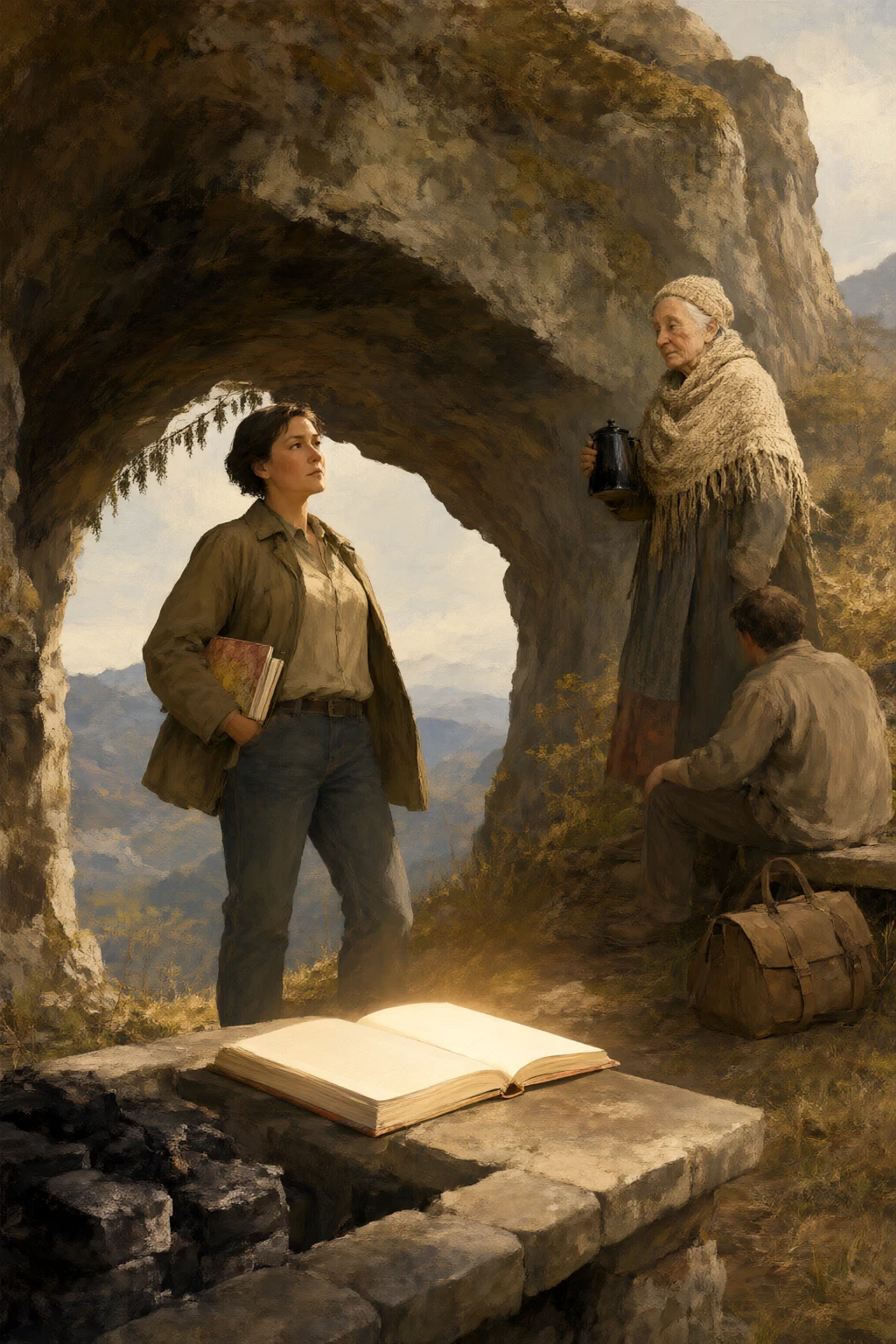
Hester Roane was seventy-nine years old and was standing in the mouth of the toe with a coffee pot, pouring for three other people, and the three other people were a fifteen-year-old boy she did not know, a man of about thirty with a duffel bag and a paper cup, and a woman in a county jacket who was crying in a manner Corrie Deane was extremely familiar with, which is to say with her mouth shut. "Morning," said Hester. "You will be the county." "I am the county." "Then you'll want to not come up here in February." "Why February?" "Because then it's a different conversation," said Hester, "and I'd have to be polite about it."
The hollow is not a cave. It is a scoop in the face of the ridge, roofed by an overhang of rock that runs back about sixty feet, and the roof has been smoked black over a span of time that Hester puts at "since before the road," and the floor is beaten earth laid with flat stones laid by somebody else, and there is a bench along the back that is nine people long and was cut out of the mountain in 1961 by a man named Emery Roane, who was Hester's husband and who is dead, and who had cut it because they were going to be there a while.
There is a wood stove. There is a kettle. There is a line of drying herbs across the mouth of the toe, and the arrangement of them is a filing system, and Hester will tell you which is which, and there are nine kinds. "A boot," said Corrie Deane, "is not a dwelling." "It's a dry place at the top of a hill with a spring at the ankle," said Hester. "You are going to write a word on a form about it, and I'd like to know which word." Corrie Deane looked at the boy, who was eating a canned peach over the fire, and at the man, who had not stopped holding the paper cup. "How long have people been coming up here?" she asked.
"Since the road," said Hester. "There was a road in 1951 and there was a boot before that, and the first person who slept in it was a man named Tal Bott who had come out of the mines at Gauley and could not make a room, and I made him one."
The hearing was on the fourteenth of November at nine in the morning in the courthouse annex, and the county's position was that the parcel was unoccupied, and the quarry company's position was that the parcel was unoccupied, and the two of them had arrived at the same conclusion independently and with enormous relief. Corrie Deane sat in the third row and had a form on her knee and did not use it. The clerk said the old woman had no standing. "She has no parcel number," said the county attorney, "and no deed, and no record of residence, and no next of kin, and no correspondence address. She is, in the language of the county, an unaccompanied adult on an unaddressed structure. She cannot be a party to this hearing because she is not a person to the county of Doss, she is a location."
Hester Roane, who had put on a good coat for this, said: "I have paid taxes." "You have paid taxes on the bench," said the county attorney, kindly, "which is a fixture of the structure and is exempt. The bench is your personal property. The mountain is not yours and has not been for a hundred and thirty years, and the county has no obligation to you in respect of a thing you have never owned and have been permitted to use." "That is a long sentence," said Hester. "It is the true sentence."
"Then I will say a short one," said Hester. "There are four people in my boot tonight and two of them have no other address, and if you take the mountain this winter, one of them dies, and you will be able to say afterwards that you did not know. I am trying to save you from that sentence." Nobody in the room believed her, including Corrie Deane, and the hearing adjourned, and the permit was thirty-one days from being written.
Corrie Deane went down the mountain and drove to the records barn in the yard of the old county hospital, because that is where the Doss County emergency plans live, in grey boxes, on a shelf, filed by year, and because she was in the habit of a thing she could not explain, which was that when a case would not resolve in a room, it usually resolved in a box. The 1974 plan is a hundred and nine pages and it was written by a man named Belcher who had a hard time with a typewriter. Page seventy-one is titled SHELTER-IN-PLACE SITES, NORTH SECTOR. Item four is the Shoe. It is written as: sho, talow ridge, 6th bench, crkt bot rd, 40 cap. She sat on the floor of the records barn with the box on her knees for a long time.
They had used it. That was the thing. It was in the plan as a shelter with a capacity of forty, and it had a number, and the number had been used: in 1998, in 2004, in 2011, in 2013, in 2016, in 2019. In 2013 it was in the plan as the designated site for the closure of the Beech Bottom road, and eleven people slept on that bench with a county blanket, and the county did not know the name of the person who let them in, and the person who let them in did not send a bill, because she did not have a bill to send, because the county had never sent her a form either.
Fifty years. A hundred and forty people, somebody estimated, in the boxes. Forty capacity, and it never had more than fourteen, because it never had more than fourteen, and the reason it never had more than fourteen is that a boot that has fourteen men in it is not a refuge, it is a fire hazard, and a woman of seventy-nine is not going to say that to a magistrate.
She drove back up on the Thursday. She brought the plan in a plastic sleeve and a legal pad and she did not come alone, because by then there were eleven other people coming, and four of them came up the mountain in a van, which is not a road. "Nobody asked me to do this," Corrie Deane said. "You asked me," said the man with the duffel bag. "You asked me if I would come and say it again in front of them, and I said yes, and that is a thing you can stop doing at any time, and I am not stopping." "You were the fourth person in the boot in 2013." "I was the one who came back for my cousin's dog," he said. "The dog is a different story. The dog has a vet bill."
The hearing was rescheduled, and the county's position changed twice, and the second time it changed because the county attorney did the ordinary thing, which is to go and get a copy of the county's own plan. Hester Roane lost the mountain. There was no argument about that and there was not going to be, and the quarry company's engineer was in the room and he was not a cruel man, and he said, plainly, that he had a permit application for eleven acres and a condition about existing structures and that he would rather have a clean site, and that the boot was not going anywhere because it was a scoop in the face of a rock face, and if she left it would be full of water by spring. "That is the rock coming down," said Hester. "That is the whole of that rock coming down."
"Yes, ma'am," said the engineer, and it turned out he was from two counties over and he had a grandmother exactly like her, and he could not look at her for the rest of the hearing. What the county had to do, and did, and did because the plan said so, was this. Under the county's own emergency management regulations, an unaccompanied adult displaced from a designated shelter-in-place site is not to be relocated outside the community of prior residence. Corrie Deane knew that section number by number. She had written the revision of it in 2015 for a completely different reason, for a woman in Wheelwright, and she had gotten that woman a bed in her own township, and it had been the whole of what she was proud of.
She read section 4.11 out loud. Then she read item four off page seventy-one of the 1974 plan. Then she said: "That site is decommissioned, effective today, and the occupant is a county liability as of today, and county liability is relocated by the county, into the community of prior residence, on a voucher, with an advocate of record, or the county is in violation of its own regulation, and the violation is discoverable, and the plan is a public document." The county attorney looked at her for some time. "Would you like to step down?" he said. "No," said Corrie Deane. "I would like to be the advocate of record. That is what section 4.11 gives me. If I am not the advocate of record, the county must appoint one, and there is nobody in this county more qualified than me, and I would like it minuted."
There was a house on Lower Road in Bray's Fork, four rooms, unheated in the sense that the county's voucher would buy a space heater, and a well, and a yard with a gate, and it is eight minutes by car from the sixth bench of Tallow Ridge and about the same by somebody on foot who knows the way. Hester Roane did not want it. She refused for eleven days, and she refused in writing, which meant Corrie Deane had to write a response in writing, which meant that for eleven days the two of them produced more correspondence than either had produced in a career, and neither of them ever once raised her voice, because they were both raised by women who considered it a form of bad debt.
"You have a chair," said Corrie Deane, on the sixth day, standing in the rain at the mouth of the toe. "I have a bench I cut out of a mountain in 1961." "You will have a bench. I will put a bench in that yard with my own money and I will not be reimbursed and you can report me if you like. You will have a stove. You will have a door that locks, which is a thing you do not have, and I have written that into the file, and it is a condition, not a request, and I made it because I am the advocate of record and I am allowed exactly one condition and that is it." "That is a small thing to spend your one condition on." "It is the only thing in that house that is not a benefit," said Corrie Deane. "A chair is a benefit. A locked door is a service. I have spent a great deal of my life being right about the difference."
They moved her on the third of December. The stove went in the truck. The herbs went in a basket, sorted, nine kinds, in the order they hang. The bench stayed on the ridge, because it was cut into the rock and could not be moved, and Hester Roane sat on it for forty minutes before she would go down. The ledger went in Corrie Deane's own car, in the front seat, on her knees, because it was the one thing Hester Roane would not put in a truck.
It is a school composition book, the plain kind with the marbled cover, and it begins in 1964, and it has run out twice and been replaced twice, and there are one thousand one hundred and six entries in it. The form is the same every time and Hester taught it to a county clerk in 2008 so that it could be typed: name, the date, where from, and what was needed. What was needed is always short. Bread. A week. Somewhere to wash. A phone call to a sister in Hazard. Somebody to talk to, twice, on a Sunday. Once, in 2002, in a hand that got smaller toward the end, because the person was nine years old: somebody to believe me.
The newest entry is three weeks old and says: WADE T., 19, from the yard behind the Shell, no charge, needs a job and somebody to know where he is. Corrie Deane put the ledger on the kitchen table of the house on Lower Road, and squared the chair to it, and opened it to the back, and wrote the date, and then stopped with the pen on the page for a while, because it is a small thing to be asked to do a thing you have no standing to do. Hester Roane came in behind her with the last basket and put it down on the floor and said, "Leave it. You'll smudge it."
And then a knock at the door, and the boy from the toe was standing on the step with his hands in his pockets and a paper cup in each hand, one of which was for the old woman, and Corrie Deane got up to let him in, and the ledger was lying open on the table with the pen across the page where she had left it, waiting to be finished in the morning.