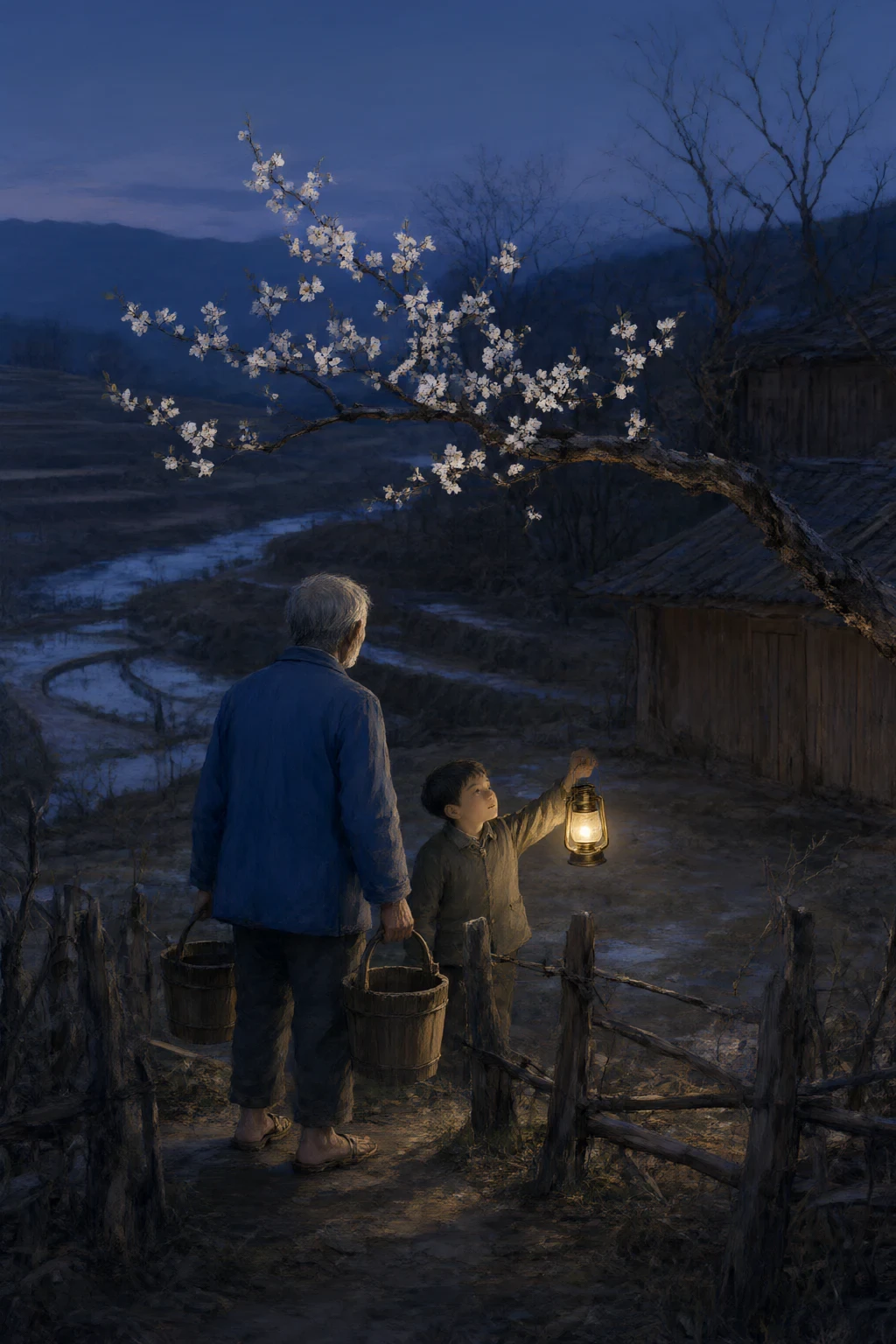
The old man's cherry tree died in the third month of the year before last, and he did not have the dead wood taken down for twenty-eight months. The house stood on the last ridge above the village, and from the ridge the fields went down in a long brown fan to the stream, and above the house the wind came out of the north with nothing in front of it. Hizaemon had set the tree the year he married. Osae said at the time that a cherry planted in a wedding year would outlive them both, and she turned out to be right about most things. He had carried the first two buckets of water up from the trough every evening for sixty years. When the tree stopped, he carried the buckets anyway.
"You are watering a plank," said the neighbours, coming up the path to say so, and grinning. He did not answer them, because he had stood on the same spot when his own father was watering a section of wall, and had heard the same sentence, and his father had gone on carrying the water up for six more years. There is a kind of labour in a family that nobody can be talked out of, and it is not strong exactly. It is stubborn in the way a wall is.
The dead tree had one live limb left, at the top, on the south side. Every spring three or four leaves came out on it, thin and small, and every autumn the sparrows stripped it bare. A dead tree with a little life still in it is safer than a live one, because you can see out of it. Each March the sparrows came back. Each May the two elder boys, Setsu and Roku, shook the branch and the nest went down into the grass. "Don't," said their father. "It is only sparrows." "It is only sparrows today," Hizaemon said, and neither boy heard anything in it at all, and the third boy, who was nine and named Jiro, would remember the sentence forty years later and hear all of it. Nobody in the house said the word wish out loud. The word came in sideways, the way the pedlar Sasaki brought thread and needles and small lies to the ridge once a year in the eighth month and slept in the outbuilding.
"He said a tree that is watered every day, and never given up on, will bloom for a man who asks it properly." That was Setsu, the elder, at the winter table, cutting bread very slowly so that the cutting would last. "He said it in the eighth month and you have been quoting it since the ninth," said Roku. "I am quoting a man who sells needles." "He sells needles and he sells the truth besides, and you can check it with any farmer on this ridge, because every farmer here is watering something."
Which was fair. The old man had said it out loud that winter, to the boys, and the boys were not the ones he meant it for. The orchard above the house was the family's living, and the cherry was the one tree on the ridge that was his alone and not his father's, and the only thing on this land he had set with his own hands and kept alive on his own stubbornness. He would have liked to see it flower again. He wanted no money out of it, no horse, no marriage for anybody. He wanted to know that sixty years of water had not been wasted.
Roku wanted a horse. Setsu, who said he did not care, had a small canvas bag packed and repacked twice a month for three years. A dead tree that blooms is worth a great deal at a market, because a blooming branch sells for a festival offering and a dead cherry sells for firewood. They set the snare in the third month, on the live limb, at dusk, because the sparrows were on it and something ought to be on it. What came into the snare at the dark was not a sparrow.
He was a white wagtail, in his second year, from the second brood of the summer, and he had been hatched in the plum tree in the yard and had never known a trap was a thing with opinions. "Leave me," he said. The boys had a name for the catching. They wrapped him in a cloth and took the snare off his leg and dropped the snare into the stream, because Setsu thought a drowned snare might somehow report back. The wagtail was not sorry for himself in a way that either boy could stand. He was interested. He looked at their hands. He asked, without any particular politeness, whether they were going to kill him, and when neither of them answered, he said, "Then you have not decided, and I have." "What's it say?" said Roku. "It's talking." "It's swearing," said Setsu. "It's swearing in wagtail."
There was one wagtail nest in the yard, in the plum tree, that spring, and it was not this bird's nest, and they had not looked. Old Hizaemon was in the barn when Setsu came to fetch him, and the boy did not say a bird. He said, "You should come and see the tree."
The old man came out with his hands still wet. He was eighty-one, and the light was going grey at the edge of things, and he had learned to stand close to a thing and let it come to him. He was shown the bird. The bird was in the cloth on the ridge. It was not dead. It had not been killed; that had been decided later, on the way up, by Roku, in a sentence, while Setsu walked on ahead and did not turn round. The old man knelt down, which took him a while, and put his face close, and smelled it, because his sight was not much use any more and he knew the smell of a living bird better than he knew the shape of one.
Then he sat back on his heels and asked, the way an old man asks a question when he already knows the answer and wants to hear the other side say it. "What have you done with him?" "He will not say it," said Roku. "He will," said Setsu. The wagtail said it. He said they had caught him and were going to kill him, because the old man wanted the tree to bloom, and the tree wanted blood, and the boy's father had heard it from a pedlar and did not want to give up a horse. Then, because he was a bird and had a bird's habit of finishing the most important thing at the end, he said: "Your tree is not dead." "My tree is dead," said Hizaemon. "I have carried water to it since the third month of the year before last."
"Your tree is not dead," said the wagtail, "and it is not thirsty, and it is not waiting on you." "Then what is it waiting on?" It was Setsu who answered that later, in the village, to the scribe, years afterwards, when he was a man with a reason to remember it exactly. The bird told his father that a tree pays in the coin it is given, and it pays the one who gave the coin. The old man had been giving the tree water for sixty years, and patience, and two buckets. A tree does not count patience. A tree counts what was taken off it, and thirty springs had gone by with nothing coming up, and every year the boys had shaken a nest out of it and carried it down the hill in their pockets, and nobody had ever put anything back.
"It wants the coin," said the wagtail. "The tree is owed. That is all a tree says. It says it by not flowering." The old man did not say anything for a long time. The two boys stood on a bare ridge in the third month with a bird in a cloth and their father's back bent, and in that moment nobody in the field was thinking about a wish. The wish had gone out of the business. What was left was an old man and a debt, and a tree that could not speak and had been waiting anyway.
They killed him at dusk on the ridge, and they did it quickly, in the way boys do a thing they have decided in advance to be quick about, and the old man was not there. Setsu did it because Setsu had said on the way up that they would do it and could not then be the one who did not. The blood went on the dead limb at the place where the nest had been.
They came down the hill in the dark and the old man heard them on the path and heard, in the middle of their coming down, one long silence where two sets of feet ought to be, and he understood, standing at his own gate, before either of them had got to the step, exactly what had happened. He went on standing there for some time. Then he went out and up the ridge with a lamp, and it took him a long time, and Jiro, who was nine, went with him because a nine-year-old cannot be sent to bed in a house where the lamps are being lit.
The old man's face when he saw what was on the limb is not worth describing. It was not grief for a bird. Jiro understood that much even then. It was the face of a man who has been watering a thing for sixty years and has just been shown its account.
It bloomed on the ninth day. Not a great deal of blossom, and not the drowning flood the boys had pictured and had already priced. Something under three hundred flowers on one dead limb, pale and thin, each about the size of a thumbnail and set on a short stalk, so that the whole thing looked less like a tree flowering and more like something hung up to dry. The village came. That is what happens; people come. They stood at the fence and said it was a miracle, and the word went round the ridge inside two days, and by the middle of the fourth month there were three men from the town asking after the cherry with a view to buying a branch.
Hizaemon stood in the yard and said, to each of them, "It is not for sale," and to one of them he added, "Tell them who you heard it from, and ask that man what the cause was." Nobody could answer that. That was the thing that went wrong for the story later. The cause was not sayable in the marketplace, because the cause was a second-brood wagtail with no name of his own, called Kokko by two boys on a ridge and given that name on the strength of a noise he made at the gate. The pedlar's story had a shape: an old man, a wish, a reward. The old man's story had a shape too, and no reward in it anywhere.
Roku, who was seventeen and had wanted a horse, was the one who broke. He came in at dusk and stood in the doorway and said, "What do you want, then. Say it plainly. I will do anything you ask and let it be said I did it." The old man thought about it for a while, and the answer he gave was not a punishment. It was worse than a punishment, and Roku understood within a year that it was worse, and has never been able to describe it to anybody who did not live in that house. "I want it written down," said Hizaemon.
Motegi kept the village record, and one of the books in his hands was the register of the trees. Not a poem-book; the temple had the poems about the blossom. Motegi's book said which tree on which holding had flowered in which month, and in which year, and it had a column for the cause, and Motegi had never once been given anything to put in it in eleven years, because no one on that ridge could tell him why anything did what it did. The old man came to Motegi's house in the ninth month with Jiro, and asked him to enter the flowering of the cherry at the Tsukuda gate.
Motegi wrote the date and the number of blossoms and the colour. Then he stopped and put his brush down, because the cause column was empty, and the whole ridge had an opinion, and the whole opinion was that the old man had got what he wanted, and Motegi did not want to write a lie in a book that people keep. "Write what you saw," said Hizaemon. Motegi wrote: A wagtail of the gate, killed without its asking, and the limb it was caught on put out flower. Motegi read it back twice. Then he said, "There is no name." "There is a noise it made at the gate," said the old man, "and the boys called him Kokko when they caught him, and I have heard of no other name, and a bird that has only one name is not badly off. Put that."
So it went in. And Hizaemon stood there while the ink dried, and watched the column, and did not ask for the sons to be written anywhere, because there was nowhere to put them. He had thought about it on the walk down. He had wanted a column. There was not one, and so the record said what the record had room to say, and the rest stayed in the house, which is where most of it stays. Roku came in the next month and asked what had been written. "That the tree bloomed for him," said the old man. "For the bird. Not for us." "I want it in that I was there." "Be where you were," said Hizaemon. "There is no column for that."
The fruit came in the seventh month, small and hard and sour beyond what a cherry ought to be. The village came and tasted it and said the tree was a marvel, and the old man gave all of it away, which annoyed his sons. By the third year the fruit was good. Nobody ever found out why, and he was asked twice, and both times he said that a tree took its time and did not work to a schedule. In the eleventh year he had a fifth column cut into the household board.
The board was a plank of cedar a hand wide, hung by the door, and the notches on it were the family's whole accounting: seed in the third month, the two ploughshares, the hens, the tea, the winter fuel, the eight hundred strings of thread Osae had spun. Every year the count was cut in the wood and paid off in cord, and a fresh length of cord was hung over the nail. The old man cut the fifth column himself, badly, with a chisel and a lot of swearing, and it ran the whole length of the plank, and the only thing that had ever gone in it was the name of a bird.
That was the only reward the bird got, and it took the old man two days of work to make it, and he said nothing about it to either of his sons, and they did not find out for a year. The boys carried water after that. Not because the tree needed it; a cherry that has flowered needs less water in a dry summer than a cherry that has not, and the old man said so. Setsu did it on the third day of the month, and Roku on the fourth, and the elder of them did it without being told, and the younger turned up for six years running, which was four more than anyone had expected of him.
The tree is still there. It is not a famous tree and it is on no list except the register, where it is entered in a column that was empty for eleven years and has had two entries in it since. In the eighth month, a young woman on the ridge below asked the old man whether the blossom was worth anything, meaning the tourist trade, and he took her up the path and put her hand on the board and showed her the fifth column without saying anything at all, and she looked at it for a while, and then she apologised, in her own way, and did not ask again.
He went up at dusk that evening with the two buckets. He had carried them up every day for sixty-one years, and he was eighty-two, and the path was short. The lower bucket he set down first, under the north side, where the roots ran shallow, and the upper bucket he hung on the hook at the crotch of the limb, at the place where a nest had been taken in May, and where, if you looked for it, there was a knot in the wood the size of a thumb.