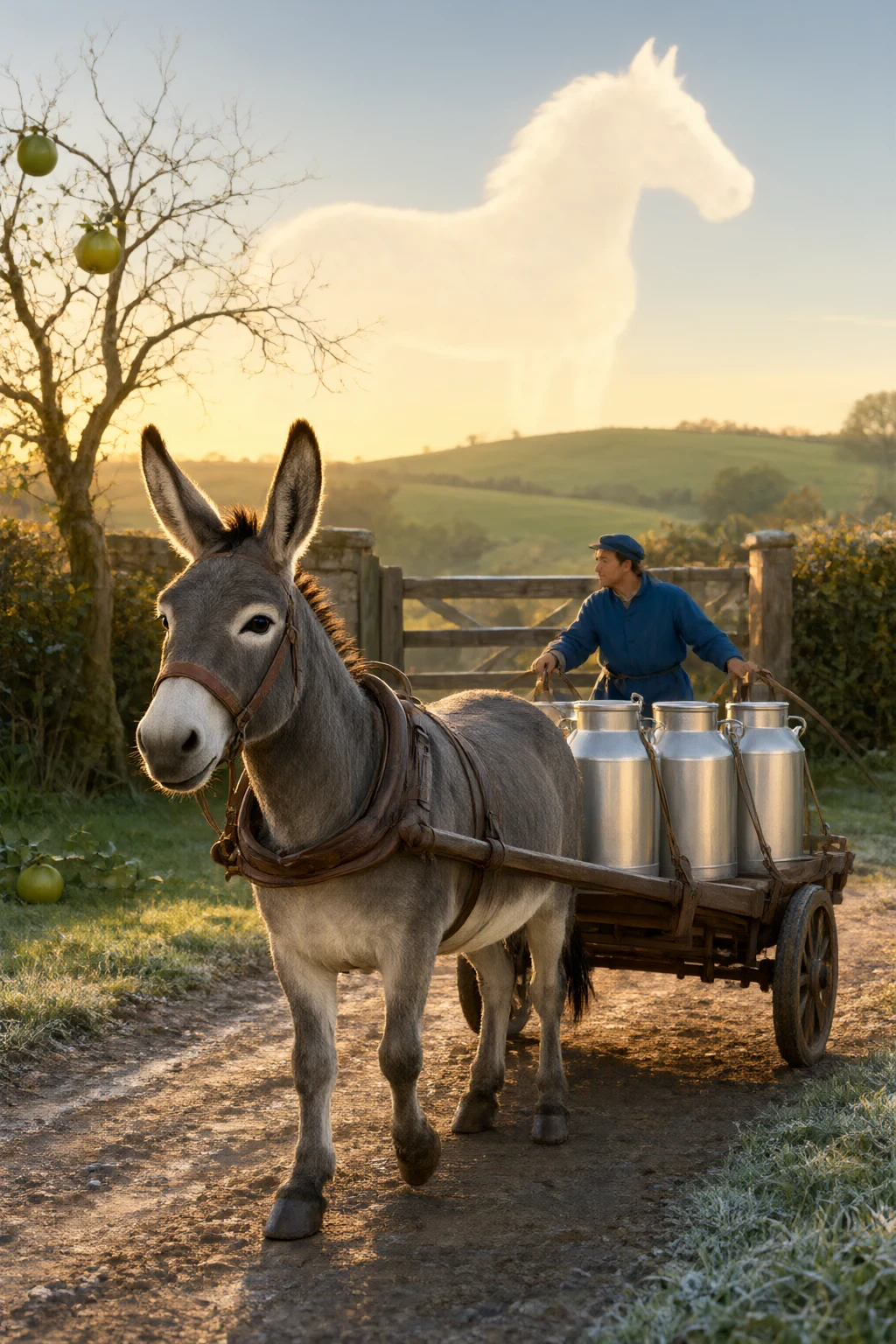
His name was Grey, and everybody called him Grey, and Grey thought a great deal about that. He had been four years at the dairy, and the work was the same every day. He was harnessed, and the cart went out at five, and he walked the lane down to Marta's farm and back, and on the way he carried four cans of milk.
Four cans, and every can in a sling. That was the part people did not understand. A strap went round each can and up under the belly, so that when the cart went over a stone the can went with the cart instead of going to pieces. Grey wore a broad strap across his chest for it, and the strap had been made by the cartwright and fitted by a man who had fitted it four hundred times. Grey was the only cart on that road that could take the lane with the holly on it.
What he had against Grey was the name. He had decided in his second year that he was called Cloud, after the cloud that is the shape of a horse, and there was a field on that road where you could lie down and watch one come over the hill. He had never said this out loud, but he thought it every morning, on purpose, on the way to Marta's farm. It was a Thursday in May, and it went wrong in four small ways, one after another, the way days do.
It was a Thursday in May, and it went wrong in six small ways, one after another, the way days do.
One: the hens were out. He had to go along the outside of the hen field, which took him past a gate with a bar across it, and the bar was new, and it was lower than his head, and he did not duck. It caught him across the ears. The hens did not stop. He stood there with his ears ringing and the cart a foot behind him and had to back up and start again, and by the time he had started again the hens had gone over the wall and found the beans.
Two: at the top of the lane there is a bad stone, and on the bad stone there is an apple tree, and in May the tree drops its small green apples across the whole width of the road. He stopped. Everybody knows he stopped. He ate four, and there were four left on the road behind him, which his ears had told him about without being asked. Three: the church bell went while he was under the arch, and it was a quarter past, and it was not the quarter past, and he went forward at a trot for a quarter of a mile.
Four: he got to Marta's farm and one of the cans was laying on its side in the cart with the milk running out onto the straw, and the strap had not gone, but the can had turned, and he had to go and say so.
Marta did not scold him. That was the worst part, and he was not ready for it. "Oh dear," she said. "Did it turn?" "Yes." "Which one?" "The near left." She tipped it up. She wiped the rim. She put the strip of clean sacking in the neck and the strap back under the belly and tightened it, and she did all of it herself, and she did it in about as long as it took to say nothing. "Ole will be cross with you," she said. "He is cross with the harness and the cart and the price of everything. Do not tell him it was the bell."
Ole the miller came down the lane in the afternoon with a load of flour, and he saw the cart, and he saw Grey, and he laughed the way a man laughs when a thing is very predictable. "Well, Cloud," he said. Grey stood still. "Mill's running lovely," said Ole, and went home. He was only joking. He thought nothing of it for the rest of the day. It was the one thing Grey carried down to the byre that evening and did not put down again.
On the Friday he was slow. He knew he was slow. He walked up the lane with his head down, and he did not look at the apple tree, and he did not look at the sky. The next week he was slower. The week after that he stopped eating the four apples and stood with his nose over the bad stone, and there were always four, and he left all four, and they fell round his feet. By the middle of June the dairy boy said it out loud in the yard, not to anybody, the way boys do. "They ought to get rid of him. He is old." And Grey heard it, and went into the dark of the stall, and lay down in the straw at the back where they do not look, and was not there in the morning for the cart.
Marta came out to the byre herself. "Get up," she said. He did not. "I have been getting up at four since I was seven. You get up." "You ought to get rid of me," said Grey. "The boy is right. I am old and I am slow and I cannot be trusted with a bell any more."
"No," said Marta. "I have a bell and two hundred cows and one cart, and I am not going to the market on a horse I do not know to buy a young one who has never been down a lane in his life and will be frightened of the holly. You are the only thing here that knows that lane. That is not being old. That is being the one that knows." He got up.
On the Monday after that, the dairy boy called Jens was left to do the round alone, and he did it wrong. He stropped the cans loose. He heard the milk slopping and he pulled them tighter, and he was pulling on the strap and not the belly band, and by the corner of the hen field the near can was swinging with a foot of daylight under it, and Grey knew exactly what that meant, because he had felt that can go on the second Thursday of May, and he could feel the difference between a strap that is holding and a strap that is about to let go.
He stopped. He would not go on. "Cloud, come on," said Jens. He did not move. "Cloud! What are you doing?" "You have not put the belly band under," said Grey. "You have put your thumb on the buckle and the strain is on the top. It will hold until the arch and then it will not hold after the arch."
Jens looked at the cart. He got the can down on its side in the grass. He undid the strap, and found the belly band hanging loose on the shafts where it had been since they left the yard, because the strap that keeps the band in place was the same strap, and he had undone it and thrown it over the can.
They got to Marta's farm four minutes late. Marta did not scold him. She said, "Off with the yoke then, Grey, and put your head over the fence," and she did, and she said, "That is enough. Go and eat the grass by the gate and do not stand over it." He did not want the grass by the gate. He wanted the lane, and nobody had noticed that he had stopped wanting it, because a slow cart is not a thing anybody watches.
On the Tuesday the cart went out at five as it always had, and Grey was harnessed before he was finished eating, and the four cans were stropped in with the belly bands, because Marta had done it herself, twice, and showed Jens how.
They went down the lane. The hens were in. The bad stone was there and the four green apples were on it and he walked straight past all four of them. The church did not ring. He went under the arch with his head up and his ears where they belonged, and the hooves went on the gravel, and the cans did not make a sound at all, because four good cans on four good straps do not.
At the top of the hill he stopped anyway, and looked back, and the whole road and the four apple trees and the dairy roof were going gold in the early light, and there was a cloud over the field on the east side, and it was the shape of a horse. He went down to Marta's farm and put his nose in the pail and drank the foam off the top, which he was not supposed to do, and which everybody at that dairy allowed him to do, and got his ears rubbed, and was harnessed again at four the next morning, and every morning after that.