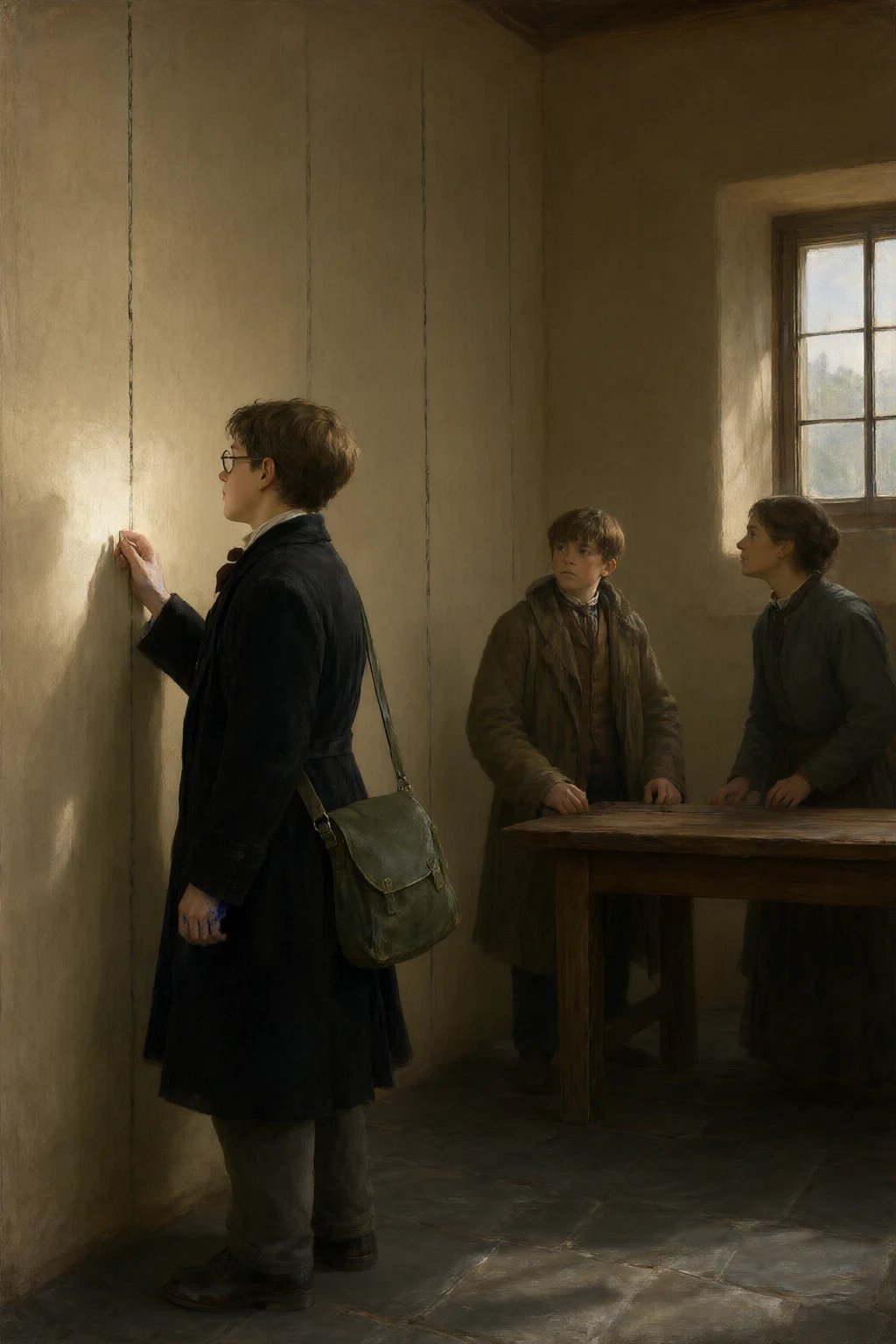
The Chart House had one north window, one long table, and a wall on the east side with the rota on it in ruled black chalk. The table was four tables. It had been joined with iron dogs in a year nobody could name, and the join had a dip in it where a cup had been set down and forgotten, and for nineteen years every clerk who had ever laid a sheet of paper across that table had put the sheet in the dip. Ansel Roke had never had it mended. He liked the dip. It was the only part of the document he had not written. On the twenty-fifth of Sleetmonth he came in before the light and unjoined them himself, which took him until the light came properly through the north window and lay along the slate floor, and set the six apart in a row under the rota wall, with a chair at each and the chairs a foot apart so that no two of them could hear a lowered voice from the next. Ione Sarrack had called the audit. She had called it because the Register of the Living had to be closed before the turning wind, or not closed, or closed with a note on it, and because she was the Head Tuner and the chart was the instrument she kept and there was nobody else in the valley to call anything.
“Terms,” she said, when they were all in. “Six tables. Six hours, one hour to a table, and the hour is not lengthened and not shortened for anybody, and the glass goes over at the sixth hour whatever is unfinished. A person may speak to the auditor. A person may not speak to another person at another table. A person may not refer to a table they have already left.” “Agreed,” said Ansel. “And the second term, which is mine and not yours.” She had her hand out of her sleeve. “Nobody remembers anything.” Marda Illis put her head up. “No.” “No. Not in the room. Not out loud. If you have a bell in your head you will put it on the table, and if you have a bell in your head and you put it into your mouth while the colonnade is sounding, you will not have that note again for the rest of your life, and this valley will not be able to give it back to you, because the only account we keep of what a person’s voice was is the person.” She said it without any weight, being a woman who had said heavy things in a furnace yard before. “It is the only kindness this house has ever been able to offer anybody, and it is a monstrous one, and I am making it law for six hours.”
Nobody argued. It is easier to accept a rule like that than to explain why you would rather not have it. “Every answer,” Ansel said, “comes from a record. If you have nothing in a record, you have nothing, and I will write that you have nothing, and that is a finding and not a failure.” “Then we will find very little,” said Bela Truce. They sat down. The audit had to be finished before the turning wind, because the turning wind is the one wind of the year that reaches all nine bays, and the Register is read in the Chart House courtyard on the first Thursday after the first hard frost, when a boy-tuner stands in the middle of the yard and reads the wind out loud and nine hundred people stand still until he has finished. That is the one public act the valley performs about who it contains. A Register not settled by then gets read unsettled, or gets read off a rumour, and a rumour about who is alive has cost this valley more than a gale ever has.
Ione Sarrack sat first because she was the Head Tuner and it was her house, and she brought nothing, and she put her bare right hand on the table with the chalk-dust in the creases of it and did not use it. “State the rota for the last twelve months,” said Ansel. “Twenty-fourth of Sleetmonth, fourteenth year, to the twenty-third of this month. Bay one, bell one, Perrin Vole, winder’s mate, called at dusk on the eleventh and the nineteenth. Bay two, bell two, Perrin Vole, called on the eleventh and the nineteenth. Bay three, bell three, no rung, the yoke pin was cold and was not touched. Bay four —” She went on for fifty minutes. The slate floor carried the sound of her voice and made it a little harder, so that it was like listening to somebody reading in a room with the window shut. She gave dates and bays and bells and ringers and called, and she gave them without a stumble, and the one thing she did in fifty minutes was look up, once, at the wall, at the place where the last column ended. “There is no gap in my chart,” she said. “I have never permitted a gap. I was taught the chart by a man who had a gap in it and he was a fool.” “State the acts of your tenure that required a form other than the rota.”
She was quiet for the length of four breaths. “One,” she said. “Thirty-first year of the turning wind, eleventh of Sleetmonth, twenty-third year. Bell nineteen in bay four. Re-pitch. The crown was opened and the lip was ground. It is a lawful act and it was minuted and I signed the minute and the ash reader witnessed it and the blower's grandmother witnessed it, and the minute is a sheet of paper in a chest in this room and it says what I have just said and it is a good sheet of paper.” She put one finger on the table, not quite touching it. “It does not say whose sentence was in the bell.” “Can it?” “No. A re-pitched bell keeps the tone and loses the sentence. There is no language for the loss because there was no language for the keeping. The words died with the body. What the glass has is the interval, and a re-pitch grinds the interval off the lip and leaves the bell with a name on its crown and nothing to say.” She looked at him. “So there is a bell in bay four with a name on it and no sentence in it, and I do not know whose last words that bell was made to hold, and I signed the paper that took them out.” “Do you know which bell it was?”
“The minute says bay four, bell nineteen. That is in the record. I have never been able to remember which bell it was, and I have organised forty years of charts around not finding out.” “Why?” “Because a chart is a machine for remembering,” Ione said, “and if the machine is told to remember one thing it will be faithful to that thing and to nothing else, and the Chart House is not large enough to hold a machine and a memory both.” Ansel wrote for a while. The hourglass on the sill went on quietly doing the only thing in the Chart House that could be relied on to end. “State, from the chart,” he said, “whether a ringer is a person in the courtyard or a person in the colonnade.” “No.” “Why not?”
“Because there is no column for it, and because a chart does not hold what it has no column for, and because the man who ruled these five lines in the year of the colonnade was a builder, not a clerk, and he built the wall he was given.” She nodded at the east side. “Six inches to the right of the called column there is nothing. It has been nothing for four hundred years. I have had it pointed at me by four Head Tuners before me, and none of them ever put anything in it, and I have not either, and if you ask me why, it is because the person who does put something in it has to be the person who will read it, and I could not think of a thing I would want to read.”
Bela Truce came in with soot to the eyebrows and had to sit on a stack of ledgers because the only other chair had a broken leg, and she put her forearms on the table, which were shining with sweat and pale with fine glass dust, and one ear of hers was a different colour from the other and had been for forty years. “Produce the record,” said Ansel. “I have produced the record,” said Bela. “It is a wall.” The Chart House was quiet in the particular way it was quiet. “It is the annealing rack in the Crown Kiln,” she said. “It is three racks and the third one is the kiln’s. It is oak, and it is black with forty years, and it is ruled in wax, and the wax is not numbered because I cannot read numbers and never have, and my mother could not, and her mother could not. So the rack is ruled in marks. Thirty-one of them. A season is a mark.” “You keep the rota there.”
“I keep everything there.” She said it without apology, which Ansel noted. “What was blown, and when, and out of which firing, and which gather went to which bay, and which mark was doubled, and which bell cracked in the lehr, and which four I made and did not turn into bells because I was not permitted, and which nineteen are standing on the end of the cooling shelf this minute in the shape of a fist.” “The Chart House has never been able to read it.” “No. And I have never been asked to learn to read.” She put a finger on the table, and there was glass dust in the whorl of it. “The Head Tuner is a decent woman and she has never once said the words to me. Eleven years of a decent woman.” “State the count of bells blown in your time.” She thought about it, and her eyes went slightly to the left, which is where the rack is in her head. “That is the fourth from the mouth,” she said, “the one with the split wax, and it is the two hundred and sixth mark, and it is not a number, it is a place, and I can give you the place and the Chart House can do what it likes with it.” Ansel wrote: the witness names a mark. “Can you read your own record?”
“I can read it the way you read a road. I know which is which and what follows what and where the weather got in.” “Then it is not a record. A record is that which can be read by somebody other than the person who made it.” “That is not a fair thing to say to a woman in a hot room,” said Bela, “and it is also true.” He asked her then whether a bell could be blown with more ash in it than one person makes. He asked it in the plainest words he had, because he had learned from the Chart House that plain words are the only ones that get written down correctly. She did not answer at once. “The thimble is a habit,” Bela said. “It is not a measure. Nobody has ever weighed a bell, and I have never put in more than a thimble because that is what you do, the way you put a thumb in a buckle. If a man came and asked me to put in more I would do it. I would not think anything of it. But nobody has ever come and asked.” He wrote that down and underlined it twice, which was not a thing he was in the habit of. “And the marks,” he said. “Is there anything in the record that is not a season?”
“There is one mark with two strokes on it,” said Bela. “Third from the mouth on the second rack. Two strokes where every other season has one. I have looked at it for eleven years. I thought it was a slip in the wax, or a hot night, or a thing I did and forgot doing, and I could never find out, and I never told anybody, because there was nobody to tell and no column for it.” Marget Oskell came in with both volumes of the seal ledger in a satchel and put them on the table and did not open them. “Have you seen it twice,” she said, before she sat down. “I have not seen anything at all,” said Ansel. “That is a good answer and it is the only one I would have accepted.” She sat. She had a shallow tin of dry ash on the table beside her the way other people keep a purse. Her apron was black and worn through to white at the knee. “Nineteen years. I have certified one hundred and forty-one names. One hundred and forty-one is not a number I am proud of. It is a number I am employed by.” “State the certification of the eleventh of Sleetmonth, eleven years back.” She opened the second volume, and turned to a page, and put her finger on a line, and did not read it, and closed the book again.
“Tamsin Quill,” she said. “Five years old. The crown seal is cut with that name and a rota number. The cause is given as cold, taken at the weir. I did not see a body. I wrote cold, taken at the weir, because the day wanted closing and I am the one who closes days. There is a weight beside it, three stone two, which was right for a child of that age, and I have never been able to think where the number came from.” “You have read it many times.” “Eleven times in six years.” “Is that seeing it twice?” “No.” She said it the way you put down a hot thing. “I have never seen that seal twice, and if I look at it now with any intention at all, I will be looking at it in order to do something, and a second sight obtained in order to do something is not a sight. It is a signature with the eyes on it.” “State your finding.” “The seal ledger is exact. And in nineteen years I have certified one name that I did not see twice, and I have read it eleven times, and reading is not seeing, and I have known that for six years, and there is no column in this valley in which a person may say that about their own work and be believed.” “Is there one?” “There is a margin.”
She turned the volume back open and put her thumbnail on a place about two inches to the right of the certified line. In the margin there was writing in a different ink, thinner, pressed harder, the writing of somebody who had gone back to a page with a different pen. “It says: flue down, second fire, sieves rung twice, sled sent twice, second load heavier, R.Q. asked and was told not to ask,” said Marget. “That is my hand from six years ago. It is a true note. It is in my hand, in my ink, in the yard’s own book, under my name at the head of the year.” “Read it into the finding.” “I cannot. Under these terms a margin is not a record. A margin is what a person writes when they are not yet prepared to say a thing in the proper place. You have ruled tonight that no one may remember, and I have ruled nothing about what is written beside a line, and if I were to read this into the finding you would have to rule about it, and the ruling you would make is the ruling that kills it.” She took her hand off the page. “It is the only document in this valley that could settle the question you are auditing, and it is a document nobody is allowed to read.”
“There is a day book,” she said. “That is not a margin. The yard keeps a day book, one line a day, and it stands in the second volume behind the ledger, and the line for the ninth of Sleetmonth, eleven years back, reads: flue down, cold, second fire banked, sieves rung, two loads to the kiln, the second by sled. That line is signed M.O. and it is a book and not a margin, and I can read it into the finding tonight. It will prove that the yard burned twice in one week. It will prove nothing else whatever, because a day book cannot say whose name went on which crown, and that is the only thing anybody in this room wants to know.” She shut the volume and squared it to the edge of the table. “I have read that line every year for six years,” she said. “Reading is not seeing. I said so already.”
Perrin Vole came in last and had to be told twice to sit down, and he sat on the edge of the chair with his boots not reaching the floor and his coat four sizes too large with the sleeves rolled four times, and one bare foot through a hole in a boot sole on the slate, which he took out of the draught as though it were a private matter. “You are on the rota,” said Ansel. “Winder’s mate. You are the only person under forty in this room. State what you have seen.” “Forty bells on the cooling shelf,” said Perrin, “and nineteen lumps, and sixty-one in the colonnade, and I have never once got a different answer for any of the three, except the thirty-nine, and I got the thirty-nine in the dark and I do not count it.” “And the seal ledger.” “I can’t read it. I know the marks. Bela knows the marks better.” “State, in your own words, what the Register of the Living is.” Perrin thought about it. He had a chapped red nose and he looked at the chart on the wall behind the auditor's shoulder while he thought about it, which was a thing he had been told not to do. “It’s a list of people nobody has written off,” he said. The room did what rooms do.
“The Crown Kiln blows for people somebody has written off. So if your name’s on the list, the kiln can’t have you. That’s what it’s for, isn’t it. That’s the only reason anybody wants it.” He looked at Ansel. “It can’t be wrong the other way. It can only ever be too many. It can’t be too few, because a name only comes off when somebody signs it, and signing is Marget, and Marget doesn’t sign anybody who isn’t dead.” He stopped. He worked it out while he was saying it, and his face went through several things. “So Tamsin Quill isn’t on it. Nobody’s written her off. Nobody’s written her on either. She’s in the yard.” “No,” said Ansel. “She is not on the Register.” “She’s alive.” “She is not certified dead. That is a different statement, and it is the only statement this valley can make about her, and I have been making it for eleven years through nine hundred and four names on a list that is not a list of the living.” “Called at dusk, and yes?” said Perrin. “Can I have a column?” “You cannot have a column.” “You said there was six inches of wall.” “Six inches of nothing. Not for you, and not for anybody. That is the whole of the finding of this room and I have not got to the end of the hours.”
Perrin hummed something, two notes, under his breath, the way he did, and Ione said, “No sounds at the table,” and he stopped. He did not start again. He was fourteen and he obeyed instantly and completely, and he sat with his hands in his lap for the rest of the hour with his lips shut, and none of the five people at the tables understood what they had done, and the person who understood it was the boy.
Marda Illis was fifty-two and had kept the Washing Steps for thirty-one years, which meant that in the ninth week of Sleetmonth she was out on the ninth weir at dawn with a bar of iron and a lantern, breaking ice to a depth she judged by how far the bar went down her sleeve, and coming in at dusk with her hands white to the elbow and her eyes streaming. She sat down and put a board on the table. “Log of the weirs,” she said. “Thirty-one years. One line a day in the thaw, one line a week in the frost, and the winter lines are the ones that matter, because that is when the ice gets thick and that is when the wind comes down the valley and the colonnade sounds all night and nobody sleeps, and I am out there telling them the ice will hold or it will not.” Ansel read it. It was kept in a hand better than his own, and it ruled five columns. “Depth. Hour. Bar. Men on the step. What it took.” He counted the columns with his eyes. “Five.”
“It is five because there is no use in knowing that the ice is thick. You want to know how thick, and when, and what you were standing on, and what it cost in a man’s time to find out. You write that down and the next year you have last year to look at.” She put her thumb on the last column. “Your Register has one column.” “The Register has one column because the Register records one fact.” “The Register records one fact and calls itself the living,” said Marda, “and I have been on it twice since you last revised it, because my mother was certified Yllis and I have always been Illis, and a name cannot be struck, only lost, so instead of losing either one the yard kept both. Thirty-one years of your arithmetic, Ansel, and it has counted me two times. I am one woman. I have four children and none of them are on the Register twice, which I checked, because I am the kind of person who checks.”
“You have never asked me what it is to be out there,” said Marda. “I will tell you, since remembering has been ruled out. In the fourteenth year of the turning wind there was a night the wind came in at nine and went all night, and I was on the fourth weir with the bar and a lantern, and the colonnade was going the whole length of it bay after bay, and the ninth had that note in it again. I was two hundred yards downstream with ice under my boots and the water going green and glassy over nine weirs, and the note came off the roof of the colonnade and off the water and into me, and I knew it, and I could not have told you the words, and I have been a person who loses things every week for thirty-one years and I have never once known which of them that was.” “That is an error in the Register.” “That is an error in the Register, and it is an error of the kind that only ever adds.” She squared the board on the table. “That is the whole of what your instrument can do. It can be too long and it cannot be too short. And a list that can only be too long is a list of everybody the kiln has not finished with.” “That is a fair statement of the instrument.”
“It is a statement of the instrument,” said Marda Illis. “You have been reading it as a list of people.” Ansel wrote for some time. Then he asked her the question he had to ask, which was what the new column should be for, and she answered without hesitating. “Count.” “Count what.” “The cost,” said Marda. “Every one of these six is going to lose a sound before the end of the winter, and not one of you has written it down, and if you put a column in for what a person has paid, then the valley would at least know the price of what it does with its ears.” Ione did not look up. Bela Truce said, “You are not serious.” “I am entirely serious,” said Marda, “and I have been on your list twice, and you can put it in the column or you can not, and either way I will be here in the thaw.”
The sixth table stood at the end of the row with its chair turned the other way, and Ansel Roke sat at it with his satchel on the floor and his spectacles on the table in front of him instead of on his head, and the five of them looked at him across nine feet of slate. He had called the audit. He had written the terms. Nobody had objected to his sitting at the sixth table, because the objection would have been that the compiler cannot examine the compiled, and the alternative was that nobody examined the compiler at all, and everybody in the room knew which of those two was worse. They took him in turns, and they took him from the record, and it was his own record, and he answered all of it. “Names added in nineteen years,” said Ione. “From your own sheets.” “Three hundred and six. Names lost from the Register without a cause given, forty-one. Names struck, none, because no name can be struck. Names removed on the certificate of the ash reader, forty-one, and I have the certificate number against every one of them and the date, and the bay, and I can put my hand on any of them.” “Correct,” said Marget. “It does not follow.” “Show me a name you lost and the day you lost it.”
“Eleventh of Sleetmonth, eleven years back. A child of five from the far end of the valley, carried in cold. I had her on the sheet at the beginning of the year and off it at the end of the year, and I wrote the reason I was given, because the reason I was given was a certificate, and a certificate is a reason. I did not know her. I never knew her. I have her name and a bay and a number and the date the paper was made.” “Who was the child?” He did not answer for a while. “Tamsin Quill.” The Chart House did what it always did and made the silence harder. “And your finding is that the Register is correct,” said Marda. “My finding is that the Register is correct. Every name on it is a name that has not been certified dead. That is a true statement. It has been true every day for nineteen years, and if you want to know whether the Register is a list of the living, it is not, and I have never been able to make it one, and I have been printing it with a title that says it is.” “Correct,” said Marda, “is not the question.” “What is the question?” “The question is what you did on the days nobody was looking.”
He had it ready. He had had it ready for eleven years, in case anybody ever put the question to him directly, which nobody had, and he discovered in the space of a breath that having it ready was no use to him at all. “It stands in the record as follows,” he said. “The Register of the Living is not a list of the living. It is an instrument for preventing a second bell. Its function is executed at the Ash Yard bench and nowhere else: a man whose name is on it may not be certified dead, because the yard is instructed to look for the name before it takes a seal, and a name found on the Register stops the seal. That is its entire use. It is not a census. It is not a proof. It is a lock on a door, and the lock is the good part, and the door is the Crown Kiln, and the lock was made by a schoolmaster because there was nobody else in Coldrow who could write a list.” He turned the sheet over and looked at the back of it, which was blank.
“So when you ask me what the Register is for,” he said, “the answer is that in the fourteenth year of the turning wind it is the whole of the reason a man in a furnace yard could not have a second glass bell blown for his own daughter, and whether I have written that down correctly is a question I have not been able to put to myself for a fortnight.” He put his spectacles on. He took them off again. “That is not a question that can be asked from the record,” he said, “and if it is asked from the record the answer is nothing, and the nothing is the finding, and I have written nineteen years of it. I compiled the list. So the list can only ever agree with me. I knew that when I took it and I have known it every year since, and I have gone on compiling it, because a valley that keeps no list of its living keeps nothing at all, and a list that admits its own fault is still a list, and a list with a fault in it is worth more than no list, and I have never once been able to say that sentence in a way that made it sound like anything except an excuse.” “State it as a finding,” said Ione.
“Very well.” He wrote for a long time. The hourglass was nearly gone. “It stands in the record as follows — the Register of the Living is a list of persons not certified dead, and it is compiled by one person, and it has never been examined by anybody, including the person who compiled it, until today; and today it was examined for six hours by the two other people in this valley whose hands are on any part of the making of a bell; and it was found to agree with itself, which is not the same as true; and there is in this valley no second sight of a name, and there is no column in which a second sight could be entered, and the Register cannot therefore be closed, and will not be closed by me.” He put the pen down. “That is the finding. It is a finding about an instrument. Write it where it stands.” They wrote it where it stood. Then they argued about the column for fifty minutes, which is twenty minutes past the hour, and the glass had run out at the sixth hour, and nobody turned it, because the argument was more important than the hour and everybody in the room knew it and nobody said so.
“Certified,” said Ione, for the column’s name. “The column is for the certificate. Everything in this valley starts with a certificate and the Register has never had one in it and that is why it can be wrong.” “Sighted,” said Marget. “The column is for the second sight. A name is not in this valley until two people have laid eyes on the body, and the Register has never once had that on it, and that is the whole of the eleven years.” “Mark,” said Bela. “Put the rack mark in it. If the column is a place to write, put the one thing in the valley that has never been written and let the Chart House have it. Wax and chalk are the same material in different hands. Put wax on the wall and let the chart learn to read.” “Count,” said Marda, and did not say anything else, and did not need to. Perrin said, “Ringer.” Everyone looked at him. “If you have a column you have to write something in it every day,” he said, “or it is only a line on a wall. And the only thing that happens in this valley every day is somebody is put in the colonnade and the wind goes through nine bays. That is the daily thing. That is the only daily thing. So the column is for the ringer.”
That is the argument, and it was a good one, and it was beaten, and he was not asked to argue it again. Ione took out the chalk. She ruled the line herself, on the limewashed wall, to the right of the called column, and it was a true line and a thin one. “The width is your business,” she said to Marda, who had the bar of iron with her and had been turning it in her hands. Marda put the bar against the wall and looked at it, and then she took a piece of chalk and measured off the width of the crown of a bell, which she knew, because she had once helped a man hold one up while a seal was cut and had been eleven and had not let go for an hour. “Six inches,” she said. “That is the width of a hand on the crown of a bell, and if a person is going to hold a bell by its crown and look at it, that is how much hand they have.” They left the heading blank.
They came out into the courtyard in the last of the light, all six of them, and stood about in the gravel, because there is nothing to do in a Chart House courtyard at that hour but stand in it and wait for the wind, and the courtyard is the only place in the valley where nine hundred people can stand and hear nothing happen, and on the twenty-fifth of Sleetmonth six people stood in it and heard everything. The wind came down the valley off the frozen Washing Steps, where it had been gathering all day on nine broad weirs of dressed stone, and it went through the nine bays from the near end to the far, one after another, in the order they always come, and Perrin counted them on his fingers out of habit and got to nine. And on the ninth, in the middle of the run, the note came, the one that is not in the wind and never has been, and none of them said a word, and the hourglass stood emptied on the sill in the north window behind them, silent, a thing of blown glass that makes no sound when it is finished.
Inside, on the east wall, in ruled black chalk, five columns said everything the valley knew how to say, and to the right of the last one, six inches wide, the chalk line went from the table height to the height of a person’s hand, and above it there was nothing at all, and the north light came across the wall and found the place and could not read it.