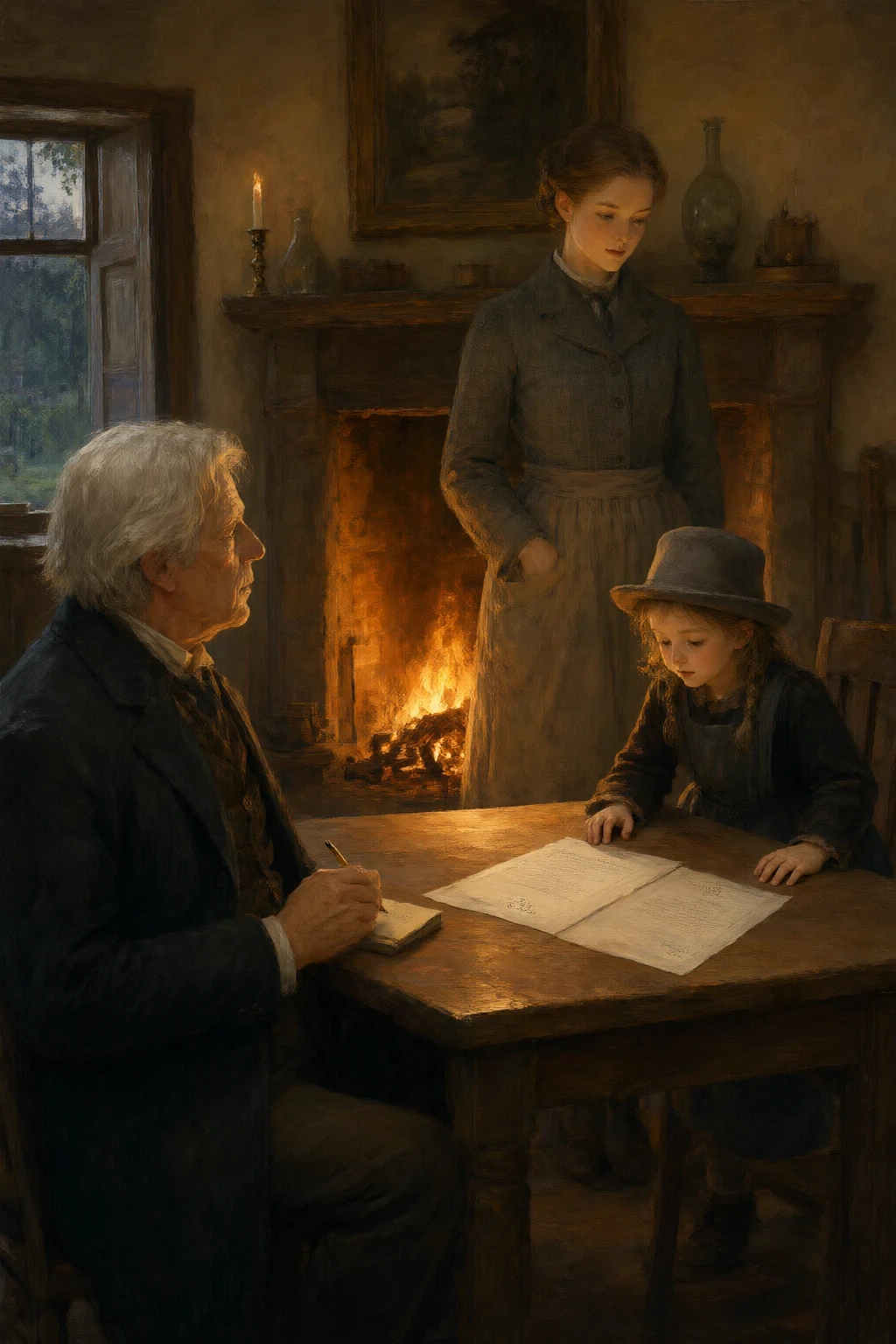
The fire in the first stand was lit at ten past six and had not been let go out since the September of 1966, and the only person who had ever asked about it was a clerk from the tithe barn in the winter of ’seventy-one, who asked it as a question about a chimney and was answered by nobody, and wrote in his day book that the chimney was sound. The first stand has a room, a hearth, a door, a yard eleven feet deep, and a strip of ground called the north close that comes up to the inside of the nine-foot wall. The strip was forty-one acres in 1972 and was nine in 1975, because a holding that is behind with a sum is a holding that is paying, and the town does not send anybody round with a notice; it does it in the roll, in a column, once a year, in the spring, in the same hand. And in those three years it took the money as well as the ground, which the roll does not do, and which is the only piece of housekeeping in four hundred years that has ever failed.
In the room there was a table with two chairs and a third chair against the wall that nobody sat in, and a dresser, and a hearth, and a box of papers on the shelf over the hearth with a candle-box lid on it, which had been the same box since the holder of the first stand was a young man. The box was where the household kept its business, and the household was two people, and the household business was the mess.
There was the covenant of the fourteenth of April, 1972, in a fair copy in a hand that was not anybody’s in the house. There were three entries in the roll for 1973, ’74 and ’75, copied out, with the figures. There was a receipt for £400 from the second stand, a valuation of 1969 with a crease in it, and a printed form from the warden’s office with the top half filled in and the bottom half not, because somebody had needed a copy of the top half and had not wanted a copy of the bottom half. There was a lease of a quarry field made out in 1958 and never acted on, and a covenant of 1961, folded twice, which everybody believed had been finished in 1963 and which had not been looked at since. And on top of all of it, on a sheet of ruled paper, in a large careful hand, were two lines.
1. The pair of boots, given by the second stand, refused. 2. The whole of a cheese, given by the wool yard, refused. The sheet had been ruled for a third line. The third line was blank, and the paper had been cut off square under it, and somebody had cut it off square on purpose. Old Brannic Sallow had not spoken since the March of 1973. He was sixty-five. He was the only one of the seven who had ever been asked the question, and nobody had got as far as his door and said it, because the town’s way of saying it is to send a woman with a scrubbing stone and a fire in the front of her apron, and Halla Dree of the second stand was the woman, and she had been at the first gate four times, and three times the door had been opened by a girl of five in a grey felt hat who asked who it was for and shut the door.
Halla Dree was twenty-eight. She held the second stand, which was the warmest room in Coldhay, and she had a hearthstone in her apron pocket that she had carried for eleven years and that was worn smooth on one side, and she stood with her back to her own wall when she was in her own kitchen, which was a way of being in a room she had decided to think about properly. She did not knock. She went in. “The fourteenth of April, 1972,” she said. “Under your roof, with Tam Kelder standing there with his hands open. And the sum of £400 with the arrears of ’seventy-three at forty-one pounds, of ’seventy-four at forty-four, and of this year at forty-eight, which is five hundred and thirty-three pounds and no part of it paid, and the north close is nine acres and it was forty-one, and I am the lender and I am owed it. Is the first stand discharged.”
The room did not answer. Outside, in the yard, a hen got over the wall and went along the eleven feet of it and came back. “No,” said Halla Dree. “That is not an answer. I have said the same words three times in this room and I get the same three times, and the town is watching, and the town does not count, the town only says that a person was asked.” “Then say it,” said Brannic Sallow. He had not said anything for two years, and he said it now, quietly, in the voice of a man who has had two years to get the level right.
They did the arithmetic in the first stand because the second stand could not be used for it, and because the second stand was the warmest room in Coldhay and the arithmetic was the coldest thing in the county. Tam Kelder came at four with a pencil and a book and sat on the table, because the third chair is against the wall and nobody sits in that chair and everybody in Coldhay knows why. Tam Kelder was forty-one. He was the youngest of the seven and the only one of them who could read, and he had a small hand-bound book inside his coat lining that he had kept for nineteen years and had never used, and he counted the doorways he came through, and he had come through one. “Read it out,” said Brannic Sallow. Tam Kelder read the covenant out as it is written, word by word, and cannot be stopped without becoming unpleasant, and nobody tried.
“I, Brannic Sallow, of the first stand, take of Halla Dree, of the second, four hundred pounds, and give her the north close for the term, and the term is one year from the day of asking, and at the end of the term I pay the sum with the arrears, and if I do not, the sum stands against my holding in this house, and the lender may ask me once a year, in this house, with a witness, whether the covenant is discharged, and my answer ends it or it does not.” “And the answer has not ended it,” said Halla Dree. “No,” said Tam Kelder. “Because the answer has never been anything, and a covenant that is not completed and not expired is open, and an open covenant accrues, and the accrual is the danger. That is the whole of the law and there is no other law.”
“Then I will give it away,” said Brannic Sallow. Tam Kelder put his pencil down. Halla Dree did not move off the wall. “Say the rest of it,” she said, in the exact words she had been given. “The ground. The nine acres and the yard and the gate and my half of the lane and the nine feet of coping on the wall at my gate, and the water, and the beasts’ house, and the whole of it. All of it. I will sign it and I will say it and Tam Kelder will stand there with his hands open, and the girl will take it, and the sum will stand against this house and the fire and nothing else, because there will be nothing else.” “There will be this house,” said Halla Dree.
“There will be this house,” said Brannic Sallow. “And in ten years the town will take this house, and after that there will be the fire, and after that there will be a man in a room with no ground, which is what I am.” Nobody said anything for a while. The hen was on the wall again. “Explain to me,” said Halla Dree, “why the girl.” “Because of rule eight. Because a gift to a foundling is the only gift in Coldhay that cannot become a covenant. It cannot be one, because there is nothing to encumber. It is the only door in this town that a covenant does not come through, and it is the only door in this town that is not locked, and I have been standing in front of it for two years.”
“You have been standing in front of a fire for two years,” said Halla Dree. “You have not said a word in two years. You did not stand in front of anything at all, because standing in front of a thing is a thing a man does when he is going to speak, and you were not going to.” “Then I am going to,” he said. There is one part of that which every person in that room understood, and it is the part that made the gift worth making and the part that made it ruinous, and it is this: the girl was safe.
A foundling in Coldhay holds nothing and is owed by everybody, and holds nothing is not a way of putting it, it is the whole of the law and it is the reason foundlings are worth a great deal to people with debts. Any gift to her cannot become a covenant, because a covenant binds the speaker’s holdings, and she has none, so the gift passes through her without taking anything of hers and without giving the giver anything at all. A man with a debt has exactly two lawful doors: he performs, or the lender accepts less, and accepting less is the most dangerous act available to a person in this town and is done about four times a century. A man with a debt and no ground and no money has no third door.
The gift was the third door. It cost the giver everything and it bought him nothing, and it could not be argued with, and it could not be called in, and it could not be discharged, because it was not a covenant, and there was no witness to it who could be asked what had been done, and a deed is a paper and a paper is not a word spoken under a roof.
And the girl was safe while she held nothing, and a foundling who holds ground is not protected by rule eight, because rule eight is the absence of anything to encumber, and the whole of the protection was the nothing. Give her nine acres and a gate and a foot of coping on the town’s own wall, and there is something in her hands for the first time in her life, and every covenant in this county can be made against it, and every person in this town who is in debt to anybody has a reason to walk up the lane to the fifth gate and find out what the girl holds and on what terms. “That is what it will cost her,” said Tam Kelder. “That is what it will cost her,” said Brannic Sallow. “You have both worked that out,” said Halla Dree, “and neither of you has said it out loud in front of her, and I am most of the way certain that is why you picked her. Not because you are giving her something. Because it is the one gift in Coldhay that cannot be made to cost you a penny, and you did not stop to ask the girl.”
The girl had been in the doorway for eleven minutes. She was five. She had a grey felt hat turned up twice, and she turned it up a third time when the two adults turned and looked at her, and she came in and put herself against the table because the table was the only thing in the room she had decided was hers. “Who is it for?” she said. “The papers,” said Brannic Sallow. “The papers are for you,” said the girl, and she was right about most of them. “The boot is for you and the cheese was for you,” said Tam Kelder, “and you did not say thank you, and both of them are on a piece of paper on the shelf, and the third line is ruled and there is nothing on it.” “Then I will not say thank you either,” said the girl. Nobody moved. Halla Dree looked at the shelf and then at the girl and then at the shelf.
“That will be a third line,” she said. “A refusal in this town is a declaration, and a declaration can be entered, and the clerk will enter it because he enters everything, and a girl of five with three lines ruled under her name is a girl of five with a record.” “I do not want the ground,” said the girl. “That is not a refusal,” said Tam Kelder, “because that is what is in it. A refusal is a refusal of a thing that is offered, and you have not been offered anything yet. Being careful is exactly that, and you are the only one in this room doing it.”
Getting the paper done took nine days and it went the way paper goes. The warden’s office required three copies of a deed of gift, one to be held in the tithe barn, one by the person giving, one by the person receiving, and the warden’s clerk was a man who had been told by a man in a bad temper that the bottom half of a form was not wanted, and who never told anybody which half he had been asked for, and who sent Ivo Colm up to the first stand with a form and a pen and a request that the matter be done in his own words and in the house, because a deed of gift out of a house is not a gift, it is a rumour.
Ivo Colm was forty-nine and had been in the roll room eleven years. He had a leg that was beginning, and a habit of reading a document in the room he was in and finding nothing in it to trouble him until about eleven days later, and a habit of never entering a thing he had not seen, and a worse habit, which was that he was certain he could tell the difference between a thing that had been said and a thing that had been written down, all his life, and had never yet been put to the test. He read the covenant of 1972 out of the box, and he read the three entries, and he read the valuation, and he read the top half of the warden’s form, and he came to the end of it and looked at the girl, who was on the table with her legs over the edge.
“There is no covenant in this,” he said. “A deed of gift is not a covenant. A covenant is a word spoken under a roof with a witness, and this is a piece of paper, and if I enter it as a covenant I have made a false entry, and if I enter it as anything else there is nothing in my book for it to be, because my book takes covenants.” “Can you not write it down?” said the girl. “I can write a note,” said Ivo Colm. “I have written a hundred and nine notes in this room in eleven years. A note is not a record. A note is a man saying out loud in ink that a thing happened and being willing to be wrong about it. Not one of the hundred and nine has ever stopped anything.”
“Then the girl can have the paper and the note can be in your book,” said Tam Kelder, “and the three copies can be signed, and there will be no covenant, and there will be no witness to what was said, because a word with a witness is a covenant and we do not want a covenant, and so the deed must be written and the deed must be signed and the signing must be done in silence.” The witness is not optional in Coldhay. It is optional in the case of a paper, which is a different thing and which Ivo Colm said out loud in the roll room on the Wednesday with the volume open in front of him, to nobody, because he had begun to say things out loud in that room.
“A word under a roof with a witness binds the speaker’s holdings in that house for a year from the day. That is all of it. It does not want an oath and it does not want a signature and it does not want a ceremony, and it is made by a person who is awake, of an age to know what is being said, and not one of the two parties.” He turned the leaf back and read the previous entry exactly, and waited, and the room did not finish it. “So if the man says one word under that roof on the day, with a witness, then the gift is a covenant, and a covenant against nine acres is a covenant that can be answered by nine acres, and there is no such thing as a gift to a foundling any more, because a covenant is a claim and the claim has found the one person in this town who cannot be claimed against.”
“Then he does not say a word,” said Tam Kelder. “He signs. He signs a paper in a room with three people in it and he says nothing that binds, and a deed is a deed, and the gift is a gift, and I shall witness the signing, and a man who witnesses a signing is a witness and no more than a witness, and I have never in my life been asked to do the other thing.”
The signing was on the Friday of the ninth day and it took four minutes. The three copies were made on one sheet with a carbon between, which is the way of it. Brannic Sallow signed the first and the second and the third in a hand that had got worse over two years and was steady on the day. Tam Kelder signed under him and put his hands down. Ivo Colm read the three copies aloud to the girl, who is five and cannot read, because the warden’s office requires that the person receiving be told what the paper is, and he read them slowly, and when he had finished he asked her whether she had any question about it, which is the form of words, and she answered with a question. “Who is it for?” she said. “It is for you,” said Ivo Colm. “It is for him,” said the girl, “because he is the one who is frightened.”
Brannic Sallow laughed, which he had not done since 1973, and the fire moved, because a fire moves when a man laughs in front of a hearth, and the man and the girl looked at each other for the first time in two years, and neither of them said the other thing, and the thing neither of them said was that the girl had been in the first stand for four years and had eaten at that table and had twice refused a gift and been entered twice for it, and had not once been entered for anything else, and that was the whole of her life so far.
Halla Dree came on the Monday and the market was on, and the market is the one place in Coldhay where all seven stands have to appear together in daylight and in public and cannot speak, so the seven of them stood at their own stalls and looked at each other across six awnings in the rain and said nothing, and then they went into the second stand, and the second stand has a long scrubbed table and a drying rack and a hearth with a stone in it and a chair against the wall that nobody will sit in because of what was said in it in 1971.
Halla Dree took the stone out of her apron pocket and put it on the table, and it was grey, and one side of it was worn to a shine, and nobody asked who it was for, because the answer to that question in Coldhay is that nobody knows, and nobody has ever admitted to having carried it, and it is the oldest legal move in the county and there is no entry for it in any roll. Ivo Colm said that the practice of the town is that a house is a house with a fire in it, and that the stone is not in the roll, and that he had been clerk eleven years and had never once had it before a court, because there is no court in Coldhay for it, and then he sat down on a chair that was not the one against the wall. “What the town has to understand,” she said, “is what has happened to me. I was owed five hundred and thirty-three pounds against forty-one acres of north close. This morning I am owed five hundred and thirty-three pounds against a fire.”
“That is the whole of the town,” said Tam Kelder. “I have been sitting in the middle of it all week with a book and a pencil, and the town has understood it perfectly, and that is the part that frightens me. The town has understood that a man with a sum against him and no ground has given his ground to the one person the sum cannot touch. The town has understood that in three months there will be a woman from the wool yard at the fifth gate asking the girl what she holds, because in three months the girl holds something, and the first person to find that out in Coldhay will not be a woman from the wool yard. The town has understood that in a year there will be four people in this county in debt to somebody, and all four will be walking up the lane, and not one of them will ever be able to say out loud why.”
“And when they say it out loud,” said Halla Dree, “it is a covenant, and the girl will be the first person in the history of this town to be able to be charged, and she is five, and she has three lines ruled under her name and two of them are about boots and cheese.” “Three lines and one of them is not about boots or cheese,” said Tam Kelder, “and we are all three of us sitting at this table letting it be the fourth.”
The deed went into the roll in the summer, under the column for 1975, in a hand that was the hand of 1975, and it took up two lines, and the two lines said what a deed of gift says a deed of gift says. Underneath the two lines, at the foot of the page, in the same ink and the same sitting, Ivo Colm wrote a note: No covenant was made. The paper was signed in the first stand on the fourteenth instant, the man signing said nothing under the roof, and a witness to a signing is a witness to nothing else. I. Colm. The third copy went into the drawer with the hundred and nine, and the drawer is the bottom drawer, and the drawer is under the day book, and the day book is on the shelf and not in the press.
On the shelf in the first stand there is a box with a candle-box lid on it, and in the box there are a covenant, three entries, a receipt, a valuation, a half form, a lease, a folded covenant from 1961, and a sheet of ruled paper with two lines on it and a third ruled under them and nothing at all on the third. The fire in the first stand is lit at ten past six. The hearth has no stone in it and has not had one since the spring of 1976, and nobody in Coldhay will say who moved it, and the fire is still lit, and the door is shut, and the girl has a copy of a deed in a box with a lid, and she does not know what it is for.