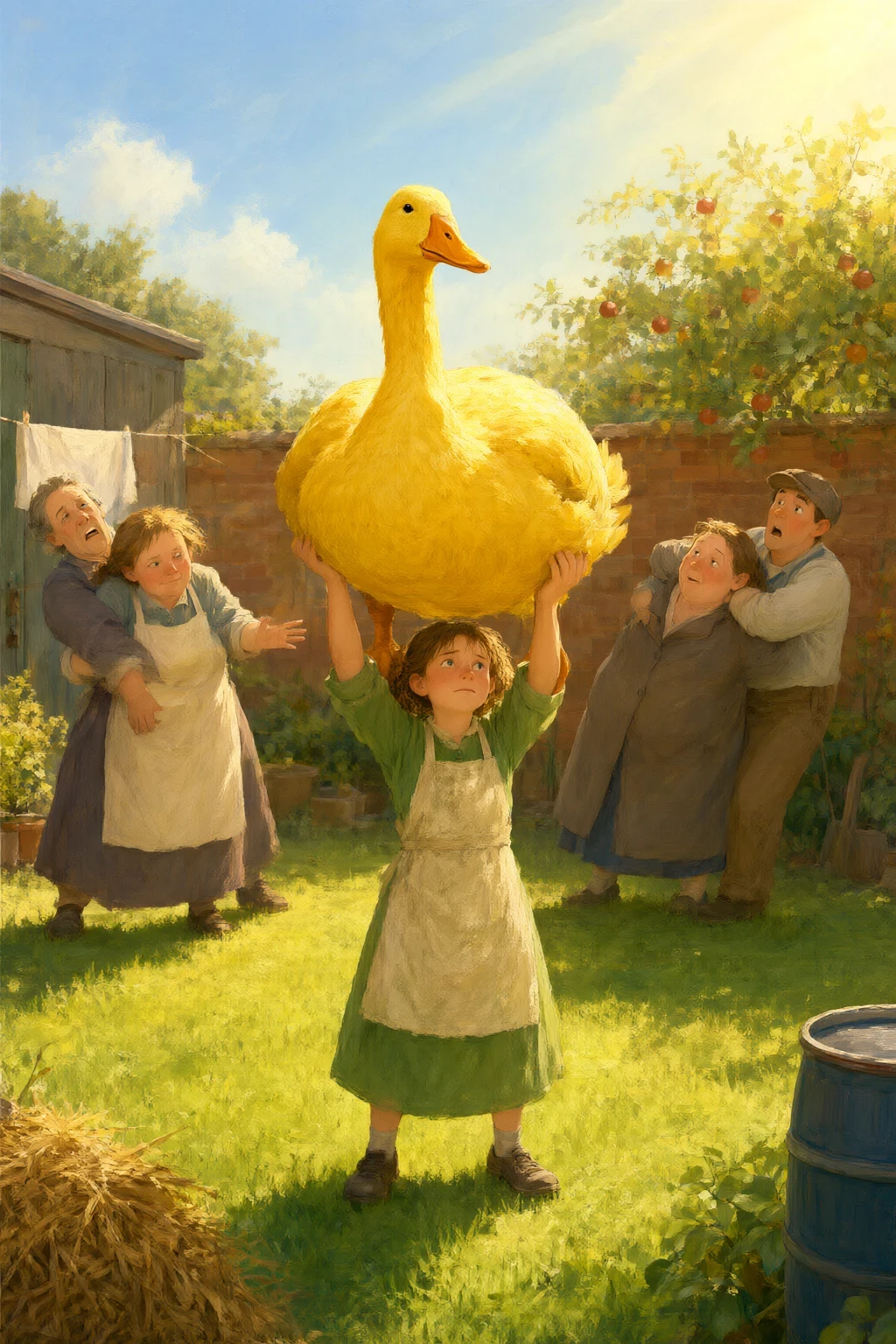
The goose came out of the cart with a sound like a chair being dragged across a floor, and it was the most beautiful thing any of them had ever seen. That was the first thing about it, and it was the thing that ruined the whole summer.
It was not gold. That is worth saying clearly and worth saying early, because three people in that yard wasted a good deal of the next two months on it. It was yellow. It was a very deep, impossible yellow, like the inside of a buttercup with the sun left in it, and every feather was the same, and the whole of it shone. "Mother," said Davy, from the gate. "Look at that." Uncle Ren came out with his coat still buttoned, looked at the goose on the grass, looked at Davy, and said, "Well. Get a bowl."
It did nothing strange that first day. It ate. It walked about. It sat in the shade by the water butt with its wings folded like a closed book and looked extremely pleased with itself, and it was a goose, and there is no more to a goose than that. Then on the third day a woman came over the fence to look at it and put her hand on its back.
Nothing happened at first. She laughed, and said it was lovely, and asked what it was worth, and Davy's mother said the whole street had been asking and nobody knew, and the woman said, well, it does not matter, I only wanted a feel of it, and she tried to take her hand away. Her hand did not come away.
She stood in the yard with her fingers spread out on the goose's back and her mouth open, and the goose carried on eating, and the two of them went round the water butt together like a woman walking a very small dog, and the woman said, in a voice that had gone up very high, "It's stuck. Oh, help. It's stuck."
They got a pot of water and poured it over her wrist. Nothing happened. They got the vet, who is really a man with a cart and a strong opinion about horses. He said he had a theory and no intention of testing it, and the woman said that was not what she had come for. By the afternoon there were nine people in that yard and the story had got up to two ponds and a cathedral.
The thing they had all noticed, standing about looking at it, was that the woman was the only one stuck. She had said it did not matter, she only wanted a feel of it. She had not come to fetch it, or buy it, or feed it. She had come to feel of it.
The tax man came on the Thursday, because the tax man always came on the Thursday, and was shown the goose. "Well," said Davy's mother. "Nobody can move it." The tax man wanted to say something about value, and Davy's mother pointed at the woman, who was still stuck, and who by then had been stuck for two days and had got very good at it, and had taught that yard a new kind of patience.
"It is a goose," he said. "It is not gold. It does not pay anything, and the moment there is a bit of writing on it I have to make a return, and I have not got the hours." He sat down on the wall. "I would rather the whole town had it, and I would rather nobody could say I wanted it."
Davy's aunt came the next day in a good coat and said she would take the risk of the animal on herself, and the family could have thirty pounds for it and no questions, which was more than the family had ever had at one time in their lives. She got both hands on it, and then a foot, and she was stuck so thoroughly that Uncle Ren had to fetch the doctor and the doctor had to fetch a chair, and the aunt sat in the yard in her good coat until the light went. Nobody said anything to her about wanting only a feel of it, which was the most useful thing said in that yard all summer.
There were four stuck people by the end of July and no way of unsticking any of them, and it began to look like a permanent feature of the household, and then Davy's sister Nella came home at four o'clock one Thursday with her bag over her shoulder. She came through the gate and stopped. "Nell," said her mother. "Come and see the goose." Nella put her bag down in the grass, walked up to the goose, and put her hand on it, flat, and picked it up.
The goose came off the grass about four inches and let itself be carried, making that noise again, and Nella carried it to the water butt and set it down on the edge and let go, and it walked off to eat. The yard did not say anything for about four seconds. "You have got hold of it," said her father. "Yes." Nobody said anything to her about wanting only a feel of it, which was the most useful thing anybody said in that yard all summer.
Nella thought about it for a while. There had been a great deal of standing about in that yard, waiting for somebody to say something. "It does not stick to me," she said. "That is all. And I have never been in this yard when anything has stuck to me either. I have been thinking about it in the field, and I think it sticks to people who want something off it and say they do not."
And that turned the summer over, the way a beam turns when you take the wrong prop out. The landlord offered forty pounds for it and was told no, and then sixty, to be rid of the mess, and was told no again, and then asked, more carefully, what anybody actually meant to do with it.
What anybody meant to do with it, it turned out, was nothing. That was the shape of the whole business. Four people in the yard were stuck to it for wanting to feel of it. The rest of the town wanted to want it. Nobody at all had ever thought of the most obvious thing, which was that it was a bird, and that birds want somewhere to be. "There is the whole side of the house it never uses," said Davy's mother, after a while. "Does it want a house?" said Davy.
"It wants a yard," said Nella. "And somebody to scrape it out. And its own corner. And somebody who will come when it calls, and there is no point in coming when it calls, because they will not come. That is what it is."
They put her in the yard on the Sunday and she stayed. She took up the west side, which was the weedy end with the wall the water butt leaned on, and Nella got an old door off the shed and made her a night house out of it, upside down, with a bit of sacking at the front, and the goose inspected it, went round it twice, and slept in it on the first night without a word of complaint.
The four stuck people unstuck themselves over about three weeks, one at a time. Each of them left quietly. One of them, the aunt, left a good deal of money on the kitchen table, and Davy's mother put it straight into the tin for the roof.
And the goose came out of it. That is what nobody had expected, and nobody could afterwards say when it happened. The shine did not go. What went was the feeling that it was a thing that had come to be looked at. When it laid, and they found one egg under the door house in May, fat and pale gold, it was an egg, and it went in the pan, and it was very good.
By August the west end of that yard was the best part of it, and the wall the water butt leaned on had a rail on it, and the rail had a name on it, and the name had been on the door house in charcoal and had gone grey.
The four of them were out there on most evenings, and the rest of the yard was empty, and on the last warm evening of the year Nella went out at dusk to shut the door house and found the goose had already gone in, and turned the sacking, and was standing with its head out and its eyes shut, having done the whole thing itself.
Nella propped the door with a stone and sat on the step with her back against the warm wood. The yard was very quiet, and the goose made the noise it always made, which was like a chair being dragged across a floor in the next room, and nothing at all in the world answered it.