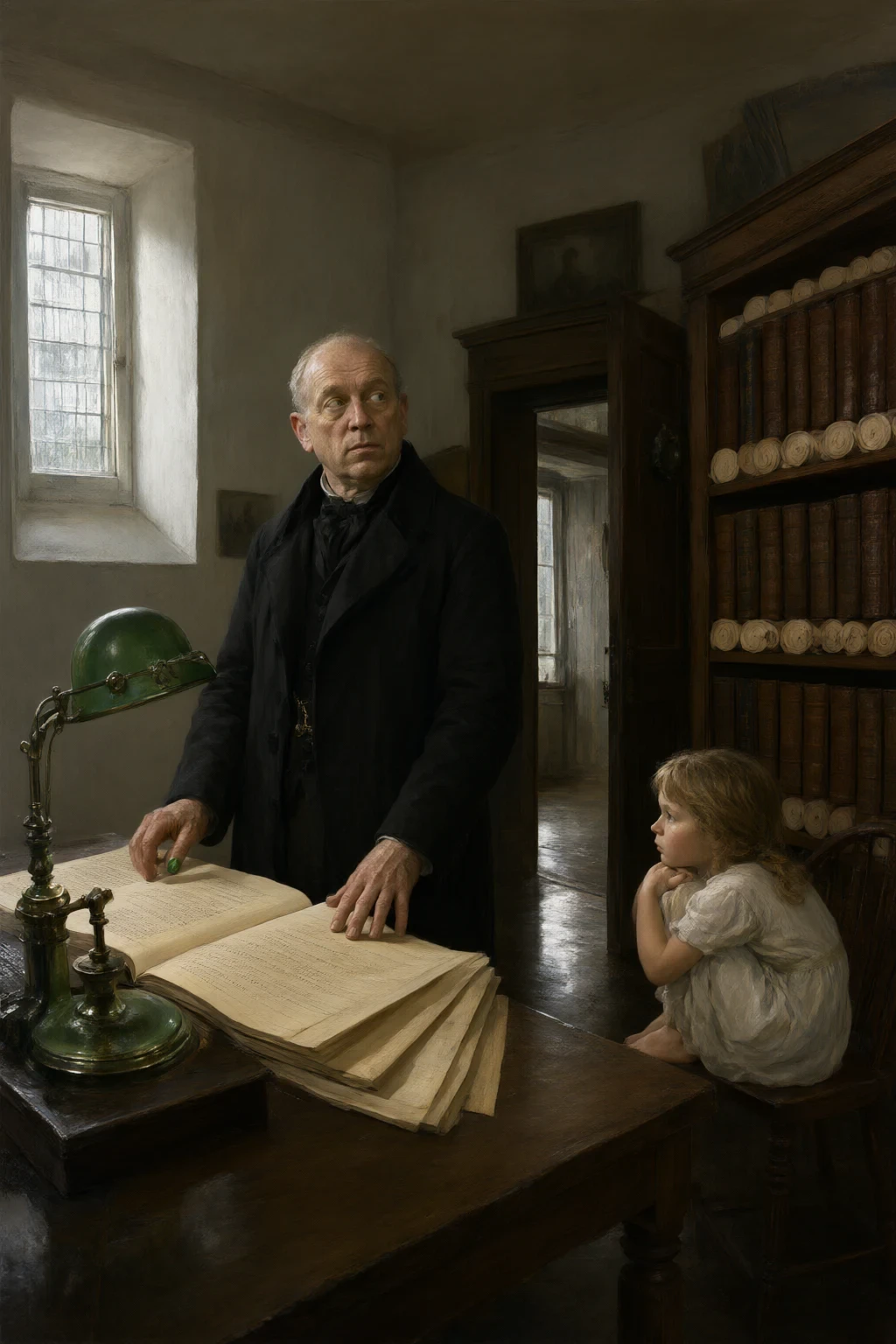
Ivo Colm received the order on the fourth of October, in the roll room above the tithe barn, and it was four lines long and gave a man no room to be pleased with himself. It read: that the boundary rolls be collated against the register of land; that every covenant now standing be set against the strip it binds; that the collation be made in seven sheets, one for each stand; and that it be delivered at the quarter court on the eleventh. He read it twice, which was twice more than it wanted, and unlocked the press and began at the beginning, because you do not collate a book you have not opened at the beginning. The roll room is one chamber with one window and the window faces north, and a north window in Coldhay is a lamp left burning all day that never got warm. The press runs the north wall, six shelves, four hundred years with the years pressed into the spines in gold gone the colour of weak tea. There is a brass arm bolted to the desk and swivelled so a page can be held under the light without being touched, which matters, because Ivo Colm has not touched a page since 1888.
There are two documents in Coldhay and neither is complete. The roll keeps covenants: what was said, in which house, on what day, and what term was given under it. The register keeps land: seven strips between the nine-foot wall and the pasture, with the rent against them and the holder in the column. The roll does not keep the witness, and the reason is on the face of the rule itself, which is that a witness is a person awake, of an age to know what is being said, and not one of the two parties. So the join between the two documents is a man in a doorway remembering. Ivo Colm had seven doors to stand in. He ruled seven sheets and headed each: covenant, date, house, holding bound, entry in the register, witness. Then he wrote the first entry and read it aloud, because he has read the previous entry to himself or to the room for thirty-one years, on the theory that an entry is a sentence somebody began, and the next man is expected to finish it. The entry for the first stand ran from the sixth of November, 1886.
Item. In the first stand, between the holder of the first stand and the holder of the sixth stand, a covenant was made and the term given under it was, that the byre strip and the hard ground above it, being the first stand’s holding in the first stand, should be the sixth stand’s for the term of a year. The holder of the first stand was asked to complete it and did not. OPEN, ACCRUING, in the margin, and the year, and the rent, and the sum, because the roll does not carry money and the register does. The register carried six pounds a year against the byre strip. A covenant that is completed runs a year and is discharged by expiry. A covenant left open does not run and does not expire. It accrues, and the accrual is a sum the law does not fix and does not cap, and it goes into the register as a charge on the strip, and a purchaser takes the holding with the holding’s charges on it. Nine years. Fifty-four pounds. He entered it and set the sheet at the left of the desk, and it was a quarter past seven, and the window had gone from grey to white without doing anything about the cold.
The market is on Monday and the market is the one place where the seven stands are all in one square in daylight, in public, and cannot speak. The reason is on the face of the law: there is a roof on a house and no roof on the cattle market, and the six stalls are under woollen awnings, and wool is not a roof. So a word said on the setts binds nobody, and seven men who have spent their lives not saying things can say all of them. Ivo Colm went down on the Monday to the third gate of the boundary wall, where the byre strip comes up to the coping stone, and Old Brannic Sallow was at the gate with a barrow of stone and no intention of moving it. “Morning,” said Brannic Sallow. “You are in the way.” “You are in the way first.” That is the whole of it, and it has been the whole of it for nine years. Brannic Sallow was seventy-one, had been asked the same question seven times and had answered never, and a man asked seven times who answers never is not being careful. He is holding a covenant open by refusing to complete it, and the fire in the first stand has not been let out since the covenant was made, and nobody has ever asked about the fire, because everybody can see the fire. Ivo Colm asked him about the fire. “Who is it for?” “That is not an answer,” said Brannic Sallow. And then nothing, for a very long time, and the barrow stood in the gate, and Brannic Sallow looked at the ground between his boots the whole of it, and did not have to say anything, because the law does not require a man to fill a silence.
The kitchen of the second stand is the warmest room in the town and the site of four covenants in one year, and Halla Dree held the second stand, and had asked the same question in four houses in one year, and had had four different answers, and had stopped counting which of the four she was in. None of the four was in the kitchen. Ivo Colm established that in eleven minutes from the doorway: a scrubbed table, a drying rack, a hearth with a stone lying in the ash at the back, and a chair at the head of the table that nobody has sat in since 1871, and that is a chair like any other except that in 1871 something was said in it. The covenant of the fourth of June, 1871, gave the strip at the north end to the fourth stand for a year, and ran its year, and the strip came back. And in the chair, at the end of that year, somebody said out loud what the strip was worth, with a witness in the room. You cannot say a price in a house. That is the one thing everybody in the second stand knows and nobody will say in front of the other six.
“Nothing in your register for the north end,” said Halla Dree, without looking up. Her thumb was going over a hearthstone in her apron pocket, which is a thing her hands do and not a thing she has decided to do. “It is not a charge. I have not got to the second stand yet.” The second stand came to the second sheet on the Wednesday, discharged by expiry in 1872. Ivo Colm entered that in two lines and did not put the words PRICE UNDER A ROOF on the sheet, because a collation is a collation.
The third stand carried a charge, and the charge was not a covenant, and the man holding it had carried it eight years and had never disputed it. Item. In the third stand, the thirteenth of February, 1887, a covenant was made between the holder of the third stand and the Ottery household of the fifth stand, and the term given under it was, that the Ottery household should have the use of the back room of the fifth stand for so long as the girl should sleep in it, and at the foot of the entry four words: the room is not held. The register carried it at a pound a year against the third stand’s nine acres. Ivo Colm asked the holder of the third stand about it, and the holder of the third stand answered it as a covenant, word for word, in the form in which covenants are written, and could not be stopped without becoming unpleasant. “It is not a covenant,” he said, when Ivo Colm had got as far as the room. “It is a licence. It binds the room and not the ground.” “It is entered under covenants and carried in the register as a charge on your nine acres, and I did not make that, and on Monday there will be a purchaser in this town who knows it.”
Tam Kelder stopped. He was forty-seven, the youngest of the seven, and the only one of the seven who could read. He stood in his own doorway and counted the doorways he came through, which he did by lifting his left foot and setting it down again before he came in, and Ivo Colm said nothing, because it was not in the roll. “The witness column,” said Ivo Colm. “Whose word do I take for that entry?” “You know whose word.” “I want it in a hand. I do not want it in a doorway.” And Tam Kelder went in and came out with a coat over his arm that he was not wearing, a pressed wool coat eleven years old, its left lining let out at the shoulder and restitched at the shoulder eleven times, and he put his hand flat on the outside of it for a second.
The girl in the fifth stand is nine years old and sleeps in the back room four nights a week, and the covenant of 1887 is the reason for the arrangement, and the arrangement the reason for the covenant. It binds no acre of the third stand, because a room is not a holding. But it was made in the third stand, and it binds the speaker’s holdings in that house, and a pound a year has sat on nine acres since February 1887 for a room that is not held. Ivo Colm entered it as he found it, and did not enter the girl. A child who sleeps four nights a week under a licence is not a term of anything. She is the reason for the licence, and reasons are not entered. He came in at four on the Thursday and found her in the roll room. He worked from four, because the room has one north window and no other light in the year, and he had left the door unfastened out of a habit he had never examined, and she had come up the outside stair in the dark without making a sound, which is why nobody in that house ever knows she is there. She asked in a very clear voice: “Is the window meant to be open?” “No. It is a north window. It has never once been meant to be open.”
“You can sit down,” he said. “I have got two hours of this and I am not going to talk to you, but you can sit down.” She sat on the floor by the press and stayed four hours, and about the eleventh hour she asked whether the fire in the first stand was ever let out, and he said that as far as he knew it was not, and she said her mother said it was for the light, and he said it was for the light, and not one word of the four hours binds anybody, because a man alone in a room is not a witness to himself.
The fourth stand took him from Friday to Tuesday, and everything that happened afterwards happened because of the fourth stand. The covenant was entered on the ninth of March, 1873, between the holder of the fourth stand and the holder of the seventh stand, and the term given under it was that the four acres, the long strip, should be the seventh stand’s for the term of a year, and the holder of the fourth stand did not complete it. It was open, and it was twenty-two years old, and the register carried a hundred and thirty-two pounds against the long strip, entered every year in a column with a rule above it and nothing under the rule. And in the roll, eleven lines below, in the hand of 1978, this: Item. The nineteenth day of October, 1978. In the fourth stand, the holder of the fourth stand said, I take less, and the covenant of the ninth of March, 1873 was discharged. Nothing else. No witness. No second name. No note of the glass. No hand but the clerk’s.
Ivo Colm had read that entry for seventeen years. He had been in the chair eight years when it was made by somebody else’s pen, and had never once read it as finished, because it is not finished. It is three lines short. Rule seven of Coldhay is that a covenant is discharged by performance, or by expiry, or by the lender accepting less, and that the third requires the lender to say so out loud, in front of a witness, in the lender’s own house. The entry has the words. It has the house. It does not have the witness. Ivo Colm’s disagreement with the 1978 hand was seventeen years old. That hand came into the chair in 1971 and was gone in 1983 and wrote a beautiful clear upright hand, and had made the mistake everybody who ever comes into that chair makes, which is to be sure of a thing in a hurry and enter it without the hand that keeps it. Ivo Colm had known the man eleven weeks, and had decided within a month of reading the entry that the 1978 hand was wrong, and had never gone back to that.
He drafted the sheet on the Friday afternoon and drafted it three times, and the third read: that the covenant of 1873 stand; that the entry of 1978 be not evidence of a witness, the witness not being kept in the roll by rule; that a hundred and thirty-two pounds stand against the long strip and accrue from the eleventh of October next; and that the long strip may not be conveyed. He read it twice, and then went back through the quire for the covenant of 1873, because that is what he did, because the previous entry is the one you finish. The quire was one sequence back to 1611, and above the covenant of 1873, on the fly leaf, in the hand of 1902 — the one hand in the volume he had never had to guess at — four lines stood that were not a covenant and not a minute and had no covenant under them anywhere in the book. He read it exactly, because that is what he did, and then he waited.
Item, of the second of November, 1902. That the roll is not the account. That the account of a house is the glass of that house, and the roll is but the copy, and the copy is good until the glass is read, and thereafter the glass governs, and the clerk who shall find the copy and the glass differing shall not amend the copy, nor strike it, nor hold it wrong, but shall enter the difference in the margin in his own hand and shall go to the house and read the glass again in the presence of two holders, and shall enter what the glass says, and the glass shall govern. He waited. It did not finish itself. He closed the volume, put the pen down, and went down the outside stair into the tithe barn yard, and it was raining on the yard, and the market was over.
The fourth stand was held by a man of sixty-one who had held it thirty-four years, and the purchaser was the quarry company, which wants a tip, and the tip wants the long strip, because the long strip is nine feet higher than the yard. Their condition was a clean register at the court and the money in the bank by the eighteenth. Ivo Colm’s sheet went up in the chapel on the Friday evening, because a delivered collation is read. It was read on the Monday by about ninety people, of whom perhaps forty could read it, and by the rest because it was on the wall and there was a queue. On the Monday the holder of the fourth stand found Ivo Colm at the third gate with his hand on the coping stone, which is nine feet of limestone and cannot be seen over and cannot be heard over, and both of those facts are why the wall is there. “Six pounds the year,” the man said. “You have put six pounds the year on my strip.” “Yes.” “My grandfather worked that strip.” “Yes.” “Nineteen years I have had that company at my door, and they have never once asked for the register, and now they have asked, and you have put it in the roll, and I am sixty-one, and there is nothing at the back of your quarry but a hole with water in it.” “I am sure of the copy,” said Ivo Colm. “I am not sure of the account.” The man put both hands on the coping stone, which is cold, and looked at the wall so long that a cart came round behind them. “Then go and be sure,” he said.
The felony of Coldhay is a rewritten roll. It is the only felony, and it has been committed twice in four hundred years, and both times by clerks, and both in the same way. A clerk finds an entry he has reason to believe is wrong. He cannot prove it and he cannot leave it, so he enters the correct matter, and the entry is now two entries, and the roll says the same thing twice. That is the felony. A forgery is a lie once. The felony is a lie entered twice. The first was in 1744 and the roll says so in the margin, in a hand that is not proud: entered by a hand that is not the hand of 1744. The second was in 1861 and the roll says the same in the same words, in a hand that is not the hand of 1861. Neither of the two men was a thief. Both thought the earlier hand was wrong. One of them was right, and it did not save him, because the felony is not the opinion. The felony is the second entry.
This was written in front of Ivo Colm for eight days and he did not see it. His collation sheet was on the chapel wall for six days. It was not a roll. But a collation is a document, and the document said that the 1978 hand was wrong, in a hand a man who was not there could compare with the 1978 hand. A copy that disagrees with the roll is the first half of the felony. The other half is the roll, and it was on his desk on the Tuesday in a fair copy, with a ruled space at the foot for the clerk’s hand, and the nib was in his hand. He put the nib down. He went up the outside stair in the rain and opened the volume at the fly leaf, and the four lines of 1902 were where they had been on the Friday, and he read them exactly, because that is what he did. It finished itself. It took eleven seconds and it had been there for thirty-one years and he had read it perhaps nine hundred times.
Two holders, in the presence of two holders. Ivo Colm went to the third stand at seven on the Wednesday and asked Tam Kelder to come and be a holder, and Tam Kelder asked why, and Ivo Colm told him, word for word, because Tam Kelder could not hear a thing described and had to have it as it was written. The third stand counted. The row is the seven and the seven is the boundary, and a man may be a holder for the purpose of the glass without answering for his own holdings, which is the only time in Coldhay that the two are separated. Halla Dree was the second holder. She came without being asked and stood in the fourth stand’s kitchen with her back to the wall, which is a thing she does in her own house and in other people’s houses too. “Who is the glass for?” “The fourth stand.” “Who is it for, the reading. Whose account is it going to be?” “It is not going to anybody. It is going in the roll.” “Then read it properly. You will read it properly or you will not read it here.”
The glass of the fourth stand is a pane of the door, and it is old, and it is the best-kept account in the town, and the house has kept it without knowing it was worth keeping, which is the usual way. The keeper of a glass in Coldhay is the hand that does the opening. The custom of the fourth stand, and a custom and not a law, and the custom since 1811, is that whoever goes out with a hand on the latch wipes the pane at the height of their own face with the heel of that hand, once, and not twice. No wax, no polish, soap and the heel of a hand, and the reading is exactly as complete as the hand that kept it and no more complete. The wiping is not a record. But a house that has kept a glass for eighty-four years without knowing what it was keeping has a record, and on the clearest of the lines there is a day scratched in the corner of the pane in the manner of a man marking a gate-post, and a date, and words. Ivo Colm read it with the brass arm and the north light off the yard wall, and read it twice, because he was not going to do this once.
The nineteenth day of October. He was fifty-five and he has a cataract, and the nine of 1978 was a seven, and it was a nine, and the day and the month were right, and the pane and the roll had been saying the same thing for seventeen years. The words were the words of the law and there were four of them and they were the whole of the third way of discharging a covenant in Coldhay: I take less. And underneath, same scratch, same hand, same day, same hand on the latch, this is the part that finished the business: two short strokes side by side, and a cross stroke through the top of each. Two hands, both visible. The rule of the witness is a person awake, of an age to know what is being said, and not one of the two parties, and a house that has wiped a pane for eighty-four years without knowing why has a mark for the two hands a man can see. The lender was the holder of the fourth stand. The house was the fourth stand. The lender’s own house. The words were said out loud, because words on a pane are words that were said, and a pane does not write.
The covenant of the ninth of March, 1873 was discharged on the nineteenth of October, 1978. It was not discharged on the eleventh of October, 1895. The hundred and thirty-two pounds was not a charge. And the twenty-two years of accrual were a sum a man had written into a register on the strength of a copy, in a good hand, meaning to be fair. He entered the difference in the margin in his own hand, as 1902 requires, and did not strike the 1978 entry and did not hold it wrong, and wrote under his collation the six words the fly leaf gives him and no others. Item. Fourth stand. The copy of the nineteenth of October, 1978 differs from the glass of the fourth stand of the same date in this, that the copy is silent of a witness, and the glass is not silent. The covenant of 1873 was discharged. The charge is struck and the long strip is free to convey. The witness was the holder of the seventh stand, then, and is now of the sixth. He dated it the seventh of October, 1895, and signed it, and read the previous entry exactly, and the previous entry was the covenant of 1873, and it was thirty-one words, and it had been finished since 1878.
On the eighth of October there was a girl of eleven standing by the third stall post in the tithe barn yard with her hat turned up twice. “Who is it for?” she said. “The collation. Who is it for?” “It is for the quarter court.” “It is for the register.” “It is entered against the fourth stand’s long strip, and the fourth stand is going to sell it to the quarry company, and the quarry company are going to have a tip on it, and that is all it is for, and you can see the whole of it from here if you can see over the wall, which you cannot, because you cannot see over it.” She turned the hat up a third time, which she does when an adult looks at her, and Ivo Colm looked at his boots. “My name is Wren Sallow. I was found three times and I have been gone twice, and I am owed by everybody and I hold nothing, and I have been told that makes me worth a great deal to people with debts, and I do not think it does, and I am asking you. Who is the collation for?” “It is for whoever reads it next.” “That is not a house.”
“No,” said Ivo Colm. “It is not. That is the fault of the law and not of the register, and the register has been keeping the fault for four hundred years, and I have been keeping it for thirty-one.” He went up the outside stair and shut the door, because the north window wanted shutting, and on the second sheet, in the margin, there was a note that was not about a covenant at all. It read: asked by the second, of the north end, and not yet answered, and to be answered in the words it was asked in.
At the quarter court on the eleventh the register was produced, and the hundred and thirty-two pounds was not in it, and the long strip was free to convey, and the quarry company put four hundred and fifty pounds into the bank on the eighteenth, and the man of sixty-one said the clerk was the only man in Coldhay who had ever cost him money and given it back. Ivo Colm said it was in the roll and in the glass, and the man had never in his life heard of the glass. The two holders walked back up the row afterwards, because it is one row and there is no other way to walk up it. Halla Dree took the stone out of her apron, looked at it, and put it back, and at the second stand’s door she stopped. “You will answer me about the north end.” “On the Friday. The north end. Yes.” “In the words I asked them in.” “In the words you asked them in.”
The girl in the fifth stand was awake at four that morning, as she was on most mornings, and came out onto the cold flags with the door standing open behind her, because the door does not lock, and nobody came in. The hearth in the first stand was still lit at the fourth hour, and had not been out since 1886, and when it went out it would be put out by a man who was not Brannic Sallow, and Ivo Colm was fifty-five years old and had read the same four lines nine hundred times and had never once asked what they were for.