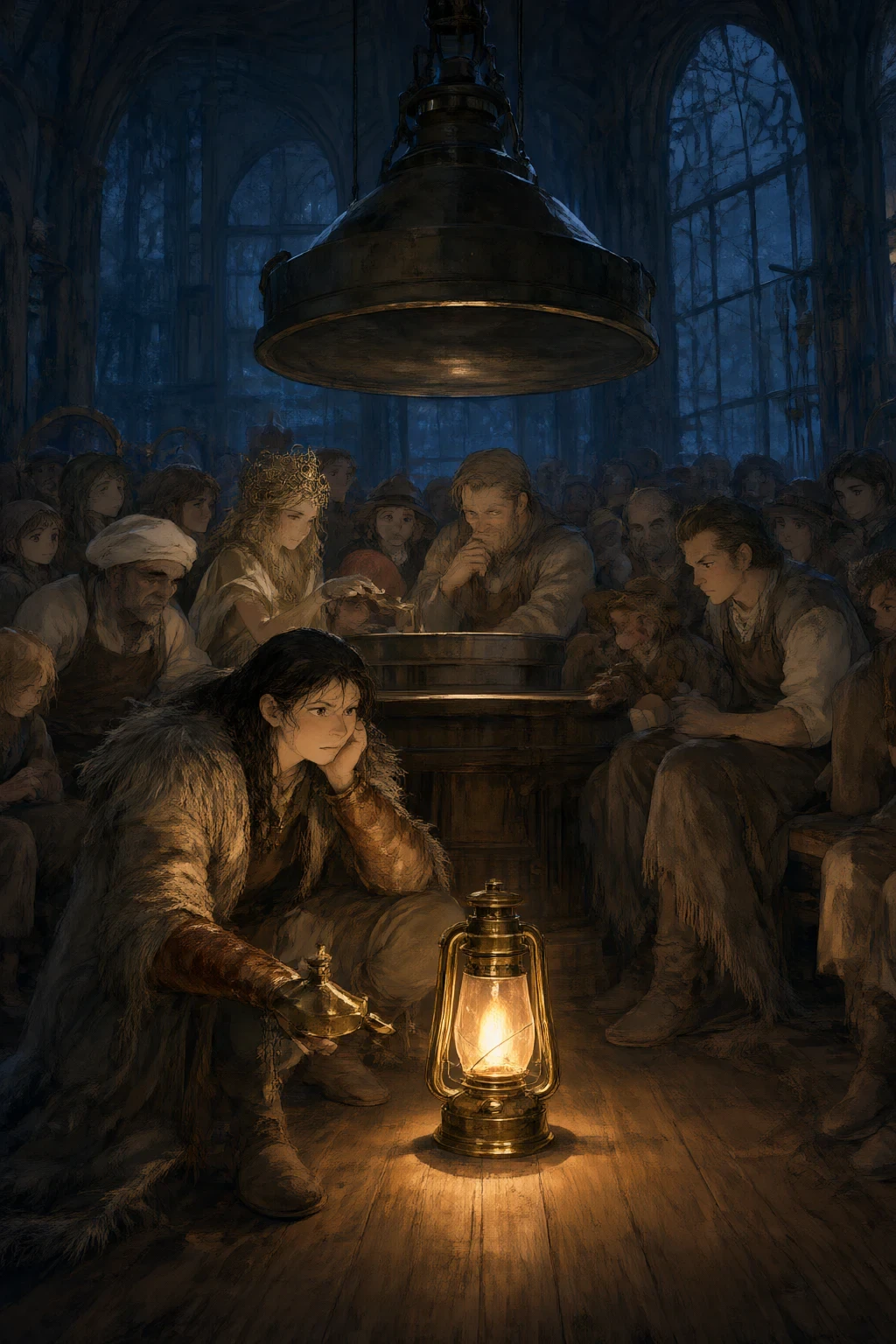
The Hall of Telling had one floor, one lamp and no corners, and for nine hundred years the arrangement had suited everybody, because the light was a hard pale disc in the middle of it and a teller stood in the disc and everyone else stood at the edge of the disc in the dark, at a respectful distance, and watched. On the afternoon Cresset Ombre sat down on the step of the minting table and would not get up, the arrangement suited nobody at all. “Tell her about the salt,” said Grist Bellweather from the dark. “Have you eaten? No. Sit. Sit, there is broth.” “Cresset has eaten,” said Cresset. The hall did not believe her, and the hall was right, because there had been a heel of bread at noon and Cresset could not remember it.
Tallow Merrick came along the edge of the disc with the brass measuring rule in one hand and her chain of a hundred small iron keys round her neck, all of them cut from a different coin, all of them a size too small, and she held the rule up into the flame the way a person holds a spoon up to a sick child, and read it, and read it again, because the first reading had been unpleasant. “Two fingers and a bit past the joint. Eleven hours ago it was three fingers and a bit past. Four hundred and six, dreadful. Four hundred and five, worse.” “It is not shorter,” said the Queen.
“It is exactly shorter, Your Majesty, by a hand’s span in a day and a night, and the day began at noon, and it is a quarter past four, and Cresset has been holding that flame for thirty-one hours without once being relieved, because there is nobody left to relieve her.” Tallow tucked the rule into her apron. “Nine hundred and eleven, dreadful. I have stopped counting the two-hundred trays.” Cresset sat with her right arm up on the minting table. The brass lamp-stand was fused to her forearm the way a scab fuses to a knee, and it made her hand permanently a wick-holder, and there was a thumb-piece and a shade-cap and a hinged door for cleaning the wick, all of it worn to a shine. The skin inside her cuff was scorched brown, and it had been that colour for thirty-six years. “I am not going to do the night,” she said. Nobody spoke for a while. That is what the Hall is for; that is most of what the Hall is for.
The trouble with refusing to tend a flame is that nobody notices for about forty minutes. Then the Hall began to change, the way a room changes when a window is opened at the back. The brass lamp did not go out. It went large. The light stopped being a disc with an edge and became a whole room of very soft blue nothing, in which everything was still there and none of it was available, and the watchers at the edge of it could no longer tell who was standing next to them. “It is very blue,” said Nim Ollowan, thirteen years old, with a strip of unspun silver thread round her left wrist, frayed at both ends, which she retied twice a minute. “Nim thought it would be dark.” “Nim,” said Cresset, “come and hold the shade-cap.” “Cresset said no to the night.” “Cresset said no to the night. This is the morning, or it is pretending to be.”
Somewhere in the middle of the dark a young man said, “I have always wondered what that ring is for.” “Marrow,” said the Queen. “— and that is a coin in somebody else’s pocket.” The Hall laughed, because the Hall always laughed, and a laugh in that room is a small bright nail that holds a true story to the floor. The trouble is that Marrow could not tell a true thing to save his own life, so his jokes fell through the disc and hit the boards, and a joke told for a laugh is not a story at all. It landed anyway, on the other side.
Cresset felt it arrive. Everyone else had gone on talking, because nobody looks for a hole in the air at the moment their own joke lands. She turned and looked at the west end, above the third pillar, and there was a ring of dead air hanging there, the size of a good teacup, absolutely still, and not moving when she moved her head. “A silent,” she said. The Hall stopped. “Where,” said Tallow. “West end. Third pillar. Height of my head, and it is still growing, and please do not tell me how fast, because I will feel it.” Tallow put a hand over her mouth, and then took it away, because there was no tray in the world for this.
What the Hall did at twenty past five was what a court does when the throne is empty: it found a smaller throne. In the mill kitchen under the Chaff Mill, where Grist kept the lamp oil, there was a common tallow candle in a tin dish with a loop of wire for a handle. It was not silver. It was not brass. It had a wick a quarter the width of Cresset’s and a flame that leaned about if you breathed in the general direction of it, and by every standard the Hall had ever measured anything by, it was worthless. Grist brought it up the stair himself, because Cresset could not carry anything and would not have let him. “Sit,” he said at the top of it, to everybody. “Sit, there is broth, and if you have not eaten you will not hear a true thing, and I have watched this Court go deaf on grey bread more than once.”
He set the tin on the minting table. Nim found a saucer to put under it. Somebody’s cold hands made a ring of light about eleven inches across, and the whole Hall came in to look at it. Then, because they had nothing else to do, they began to talk. And here is the thing about the Hall: for nine hundred years the watchers had stood in the dark. They had never once been able to see each other’s faces. Under a hand-lamp, a court can count heads. Tallow could see that Grist was ashamed about the mill. Grist could see that Tallow’s hands were shaking, which they were not, not that night, for exactly this reason. The Queen had her knuckles on the table, pale as paper, and from the dark nobody could tell whether she was angry. Nim stepped up.
She was the only person still allowed to stand in the light, and now there was no light to stand in, so she stood in the ring of the saucer with the tin dish behind her, and she told a true thing, because that is what she was for. The previous Lampwright, Cresset’s predecessor, a small man named Ovain, had carried a saucer of water in that same hand for eleven months in the year of the flood because the palace cistern cracked, and had never been given a coin for it, and had died that winter having been told exactly two stories, both of them husks. “— and then—” said Nim, “and then the coin came out.” It came out. That was the astonishment of it. Silver thread spun into a disc, warm as a stone off a stove, and it landed in the tray with a sound like a coin landing anywhere else in the world. Tallow did not sign it. “Out of the tray, please. Hold it up.”
She held it up. It was a fine coin, heavy, bright, the colour of milk. “Now put it on the sill.” It went on the sill and sat there and did not move, and everybody present knew what that meant and everybody present pretended, for about four seconds, that they did not. “It is true,” said Tallow carefully. “That is the horrible part. It is worth exactly what she said and it will not go across the Table’s rim, and it will not go through the Upper Gate, and it is the best-minted coin in this palace in nine years, and it is dead.” “It is not dead,” said Cresset. “That is the third time tonight somebody has used a word for a thing they have not looked at.”
They came to it one at a time, from different rooms, pretending each of them found it. “Seventeen sacks out of the mill in October,” said Grist, “and every one of them was grey. And if you have been eating bread since October you have been eating the Court. Not — not meanly. I have ground what there was. There was a bad year. That is all. That is a harvest.” “It is a harvest,” said Cresset. “I know the difference,” said Grist, “and Cresset does not need to look at Cresset that way.” Tallow had gone the other way. She had the Palace Ledger open on the minting table with the candle in it, and the flame leaned over the page and made the old ink shine.
“Her Majesty’s supper,” she said. “Nine hundred winters. Ninety years of chalk. Every year a supper, and every year chalk; the flour out of our own tales, and the tales came in as husks, and the husks came in as the same tales, told the same way, for a very long time. And the lamp is not on the Queen’s account.” “It is on nobody’s account,” said Cresset. “It is on nobody’s account,” said Tallow, “because it cannot be. Look at the totals. They do not work. There is a fire in this building nine hundred years old and it has never once been entered anywhere, and a fire that is not entered anywhere is eating something that is not in the building.” Marrow said it out loud, because he was the only one in the Hall who could say a thing and not be responsible for it.
“Nine hundred years of lamp oil,” he said, “that nobody has ever once bought, at a rate nobody has ever once written down, off a flame the size of my hat, in a hall where the only thing that has ever been burned is us — and that is a coin in somebody else’s pocket.” The western end of the Hall made a small sound, like a held breath let out.
Cresset went down to the mill at nine, on the stair with no rail, because she had to know whether the hand was still going to work, and the answer was four hundred steps down and a long way off in her own arm. The mill was warm and made its one noise, distant surf, and the hopper stood tall and full of shredded tale, grey as woodsmoke. On the stool was a candle stubbed to a half-inch, with a collar of wax that had been run and set. “Sit,” said Grist, from the dark by the hopper. “Sit, there is broth.” “Cresset is not sitting down.” Cresset put her good hand flat on the stool. “Look at the candle, Grist.” “I have looked at that candle every day for thirty-six years. It is the candle I was holding when it happened.” “Yes.” The millstones turned, because they were always turning; there was no power in the mill but want and habit.
“Nineteen hundred and eleven,” said Cresset, to the stone. “Cresset was nineteen, three days out of the upper city with a candle and a crust and no idea at all. A woman in a barn above this mill said the Court would give work to a girl who could hold a steady thing. She was right, and that was the whole of the lie in it.” “The hand,” said Grist. “The oath is not a promise to the Court. That is what nobody upstairs has understood for thirty-six years. The oath is a promise to the flame. A thing I say to a fire lasts as long as the fire is lit. Cresset swore never to say aloud what the flame is fed on while it burns, and there is a name for that in the old tongue, and the old name is better than the new one.” “Grit.” “Grit has nothing to say. Grist is a miller, and Grist is putting a kettle on, because Cresset has not eaten.”
“It has been burning on us,” said Cresset, “and on the flour, and on the Queen, and on the tales we have told about ourselves until there was nothing left in them but the shape. It is fed on the Court. It is the only fire in the world that runs on being told what it already knows.” The millstones went on turning, going nowhere. “Then what do we feed it,” said Grist, “when the telling is the only thing we have got?” Cresset looked at the stub of candle, and at her own hand. She had known the answer since the year of the flood, and had sworn the oath in the same breath in which she learned it, and the two facts had lived side by side inside her for thirty-six years without ever once touching. “Anything true,” she said, “that is not about us.”
She went back up at eleven, and the Hall was awake, because it was always awake. She did not stand in the ring of the saucer. There was nothing to stand in; the tin of tallow sat on the minting table throwing its eleven inches of light across a hundred and forty faces, and she stood on the dark side of it with her arm held up out of the way, the way you hold a burned thing. “Cresset, we cannot have a true story,” said Nim, from the edge of the light. “We have had the good one. The good one was about Ovain and it is dead in a tray.” “Then we will have another one.” And Cresset Ombre told a true story, out loud, in a Hall of Telling, lit by a common tallow candle in a tin dish, at a quarter past eleven on a night when the only flame in the palace was nine inches tall and could be put out with a wet finger.
She told it plainly. No cadence, no court voice, the way you would tell a miller what happened in a mill. The nineteen hundred and eleven. The barn above the mill. The oath, and the word for the oath, and the candle on the stool. And then the true part happened again in her body, which is what it does, and which is why nothing in this palace is free.
Her right hand went into the candle. That is not what she chose; that is not a thing you choose. Her arm simply came up off the table, and the shade-cap swung open on its hinge, and the wick was in, and the palm of the wick-holder went into a flame nine inches high, and the flame went up to two feet, and the brass of the stand took the light and threw a very long hard shadow of a woman with no arm out across nine hundred years of silvered pine. Nobody in that Hall moved. The Queen stood up at the Long Table and sat down again without knowing she had. It took four seconds. It is always small. That is rule seven, and rule seven has never once lied.
Cresset sat down on the step of the minting table, the same step she had sat down on at four o’clock, and looked at her hand, and the brown of it was new again in the middle, bright and wet, and the brass was very hot. “It is a good coin,” said Tallow, from a long way off. It was. It came out of the air with no sound at all and lay in the tray glowing, a thin silver disc with a raised shape on its face that turned out, when Tallow got up close to it with the candle, to be a hand. Not a beautiful hand. A working hand, with the palm out, and a small burn on it that the metal had kept because the metal had been there at the time.
“Nine hundred and twelve,” said Tallow. “Good. Genuinely good. Four hundred and twelve, awful, and one of those, and I have been in this room fifty years and I have never once had to say both at the same time.” “It will not spend,” said Cresset. “It is not going to spend,” said Tallow. “It is yours. Rule six. It is warm and it is the finest thing in this palace and it will not go a finger’s width past the edge of the Table, and you may hold it in your hand until you are dust.”
The silent in the west end went off at about two in the morning, without ceremony. Cresset felt the space where the ring had been, and found it warm, and not a hole, and gone. The Queen came and sat beside her on the step, which nobody in the history of the Hall had ever done, and put her pale hands on her knees, and looked at the far end of the room for a long while. “Cresset Ombre,” she said, in that beautiful formal voice that loses the end of itself, “the Court has owed you an evening for thirty-six years, and it is going to go on owing you, and I would like to begin by asking you a question.” “Yes, Your Majesty.” “It is a stupid question.” “Yes, Your Majesty.” “Why?” Cresset turned the coin in her hand, the little raised shape of her own palm coming in and out of the candlelight. “Because the Court has never once been short of questions,” she said, “and it has never once been short of answers, and it is the first time in nine hundred years that anybody has had the manners to wait.”
At twenty past five, grey in over the water, Cresset Ombre climbed the single ladder of the Hall lamp and put her wick-holder into the wick, and the great brass ring took the flame, and the flame found its size and came down to one clear steady burn, and the Hall had a disc of light in it again, hard-edged on the plank floor, with one person standing in it and everyone else at the edge of it watching. There was no fuel. She held it all the same. She was not going to let it go out on her last shift, not after thirty-one hours, not with the ring of her own palm still bright under the brown.
But the disc lay on the floor, and the watchers stood in the dark, and Tallow Merrick was already counting, and the west end of the Hall was clear of air for the first time in nine hundred years, and every person in it had work to do in the morning that was not the work they had always had.