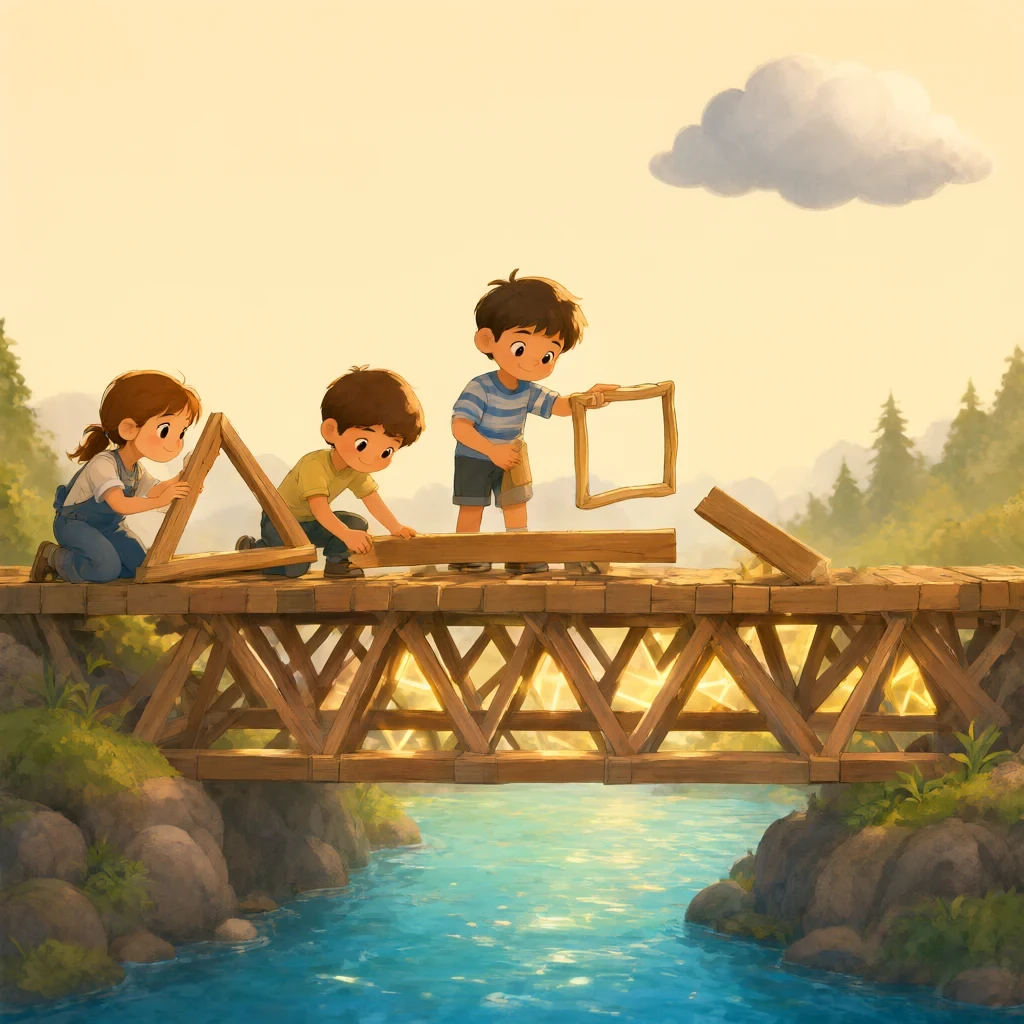
Every spring, the village of Willow Steps had to cross the Bell River to reach its school garden. A fallen branch waited at the water, warm as if it were holding a secret. When rain raised the river, children waited while teachers carried seeds to higher ground.
On a warm day, Iven found craft sticks beside the gate. “Let’s build a model bridge,” she said. She made a flat bridge with two long sticks, two shorter sticks, and crossbars. Talo placed a wooden cube on top. One side slid, and the cube tumbled into a bowl.
They made a square frame. Its corners stood neatly, but when two cubes rested on it, the square leaned into a diamond and folded. “The sticks are weak,” Talo said. Iven pressed each one. They were straight and firm. The problem was the shape.
Auntie Vespa gave them thin wooden strips and paper clips. “Build a bridge for a model boat,” she said. “Keep the strips the same length and use a load that will not roll away.”
Iven made another square. It folded when the boat pressed its center. She added one strip from a corner to the opposite corner. The square became two triangles. “Try the boat,” she said. The bridge held. When Talo tapped it, the triangles changed shape very little. A diagonal kept the corners from racking into a parallelogram.
“Triangles are strong,” Talo said. “Fixed-length triangles resist racking,” Vespa replied. “They are not unbreakable. Loose joints, weak pieces, or a load that is too great can still make one fail.” To test the warning, Iven nicked one strip. The heavy boat opened the corner joint. The pieces fell apart, but the model boat landed safely in the bowl.
The bridge was not magic. The triangle was an arrangement of fixed lengths that shared a load. The wood still carried weight, and the clips still had to hold the corners.
At the river, a fallen branch made a narrow crossing. The village needed a wider bridge, but a craft-stick model could not carry people. Vespa brought a larger model with two parallel beams, vertical supports, and diagonal strips.
Without diagonals, the model bowed under the first book. The second book twisted a beam, and the third sent the whole bridge sliding. They added diagonal strips, making a row of triangles. The books moved from one end to the other. The bridge creaked but kept its shape. Vespa pressed down on one side while Iven held the other.
The diagonal pieces were being pushed together while other members were pulled apart. “Loads make pushing and pulling,” Iven said. “Every bridge carries forces,” Vespa answered. “Good designs send them through connected members into the supports.”
The village builder examined plans for a real crossing. The plans showed a solid deck, strong connections, and supports that carried weight into the banks. Some members made triangles, but the bridge was not a simple truss. A stone arch and a solid beam could also carry a bridge.
A storm arrived before repairs were finished. The old bridge’s railing cracked, and the river covered the lower path. Families on the far bank shouted for help. Iven and Talo ran to the craft room. Their first design used thin sticks. Wind twisted the joints. The triangles were real, but the members were too flimble.
Their second design used stronger strips, tightly joined diagonals, and crossbars. They tested it with a book, a lunchbox, and a smooth pebble. The pebble rolled off the edge, so they placed the load directly over the supports. This time the model held.
When the river struck the supports, Iven imagined the forces moving through the deck, along the diagonals, and down into the banks. The model was too small to save the village, but it showed the children what the grown builders needed to ask.
The builder arrived with ropes and strong beams. She listened to their observations. She did not pretend the model was strong enough or that every bridge had to be a truss. She used its lessons while repairing the crossing.
By afternoon, a temporary bridge opened high above the swollen river. A family carried a basket across. Then a teacher led the younger children. Iven walked in the middle and felt the deck tremble.
Below, the water pushed against the supports. Above, the deck carried the weight. Diagonal members kept the frame from racking. A triangle could still fail if its pieces snapped or its joints opened, but this bridge had been tested and watched. A younger child asked, “What if it breaks?”
“It could,” Iven said. “That is why we test, use strong joints, and never call a triangle unbreakable.” That evening, the children made one more model. They made a square, watched it lean, and added a diagonal. They made a row of squares and turned them into triangles. The triangles held better.
Auntie Vespa sailed the model boat underneath. Willow Steps had a repaired bridge, and the children had discovered the hidden geometry that helped it stand.