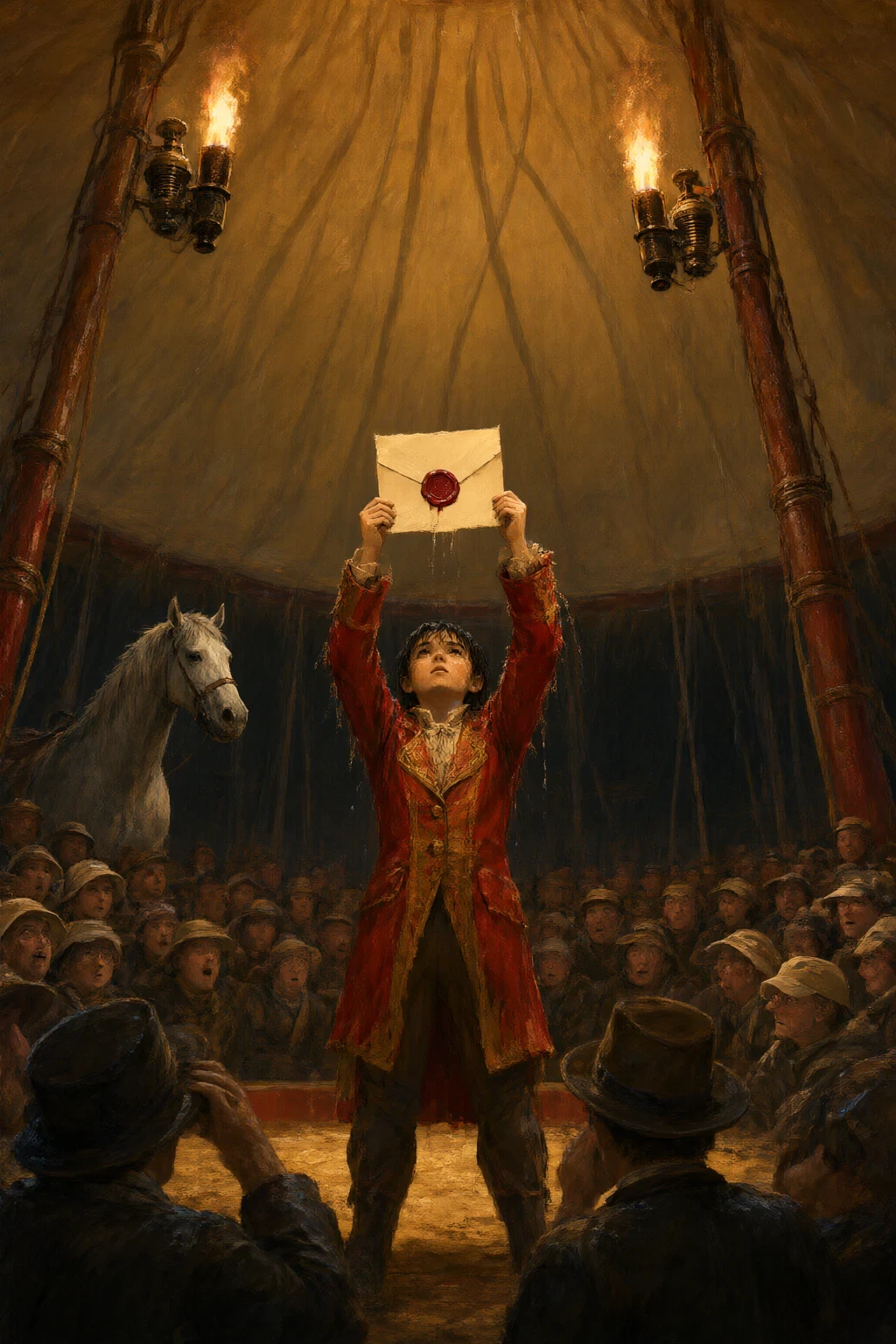
Pettifer Bridge got its fair back on the Thursday and the Gilded Menagerie came down off the Salt Line the same day, in weather that had been deciding all week and had finally decided. The town had been promised a procession. Two years running the circus had come up the causeway behind a brass band and a colour party and gone down it again in the dark, and the whole of Pettifer now held as a settled fact that a circus which cannot manage a parade in rain cannot manage much else. At six in the evening the Ivory Tent stood on the green behind the toll house with water running in the gutters of the canvas and the corona lit, and the queue outside the ticket wagon went a hundred and forty strong, and it was mostly cold. Four hundred and eleven, in the end. The boxkeeper counted them at the end of the second act, because the boxkeeper counted everything, and had a bad cold and did not care.
Odette Vrain kept her bundle in the saddlebag under her bunk in the Scented Row, and had kept it there for six years, and had repacked it perhaps two hundred times, and knew what was in it in the order she had put it in. Item one: a certified fair copy of the pencil contract of the eleventh of October, six years ago, the whole of it, one page, certifier’s hand at the foot in green-black ink, dated. Item two: a certified fair copy of the entry in the Contract Ledger, three columns, same hand, same date, the seal of the Bookkeeper pressed in cheap red wax and cracked once across the middle. Item three: the ninth clause, copied out six times in her own hand because the first five she had spoiled. Item four: a sheet of paper with the arithmetic on it, which was the part of this she was proudest of and the part nobody would ever look at.
Item five: one carpenter’s pencil, sharpened, which had not been sharpened since Tuesday and had not been used since she signed. The bundle was tied with a red tape and the tape was knotted, and the knot was the one she had tied at sixteen when she went in to sign a piece of paper for money and had wanted, very badly, to do it properly.
Here is the arithmetic. A signed performer is meant to be held half-transformed: human in the face, animal in the hands and the gait, able to speak, and to eat, and to be cross with each other backstage. The thing that holds the human half answerable is the Keepsake, the one object you name aloud at the moment you sign. A signature is the whole of it. No ink, no transformation, ever. And a transformation spends memory. For every night you perform in animal form you lose one human day, and you cannot remember that the day happened, which is why the company calls it keeping fit for the season. Odette Vrain had been in animal form for six years and had not lost a day. Not one.
She knew what it was to have lost days, because she watched it happen in the Scented Row to people she ate with. Mateo Brill, three renewals deep, could not tell you what he had done on any Tuesday in the last four years, and did not seem to want to. The old woman in wagon three, billed as a heron since before the Boer War, had told Odette twice, in the way of a person saying something they have said many times, that she had not seen the sea since she was thirty-one. And Odette, who could hear a mouse in the sawdust and had been hearing one for six years, arrived at the arithmetic slowly, over about two years, in a small cold room in Harrow’s Landing in February, and sat down on the end of a bunk and understood for the first time that she was not the company’s favourite performer.
She was the company’s mistake. The one signature in nine seasons taken in pencil, because a man had shaken the ink bottle on the first attempt and spat on the second, and because Odette had been sixteen and there was a bed going and eleven pounds in her pocket and no other offer that week. A pencil contract creates an obligation with no mechanism behind it. It can be argued with. Sometimes it can be lost. She had been arguing with it for six years, on the back of a horse, at four in the morning at Pettifer Bridge and Harrow’s Landing and Nine Elms and Saltcombe, and had built a case out of it in a room over a stable, and the case was, she thought, airtight.
The trouble with an airtight case is that you have to open it in public, because nothing in this world takes effect where nobody is listening. The rule was called the Warden Rule, and it was the rule she had built her whole life on without ever once hearing it spoken: the Director may not sign a performer directly, and a contract takes effect only where at least one paying member of the public is close enough to hear the words read. So the reading could not be done in the Paper Caravan, or the Widow’s Pew, or the Scented Row, or under the ring, or in a quiet corner of the green with a lantern and a shawl over the gasjet. It had to be done in the ring, in the middle, in front of the house, with the corona up and the seats full and the words going out over four hundred and eleven pairs of ears. She had planned for the end of her bareback act, in the second show, at the top of the gallop, with the hall at its loudest, because a loud hall is a hall that is listening. She had a fortnight to make it a fact.
The Bookkeeper was in the Paper Caravan with the door open a hand’s breadth and the green curtain drawn back, and Odette did not go in; she stood on the step. “Mr Quill.” “Miss Vrain.” “I need a certified copy of my entry.” Quill did not put down his pen. He had a green eyeshade on and cuffs inked black to the elbow, and the shell lens laid everything on his right side out in a faint amber blur, and he had not put down his pen in nineteen minutes and was not going to now. “Strictly speaking,” he said, “you have an entry. I have a certified copy of an entry. The difference is the whole of the argument and it has taken me eleven minutes to work out whether I can sign it.” “Eleven minutes is fine.” “It is not fine, Miss Vrain, it is the fourth day I have spent on the fourth day, and there is a queue.” He put the pen down. “Which name.”
“That is the entire point of the request, Mr Quill.” “That is the answer to a different question, and I would argue you have put them in the wrong order.” He opened the second case, and then the third, and came back with a volume and squared it on the long desk and turned to a page. “Sign the certificate. I cannot date it myself; I shall have to certify it in the margin, and the margin is where the margin is.” Odette signed. Quill wrote the certification in a small firm hand, and pressed the seal in, and the wax cracked once across the middle, and the whole of her six years came down to a two-inch red flaw on a sheet of paper. Then he turned the ledger round. “Strictly speaking,” he said, “I should have asked you which name before I wrote a word of this, and I did not, and you will want to know why.” “Tell me the name.” “A. Vrain.”
Odette did not move. Behind her, out on the green, a lanternist was shouting at somebody about a valve. “A,” she said. “A,” said Halloran Quill. “I have been the Bookkeeper of this Ledger for thirty years and I have never had a name in this column I could not read off the paper in front of me. I could not have certified your entry, Miss Vrain, because you do not have one. I have looked for one for six years, on the reasonable assumption that you would not have signed a contract you had not been entered into, and I have not found one, and I have not told you that I have not found one because I am a man who has never once refused a superior, and I did not know whose name to refuse.” “You knew there was a name.” “I knew there was a name.” “You knew for six years that there was a name.” “Yes,” said Quill. “And I have to say, strictly speaking, that I would argue with you about the word knew. I knew there was a name. I did not know it was your sister.”
The first thing she did, afterwards, was go and stand behind the sixth wagon in the Scented Row for eleven minutes, in the rain, out of the wind, and look at a nameplate. She had looked at it perhaps a thousand times: on the first night, and on the last night of every season, and on the nights she could not sleep, which in six years was most of them. Six letters and a date and a small painted horse, and the paint had gone the colour of weak tea. She looked at it for eleven minutes and did not read it, because she was Odette Vrain and she had signed a piece of paper at sixteen with a straight stroke and no hesitation whatever, and it turned out that the whole of the rest of her life had been arranged to prevent her from having to look at anything straight on. Behind the wagon was a lantern on a hook, low, and the rain was coming off the tilt in a rope, and in the light the name read: ADA VRAIN. FILLED THE FIFTH. SEASONS BACK, THREE. KEPT IN THE THIRD PLACE. CALL AT THE DOOR.
She had known since her eighteenth birthday, when she had finally got the courage to walk into the Paper Caravan and read the third column with her own eyes, and had found an entry that was not hers, and had gone out and ridden forty miles without stopping. Ada had been seventeen when she signed in ink, in a fair strong hand, with the nib held wrong. Ada had gone to the Scented Row in the March and had become something with a long back and a grey muzzle and a habit of turning its head to listen to a man three fields away, and had not been able to speak for most of a year, and had never been able to speak again.
And eleven weeks after Ada signed, Odette had gone in and signed under the same name, in pencil, for a berth and eleven pounds, because the company had wanted a second Vrain on the act and had not troubled to ask which Vrain, and because Odette had wanted, with a want that has never once in her life been explainable to anybody, to be somewhere her sister was. “Miss Vrain.” It was Nell Ferrule, at the end of the row, with a lantern and a list. “You are in the book for the second act, and Mr Vane is asking where you are.” “Good,” said Odette. “Tell him I am coming.”
The second show, Pettifer Bridge, in the rain, with four hundred and eleven people in a wet tent. The bareback act had been the same act for six years and it was forty seconds long, and Odette rode Fennel round the ring at a walk, and then cantered, and then stood on the mare’s back with one arm up while the band played the six bars that every child in Pettifer Bridge could now sing. She came off the mare at the end of it and did not leave the ring. That was the part nobody had planned, least of all her. She had meant to speak after the act. She stood in the middle of the ring at twenty to nine with the corona on her and four hundred and eleven people in front of her, and the rain on sixty feet of canvas was making a noise like a train on a viaduct.
“Ladies and gentlemen,” she said, and the noise went on, and about two-thirds of the house could not hear a syllable of it. The man who sold programmes had told her, on the gate, that you had to get them to stop first, and that the only way to stop them was to give them something to say back. So Odette Vrain raised her voice over the rain and said, clearly, into the middle of the tent, like a woman giving a cue in a cold shed: “Ada Vrain.” It went nowhere. Two hundred people heard it. That is two hundred paying members of the public, close enough to hear the words read, and a rule that is satisfied, and it is the only thing in the world she had ever wanted and it was enough. Then she said, to the whole house, in a low sweet coaxing voice she had learned from a woman selling a pony:
“Will you say that name for me? The whole of it. Ada Vrain.” And the man in the front row, who had been on his feet shouting about the parade since the clowns came on, put his hat on the seat in front of him and said, in a carrying voice: “ADA VRAIN.”
It went round. It did not go round like a cheer. It went round like a queue: the man in the front row said it, and the woman beside him said it to her husband, who said it to the man behind, and by the time it reached the fourth row on the left it had stopped being a name and become a beat, and the fourth row on the left said it four times in time, and the beat went out under the band, and the band stopped, because a brass band in a circus stops when the ring goes quiet. And then four hundred and eleven people said a dead woman’s name at the same moment in a tent in the rain, and the tent heard itself do it, and the tent went quiet, and in the quiet there was a noise like a hundred and forty people discovering at once that they had just enjoyed themselves.
August Vane, at the ring edge in his oiled black hat with the worn brass band and his one white glove, looked at Odette Vrain, and then out at his house, and then at the woman in the plain grey coat in the second seat of the front row, who had not moved and had not enjoyed herself and had not missed a syllable. Odette said what she had six years to say, and she said it fast, because the rain was coming through the east tilt in a bright sheet across the boards under her boots, and because she had learned from Mateo Brill, who did not know he had taught her, that a sentence said quickly in a working circus is heard by a working circus.
“Eleven years ago this company signed a book. There is one signature that goes into it, and one signature only, and the whole of the magic is that the signature is the thing. Not the contract, not the parchment, not the wax. The signature. In ink, and in a witnessed room, or there is nothing there at all.” She held up the red wax, cracked once across the middle, and four hundred and eleven people could not see it and did not take her word for it, which was fair. Nobody in a circus takes a small thing on trust.
“My contract is in pencil. It has been in pencil for six years. I signed it at sixteen for eleven pounds and a berth, because a man shook the ink bottle, and because I wanted to be where my sister was, and because I did not read it. There is no ink in it. There is therefore no signature in it. There is therefore no contract, and no mechanism, and nothing to break, nothing to renew, and nothing to deepen.” She stopped, because there is a way of stopping that a room will wait through. “I have kept every day I have ever had. Six years. Ask the man in wagon three when she last saw the sea. Ask Mr Brill what he did on Tuesday. And you will find out, tonight, at this show, that I have not been paid in days, and it is not generosity, it is arithmetic.” “ODETTE VRAIN,” said four hundred and eleven people, and it was not a cheer, and the bookmaker’s man in the third row was shouting the numbers wrong on purpose out of sheer relief.
The Director stood up. She was very calm. She had been very calm all the way through, on a night when nine hundred people in the fairground were watching a show through rain, and she had come to the front row on the second night on purpose, in a plain grey coat, with her hands in her lap, like a woman who had bought a ticket. “Miss Vrain,” she said. “I am going to say something, and I would be obliged if the ring would hold still for it, because I have never in my life had a room this willing to hear me and I expect to be some time.”
“Everything she has said is correct. I have been waiting six years for somebody in this company to stand up and say it, and I have never once asked for it, because I am not permitted to sign a performer directly, and because I have a good reason for wanting a contract read aloud in my own tent that I would rather not give you tonight.” She said it without any drama at all, the way a woman gives a price. “So I am not going to argue with her. I am going to make her an offer, in public, which is the only way I have of making one that counts.” The corona guttered its slow circle, because the pressure was down, and the one sooted jet walked the ring behind her like a man going along a wall.
“Miss Vrain has no contract. Therefore she has no wages, and no bed in the Scented Row, and no name on the bill, and no protection when she is sixty, and no teeth, and no claws, and nothing at all, except six years of arithmetic. She is twenty-two years old. I am the Director of this company and I countersign contracts, and I am permitted to countersign, and there is nothing in the world that stops me countersigning hers.” “Madam,” said Odette.
“You have not had a contract for six years, and I am going to give you one, tonight, in front of these people, in ink, which they will hear, which makes it true, which is all the truth a contract has ever needed in this company.” The Director’s voice did not rise once. “I will countersign the pencil contract retrospectively, from its own date, so that the mechanism your pencil did not supply will be supplied now, and the term will run from the eleventh of October six years ago, and you will be on the bill tomorrow in a type size you can read from the back of the yard. Do this. Now. Sign where the ringmaster can see you, and take the wages you have earned, which is more than you have had.” Four hundred and eleven people in a wet tent.
And Odette Vrain stood on the boards with the water running round the hooves of her own mare and worked it out, and it took her four seconds, and it was the only four seconds of her life that were entirely clear. A countersignature supplies the mechanism the pencil never had. It is one of the two things in the world that can move a transformation from one person to another, and there is no other, and there never has been. The ninth goes on running from the date of the signature. Six years. Two seasons a year. Twelve degrees. There was a number in the Schedule, she had copied it out six times, and the number was not small.
And a Keepsake held the Stop in place, and the Bookkeeper had a record of the Keepsake of every name in the Ledger, and her name was not in the Ledger, so there was no record of the thing she had named aloud at sixteen, so there was nothing holding the human half answerable except her own memory — and she would not have any of that by Thursday. She would be a bird by Thursday. All the way. In one night, with no ledger column anywhere to read it against, so that nobody, including the man doing it to her, would be able to tell her afterwards where the bird stopped and the girl had been.
And there would be nobody to name the nearest one she took with her, because the company would not have a record of her, and the Warden Rule was the only thing that made the world legible, and she was asking, on a stage, in the rain, to be erased from the only book that kept the facts. “Thank you, madam,” said Odette Vrain. She took the bundle out of the saddlebag at her knee, and untied the red tape, and turned the certificate face down on the rail, so that the whole of the seal was flat against the wood, and no one in four hundred and eleven seats ever saw a red mark again that night. “No,” she said.
It rained for another four hours and they took the tent down at one, and the road up the Salt Line shone in the lantern light under a film of chalk water, and the six of the company who were on paper as horses were led down to the green by the boys, which they do every night, and which nobody in the town has ever once wondered about. Odette Vrain took Fennel back to her own line and did not ask for company, and put the bundle in the saddlebag, and knotted the tape, and did not sleep. At two she went out to the Scented Row with a lantern.
The rain had stopped. There was a moon about as big as a biscuit and a wind off the river that smelled of wet chalk and went straight through a scarlet-and-gold coat with the cuffs gone threadbare at the seams. Six long barred wagons in a crooked line, each with its nameplate and its straw bed and its tin cup, and the smell of straw and oiled iron and every animal at once, which was the smell of her childhood and of every night of the last six years. The sixth wagon. A hand-lettered plate, a painted horse, tea-coloured paint, and the words, which she could now read at a glance and had not been able to read for six years, in a name she had been signing under since she was sixteen. She put her hand flat on the bars.
The arithmetic had held. Six years, every day of it present and accounted for and hers, and no mechanism anywhere behind any of it, and she was free of the contract, and the contract was free of her, and she was a twenty-two-year-old woman standing in the wet outside a row of cages with a lantern in her hand, and the last thing in the world she wanted was to have to do with a piece of paper. She said the name out loud, once, to herself, in the yard where the lanternists were shutting off a valve, and it went up through the gap between the wagons and out over the green and the toll house and the river, and the Salt Line heard nothing, and four hundred and eleven people at Pettifer Bridge were asleep, and six draught horses stood in the dark with their heads up, and one of them, the grey in the third place, turned her head and lifted it a little, and held it there.