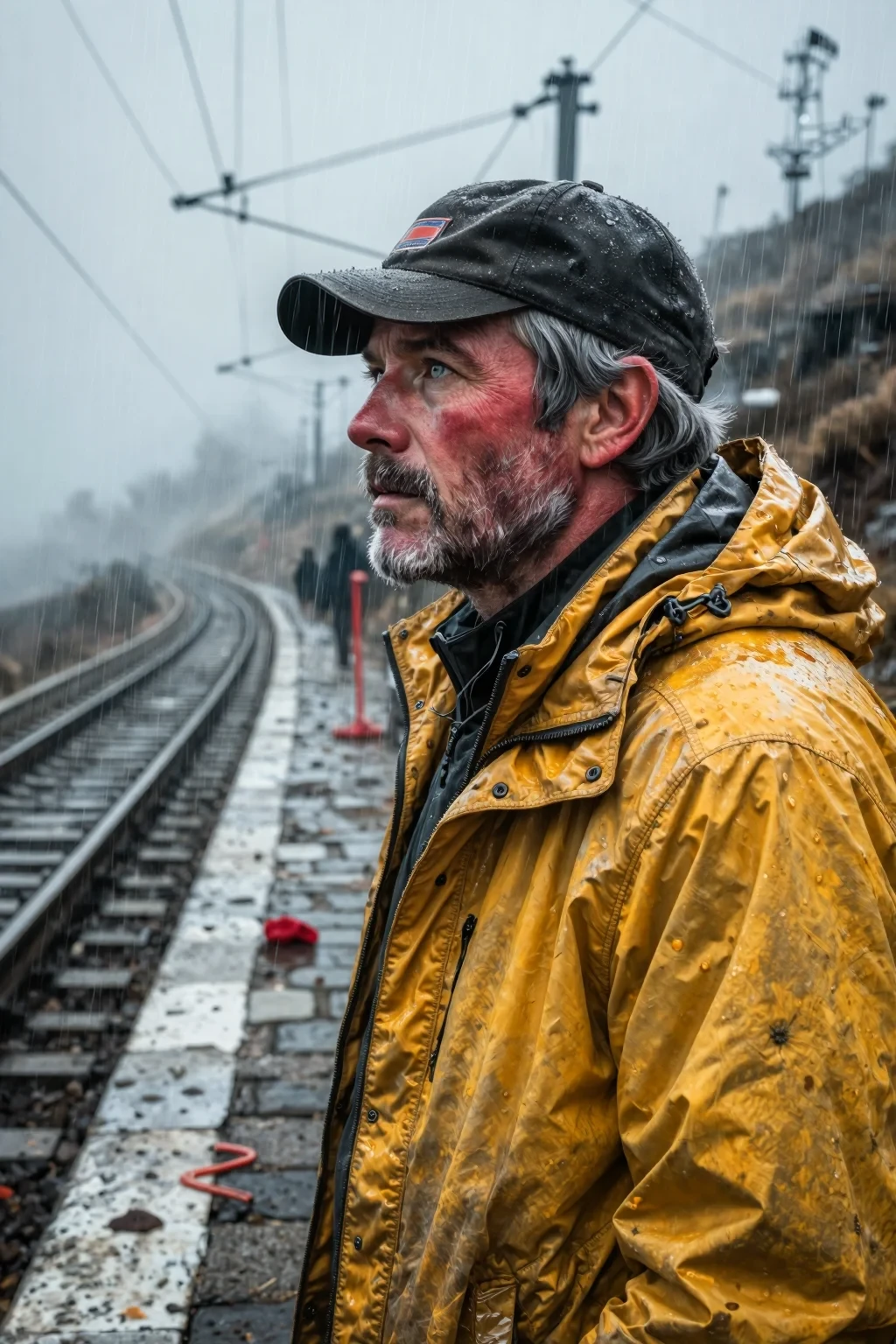
At twenty past three on the Wednesday the anemometer on the corner of the winding house read thirty-one, and Ivo Trant read it out loud to the drum. “Thirty-one,” he said. “Gusting thirty-six at the mast. She’ll hold.” The drum did not need him to tell it. He had thirty-one years of it, and the drum had never once wanted anything from him that he could not give it standing up, in his own boots, with the right hand bare and white to the second joint and a red woollen mitten on the left one for the shed in February. He put his palm flat on the brake lever and left it there. Behind him in the drum room Gwilym Ore had the gauge board open and the horseshoe burn across his leather apron was the same colour it always was, and there was a pencil behind his ear that had been there since Monday. “Twenty-nine was the figure,” Gwilym said. “Twenty-nine was the figure at two o’clock.”
“The line shuts above twenty-eight.” “The line shut above twenty-eight,” said Ivo Trant, “at twenty-nine, and I did not shut her, and she is two hundred yards short of the top with five people in her, and if you would like to write that down I will come down to the office and dictate it.” He counted under his breath. Four. Eight.
At ten past three he pulled the brake. It was not a pulling that took any judgement. He had said the number out loud so that the room had it, and then he took the lever over its notch and held it, and the drum came round a quarter turn and stopped with a sound like a man putting down a hod of slates. The car stood still on the upper span, two hundred yards short of the top station, in the middle of the part of the line where the wind comes over the shoulder of the moor with nothing in front of it. “A balance broken mid-journey is not a fall,” he said. “The cable stops. It holds where it is until it is right. It has done it eleven times in thirty-one years and nobody has ever been hurt.” He said it to the drum, and the drum did not answer, and he knew before he had finished the sentence that it was not the drum he had said it for. Then he blew into the tube.
The tube was three-quarters of an inch of lead and it ran up out of the floor of the drum room on nine clips of galvanised wire, up the leg of the first trestle, and along the cable the whole mile and a quarter, and it split at the ninth trestle into two branches, one to each car. It had been put in in nineteen eleven along with the new cable. It hissed all the time. You could hear the weather in it. “Ivo Trant,” he said. “Cars stopped. Holding. Nothing moving and nobody hurt. The line is shut above twenty-eight and I did not shut her, and that is on the book and not on the drum. How do you hear me.” The branches came back one after the other, and the eleven of them, five in one car and six in the other, spoke into the same piece of lead pipe for the next four hours and ten minutes.
The balance car was on the sheltered side, two hundred and forty feet up and coming down when the brake went on, so it stood still in the air with six people in six iron pans hanging over the pit shaft. The pans were in a row. They could hear each other perfectly well. They could not hear anything else in Wales. “Here,” said Teofil Rownt. “Loud and clear.” “Then we are all in one room, which is convenient and not pleasant.” Teofil Rownt was the largest single holder on the lower line and he had good shoes on a wet iron pan and had said nothing at all about them. “Before anybody begins. What is the number.” “Thirty-one at the corner. Thirty-six at the mast.” “And the line shuts above twenty-eight.”
“The line shuts above twenty-eight,” said Ivo Trant, “and I let a car out at twenty-seven at two o’clock because the wind was easing and because five people were standing at the top station in the rain and the road up the hill is four miles of switchback. That is the whole of my account and you may have it.” Nobody said anything for a moment, because there was no rule about it. That was the difficulty with the tenth rule and the first one and the ninth. They covered what the cable did and they covered what a person said at a pan, and between them there was not one word about a man who could stop a car.
Gwilym Ore had the tank hatch up off the balance car by half past four and had a lamp down the shaft on a chain. “Come up here,” he called, into the tube, so that everybody heard it. “Coming.” Ivo Trant went down four steps and across the floor to the pit, where the grating showed the shaft going down into wet stone, and the wind came up out of it, and the temperature in the balance room was thirty-one degrees and had been thirty-one degrees since November. Gwilym had the balance car’s ballast tank open. He had a torch in his teeth. There was ice in it, not frost but ice, a crust an inch thick lying across the draw-off like a lid, and the water under the lid had a skin on it and the whole of the west side of the tank was white. “The tank’s frozen,” said Gwilym. “Yes.”
“Not iced over. Frozen. Solid.” He took the torch out of his teeth. “This is the balance car’s tank. It draws down as she descends and it fills as she rises, and there is a draw-off under the car and a filler over the head sheave, and neither of them is any use to anybody in the world tonight.” “Then how far out is she.” “Four stone.” Gwilym said it without any feeling at all, because it was a weight and not an opinion. “Four stone heavy and hanging a foot low at the shallow end, and the six of them are not level, and Teofil Rownt has a cold hip and a cold shoulder and neither of those is his fault.” “Four stone.” “Four stone and two pound, and I will not state it exact.”
“Nobody can state anything exact,” said Bronwen Vasey from the office doorway, where she had been standing with the book under her arm for some time. “Two stone on a car is the margin. That is the margin the survey gives, and it is the margin the town has run on since I came, and tonight we are four stone past it and the cars are stopped and the wind is making thirty-one.” “The wind is falling.” “It is not falling,” said Bronwen Vasey, “it is oscillating between thirty and thirty-six and it will do that until six.”
The five in the grip car had been in it two hours and had said almost nothing, because there is a way of being silent in a small iron box in the dark that nobody teaches you, and they had all found it inside twenty minutes. Nan Gethin was seventy-four and went up on Fridays and had gone up on Fridays for forty-one years and had never once been late and had never once gone up on a Friday in weather. Cuan Llowes was twelve and had a parcel in a sacking bag tied with four different kinds of string, and his mother Mared Llowes was beside him, twenty-six, going up to sit with her mother in the four beds at the hospital, and had been in the hospital doorway that afternoon and had been told the road would take until dark.
Evan Prothero was thirty-one and had come off the Monday packet and had bought a ticket with money he did not have for a view he had been told about by a man in a public house. Doctor Pryce was fifty-eight and went up every second day and had a bag of instruments that had gone to sleep in the cold. “Ivo Trant,” said Doctor Pryce, into the tube, in the voice of a man who had decided to be practical. “How long does this take.” “We do not know yet.” “That is not a figure.” “No,” said Ivo Trant. “It is not.” “And can you not simply run her up to the top? The catch is there. Put the catch down.” “The catch is there,” said Ivo Trant, “and the catch would have taken her, and I did not use it.” The tube hissed.
“I pulled her at ten past three,” he said, “at thirty-one, on the strength of a gauge on a wall, two hundred yards short of a station. That is the whole of what happened and there is no more to it than that.” Nan Gethin said, “Well.” She said it to the tube and everybody heard it, five hundred feet and a mile away, and it was not a complaint and it was not agreement, and it was the first thing anybody had said on that lead pipe in two hours that was not arithmetic.
The six in the pans had been arguing since four o'clock and had got to the same place four times. The finding was this, and it was Gwilym’s finding, and Gwilym gave it without being asked and without using the word because. “The balance car is four stone heavy. A man is seven stone and four. The rule says the balance must exceed the grip by the weight of an adult, so one man off the pans leaves us at the margin and the margin is the margin, and the balance car comes down to this floor at ten minutes past four with one man in it who is not holding.” The wind came up the shaft and the lamp on its chain swung. “Who off,” said Cwfrig Pyle.
“You are asking the wrong question,” said Bronwen Vasey from the office. “You are asking which of us. It is not which of us. It is that one of us goes to the clerk and says his own name out loud, and the clerk strikes it, and the six of us is five, and the car comes down, and the man rides.” “The man rides,” said Teofil Rownt. “He rides. He does not hold for the rest of the year. He is a man who did not hold, and a man who did not hold goes up on the next Tuesday with four strangers and no part in it.” Nobody spoke for a while. The pans hung. “There is the arithmetic of it,” said Teofil Rownt. “One name off the pans. The margin comes from four stone to one. The balance car comes down at ten past four with one man in her who has not held this year. That is the whole cost.” “That is the whole cost?”
“For the year,” said Teofil Rownt, and did not finish it, because there was a second half and the second half was a man's winter, and he had spent thirty-one years arranging himself so that the second halves were somebody else's business. He had a brass token on a chain round his neck, worn through at one edge so it hung crooked, and he turned it over twice with his thumb and said nothing else.
Aldith Marner was twenty-nine and taught two hundred and six children the hour by the Grip and had come up on the pans because the lower line was short that week and because nobody had asked her not to. She had chalk on the cuffs of a jacket that was much too good, and she counted before she spoke. “Teofil Rownt,” she said. Four. Eight. Twelve. “Are those your words or the clerk’s?” “They are mine.” “Then the clerk has not heard them and the book has nothing in it, and you and I both know what a sentence of yours has been worth for thirty-one years, which is nothing, because you have never once said one out loud on this line. So I am going to put it in the form. Is there a man among the six of you who will give his name to the clerk to be struck out for the remainder of the year.” She waited.
They are extremely good at waiting. That is the whole method and it does not fail. Cwfrig Pyle said, no, and gave a reason about his knee, and the reason was mostly true. Bessie Vaughan said, no, and gave no reason at all. Dafydd Trant, who was Ivo’s cousin and had not said one word in five hours, said that he held for the lower line and not for the mill and would thank them not to be helpful on his account. And Nell Cardew said nothing for a while, and then said a number.
“Seven stone four,” she said. “That is the least that comes off her and that is the figure we have to take off her and there is one name to do it with. There are six of us. Any one of the six can be the one. I am the smallest entry in the book by two stone and it would take me eleven minutes to get down the shaft ladder to the office and about thirty seconds to say the sentence.” “Go on,” said Aldith Marner. “That is the fourth number I have given,” said Nell Cardew. “It is a good number. I have checked it twice.”
She did not say the other thing. She had a wicker splash of boiled leather round her shoulders and a tan line across her forehead where the sun came through the winding house window in June, and chalk on her fingers from the book, and she had eaten her lunch at noon standing up facing the drum, the way she always did, and the drum had been still for four hours. It was Gwilym Ore, from the pit, at about seven, that told them the thing none of them had thought to say. “The balance car is four stone out,” he said, “and she is out because a tank froze. That is the whole of the fault and it is not anybody’s fault and there is no name in your book that would have stopped it.” “Then it is ice,” said Bronwen Vasey.
“It is ice and it is a cable,” said Gwilym Ore. “Nineteen eleven. They put this cable up on the upper span in nineteen eleven and they greased it every autumn after that until the works shut, and there is not one man left in this town whose job it is to grease anything. I am sixty-one and I can strip that drum in a day and I cannot reach the sheave at the ninth trestle with a can in my hand, and I would not go if you paid me and I would not go in this, and neither would you.” Nobody said anything. “So we can have a man,” said Gwilym Ore, “or we can have the cable. We cannot have both and it is not a matter of anybody’s nerve.”
Aldith Marner put the question to the drum room at a quarter past eight. “Ivo Trant.” He had the brake lever under his palm and the lamp turned low and the tube in his other hand, and he had been listening to eleven people argue for four hours and ten minutes and had said perhaps forty words. “Yes.” “The line is shut above twenty-eight. It has been shut for five hours. There is ice in the upper sheave and there is no man on the cable. Six people in iron pans have been asked whether they will lose their year and four of them have said no and one has said a number. Nobody can walk down the trestle path; it has eight feet of snow on it above the second switchback and it is closed and it was closed before you came on this shift. The only road to a second pair of hands is a car, and a car needs the balance, and the balance needs a name out of the book.” “I know all of that.”
“I know you know it. You have been waiting all evening for one of them to say it to you as a question, and nobody has, and that is why the wind has been making thirty-one for five hours while a man with his hand on a brake does arithmetic at them.” The tube hissed with the weather in it. “Ivo Trant,” said Aldith Marner. “Do you want a man.” He gave her the wind. He gave her thirty-one, gusting thirty-six, and a half of it at the corner. Then he gave her a brake time, which was that he had had the lever over its notch since ten past three and his arm had not changed and the night watch would find it exactly so. Then he gave her the number of minutes the drum had been still, which was three hundred and five.
That was the way he had been given his orders for thirty-one years, and it had never once occurred to him that a man could be asked a question in that order and be expected to answer it in the same order. The tube hissed for a while. “I want a man,” he said. Nobody said anything for a long time. The pans hung on their chains. The lamp swung on its chain in the shaft, and the wind came up the grating. Then Teofil Rownt said, “Well,” and stopped, because a term had been offered and he could not cost it, and that was the end of what he had to say that night.
They did not strike a name. That is the finding and there are eleven people alive who can be asked about it and they will all give you the same eleven minutes, and no two of them will give it in the same order. At half past nine Doctor Pryce asked whether the grip-man could come about and put the balance car down to the bottom station empty, since it was four stone heavy and wanted to come down anyway, and take the weight off the loop and see whether the grip car would come with it. Ivo Trant said that if the balance car came down to this floor with nobody in her pans, she came down as a free weight and nothing else, and the grip car stayed on the upper span until the ice came off her or until somebody went up to the ninth trestle with a can.
At ten o'clock Evan Prothero, who had bought his ticket with money he did not have, asked whether they could not simply send the car up over the top and let it come down the other side, and Bronwen Vasey explained to him for the second time that the two cars are on one cable and that the west leg is running the balance car, and that the arrangement is not a suggestion. At half past ten Cuan Llowes asked his mother whether the parcel would go down in the wet. At eleven Nell Cardew gave the room a time, which was that the wind would go under twenty-eight by about eight in the morning, and nobody asked her how she knew, and she had not said how she knew.
At twenty past midnight Teofil Rownt said that he had held the lower line for nineteen years without a single Tuesday missed, and that the rota was his, and that the rota existed so that no individual winter would ever fall on one man, and that this evening he had learned what the rota was for, and would not be repeating it.
At ten past seven the corner of the winding house read twenty-six. Ivo Trant put his hand off the brake lever, which had been over its notch for sixteen hours and two minutes, and found that his arm came up out of the socket with a sound. “Twenty-six,” he said into the tube. “Gusting thirty at the mast. She’ll run.” He brought the balance car down first, on the strength of four stone and against four stone of nothing, and the pans came slowly down the shaft past the grating with six people standing in them not touching anything, and the six of them got out onto wet stone at seven twenty-three and their legs went under them, all six together, the way legs do. Then he reversed the loop.
The grip car came down the east leg in nineteen minutes and did not stop where it was asked to stop, because on the way down a car is not stopped by weight at all. A car is stopped by a bar into a slot. Doctor Pryce had said put the catch down, and Ivo Trant had said he had not used the catch, and the catch had been waiting at the top station for sixteen hours doing nothing at all. The five got out onto the granite of the lower station and Mared Llowes took the parcel off her son and put it inside her coat, and Nan Gethin said the thing she says, and Doctor Pryce went up the hill on foot and arrived in time. And the balance car went up the west leg on the reversed loop and stopped at the top with four stone and two pound of ice still in her tank, which is a thing to be dealt with in daylight.
Ivo Trant kept a hand-book behind the drum where the oil did not go. It was not a company book and it was not in anybody’s hand but his own. It had eleven entries in it, and the eleventh was the twenty-second of December, and it said: wind twenty-six steady, ice on the west sheave, held four hours and fifty minutes, no name struck out. He wrote the twelfth on the Monday morning with a pencil he found, because the pen had gone hard in the winter, and it said: wind thirty-one gusting thirty-six, car stopped short of the top two hundred yards, balance out of true four stone two pound by ice, held sixteen hours two minutes, no name struck out. Then he looked at it for a while, and added a second line, which was the first second line he had ever put in that book.
It said that a man had asked for help at a quarter past eight in the evening and had been answered by eleven people at twenty past seven in the morning, and that it had taken him all that time to say what he wanted, and that Aldith Marner had asked him and had then waited, and that she had been right to wait, and that he would not have been any use at all inside a quarter of an hour. He shut the book and put it back behind the drum. The wind came round the corner of the building the way it always came, like water round a stone.