It was market day, and the rain came sideways off the moor and went into the lime yard sideways too. The visitor stood in the middle of it in a waxed coat and a very clean collar. He had come from Hallowmere, four counties away, and he was holding a piece of paper. “I will pay for a bell,” he said. “I have paper for it.” Nan Ilva pushed her sleeves down over the crescents on her arms. They were white, and the width of a ladle handle, and they never went away.
“Eleven hundred of us,” she said. “Nine hundred, and falling. We do not sell bells, Mr Sallow.” “Then I will buy a broken one,” said the visitor. “I do not want it to speak. I want it to be a bell.” Nobody could think what to say to that, and market day went on.
Nan looked along the wet street and found the youngest hand on the ropes. “Ebba Roke. Fetch me the one bell this town would not miss. If you can find it, we will talk about money like grown men.” Ebba went up the steep street with the rain in her face. A strip of grey wool was wound round her right palm, damp as it always was now, over a burn she would not show anybody.
She asked at the bakery. She asked at the lime yard, where the ingots stood in a row like a fence. She asked the schoolmistress, who said, “The school bell. Half the children in this town learn the hour by it.” She asked a man by the coal wall, who said, “Sell the dead one. Nobody will miss it in April.” She asked Odo Marrack, who was sitting on a wall in his black felt hat with two fingers short on his left hand.
“I am not going to say this is advice, but,” he said, “ask them what they would lose. That is the whole job.” At the door of the laundry they said the fire bell. At the smithy they said the fire bell again. At the net-loft they said the tide bell, because the Corrach comes up faster than the parish can write about. In the Cloth Hall two old women said the bell for the dead, and one of them said the name of the person she had said it for. So Ebba climbed the tower.
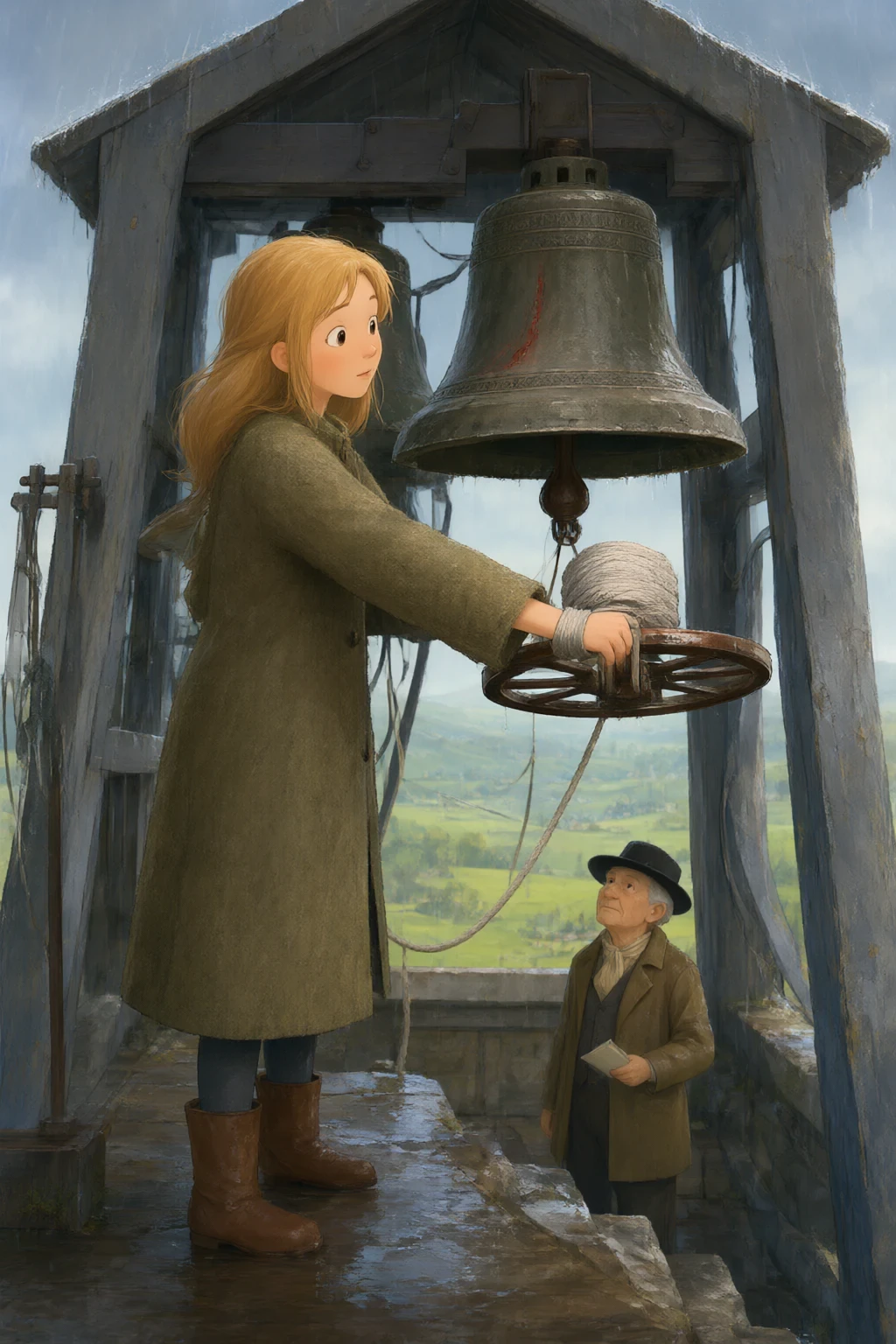
Ebba stood on the landing under the louvres and did not touch a rope. That was the rule and she knew it in her hands. She was fifteen and the youngest hand on the ropes, and the fire bell was not hers. Not ever. And older did not come, because the tower man had said so once and she had thought about it every day since. So she looked instead.
“That is the dead one,” she said out loud. “That was the school. That one is the tide. And that is the hour bell, which counts and will not stop. And that is the fire bell, and I have not rung it, and I am not going to today.” The fire bell was the biggest thing she had ever stood close to. Down in its shoulder was a line three inches long, dull red, where the metal showed through the bronze. A founder had filed it so that you could see it. A founder had wanted it seen.
She put her hand flat on it. It was cold. “It screams an hour early,” she said. “That is the whole of what it is. I felt that in my teeth from here just now, and it is not even ringing.” And then she understood the job, and it was not a sum she had to do at all. You do not miss a sound you never had. And you cannot miss a bell that is not a bell.
She went down the hill and west to the scrap field, where the children are told not to play. Out there it was totally quiet. Hundreds of broken bells lay in the grass and the puddles with their letters facing up through the water. Some were as big as a cart and in pieces. Some had their crowns torn off by tongs. A bell out in the open air is not a bell. It is a heap of bronze. It cannot be heard at all.
A bell only speaks inside a frame, hung up, with somebody out in the weather keeping the promise of that frame.
That was the answer, Ebba thought, standing in the wet grass with her shoes full of it. You cannot sell a bell. To sell it you would have to sell the frame with it, and the frame is a promise somebody is standing in the rain keeping. And if you carried a bell out of this valley it would stop being that bell, and one day somebody would melt it down, and for the rest of its life it would be a bell that tried to be something else. Which means the bell this town would not miss is not one bell. It is the lot.
She went back up the hill and told Nan Ilva that the town would not miss the fire bell, or the dead bell, or the tide bell, or the school bell, or the hour bell, and that it would miss a bell nobody had thought of yet, because a town cannot miss what it never had. The visitor had not gone home. He was under the notice-slate with his paper folded in his pocket. “How much for all five?” he said. “I will send the cart on Monday.”
“All five, and the frames, and every bell in this valley that has ever been hung,” said Nan Ilva. “And you would still not be able to lift them. They are not heavy. We are not selling. What we are doing is going up to the counting house and writing down that this conversation happened, so that it is a fact and not a rumour.”
The visitor did not stay for the barley drink. At the bottom of the street he stopped, with the rain going over his good coat. “My mother is buried in the churchyard at the top of your street,” he said. “That is why I came. I thought one of yours might be hung over her.” “Then it is nearly over her,” said Ebba, “and she would hear it first, and that is better than being in the low country where nobody knows what a Gethin bell sounds like.”
“My girl cannot hear well,” he said. “One ear. The bells where she is all say the same thing. I wanted her to hear one that says something else.” “Which is what?” said Ebba. The man shook his head. “That is your business, not mine. I have paper and I have come a long way and I am going home.” He shook her hand, and he did not say that he was sorry.
Afterwards Ebba went up the tower again, because there was nothing else to do with the evening. The stair was cold. The rain had got in and was tapping on the frames, a hundred little noises, and none of them was a bell, and the one that was a bell was quiet.
She stood on the landing in the dark with the wool round her palm wet against the burn, and she did not touch the wheel. Not the school bell, and not the tide bell, and not the dead bell, and not the hour bell, and not the fire bell with the three-inch seam she could see from six inches away.
She had rung nothing at all that day. She had been sent to fetch a bell, and she had come home with an answer instead, and the answer had been in the shape of the bell and not in a single word anybody had to write down. The town was not short of sounds. It was short of one thing only, and that thing was not hers to give away. She went down the cold stair, and the rain went on tapping.
On the Monday there is still the same four on the ropes. But the visitor's letter came up with the Tuesday post. It said that a man from Hallowmere had been asked by a girl of fifteen what this town was short of, and that he was going home to find the answer first.