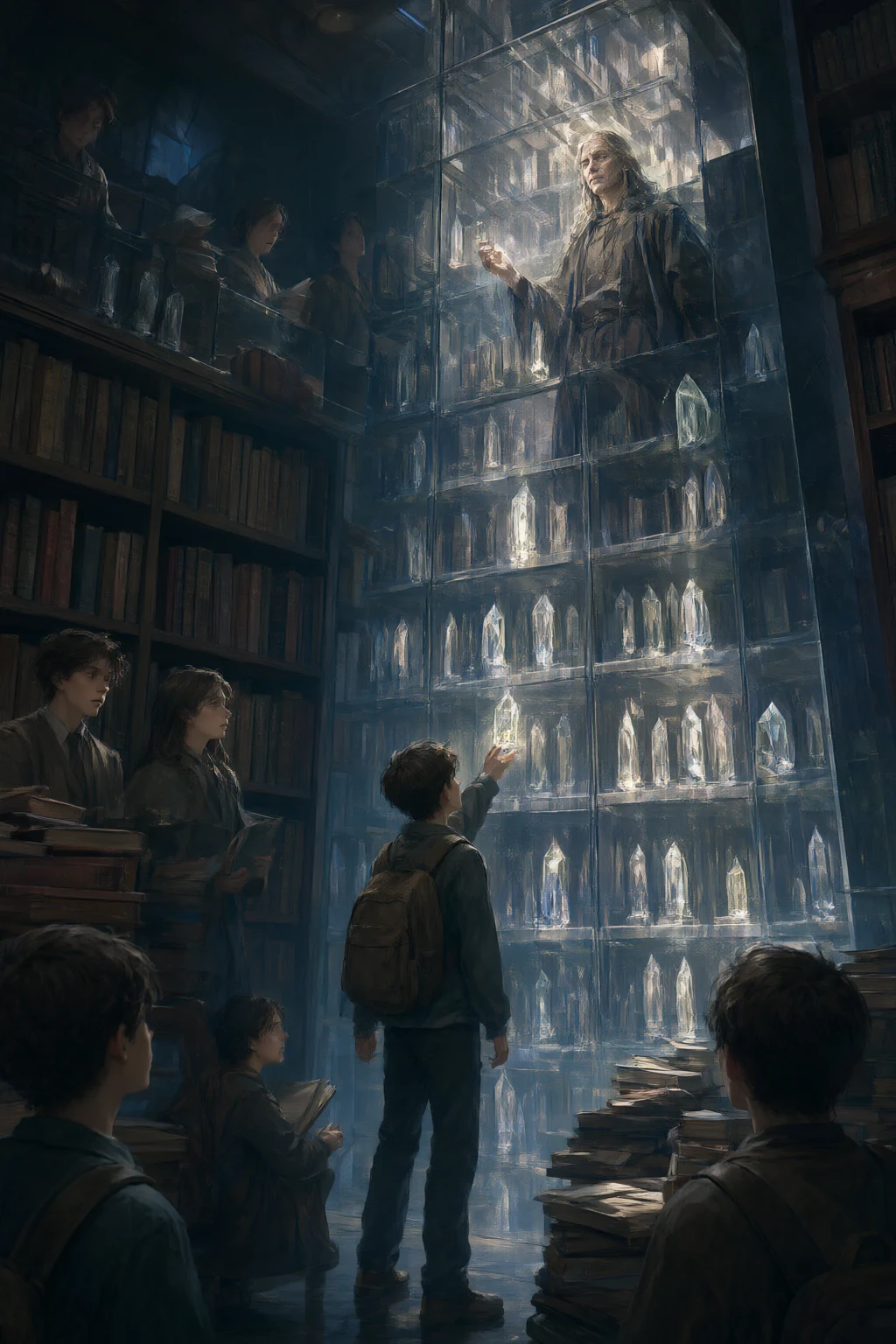
The memory crystal in Room 14 hummed whenever someone lied. It sat inside a black mesh box on the teacher’s desk, no bigger than a fist, polished pale as a winter egg. Principal Venn called it a promise from the school: no more cheating, no more stolen answers, no more pretending a rules did not matter. Mara noticed the hum first during a history test.
She had not lied. She had looked toward the window because a crow had struck the glass and the teacher had begun writing a wrong date on the board. The crystal glowed amber, and every head turned toward her. The sound was soft, like a teaspoon dropped inside a pillow. Mara kept her pen still. “The crow startled me.” “You looked at the board,” said Mr. Vale. “The board is wrong,” said Niko, who sat behind her. “The treaty was signed in winter, not spring.”
The crystal’s glow sharpened. A red line appeared in the corner of the smartboard, and the number of points remaining on every test in the building dropped by one. Principal Venn appeared in the doorway before the bell finished ringing. He was a compact man with a neat beard and the careful expression he wore when he wanted the room to believe he had already made the difficult decision. “Honesty scores are now attached to the crystal,” he said. “No more disputes about who knew what.”
Mara looked at the black box. It had arrived in the summer, after a year of accusations: copied essays, stolen lab results, a boy who had cried in the stairwell because he could not prove he had done his own reading. The school’s first meeting had been reassuring. Students would concentrate, teachers would have proof, parents would stop receiving anonymous accusations. Mara’s mother, who cleaned the school at night, had heard a custodian whisper that the crystal could be disconnected.
“Then no one can accuse anyone,” he had said. “That sounds fair.” Fairness had not been Mara’s first thought when the crystal sang. It was the way Niko lowered his head and began copying another student’s answer. It was the way Ms. Orr, the art teacher, started every class by asking the crystal whether she had hidden her keys. It was the way a student with a migraine once had a red mark appear beside his name because he had lied about having a headache.
Mara’s mother noticed Mara staring at the box while she scrubbed the floor after the last club meeting. “The crystal is helping,” she said. “People are behaving.” “Or people are afraid to be seen.” Her mother’s hands slowed in the bucket. “If one child cheats, everyone carries it. That is hard.”
That evening Mara found a small service hatch behind the crystal’s wall panel. The crystal was linked to the school network, the attendance system, the library printers, and a cloud archive managed by a company called Palisade Metrics. A label inside the hatch said, “Preventive integrity: continuous capture.” The copy button was a small blue crescent.
The next morning the crystal hummed during a staff meeting. Mara sat outside the door with her notebook. She heard Principal Venn say, “It is working. Deterrence is working.” Ms. Orr’s voice came next, tight and low. “It remembers private conversations. A student said she was afraid of failing. Does that become evidence of a lie?” “Only when the statement conflicts with an action,” Venn replied. “Her pulse, her hesitation, her room?” “Pattern recognition.”
A chair scraped. “Pattern recognition is not consent.” Mara’s face grew hot. She wrote the quotation exactly, then wrote the date beneath it. At the end of the day, a message appeared on the school board: Student 247 has been detected engaging in unauthorized observation of the integrity system. No name. Everyone knew the number belonged to Mara.
The next morning a security officer stood beside the crystal. He was young, with a gray lanyard and shoes polished for a room where no one ran. Principal Venn asked Mara to wait after class. “You photographed the service label,” he said. “I noticed a privacy notice.” “There is no violation of privacy in a system designed to protect integrity.” “You collect more than exam answers.” “We collect patterns. Patterns allow us to spot a hidden cheat before it happens.”
“That sounds like collecting people.” He looked at her as if she had made a poor but useful arithmetic error. “A system without blind spots is a system that can be abused. You are eleven. Do not confuse privacy with a right to secrecy in matters of safety.” “Privacy is a right even when it is inconvenient.” Venn’s jaw tightened. “You may write a reflection. You may not contact Palisade Metrics or other students about the system. A complaint will be treated as a disciplinary matter.”
That afternoon, Niko passed her a note: You were right. It marked me when I copied. It also marked me when I said I had a stomach ache and went to the nurse. In the weeks before the crystal, Niko had lied about being sick after his father left. The school had made a big correction in front of everyone. The crystal had made it permanent.
At home, her mother was sorting donated books. A charity had given the school tablets, and Mara had been asked to load them. She found the crystal’s backup connection on the network. The archive had records from three years, including the initial sample weeks when the device was tested on staff. Ms. Orr’s low voice was stored. Principal Venn’s warnings. A school counsellor spoke to a student about a panic attack, and the crystal marked the student’s words as “evasion.”
The student’s file also contained her location in the library and the minutes she spent near the emergency exit. Mara felt anger turn into a hard, clean line. She could copy the archive to a public drive. That would be evidence. It would also put the names of other students into a place no adult controlled. Her mother had once told her that exposing a secret did not always make the world safer; sometimes it moved the danger from a locked room to every unlocked door.
“Do you want to tell the whole school tomorrow?” her mother asked, after Mara had shown her the dates and labels. “Or do you want to tell one careful person first?” “Who can I trust?” “Someone who can protect the evidence without controlling it.”
Mara considered Principal Venn, who had already called the truth a discipline problem. She considered Ms. Orr, who had asked whether pattern recognition was consent but might still be too close to the system. She considered the librarian, Mr. Sen, who had once kept a copy of a banned novel behind the poetry shelves. He knew how to hide information without pretending it did not exist.
The next day Mara asked Mr. Sen to help her make an archive copy. He did not ask to see the whole file. He set a clean spare computer on the circulation desk, gave her a blank drive, and said, “If you publish it, decide what the people in it can afford. Evidence can be true and still be careless.”
Mara selected only the records that showed the crystal collecting outside testing: her own class, the student’s panic file, and an audio segment where Venn said “deterrence is working.” She left out the names of students who had not been harmed, though it felt like hiding part of the truth. She compressed the copy, wrote the date and a short explanation, and gave the drive to Ms. Orr.
Ms. Orr read the heading and looked up. “You understand that showing this will make your own case difficult.” “Yes,” Mara said. “I did not copy the wrong date on the test.” “I know. That may not be enough.” The next morning Ms. Orr requested a staff emergency meeting about “data minimization and student due process.” Principal Venn barred Mara from the room. At lunch, however, the school board’s student representative arrived with a laptop. Palisade Metrics had sent a notice to the board claiming the crystal prevented a credible cheating ring, and Venn planned to praise it publicly.
Mara stood at the microphone in the assembly hall. She did not call the crystal evil. She said, “This system is effective at making people afraid to be misunderstood. It has records that have nothing to do with tests. It marked my head turn. It marked a student’s request for help. A copy of the records is available to the board, and I can show where it came from.”
She felt the room’s attention turn into a physical pressure, hot and shifting. Venn asked whether she had stolen the records. She answered, “I copied only what I needed to prove that the system does more than it says.”
The board opened an inquiry. It suspended the crystal, which made some students cheer and others stare at the black box. The board also closed Mara’s disciplinary complaint privately with a short data-literacy plan; no public finding entered her record. The suspension did not erase its records. Palisade argued that deletion would reduce the school’s ability to investigate old misconduct. Ms. Orr argued that retaining a record without a lawful purpose was its own injury.
During the inquiry, Mara met the student whose file she had copied. His name was Eli. He had not wanted to speak in the assembly, but he told Mara that he had spent months avoiding the library’s emergency exit because the crystal had marked it as a possible escape route. “You took that out,” he said. “But I still know my breathing is in there.” “That is not something I can give back.”
“No,” Eli said. “But you could have left it out entirely.” The distinction stayed with her. Evidence and privacy were not opposites, and exposure was not automatically repair. Mara asked the board to appoint a student data council, allow each person to correct their records, and require teachers to explain any collection in plain language. She also asked that the system be evaluated by someone outside the company, with students invited to see the evaluation.
Principal Venn called her request impractical. At the public meeting, he said, “If we remove every measurement, some students will cheat.” He looked exhausted. His suit was creased, and there was a paper cup in his hand instead of the polished thermos he usually carried. Mara looked at the crystal in its case. “Then keep measurements,” she said. “But do not punish a person for a thought before they can speak it. Do not make a private fear into a public record. If you cannot explain why the data is needed, do not collect it.”
After the vote, the board suspended the program, restricted Palisade’s access, and began deleting records that had no documented educational purpose. The process took months. Some deleted files were needed to settle old cheating cases, and Mara had to listen to adults argue that the discomfort of deletion was a price for fairness. She wrote down each exception.
Eli’s file was erased, but he kept a paper copy of the sentence that had followed him: Pattern of possible flight. He showed it to her in the spring. “I do not want it back,” he said. “I want someone to admit it was never mine to keep.” Mara asked him what he wanted instead. “To have a door that is just a door.”
The crystal remained in the school’s storage room for a while, its surface dull under a cloth. Ms. Orr asked Mara whether she felt triumphant. Mara said no. “I wanted everyone to understand at once.” “Understanding at once is a dangerous thing to want.” “Does repair ever finish?” “Not neatly,” Ms. Orr said. “It changes what happens next, and leaves the person who had to ask.”
Mara looked toward the place where the crystal had hummed. The room felt larger without it, and also less certain. She had helped end a system that had frightened people into obedience, but she had learned that freedom could not be guaranteed by one brave act. It required ordinary people to keep checking the labels, the ledgers, the doors, and the words hidden inside patterns.
At the end of term, the board gave Mara a small plaque for student advocacy. She did not put it in the case with the academic awards. She wrote on its back, For the people whose data was used to make them afraid, and kept it in her notebook. The handwriting was cramped, the ink smudged after a week of rain. It was not proof that she had done enough. It was a record that she had chosen to keep learning.