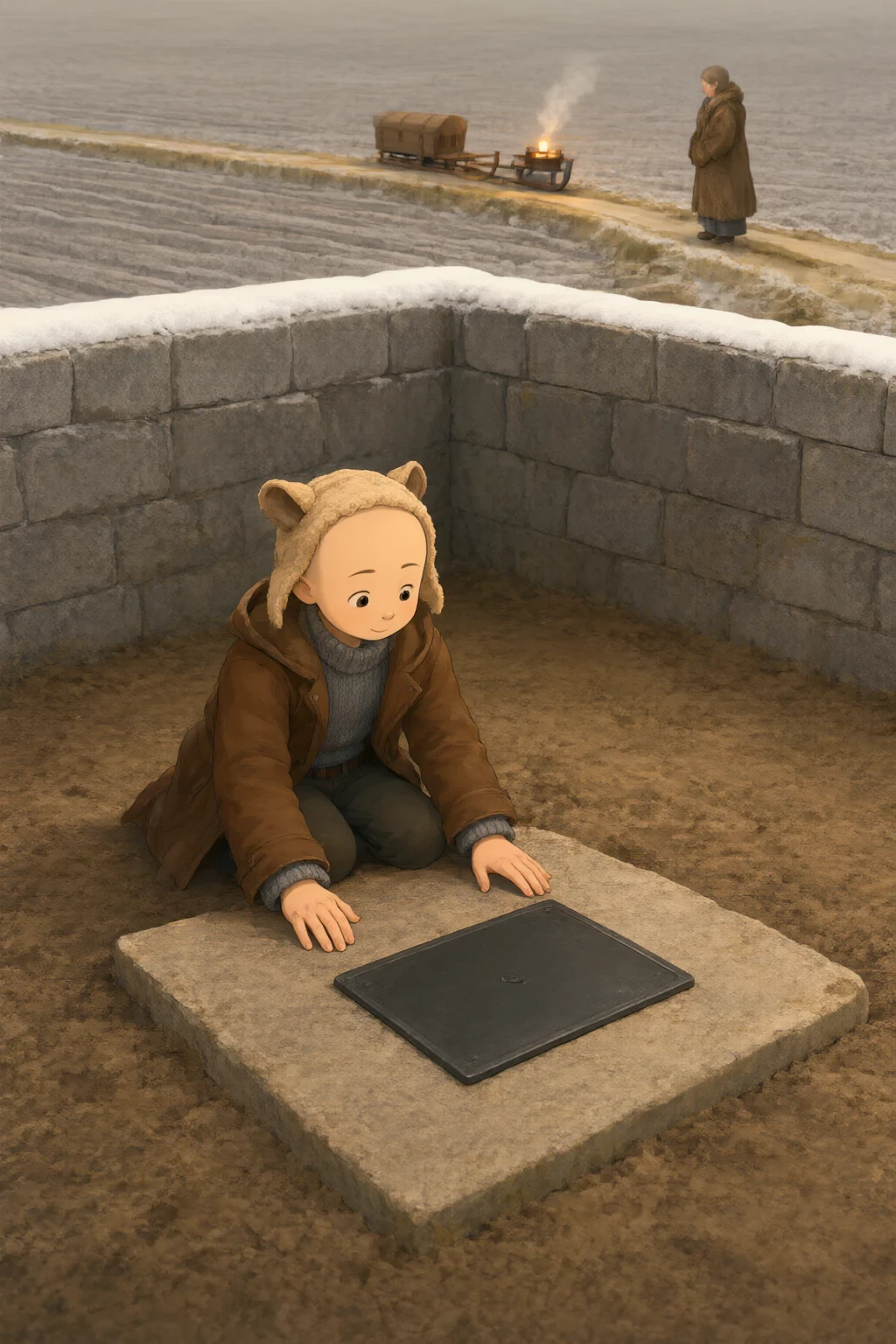
Number Eleven on the Sorne line is a walled rectangle in the middle of a sown field. The wall is waist high and made of split grey granite, and there is snow drifted against the north side of it all winter, and the gate has a bar across it that nobody has ever taken off. Nothing has ever come up in it. The wrights do not drive past the gate. They go round by the ditch, which is a mile and a half further and costs the sowing two days.
The seeding schedule for that autumn was made in Frostmonth, and it was a bad year to make it in, because the sown ground had been coming up thin and warm for three seasons running, and every day of delay now was a day of seeding taken off somewhere at the end. Bryn Ostmark was twelve. His father was Bram Ostmark, who was thirty-four and third generation and seam-holder for the Ostmark ground, and who had a fur-seam across his right eyebrow healed white, and salt-frost scars on both palms like a rope burn, and who had never in his life answered a question with a yes or a no.
Bryn read numbers the way other boys read weather, out loud and softly, and he had learned in the last month that the schedule had Number Eleven on it under BREAK AND SOW, which meant break the wall down, take out the stone, and run the drill straight through. “Eleven yards,” he said, catching his father at the door of the drying hut. “Eleven yards, and it is the middle of the run. If we go round the ditch it is two days longer.”
“Two days is eleven hundred and twenty yards of seeding at forty to the yard,” said Bram. “That is what I said.” “No. What you said is a number. What I said is what the number is.” He shouldered his barrow-hook. “The field is the Ostmark field on the north side and the Sorne field on the south, and the wall stands on the boundary, and if it comes down the drill goes through and we have the two days back.” “And if it does not come down?” Bram Ostmark looked at his son, and then he said the thing he always said, which was a measurement. “Eleven hundred and twenty yards does not come out of the air,” he said. “It comes out of somebody.”
Bryn asked his mother first, because she was the one who had gone quiet. She was standing at the drying-hut door with her hands in a bowl of turnip and cloudberry jam, and she did not stop, and she said, “The eleventh of Frostmonth.” “Ma?” “Three seasons back. It was the eleventh of Frostmonth and it was a hard frost, and I made a barley cake for the burying and I have not made one since.” She went on with the jam. “Do not ask me in the yard, Bryn.” “Why not?”
“Because in the yard it is a thing that has been said, and then it is in somebody’s mouth, and then somebody asks the next question, and the next question is who gave the order.” She looked at him then. “You go round the ditch, and so does everybody, and that is the whole of what we do about that field.”
He went and found old Ansel Rime on the Retirees Bench, which is a stone bench along the Guildhall’s south wall, out of the wind, where old wrights sit in a line from noon and are not asked to move. Ansel had a white beard, and the tops of all ten of his fingers gone blue and shiny with old cold-burn, and he was glad of anybody to talk to in a way that made his hands go faster.
He told Bryn about the first barrow, and how a wright called Aveline had sold it for less than it cost, and how the men had spat, and how the water in the well had turned that winter. Then he stopped halfway through and added, in a different voice: “But the numbers say the other thing, and the numbers are never wrong.” “The numbers agree with you, Ansel.” “That is what I said,” said Ansel, and looked extremely pleased, and had no idea that he had said it again.
The gate had a bar across it, but the wall was only waist high, and there was a drift banked against the north side of it that a twelve-year-old could get up in four goes with a barrow-hook. Bryn went over the wall at the fourth bell and into Number Eleven. It was the strangest ground he had ever stood on. It was not a late spring. A late spring has a brown look that is going to be green. This was grey, and it was smooth, and it was bare in a way that bare does not usually mean, and there was not a stone on it, not a clod, not a weed, not a single thing that had decided to grow there or had failed to.
And there was no sound. In a field with a standing crop in it you can hear it, a dry mineral tick, like a fingernail on a woollen sleeve, because cold coming up out of ground has a noise. In Number Eleven there was nothing to hear at all. In the middle of it, under a foot of drifted snow, there was a flat stone.
He cleared it with his hands. It was a slab of dressed granite about the size of a bread board, laid flush with the ground, and let into the middle of it was a plate of black iron the size of his palm, and around the plate, cut in the granite in the same deep square letters they cut in the lintels of the Voidstone Terrace, was a name. MARDA SORNE. Bryn put his glove on the iron. It was the same cold as the new plate on the Halloway bench, and no colder, and it was the cold of a stone that has been in a stream for a hundred years. Under the name, in smaller letters, there was a date, and it was three seasons old.
He got down and put his ear against the stone, the way you do to a door, and there was nothing on the other side of it, which is what he expected, because his grandmother had told him on the bench that you cannot sow over a name. A name is a claim. Ground that is already claimed does not come up. That is not a rule anybody wrote down. That is just what the ground does, the way water goes downhill.
The sowing foreman came out on the ninth day with a heated iron share and two men and a sledge, because the ground goes three feet and a frozen pan has to be broken before a share will go into it at all, and the pan in Number Eleven was the hardest in the field. Bryn got in front of the share with his arm out. “Foreman Wick, that ground is not to be broken.” Wick was fifty-odd and had a face like a closed door. “It is on the schedule.”
“It is on the schedule as bare. It is not bare. It has got a name cut in it.” “That is a stone, lad.” “That is a grave,” said Bryn, and then wished he had not, because a foreman who hears the word grave in a field before nine hundred people hear it does not stop for a stone. Wick put his hand on Bryn’s shoulder and moved him aside as gently as a man moves a sack.
The Book was right, and that was the worst of it. The assay office kept the schedule off the Assay Book, and the Book showed a standing cold for every yard of the Ostmark field and for every yard of the Sorne field and nothing at all for Number Eleven, because there is no cold in a place where a name is, and the Book does not lie about degrees. Number Eleven was not a failure. It was simply a place where the yield was always, exactly, zero.
So the schedule said unused. And the committee had read unused and said break it. The share went into the ground two feet from the stone before Bram Ostmark got there. Bryn had never seen his father run. He came across the ridged grey field with the barrow-hook in his hand and did not shout, and Wick took the share out of the ground and backed off it, because Bram Ostmark is a seam-holder and a seam-holder can have a man off his own ground without raising his voice. “Not that ground,” said Bram.
“It is on the schedule, and the committee signed the schedule, and the committee is not you.” “Not that ground,” said Bram again. “Eleven yards, Wick. Eleven yards and a stone. Eleven hundred and twenty yards of seeding is the price of those eleven yards and I will pay it, and I will pay it out of the Ostmark ground, because it was my ground that asked for the wall to come down, and a thing you ask for is a thing you buy.” “Then the committee has to be told which ground takes the two days.” “The committee will be told,” said Bram Ostmark, “in a book, with a figure in it, and it will not be the figure anybody wants.”
Bryn wrapped the stone in a square of oiled wool, because that is how cold iron is carried, and he carried it down to the Guildhall yard and stood at the end of the Iron Row until Ilva Sorne came out of the smithy with her sleeves rolled and her forearms pink to the elbow. She was twenty-nine. She had read plates for cracks by eye since she was fourteen. She did not say anything for a while. She turned the stone over on the anvil bench, and then she turned it back, and then she put both hands flat on the iron and left them there. “Do not say it to me,” she said. “Say it to the Book.” “That is not—”
“That is exactly what it is.” She lifted her head. “A thing said in a yard is a thing somebody heard. A thing said in a yard can be a rumour by the second gate and a joke by the gate. But a thing in the Book is a fact with a number against it, and a fact with a number against it has to be answered by somebody, in writing, in twenty years or in a hundred. So say it to the Book. Write my mother’s name in it, and let them have to answer it.”
Halla Rimewright read it standing up, in her coat, in the assay office at minus nine, with the lamp on its swing-arm making its small hot circle over the page. She read it twice. Then she said a number out loud before she said anything else, which was how she said everything.
“Zero. Point. Zero. Standing cold, three seasons, and a name on the ground that is not in the degrees column anywhere in this book.” She set her split thumbnail on the page. “Twenty-two years I have written in this book and there has never been a name in the degrees column. It is not for names. But the column takes what is put in it, and it will still be open in two hundred years, and that is the only argument I have ever needed.”
Halla Rimewright wrote a line on a fresh leaf, and where the degrees column wanted a figure she ruled a blank and wrote NO DEGREE across it, because a person does not have a degree, and she was not going to leave a blank sitting there looking like an oversight. NUMBER ELEVEN, SORNE LINE. STANDING COLD: NIL, THREE SEASONS. GROUND CLAIMED. Marda Sorne, wright, buried in this ground, eleventh of Frostmonth.
Sura Vane read it over Halla’s shoulder, because Sura Vane was the pension clerk and one of the guild’s nine minor officers, and she had her reading spectacles on a broad beaded cord and one hand permanently in her coat because of an old plate burn. “Is the date right?” she asked. “It is cut in the stone,” said Halla. “That is not what I asked.” Sura put her spectacles up. “The eleventh of Frostmonth. Three seasons back. That is the date, and it will still be the date in a hundred years, and whatever the Book says about cold, it cannot say anything about that day.” Old Ansel Rime was on the bench by the office door and had been listening, and he shook his head slowly.
“Forty years ago I would have told you a story about it,” he said, “and the story would have been a good one, and it would have been wrong, and the numbers would have said the other thing.” He put his blue hands flat on his knees. “The numbers agree with the girl, this time. The numbers say the other thing, and the numbers are never wrong.”
Bryn carried the notice himself, because it was his stone and his name was on what he had done, and he carried it to the drying hut and put it on the table in front of his father. Two days. Eleven hundred and twenty yards at forty to the yard. Ostmark ground, north side. Bram Ostmark read it twice. “Nine hundred and forty came up,” he said. “That is the seeding at the top of the field. Two hundred and eighty of it came up thin.” “So we are two days down.”
“We are two days down and the ground is two hundred and eighty yards short and every yard of that is a kitchen that gets its cold from us and buys it from somebody else, and somebody else is a long way down the valley.” He set the notice down. “That is what asking for a wall to come down costs, and I have put the figure on it myself, so nobody else has to.” Bryn looked at the notice for a while. “Ansel says the numbers are never wrong,” he said.
“Ansel Rime is a man with ten blue fingers who has told the founding of this guild nine different ways,” said Bram Ostmark, “and he is exactly right about the numbers.” They went round by the ditch. There were nine of them, because it is a rule that goes back further than the Book, and they went round the whole mile and a half with the sledge and the barrow and the hook, and it took two days longer than going straight through, and nobody said anything about why, and the two days came off the Ostmark ground and the Ostmark ground came up two hundred and eighty yards short.
At the end of it Bryn went over the wall one more time and cleared the snow off the stone with his hands, all the way round the plate, so that the name could be read. MARDA SORNE. Then he got up on the wall and looked at the field, on both sides of it, for a long time.
The standing cold was coming up. You could hear it, a dry mineral tick in the ridged grey earth, like a fingernail on a woollen sleeve. On the Ostmark side it was thin this year, the way it had been thin for three seasons, and it would come up thin, because a year is a year and nobody in the Coldmark can make a year better than it is. But it came up.
And the wall stayed, and the gate stayed barred, and eleven yards in the middle of the Ostmark field went on being the one place in the Coldmark where a person was standing under a name, and the wrights went round by the ditch, which is what everybody had always done, and which was the correct thing to do, and which nobody had ever once been able to say out loud in a yard.