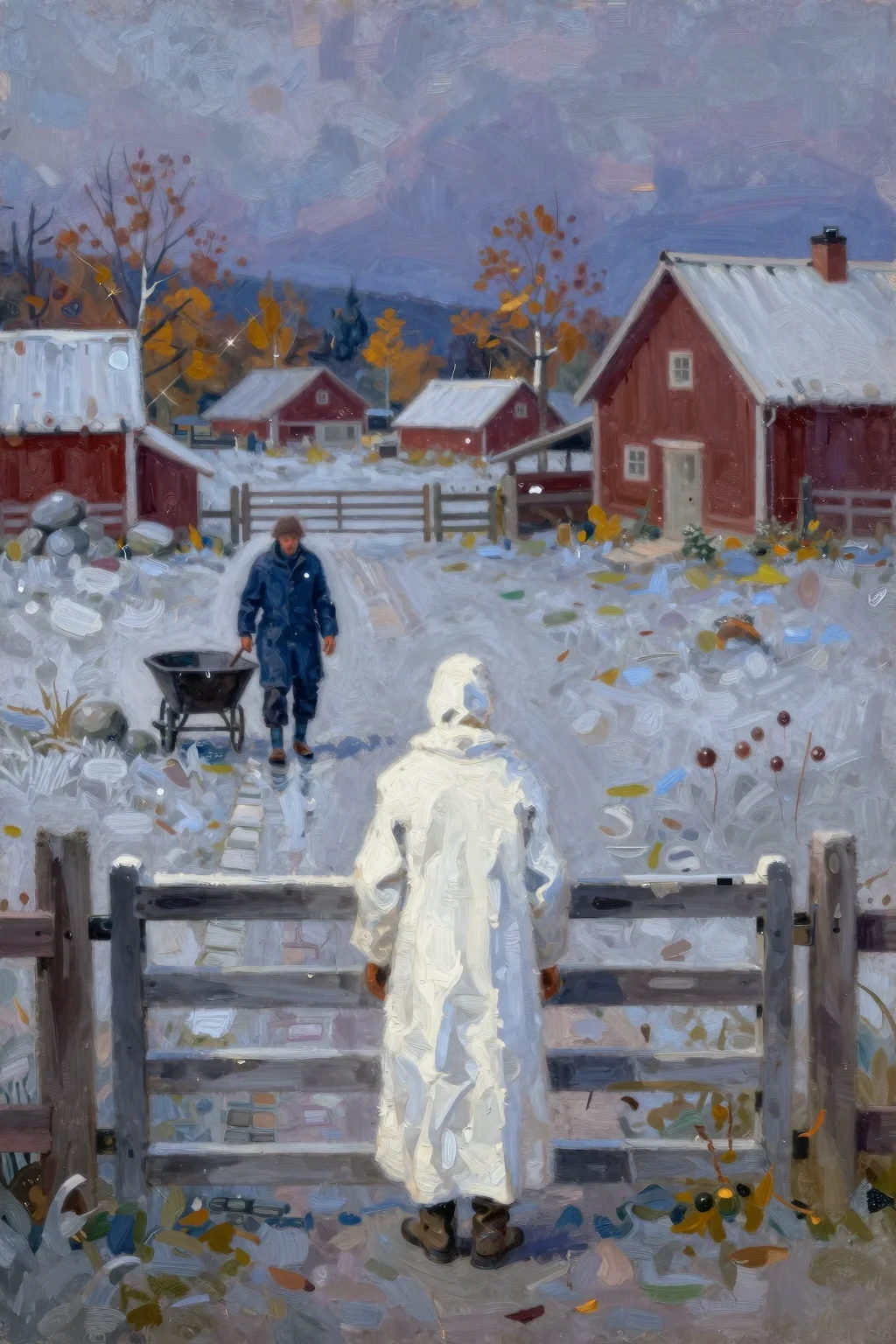
Onni drove a nail into a larch stake for every day of the year he had borrowed, and he drove it in the morning before he did anything else, and he drove three hundred and sixty-five of them, and there was no way in the world to do that for the rest of your life and stop. It was his wife's stake. Liv had set it up by the byre door in the year before she died, for the calves, with a plate at the top and a groove cut round the neck of it, and when Onni came out of the winter she had died in he cut the groove off in one afternoon with a cold chisel and drove the nails into the bare wood instead, and nailed the plate back on upside down so that the initials were the right way up, because he was that sort of man and he would not have admitted to being that sort of man.
The barley at Hjell came up thin that year and then worse than thin. There was no rain in the sixth month and none in the seventh, and the seventh was the one that mattered, and the field by the road went the colour of a rope. The frost came in the ninth month with a wind off the ice and lay on the ground, and what was standing in it lay down and lay down and stayed where it lay, and by the time Onni got out to it with a scythe it was under a sheet of grey ice a foot thick and he was forty years old and he put his back into a wet field and lost a week and got forty sacks of muck back for the two years of seed and the horse and himself. He was behind on the ploughshare rent. He was behind on the money his brother had lent him and had never once asked for. He was behind on the seed, on the smith, on the tithe, and on the winter's firewood, and there was a bad year and a bad year before it. Onni had said at the mill in the spring, to a man he did not know, that he would want to settle in October. He had said it in a way that made the man's face change, and he had said it in a voice, and he thought about it every week afterwards, the way you think about a thing you cannot undo.
The North Wind came up the lane on the evening of the twenty-sixth of September, on foot, in a coat that was white and had been white a long time. Onni was in the yard with a barrow of stones when he saw the coat, and he was a proud man and a slow one, and by the time he had put the barrow down and wiped his hands the coat was at the gate. Onni stood in his own yard and did not say good evening to the North Wind, and the North Wind stood at the gate and waited for him to get to it. “You have not asked me for anything,” said the North Wind, “so I am going to say it, and you can send me away if you like, and it is better that you hear all of it in one place than that I say it twice.” “I have not asked you for anything,” said Onni. “Then I will put one on the table. Here is what a loan is, so that you cannot say afterwards that nobody told you. I will give you one year.”
“It goes into a jar of clay and I seal it, and you break the seal and set the jar in the field, and what comes of that field will be a crop in the spring, and it is the only crop you will ever get of me.” “The jar is due back on this day of next year. Whole. Unbroken. And not one hour after dark.” “If you are a day late, you do not lose the winter. You get the year the jar is carrying instead, and the jar is carrying a winter, from its first day to its last, and so you will have had two of them, and there will be nothing in between them to gather anything in.”” Onni did not answer for a while. “And if I bring it back,” he said. “Then it is a loan like any other, and it is paid, and I go,” said the North Wind.
The jar was the size of a churn and grey, and it came out of the coat wrapped in a sailcloth, and it was warm on one side and cold on the other and it did not seem to care which way you held it. Onni broke the seal with the heel of his hand in the middle of the field and the sound went further than a jar should have carried. The frost came that night and it was the best frost anybody on that coast had ever had, and it lay nine inches in the lee of every wall in the parish and stayed there until the middle of the second month. Onni walked out into the middle of the field in the third week of the first month with a mattock, because he did not trust a thing he had been told by a wind. The barley was up. It was six inches, and it was the colour of a wet slate roof, and there was not a seed of it in that field in October and there had never been one. That year went in the other direction from every other year Onni had farmed. People came from three parishes to stand at the edge of the low field, and he let them come, and stood at the gate in his good coat talking about drainage.
They had a frost in the fifth month that Onni was certain had finished them, and it came off in two days in a south wind and took the ice off the water butt. The bees found the willows in the fourth month and made more honey that year than in the four years before it. The hay was up before the middle of the sixth month and it went in dry and it smelled all winter in the cowshed. The barley came off the low field in the eighth month and it was four hundred and sixty sheaves, and the ridges were standing black and glossy on the stubble when the cart stopped at the gate at the end of the day.
Onni did his talking that year. He bought a coat he did not need. He sang in the byre with the door open when the evenings were cold, and there was a night when he said to Halla, his sister, in front of the fire, that if there was ever any question about it he was the man to talk to the North Wind, and Halla said, “You are,” and put her cup down, and that was the whole of it. She drove the nail on the days he was away.
Halla was forty-four and she had lived at Hjell since she was nineteen, and she had come back at thirty-one when Liv died and had stayed, and nobody ever asked her why, and she would have told them not to. In the seventh month she went with Onni and Rasmus to the fair at Vika, and he had nine days there, and he did not think about a stake in Vika, and when they came back there were nine nails short, and she counted them twice and drove them in that same evening without saying one word about it. She did not trust him with a date. That was the whole of it and she would have said so in those words to anybody who had asked her, and there was no one in the parish to ask, because Onni was not a man anybody asked things.
She took the jar down to her cellar on the last day of the eighth month and put it on the shelf with the preserves, among forty jars, in the place at the back where the shelf went into the dark, and she marked the wall beside it in chalk, a short line, and every morning after that she rubbed the line out and drew it again, so that the days went by on the wall where she could see them when she was doing the fire.
The date was the twenty-sixth of September. Dark came at five that day. The road to the Veen place was four miles, two of them on the high ground, and the six of them who went to the burial did not get there until twenty past one, because Marta Veen had been sixty-eight and had been told twice to put off a wedding she did not want and had done it anyway. Halla walked with them. The ground was soft from the rain of the eighth month and the wind was straight in their faces off the ice, and they went at the pace of the slowest and the slowest was old Halloran from the low house, who had come without a coat. They did not run. Halla would not go ahead of them, and she would not go faster than old Halloran, and it was four miles.
She got to the ash tree by the boundary stone at six o'clock, and the light had gone by half past four and there was a moon on and off behind cloud, and she stood there with the jar in a sack against her chest, and an hour was the whole of the matter. Nobody came. The lane went down and up and there was nothing on it. She waited until it was properly dark and then walked the four miles home, with the others as far as the low house, and the jar sat on the kitchen table from ten o'clock until the lamp went out, and nobody said anything to anybody about it.
At nine that night the temperature fell, and by ten the rime had formed on the north side of the ash tree in the gateway in a white ridge, and it formed in exactly the same place, and in exactly the same shape, as it had formed on the night he broke the seal, and Rasmus, who was ten and could not be got to bed, put his face to the window and said, “That is the frost from before.” Onni got up and went out in his shirtsleeves and stood under it for a long time.
On the ninth of December the sun came up over the same arc it had come up over on the ninth of November. The same fingerpost in the lane threw its shadow the same distance across the road on both days. Onni went out with a stick and a cord and a piece of chalk and measured the shadow by the shadow of the stick, four times between the eighth and the twelfth, and the four numbers were the same to a finger's breadth, and then on the thirteenth it was a hand's breadth shorter, and after that it went on shortening by almost nothing until the middle of January and stopped, in that same dead place, and stayed stopped for the rest of the year.
There was no villain in it and there was nobody to be angry with, and a man will spend a whole winter looking for somebody to be angry with. The barn had the lent year's harvest in it, and the lent year's harvest was one year's food, and it went in the way that one year's food goes in when a family is careful and there is nothing else. The two oxen went in the second month to a man from Brekke who could not have fed them and said so, and Onni sold them and came home by the wall and put his hands behind his back for the rest of the walk. The cow went in the fourth month. Rasmus's goat went in the sixth, and Rasmus did not speak for two days and then asked whether they were going to be hungry, and Onni said no, and Rasmus waited for his sister to say something and she did not.
In the third month of that year the sun got as high as it had got the year before, and something came up in the low field, and it was not barley. It came up thin and pale and it froze, and the ice came back over it, and it was not harvested. On the twenty-fourth of September, two days before the date, Onni ploughed the top field and sowed eight quarters of winter wheat into it, because it was the right week for it and it was what you did. It lay under the snow. It was still lying under the snow in the ninth month of that year, and there was no eighth month coming, and by the following spring it would be dead in the ground and there would be nobody left to plough it out.
Onni stopped saying that the year was late in the seventh month of it. He was not a soft man to look at, and he was harder to live with than he had ever been, and in the eleventh month he began to sit by the horse. He did not say he was going to sell it. Halla did not ask him about it, and she told Rasmus to leave the horse alone, and Rasmus left it alone. “You lent him a winter,” said Halla to her brother one evening, when the boy was asleep and the wind was going round the gable. “Not a jar. He did not tell you to hand over the jar at any particular time, and he did not tell you the winter was gone when the winter was over.” “He told me to bring it back on the day,” said Onni. “He did,” said Halla. “And he did not tell you the loan ends at dark. He told you the jar comes back.” “The jar is empty.” “Then we carry an empty jar four miles in a north wind,” said Halla, “and we ask him for it, and if that is not enough then we ask him again tomorrow, and we do it every day for as long as the ground holds us.”
Outside the door the wind was still in it, and it had been since the twenty-sixth of September, and there was a hand's depth of blown snow on the sill where the door did not fit. Halla set the jar down in the middle of the table where it had stood for a week while they had used it for bread and for salt and for nails, and she put her two hands flat on the wood either side of it. “A borrowed kindness is still a loan,” said Halla, “and nobody keeps the gift and refuses the date.”