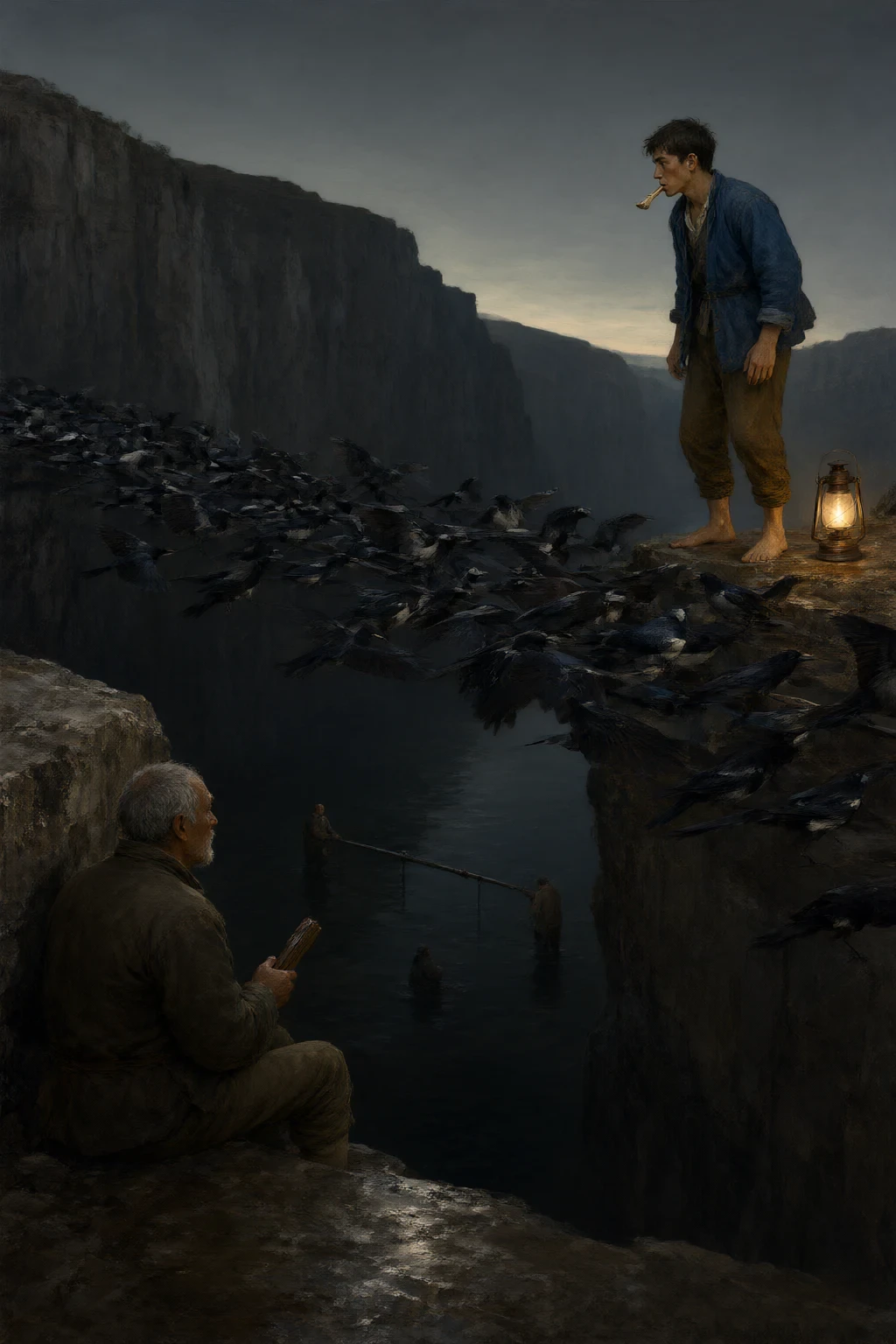
The river runs north and south through the county, and in four hundred li of valley nobody can remember it running any other way. It comes down out of the northern mountains the colour of a knife left in water. Its banks are cut, its bed is gravel, and in the ninth month a man wading to his knee comes up the colour of a cooked crab. Two things in the county do not belong to the county. The first is the gorge at Falling Magpie, where two hundred feet of cliff stands on each side with its face turned east, so that for one hour before sunrise the rock is the colour of an apricot held to a lamp. The second is the sill, three miles downstream, where a stick of wood a hundred and forty feet long lies in the riverbed silt and decides who gets to be alive.
Nobody can tell you who laid the stick. It is a linkage of mulwood, eleven lengths socketed end to end, tarred, iron-bound at the joins and gone there the colour of a plum. It runs from the head of the weir to the foot of it, and it does the one job the old weir builders cared about: when a man at the head turns his gate, the stick turns at the foot. If the two men disagree by a finger's width the stick binds, the gates jam, and neither village gets a drop. This is not a metaphor and was never meant as one. It is a machine, built to make it impossible for one bank to be clever. What it cannot do is decide. Somebody must stand at the head and somebody at the foot, every morning at dawn, and turn the handles together, and agree.
For nine hundred years the two men have been the two men. At the head, above the weir, the water is Willow Bend: forty households, a market of four stalls, and eleven hundred mu of pasture where Niu Mancang keeps forty-one head of cattle in the year of this telling. At the foot the water is Reed Reach: two hundred households, a dyeing yard, a weaving hall with two hundred looms, and the flat wet land where the reeds grow tall enough to hide a boy. Niu Mancang is fifty-one and has not lost a cow. He is a small dry man with the permanently squinting look of a person who spends his life reading the ground four hundred steps ahead, which is what a herder does and what a man raised a herder does afterward whatever else he becomes. He reads four characters and signs with a hooked stroke, and has used it on eleven contracts and one marriage paper.
Zhi Nü is forty-eight and has not lost a workday. Her name means weaver girl. She was born in the loom shed on the night of the loom festival, her mother thought it a joke, and it was a joke for forty years, until a clerk in the county seat copied the family record into a book of local history and added four hundred words about the divine girl who worked at the eastern stars. The name then stopped being a joke and became a description. She runs the dyeing yard. The blue cloth of this county is not the blue of the other counties and the buyers are not flexible, and to get the colour she must hold four vats at one temperature for eleven days, and the vats drink at the rate of a small river in August, and Reed Reach is at the bottom of everything and has learned to say no.
They married in the eleventh month of a year the county still calls the Dry One. The county arranged it, on paper, in the register style of a water-compact: a meeting of two irrigation interests, in one room, with a witness. It records that the head gate and the foot gate will be held for the term of the compact by one household instead of two, and that the household will supply a hand at each end of the stick every morning of the growing season. Everyone in the valley thought it would end the trouble. One household at both ends of the stick meant one mind at both ends, and one mind could not cheat itself. It lasted four seasons.
The compact has three clauses. Water runs at the head gate from dawn until dusk and at the foot gate from dusk until dawn, so the meadow above is watered like a meadow and the flats below like flats. The middle gate is not to be opened in the growing season except when the stick binds. And the returning fish must be allowed up. They break the first clause every year. They break it for good reasons, and this is the part no county clerk ever managed to get into a report.
Niu Mancang opens the head gate wide at two in the morning, when the air is coldest and the loss is smallest, and lets the meadow drink. In a dry year his cows go thin in June, and thin cows in September mean no fodder, and no fodder means the herd is sold in spring at whatever a starving animal fetches. He does this four or five nights a week through July, and he sleeps in the gate-house with a lantern, and he has never once called it stealing, and if you call it stealing he will look at you a long moment and ask what your village's second crop is doing.
Zhi Nü closes the foot gate at two in the morning and holds it. The yard in July loses the vats if the current moves, the current moves if the head gate is open, and cold vats turn eleven days into twenty, and twenty days means the season's cloth misses the autumn buyers, and then two hundred looms work three months instead of five. There are men in the Reach who cannot make a full year's wages in a bad cloth year. They are not cruel men. They do not argue about water. They simply have to have it.
And the third clause, the one nobody breaks, is the fish. Once a year, in the eighth month, the silver fish come up from the sea in a body so thick the river looks solid, and they can only be got over the one low bar in this stretch of river, which is the sill. So for nine days the weir stands open, both gates wide, the whole river through the sluices in one throat, and the county shuts down and the two villages are not at war, because the war has been suspended by the fish.
And in those nine days the birds go over. The gorge at Falling Magpie is two hundred feet wide at the narrowest. Both faces are pitted with holes, and in the holes are nests, and in the eighth month the nests have fledglings in them, and the fledglings are raised on silver fish the parents catch in the shallows below, which the same flood feeds. For nine nights the flock crosses. It has to: the young on the west face are nearly fledged, the young on the east need a fortnight, and a magpie that cannot reach the other bank cannot feed itself properly, and the colony's only answer is the one thing magpies do and no other bird in the valley does. It crosses in a body, tight, low, wall to wall, so that for the seconds it takes the sky has a floor.
It is not a bridge. It is a road made of birds, and it is there only in the ninth month, and the birds that make it are the same birds every year, nesting in holes whose numbers are chalked on the stone above them by a warden whose name nobody remembers. It will hold a man. That is the extraordinary fact, and the county has been standing on it for centuries without quite writing it down. A man can walk the nine hundred feet in the dark, slowly, weight on the birds' backs, and the birds do not like it and do not refuse it, because in the eighth month a magpie is stuffed with fish and fat, and a magpie that breaks formation in the ninth month goes down four hundred feet into gravel with an unfinished nest behind it.
This is the sentence the valley has spent nine hundred years getting exactly backwards. The bridge is not built for the lovers. It is not a favour and not a sign and not an omen. It is a migration: the ninth-month routing of a colony that nests in cliffs, timed to a flood that feeds a fish that climbs a bar that a weir controls. The Weaver Girl has nothing to do with it.
The boy who calls the flock is called A Shi, and he is fourteen, and he has been going up the gorge since he was seven. There is nobody after him. The wage is in the water budget under a heading the clerk writes as 禽用, fowl-use, and the amount is nine jin of millet a day and one coat in the second month. The post is filled by whoever's father drinks, and in the third year of A Shi's climb his father died of a lung thing and nobody came, and he was seven, so he came. To call the flock he goes up the west face by a route that is not a path so much as a set of agreements with the rock: a seam of mica, a leaning slab, steps cut a hundred and forty years ago that are now the shape of a bull. At the top there is a ledge six feet deep, and above the ledge the chalk numbers.
He blows a sheep's bone with a hole filed in it. It makes a sound that is not a whistle so much as a bad idea, and the flock comes. It takes six minutes. He blows, the flock lifts off the west face and turns down into the gorge in a curve identical every night because it is the same birds, and the noise is like a hundred small doors opening at once, and the light goes out behind them as if a lamp were carried across a room by people who did not want to be seen, and the gorge is four hundred feet of nothing, and the boy sits on his ledge and counts. Everyone asks him to. The market, the two hundred women, the officials who come once a year, they all want the number, and it is the one thing about the gorge that is exact. He calls it across the water. Four thousand one hundred and six. Last year it was three thousand eight hundred and ninety.
The number has fallen for nine years. Nobody has published this. It is on a board at the foot of the cliff in a child's handwriting, and the birds' parents have said for four hundred years that the birds always come, and they do, and it is getting worse, and the county has a word for it, and the word is 太平. Peace. The fifth year of the compact is the year the stick bound. It bound in the fourth month, at noon, with no wind, and it is not supposed to bind unless one of the handles is being turned, and neither of them was turning, because Zhi Nü was at the foot with the damp in her lungs and Niu Mancang was in the pasture counting. The silt had risen until the sockets at the ninth join were packed, and the machine took up its own clearance and stopped. For nineteen hours neither village had water, and below the flats cracked, and Reed Reach walked out to the channel with jars.
They were still out there when the stick was freed at seven in the evening, by four men with a long iron bar, working in eighteen inches of water with the current coming down them. Niu Mancang came and worked. Zhi Nü sent a man she had no reason to send and he came and worked. It took two hours and nobody spoke. Then the river came through, and Niu Mancang sat with his feet in the water and said, to nobody, in the voice of a man reading out a measurement: nine centimetres. It has had nine centimetres of silt in eleven weeks. Zhi Nü came down the bank in the evening to look at the join, and he was still there, and this is the closest they come to a reconciliation. "Nine centimetres," she said. "Every spring now. Twice what my father got."
"Then the bar is moving up. It has been moving up since your father's father's father, and the mill in the upper Reach has been catching the gravel the river used to carry past us, and the Reach is not going to stop the mill, and the Bend is not going to dam the mill, and the two of us are going to go on opening our gates at two in the morning for the rest of our lives." "That is a long speech for two in the morning." "It is the only clean water left in this valley and we both know where it is, so yes." He looked at her a long time. "Do you want me to stop?"
"God, no." She said it fast, and then, more slowly, as though checking the load-bearing of it: I want the herd off the meadow. If your cows were not on the grass you would not open the gate, and I could stop the yard, and then we would be two people in a marriage instead of two hands on a stick. Niu Mancang got up and put his hand flat on the iron where the bar had been freed and wiped it on his coat. "Then we do it the other way round," he said. "We stop first." And this was the joke, and he did not know it was the joke, and it was the last thing either of them said to the other for eleven years. Because a water right that both sides keep is not kept by the two sides. It is kept by a thing the two sides agree not to break first. Take away the breaking and there is no agreement left, because the agreement was the method.
The market is on the far bank, and the word lovers is only ever a joke, and the joke is the poem a county scholar wrote four hundred years ago about a woman named Zhinü and a man named Niulang, which is a herder, which is what you are if you are a man from the Bend. At the market there is silk, salt, and a horse from the upper pasture that costs what a horse costs. The villages trade for nine days a year, and they trade on the far bank, which nobody has explained except by the story, and the story says the lovers met there. They met on the sill. That is where the two gates are.
What actually happens in the eighth month is this. The gates are open, there is no war, the valley is at the sill with the water loud and everybody busy, and for nine days the man from the head and the woman from the foot can stand in the same place at once without either having arranged it. That is the entirety of the occasion. Then, on the second-last day, one of them crosses. Not both. Never both.
The rule is in the water regulations and it is not a legend. When the gates run full, the head and the foot of the sill each need a person with a bar and an eye on the current, and there are six such people in the county and all of them are working. Nobody is spare, and it is not permitted for the two of them both to be on the far bank. So one goes and one stays, and they take it in turns, and the turns are kept in the county almanac, because the almanac is where the county keeps what it cannot remember on its own. The column is called 隔岸, the far bank, and it alternates. A Shi crosses with whichever of them it is his year to take. The old men put a hand on the going man's shoulder, and the going man carries a lantern and a short line of cord, and the boy walks ahead, because a man on a bridge of magpies is a strange sight and a boy is not.
It takes nine minutes. He does not like it, and has never said so, being fourteen, and the county has a word for what he feels which is 敬畏, awe: a word for religion and for falling water and for your father when he is angry, and not a word for four thousand birds. What the birds do is hold. That is the whole of it and it is enough. Under his boots they are warm, which nobody expects and which he has never told anybody, and the noise is a soft tearing like rain on paper, and every nine or ten seconds the span moves a hand's width sideways and comes back, and he walks it out, and the far ledge comes up out of the dark, and the man steps off, and the boy goes back alone, which is the part of the night he would call the work.
The almanac says they are kept apart. In fact they are kept apart by the fish, and by six men with bars, and by a rule written by a clerk in a year with nothing else to write about, and the clerk's minute survives, because minutes do. It is this, from the fourth month of the year of the marriage, in the magistrate's hand.
The two gates are one installation. It is the view of this office that the parties hold them in virtue. In the experience of this office they do not. Left to the parties, the sill will be fought over at two in the morning for a generation and the compact will die of it, and the fish will have nowhere to climb, and the county will have a war instead of a weir. It is therefore ordered that the two parties be not permitted to be in the habit of one another's company; that each keep to the other bank in the ordinary course; and that the water be given them in turns, and at a distance, and by the calendar. It cost this office a clerk's morning. It is the cheapest water in the province.
That is the whole of it. A magistrate, six hundred years ago, with a stubborn, competent, literate pair who would rather starve at each other's gate for forty years than lose an argument, solved it by taking away the possibility. He made them a schedule. And the county, unable to bear a settlement that was plainly administrative, invented a heaven to hang it on. The bird is a bird. The water is water. The only magic in this county is that a thousand people, for six hundred years, have agreed to look at a fish ladder and see a wedding.
By the ninth year they are both too old to cross. Niu Mancang has been at the head of the sill for thirty-one days of the ninth-month opening and Zhi Nü at the foot, and on the third-to-last night the boy goes down the mica seam in the dark and finds the old man on the ledge, and the old man does not cross at all, and sits down with his back against the chalked stone. "Sixty-one crossings. I have counted. Thirty-one were yours, thirty were mine. It has been fair." "Then say it and stop." "I am going to say it and stop," he says. "It has been fair." And he stays on his own side, and the boy goes back alone across four thousand two hundred and eleven birds, the largest count of the decade, which he will describe for the rest of his life as the night the birds were numerous, and to whom.
In the eleventh year the bar comes up under the sill so far that the fish can only be got over in the week before the water drops. The fish year shortens: nine days, then four, then one year with a single day when the fish stand in the shallows and the rest of the time they are below the bar, and the county writes a report using the phrase 通道受限, passage restricted, and the county does not celebrate. The gates must be open the whole time, and there are five men with bars in the county, all of them old. So the boy goes out to the head of the sill with a bar and an old man named Tan, and a woman named Huo from Reed Reach goes out to the foot with hers, and they turn the handles together at six in the morning while the fish go up through the water in a body you could lean over and touch, silver on both sides, going north out of the county forever.
Neither of them is the child of either of the old ones. It was arranged by the water bureau, in writing, with a witness at each end, and the witnesses were given their nine jin of millet and told what the county needed, which was not that anyone be in love, but that somebody be there. Niu Mancang came down to watch and sat on the bank with his hooked mark in his hand, and did not cross, and would not have crossed if the birds had waited for him all night. The stick binds at ten.
A Shi is sixteen. He is still the bridge-caller because there is nobody else, and the flock has come back to three thousand eight hundred and one, and the last figure on the board at the foot of the cliff is his. They freed the ninth join with an iron bar in eighteen inches of water, and afterwards they walk the stick down to the water-house to oil it and lay it on its rack, because the stick is not allowed to lie in silt over the winter. The silt is what kills it. Four men carry it. Tarred mulwood, eleven lengths, a hundred and forty feet, more than four men, down the shingle of the sill bank on their shoulders, and the oiled ends shine in the early light, and the river goes north on the other side of them carrying nothing but water.
In the water-house Tan takes out the tally stick, a foot of flat willow, on which the boy carves a notch for every crossing, because it is the only record the county has. The almanac records who went, and the almanac is printed in a town ninety li away. He counts them out loud in the yard the way he calls the count across the gorge. "Four hundred and six." He hangs it back on its nail, and shuts the door, and the sun is coming up on four hundred feet of black water, and the fish have gone.