Constable Iven Pyle’s verification for the ninth ward came up on the sixth of December with one line on it that had never been on one before. The line was in the box for the holder and the box said NOT PRODUCED. Hettie Rowntree read it twice and then went and got Volume Four, which is Lamp Nine, and turned to the leaf for eighteen eighty-nine, and found what she had known was on the leaf and had never looked at, which is that there was no face note. Every entry in Volume Four has a face note. It is a column the office has kept since the ninth of October, eighteen forty-one, because the first lease on this lamp says the clerk is to enter in the margin what the face of the person did while the lease was read, and the office has done it forty times out of forty and would have done it the forty-first time if anybody had asked.
The entry for the second of October, eighteen eighty-nine read: to Henrietta Rowntree, of this office, at the desk, in the ordinary course, on a day of accounts, the whole of the term of the said lease being that of the ninth of October, eighteen forty-one, unchanged and unexpired. And in the margin, where the face note goes, there was nothing at all. Hettie held the pen above the line and did not write for a beat too long, and then she put it down, because there was nothing she could write that would not be a lie about a woman of twenty-six on a day of accounts in eighteen eighty-nine.
“A lease is not held by signing it,” she said, to the room, which was empty. “It is held by having it read to you. I signed it. I did not have it read to me. I have been the holder of Lamp Nine for fifteen years and the ring has done nothing in my hand, and the office has never once asked me which of the two I am.”
The standing instruction of the fourth of January, eighteen sixty-seven, is four lines long and it governs everything this office does with a lease, and Hettie read all four of them out from the frame on the wall where they have been since the printer came out from the town, and two of them are about tonight, and these are the two: No transfer of a lease in this town shall be entered until the whole of that lamp’s history has been read aloud in this room, in order, from the first entry to the last, including every part that has been crossed out, and including the last entry, in the presence of the person who is to hold the lamp; and the clerk shall enter in the margin of the first entry what the face of that person did while it was read. A transfer is not a matter of standing. It is a matter of a lamp being known.
“It is the fourteenth of December, nineteen four, at eight bells,” said Hettie. “Lamp Nine. The whole of it. Somebody has to hold it and the office has nobody, and I am the only person in this building who can read the hand of eighteen forty-one, and I have been telling the truth in this room since the sixth of December and I would like somebody to make the note of it.” Constable Pyle came in at eleven with his hat in his hands, because there was nowhere to sit, and asked whether the transfer was being made so that the lamp could be shut.
“It is not being made so that the lamp can be shut,” said Hettie. “It is being made because the office has a lamp with a holder in it who has never been produced and a ring in it that has been taken nine hundred times over by people who have never had the lease read to them, and the instruction of eighteen sixty-seven is the only instrument in this building that will touch either of those facts.” “Then it stays lit.” “It stays lit,” said Hettie. “And I have wanted that lamp closed since the year I came to this desk, and I have never once asked, because the office does not ask; the office records. And a thing that is asked for is a thing the office cannot refuse, and a thing the office cannot refuse is the beginning of an entry I did not see a face sign.” “Eleven reports,” said Pyle. “That lamp, eleven times, since I came to the watch.” “I know how many it is,” said Hettie, and went on with the reading.
The person who was to hold Lamp Nine was not a matter for choosing. That is the difficulty and it is the oldest thing in the volume. The lease of eighteen forty-one runs to the natural life of Nathan Skellow and thereafter to such person as shall next take the ring of the said lamp at the hour of lighting, the whole of it being read aloud first in this room, and no person is to take the ring who has not had the whole of it read to him here. There is no name in it. There is no office in it. There is a brass ring on an iron standard at the bottom of Wharf Street, and it has been in the hollow of that standard so long that the brass has taken the shape of a hand, and every lamplighter on the ninth ward round takes it in the ordinary course of a night’s work, and has done since before anybody now living was on a round.
So the question the office had to answer was not who was to hold Lamp Nine. It was who was going to be standing at the bottom of Wharf Street at four bells that afternoon with a taper in his hand and a lease in his ears. It was the boy who copies the round slips, because the ninth ward round is short-handed in December and because the boy had been standing in the office every evening for a week copying cards and did not know that the cards were a form of the same document. “Eight bells, ward nine, and I am on the wall tonight because Tam Ferrier has gone off his leg at the hip,” said Wren Alsop, before she had got as far as the chair. “I have read forty-one entries in that register and none of them is a lease.” “You have read forty-one lines off a copying desk,” said Hettie, “and you have not read a lease in your life, and the number is the same and it is not the same forty-one, and I will not have it treated in my office as an omen.”
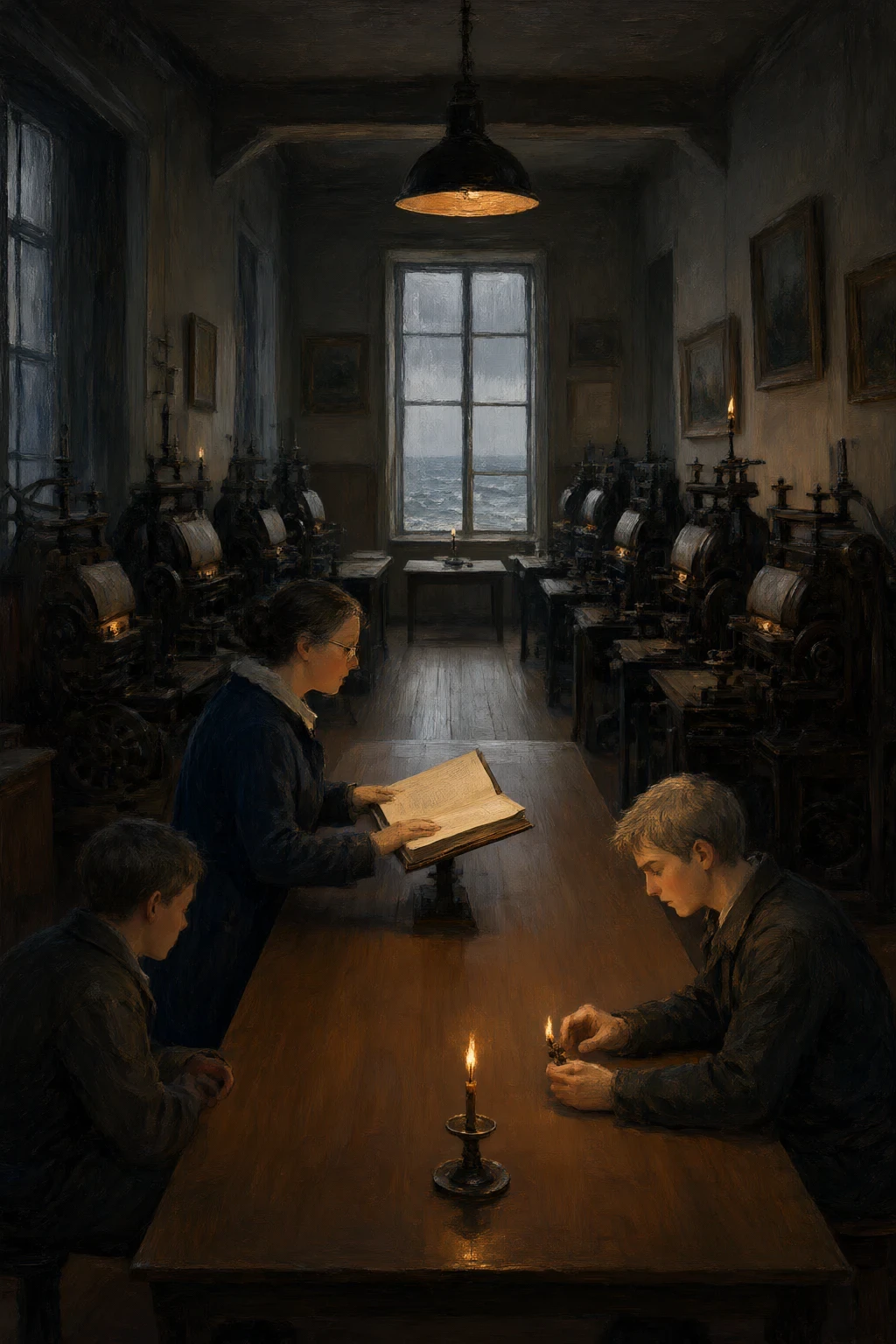
They put the long table against the wall under the presses and cleared the day books off it, and the boy sat at the end nearest the door because Hettie put him there, and Perrin Oll was put at the other end because he asked to be, and the fire had a hundred and forty years in it and the room was cold at the top and hot at the bottom, and everybody in their coats. The reading began at four minutes past eight. The first entry is in a hand that is not a clerk’s hand, because there was no clerk in eighteen forty-one and the office was two rooms above a chandler’s, and the ink of it is the brown of weak tea and the pen lifts at the turn of every long word, and Hettie had read it perhaps four hundred times and it is still the one she works from at night when the desk is shut.
“Lamp Nine, at the bottom of Wharf Street, entered the ninth day of October, eighteen forty-one, to Nathan Skellow, shipwright, of this town, for the term of his natural life, and thereafter to such person as shall next take the ring of the said lamp at the hour of lighting, the whole of this lease being first read aloud in the lamp office in the presence of the person taking the ring, and the clerk to enter in the margin what the face of that person did while it was read. The said lamp to be of a glass blown at the point, and to be kept at half a flame and not fuller, so that a man may stand beside it and read a paper by it.
And the said lamp is not to be given, sold, or made over, and is not to be given back, and is not to be broken, and is not to be drowned, and no person shall take the ring who has not first had the whole of this lease read to him in this room.” And at the foot of the leaf, in a different ink and a smaller hand, Elias Rede, first clerk of this office, adds that he read the entry over to the said Nathan Skellow after it was made, and that the said Nathan Skellow asked for it to be read a second time, and asked for the second reading to be slower, and put his thumb on the word half and kept it there until the reading was done.
Hettie narrated the entries in the present tense, which is the office convention for a reading of this kind, and which she explained to the boy once. An entry is not a thing that happened. It is a thing that is running. The only tense in which a lease is true is the one in which it is being obeyed. Then she said, because it was in the room and because somebody always says it within the first hour: “There is no bad old man.” “Where?” said the boy. “In four hundred pages. There is no other party to any entry in this volume. There is a boy, and there is a clerk, and there is a lamp, and there is a wall, and that is the whole of what Ninehook has ever had.”
The second entry is of the eleventh of May, eighteen forty-nine, to Martha Ansell, a needlewoman, of Tape Row, and it gives Lamp Nine to her for life and thereafter on the same terms, and it directs that the lamp shall be lit when the herring fleet is in and at no other hour whatever, and the face note says that she signed it without the clerk leaving the room and that the clerk had put the pen down twice in the course of it because she kept asking him to stop and start again at the fleet part. The fourth is of the third of June, eighteen sixty-one, to Anne Loam, aged eleven, by her aunt, and the face note says that the child repeated the term back aloud in a voice like a woman reading out a price list, and that she got to the words not to be given back and stopped, and that the clerk waited, and that she then said the rest of it herself.
The ninth entry is the one the town has, and Hettie came to it at twenty past ten and did not stop for it. It is entered on the nineteenth of February, eighteen seventy-one, to Reuben Ash, aged fourteen, of Wharf Street, and it carries three directions on three lines, and Hettie read all three as they stand, which is the office way and which is not the town’s way. The first direction reads: that the said lamp shall be kept at a full flame and shall not be put out. And in the margin, against the first direction, in the clerk’s hand: reduced to half a flame by the clerk and read so aloud, the said lease not permitting a fuller, and the boy said it was the same. The second direction reads: that the said lamp shall be lit when the boats come in and at no other hour.
The third direction reads: that the said lease be given back to the holder whole, with the flame as it then is, and to no person be the ring thereafter except as is already written. And below the three lines, in the clerk’s hand and not struck out, because a refusal is not a crossing-out: The third direction being contrary to the term of eighteen forty-one, the same is refused, and the lease is thereby forfeited and does not return, and Lamp Nine is let to the next applicant at eleven o’clock of the same evening. The face note on the ninth entry is one line. It says that the boy asked three times whether the third could be held over.
The town tells it the other way. The town says a boy wished for a lamp that would never go out and had it, and that there was an old man in the room who wanted it more, and that the old man was put out of a window. There is no window in the entry and no man in it but a clerk, and the clerk’s name is on the ninth entry with a date under it. “There was no sea,” said Hettie, when she had finished. “And there was no old man. There is a boy of fourteen who asked a clerk to hold a thing over, and the clerk could not, and the words that will not do what he wants to do are on the line, and the lease went at eleven o’clock, and there is a ward book entry for it because a boy let go from a place is an event and events are entered. It is not a story. It is a Tuesday.”
Perrin Oll tried to say his sentence at noon and did not get to the end of it. “Eight,” he said. “Eight ward. In eighteen eighty-nine I was the man on Lamp Nine and I did not read the lease and I have not been able to—” He stopped. He had a taper lit in his coat pocket, which he was not supposed to have indoors, and he let it burn down on the table while he sat there, and the room smelled of the lamp oil the whole afternoon because of him. “It is the same every time,” he said. “It is one clause short and it has been one clause short for fifteen years and I have had it ready since the Tuesday.” “It will keep,” said Hettie. “It is in order.”
By one o’clock the boy had stopped being able to keep his face arranged, and Hettie kept at it and entered what it did, because the lease of eighteen forty-one says the face is to be entered and does not say the face is to be a good one, and the volume has a note that says a man cried and a note that says a woman laughed, and a register is not a compliment and never has been one. At half past two he asked whether he was to read one himself, and she said he was to read the next, and he read the thirtieth entry, of the nineteenth of June, eighteen ninety-seven, to a man of the fish quay for life and thereafter on the same terms, in a voice that did not shake at any part of it, and she entered the fact of the reading in the day’s column and not in the margin, because the margin is for the person who takes the ring.
The twenty-first entry is of the second of October, eighteen eighty-nine, and it is the entry with no face note, and Hettie read it in her own hearing in a warm room with a boy at the end of the table, and she read the term of eighteen forty-one into it entire, because that is what the entry does, it takes the old lease by reference and does not restate it, and the effect of reading it in order is that the office hears the whole of Lamp Nine in one breath for the first time since the register began. The twenty-fourth is of the fourth of March, eighteen ninety-eight, to Abel Vell, glazier, of the glass yard on the point, forty yards from the lamp, and it gives Lamp Nine a chimney blown in that yard in the month of February and not of any other glass whatever, and the face note says that he looked at the burner twice and not once at the paper.
The yard has had that chimney on a shelf ever since. Hettie knows the man’s daughter and has not been to the yard in two years for reasons that are hers and not the office’s. The thirty-eighth is of the second of January, eighteen ninety-nine, and the thirty-ninth of the ninth of June, nineteen hundred, and both of them are unremarkable in the way that a volume gets unremarkable, which is to say that they are ordinary leases on ordinary nights, made by people who had the entry read to them and who signed at a desk or at a table and whose faces say nothing that a later clerk could use. And then it was twenty to three, and there were two entries left. “Who refused him?” said the boy. “The boy in seventy-one. The clerk. Who was it?” Hettie went back two leaves and read the signature at the foot of the ninth entry, which is a name and a date and nothing else at all under it.
“Marcus Iliffe,” she said. “Second clerk. He was here until eighteen ninety-four and then he was at the coal office, and he is at the coal office.” “Is he still there?” “He is,” said Hettie. “So you may go and ask him, and he will tell you what is written and nothing else, because he will have been a clerk for twenty-seven years, and a clerk who has been a clerk for twenty-seven years knows exactly what a register is for.”
The fortieth entry is of the eleventh of March, nineteen hundred and two. The forty-first entry is the last line on the last leaf of Volume Four that has anything written on it, and it is the word. It is not a name. It is the word this city uses for the person who comes next, and the office has never written it out in full on a single page, and there are four pages in the presses where it is written out in full, and every one of those four pages is in the press, and the rule for a page that carries it is that it is not to be taken out, and it is not to be read in this room while a person is in the room.
Hettie did not read it. She said that she was not going to read it, and the boy asked why, and she said because she was not going to, and the boy said that was not a reason, and she said that it was the only one she had and it had held for a hundred and forty years.
The margin of the first entry is on the left of the leaf of eighteen forty-one, and it is the only margin in the volume that the first lease sets aside for a face and has never had one in, except the second, which was left empty on a day of accounts in eighteen eighty-nine and not by anybody’s decision. The boy’s face, being what it was, is entered at ten minutes to four in the afternoon of the fourteenth of December, nineteen hundred and four, in the hand of Hettie Rowntree, and it is fifteen words long and it is in the margin, and the register has not been given a forty-second line and the volume is shut. It says: Looked at the clerk throughout, and at the fire twice, and did not look at the door.
And under the entry of the second of October, eighteen eighty-nine, in the margin where the face note goes and where nothing has been for fifteen years, the same hand entered this: Read aloud in full in this room on the fourteenth of December, nineteen hundred and four, being the whole of the lease, and the clerk notes that the clerk is the person who did not look up. Perrin Oll said his sentence a quarter of an hour before the lighting, with the taper burnt out and his hand shut on the shape of a pole that was not there.
“Eight ward,” he said. “In eighteen eighty-nine I was the man on Lamp Nine and I did not read the lease, and I have told this office that eleven times, and every time I have come to the end of it there has been a clause after, and the clause is that I did not read it in front of anybody. I did it at the foot of the wall. I did it on a Tuesday. There was nobody there and I did not ask, and the ring has been in and out of nine hundred hands since and I am the only one of them that cannot remember what is written on the first leaf.” Nobody wrote it down, because the register takes leases and not sentences, and Hettie said so, and he said he had expected as much and would not want it written, and she said that in that case the clause was his and would stay in the room.
Then she opened the bottom drawer of her desk, which is the drawer she has not opened in front of anybody in nineteen years, and took out four leaves of ruled paper with entries on them in her own hand, made at night, out of her own head, four of the forty-one of something the register cannot be shown to have lost, and she carried them to the presses and put them in with the unbound matter at the end of the seventh shelf, where a press is a press, and where they will be found in about sixty years by somebody who is looking for something else.
The boy was on the wall at half past three because the round is done from the top down and the ninth ward is the wall. At four bells, in the winter, with the sea on his right and the wind taking the glass out of every standard between him and the point, Wren Alsop put his left hand where a hand goes, in the hollow that a hundred and forty years of hands had worn into a brass ring, and it fitted, and he had been told at eight o’clock in the morning in a warm room what the ring was. Below him on Wharf Street the corner was doing what it does at four bells, which is to come on all at once from one end to the other, and the glass in the standard at the bottom of the street was blown at the point and half a flame and no fuller, so that a man may stand beside it and read a paper by it.
In the office on the quay, the day book for the fourteenth of December has the hour of the lighting in the column for the ninth ward and the word lit, and in the column beside it the volume and the leaf, because that is what the column is for, and it has said volume and leaf since the eighteenth sixty-seven, and it has never once said a name. Volume Four stands on the shelf with its forty-one entries and the last line of the last leaf that has anything on it is the word, and it is not altered, and the office has never written it out in full, and there are four pages in the press where it was, and both of the margins that were empty in the morning are full, and there is one more leaf in Volume Four and it is ruled and it is blank, and it is the same blank it has been since the ninth of October, eighteen forty-one.