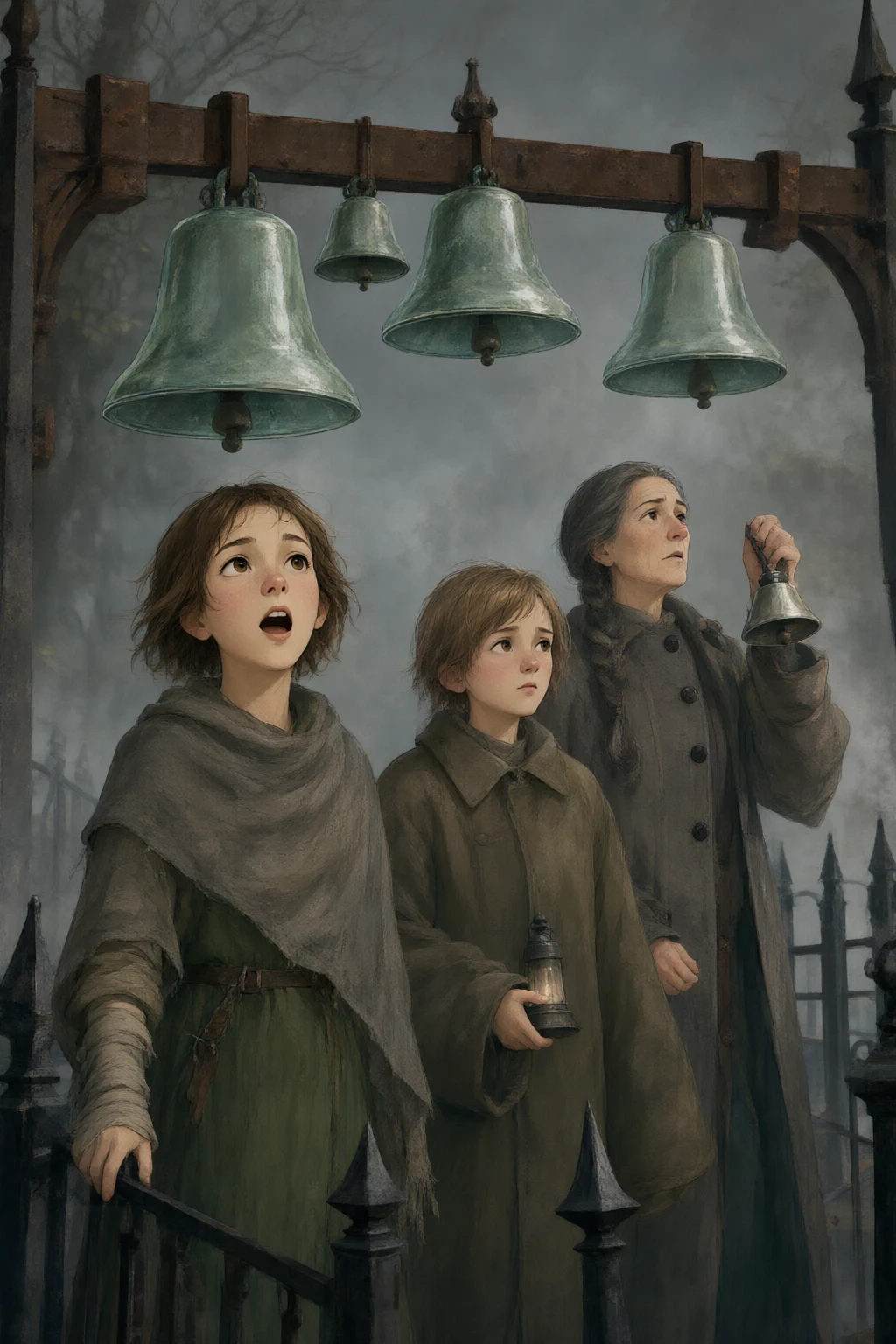
On the first day without wind, Tamsin Quill got up in the Ash Yard and put her hand in the water trough and left it there until it stopped being information and became only cold. The frost had gone hard two days before and the air had gone still on top of it, the way it does in this valley maybe twice in a life, and by seven in the morning the Smoke Hill above the Washing Steps was standing up in a light like a blade with nothing on it. There was no smoke off the roofs. There was no grit coming down the north side. For eleven winters Tamsin had heard the colonnade under everything she did — under the sieve bench, under the larch fire, under her own teeth — and on the first day without wind she heard it and nothing else, and she stood at the trough with her hand in the water and understood that it was not going to stop.
The note is not a thing that happens in the evening. She had worked that out when she was nine, or ten, or eleven; the years are not in order in her head and never have been. The wind comes down the grail at dusk and takes the valley’s angle through the nine bays and the bells say their one sentence apiece, and that is the whole of what is supposed to happen, and it happens in about four minutes. The rest of the day is for bread and sleet and not thinking about it. The rest of the day is the arrangement. The rest of the day, the note goes on.
She had gone out of the valley for a year when she was thirteen, to her aunt’s at Wick, eleven miles over the shoulder, where there is no colonnade and no wind comes down anything at all. On the ninth day there she sat down in a yard and put her head over and cried in a way she could not account for, because it was mid-morning and there was nothing to hear. And the note was there. She went home the next spring and told nobody, because who do you tell.
By the third day, people had started finding things. The first person anyone remembers is a woman called Fenn Dal, of the low cottages, who came into the Chart House at noon on the second day and asked Ione Sarrack whether a person might sit down for a minute. She was fifty-eight years old. She said she could hear the fourth stair of her own house creak, and that she had not heard it since 1979, and that the sound of it came up through the soles of her feet while she was standing in the courtyard, at noon, with no wind, and that it was the exact creak and it was in the right place in the stair. “Write it down,” Ione said, because that is the instruction she has for everything, and Fenn Dal looked at her and said no.
The second was the schoolmaster, Ansel Roke, who shut his schoolroom on the second afternoon and had it open again on the fourth, and who would not say why, and whose satchel was on the table with the roll of paper sticking out of it, and who had not written anything in it for three days. The third was at the Crown Kiln, and that one Bela Truce took in without being asked, because there is no arguing with a furnace. Twenty or thirty people went into the glasshouse over the second and third days, and stood in the orange light, which is the only warm light in Coldrow, and listened to a furnace that had been roaring steadily since she was a child, and wept, and did not explain themselves, and Bela let them stand there because Bela has a rule about the floor and the fire and who may stand on it, and the rule has a gap in it where people who are weeping fit.
Then it got past that. On the sixth day a woman called Odile Hearn said that she had heard her brother say her name in the kitchen, and her brother has been dead nine years and is in bay four, and there was nobody in the kitchen, and her husband had been out since noon. Now: this is the part that the Chart House did not like. Every time a person hears a bell and hears it correctly, recognises the note as a person and not as weather, the valley takes one sound out of that listener for good, and it is fair and silent and never announced. A bird call. A stair creak. A name spoken once. That is the price of the colonnade, and Coldrow has arranged itself for four hundred years around not paying it in daylight. There is no arrangement for the other side of that.
In the silence, the taking stopped. And what the taking had been holding, came back. Not to the right person, and not in the right order, and not at any hour anybody had asked for. A woman in the low cottages heard her son’s laugh on a Tuesday and sat down on a step. A man by the Washing Steps heard the ring of a kettle he had not owned since he was a boy. Two sisters on the far side of the stream heard each other’s voices as they had been at fifteen. And then, from the sixth day on, people began to hear things they had never lost.
That is the part Ione Sarrack wrote on the wall on the evening of the sixth day, in a column of her own devising, which is the only column she has ever devised in thirty years of keeping the rota: a column headed WIND, and under it, for six days, the word NONE, and then a line for the seventh, and the seventh was the ninth, and on the ninth she wrote, in the margin, in a hand that was not steady, the sentence that made Marget Oskell count her words on her fingers when she heard it: If nobody is being charged, then what is listening.
The new note did not stop. Nobody in Coldrow had any business noticing that, and Perrin Vole noticed it, because he is fourteen and cannot whistle, and had therefore nothing to compare the quiet with. He said it to Ione on the eighth morning, in the Chart House, with the boy standing at the satchel end of the long table where the boy stands. “Eight days, ma’am.” “Away with you.” “Eight days and not one of them has said anything.” “That is the wind, Perrin.” “No, ma’am.” He was not being clever. He had genuinely not understood why this was remarkable. “It’s not. There’s still the one.” Ione put the chalk down. “Where.”
He thought about it. He could not sing and he could not whistle and he could not say a note in words, and the whole of what he knew about the note was that it was the one thing in Coldrow he was still allowed to make, and he made it constantly without noticing, which was a thing everybody had told him to stop doing since he was eleven. “Ninth bay,” he said. “That’s where it is.” “Every bay has a sound in it when the wind comes.” “No, ma’am.” He was looking at the north window. “The others have gone quiet. That one hasn’t. It hasn’t got quieter. It’s got louder, and it hasn’t got quieter, and I have been listening to it since the day after we broke the bell in the seventh bay and you have not lost the date.”
That last part was not an attack. It was a boy reporting an observation to a woman who had stopped being able to say dates out loud and had been very careful about the fact. “Hum it,” said Ione Sarrack. Perrin hummed it. He was not good at it and he was a beat behind, and the note in the colonnade was an exact interval ground into the lip of a bell by a blower’s judgement four hundred years ago or eleven years ago, and his version of it was a child’s. “Stop,” said Ione. He stopped. They waited a minute. Two. It was still there. “That is impossible,” said Perrin. “It is a note in a bell,” said Ione, “and the wind is in it, and there is no wind.” “Then how is it going.”
Nobody answered him, and the reason nobody answered him was standing in the doorway with her shawl over her arm, and had been standing there some time, and had come in off the Washing Steps with her right hand and forearm wrapped in a strip of cloth that has been re-wrapped so often the edges of it are furred.
The ninth day was the last day. That is the part the Chart House was certain of and could not prove, and the certainty was enough to move them. The turning wind comes back down the grail in the last week of the month, and it comes back at dusk, and when it comes it comes all at once, the way a door comes open in another room. After the turning wind the colonnade is under the weather again and the note is under the weather with it, and the arrangement covers whatever is underneath it, and no one in Coldrow will get another nine days like this in a lifetime unless they are unlucky.
Ansel Roke put it in a form that could be argued with, which is the only form he trusts: It stands in the record as follows, that for nine days the colonnade held no wind, and for nine days one note continued, and the record has no column for a note that does not require wind, which is not the same as true. They went up the Pillar Walk at the last hour before midnight, on the ninth day, and it was a clear night and no moon, and the frost had raised the same mist off the flags that it always does, so that the mist was brighter than any lantern and the lantern was the dimmest thing on the walk. Ione carried the hand-bell.
There was one in the Chart House on the long table, a plain little tuning bell about the size of a fist, and it was useful for nothing whatever, which is why it had survived four hundred years of people throwing things out. Nothing makes a sound when it is struck. That is the law, and it is the first law, and a bell struck by hand is not a bell at all. Ione carried it because Perrin had carried a lantern and could not carry both, and because she had carried it out of the room on the way past the table for thirty years without ever once deciding to. “Keep it in your hand,” said Tamsin. “It is in my hand.” “If I go wrong, ring it.” “It will not make a noise.” “I know,” said Tamsin Quill. “Ring it anyway.”
The nine bays went past on the left, behind the iron rail, and the bells in them were a wall of cold light with the mist in it, and not one of them moved. Not one of them had moved for nine days, and they hung there with their mouths at their evening angle waiting for a wind that was not coming, and looking up at them from the walk was like looking at a row of people who have all agreed not to speak. Perrin struck them as they went, one at a time, with the heel of his hand on the lip.
The ninth. The eleventh. The fourteenth. The bell in the fourth bay, which is a woman called Ondrey who died in 1881 and has a note you can find in your chest without being told. Perrin put his hand flat on the lip and hit it as hard as he could hit it, and it made no sound, and the iron rail gave back one small note from the blow, and the small note from the rail died before it had got to the pillars. By the sixth bay the note in the air was close enough to have a direction. “It is in front of us,” Tamsin said. “It has been in front of us since the second bay.” “It is everywhere,” said Marget Oskell, from behind, in a whisper that was not a whisper. “Have you seen it twice?” “I have seen it once,” said Tamsin, “and I have been hearing it for eleven years, and I would know the difference.”
At the seventh bay the walk goes out into the open for twenty feet where the flagging had been relaid, and the frost had got into the new stones and lifted them, and there was a gap you could put a hand into. Under the seventh bay there is nothing on the yoke at all. That is where a bell used to be. “Nothing in the seventh,” said Perrin, unnecessarily, because everybody could see it and everybody had known for a month, and it was the one thing in the colonnade that anybody could talk about openly. Then the eighth bay, and then the ninth.
The ninth bay is the end of the walk and the end of the colonnade and the furthest thing in the valley from a house. Five bells hang in it, on the last yoke before the wall. Four of them have a hemp line running down from the lip to a winch, and the fifth does not, and the fifth is the low one, and the fifth has been the low one since it was blown. Tamsin stopped walking before they were under it. “It is in the floor,” she said. “It cannot be in the floor,” said Ione Sarrack. “It is in a bell. It is in a bell or it is not anything, and I am not going up a flagstone in front of nine witnesses and say that a note is in a floor.” “That is where it is coming from.” “How do you know.” “It is in my feet,” said the girl. “It has been in my feet for eleven years and tonight it is in my teeth.”
So they stood at the end of the ninth bay on a clear night with no wind, and the frost mist round them, and the one note in the world going on out of the ground under a bell that had no line on it, and there was exactly one thing left to do, and everybody in the party knew what it was, and it took them the better part of an hour to say it. Ione said it first, because she was the Head Tuner of Vesset Grail and the duty of the Head Tuner is to put the lawful thing in the room before anyone can put the other thing there.
“The law says a bell that is sounding takes the voice of any living person who speaks its pitch,” she said. “It takes the voice and it keeps the voice, and the person can never make that sound again, and the Chart House enters the credit of the last sentence in the bell against the name of the person who spoke it. That is how the Chart House has always known that a living person is in the colonnade. It has happened four times in four hundred years, and it is written down all four times, and I have read all four.” “Then nobody says anything,” said Marget Oskell. “Somebody has to say something,” said Ione, “or we go down that walk tomorrow morning and we wait eleven years for another night like it, and we do not get one, because I am fifty-eight and I have seen two of these and there will not be a third.”
Nobody argued with that, because it was true, and because everyone on the walk understood that the wind would be back before noon and the note would be under it again by dusk. Perrin Vole said, “I could do it.” He said it the way he says everything, which is by putting it at the end of somebody else’s sentence, and everybody on the walk turned and looked at him, and he got red to the ears. “I hum it anyway,” he said. “All the time. Everybody’s told me to stop. If a bell’s going to take a note off a person, it might as well take one off the boy who’s already got no business making it.”
“It will not be a note,” said Tamsin. “It will be a voice. That is the whole of what you have. It takes the voice, not the note, and then it credits you with the sentence, and then you are on a crown, and there is a bell in this valley with your name on the top of it, and you are sixteen and you will be struck out of the Register of the Living the same week.” “I know that,” said Perrin. “You do not know it,” said Tamsin. “You know the words.” The frost made a noise like a small animal somewhere behind the wall, and the mist came up off the flags, and Ansel Roke said, “It stands in the record as follows, that a boy of fourteen volunteered, and that the record has no column for a volunteer.” “That is my whole objection to the Chart House,” said Ione Sarrack, “and I have never once said it out loud.”
They were all quiet for a while, and Tamsin Quill stood at the rail at the end of the ninth bay with her hand on the black iron, and the rail was cold enough to take the feeling out of a hand in about four seconds, and she left it there anyway. “I will go first,” she said. “No,” said Ione. “You cannot say no. You are not the one who —” “I have thought about nothing else for three days,” said Ione Sarrack, “and I have found the reason, and it is not a good reason, and I am going to give it to you anyway, because we are on a walk with a hand-bell that cannot make a noise and I have nothing else to be exact about.” Tamsin waited.
“If you speak the pitch, the bell takes your voice and the credit of the sentence is entered against your name, and I will have to minute it. I will have to minute the date and the hour and the bay and the bell and the ringer and who was called, and I will do all of that correctly, and there is not one column on that wall for the fact that you offered. There is not one column on that wall for anything you could possibly have wanted, and there has not been one since the wall was whitewashed, and in forty years I have got very good at writing down things that are true and have never once been able to write down a thing that was true and mattered.” She put her hand back in her sleeve. “I have spent my life making this valley into paper.
If I let you do this, it will go in the paper, and what will not go in the paper is the only part of it, and you will be struck off the living list in a hand that is as neat as the rest of it, and there will be a bell in this valley with your name on the crown of it, and no one will ever be able to say that you chose it. I have read four such entries. I know exactly what they look like. They look correct.” The wind did not move. There was no wind to move. “Then who,” said Tamsin. Nobody answered for a while. The note went on out of the floor of the ninth bay, and the bells hung above it in their evening angle, silent, and the frost-mist came up through the stone between them, and the hand-bell in Ione’s fist was a small cold thing that could not speak.
“Nobody,” said Tamsin Quill, to herself, and half a beat late, as she said everything, and then again: “Nobody answers first.” She had been startled by something. There is no other word for it; there was nothing there to be startled by, and her shoulders came up half an inch and her hand came off the rail, and she made, in the cold, one note, always the same one, the one she has made since she was small, and which is the note that has been going out of the colonnade for eleven years. It was very small and it was perfectly in pitch. The note in the air went on.
Nobody in the party moved. The valley takes sounds without announcement, fair and silent, and a listener who hears a bell correctly loses one sound for good, and there is nobody in Coldrow who could have told you afterwards which sound it took, because it does not announce itself, and it is fair, and that is the whole of what can be said about it. “First light,” said Tamsin. “Before the wind. I will be on the walk at first light and I will say it then, and Perrin can ring the hand-bell, and the yard can have the rest of it.” “That is not lawful,” said Ione Sarrack. “No,” said Tamsin Quill. “It is not.”
The wind came up the valley at ten past six in the morning, while she was still asleep, and went through the nine bays and covered the whole arrangement again, and the note went under it, where it stayed. The Chart House wrote the decision on the wall under the finding, unsigned, because a thing that has not happened cannot be entered as though it had, and the wall held it there for eleven months.
There is one more entry on the Chart House wall, and it is not a column, and it is at the bottom, in Ione Sarrack’s chalk, under the ruled lines where the plaster is scuffed from the table, and it was not recopied the following year because a winder’s boy cleaned the board, and there is a copy of it in a schoolmaster’s satchel in a green-shouldered bag: Ninth of the month, and the ninth. Wind: none, nine days. One note throughout, bay nine, from the floor. No column for this.