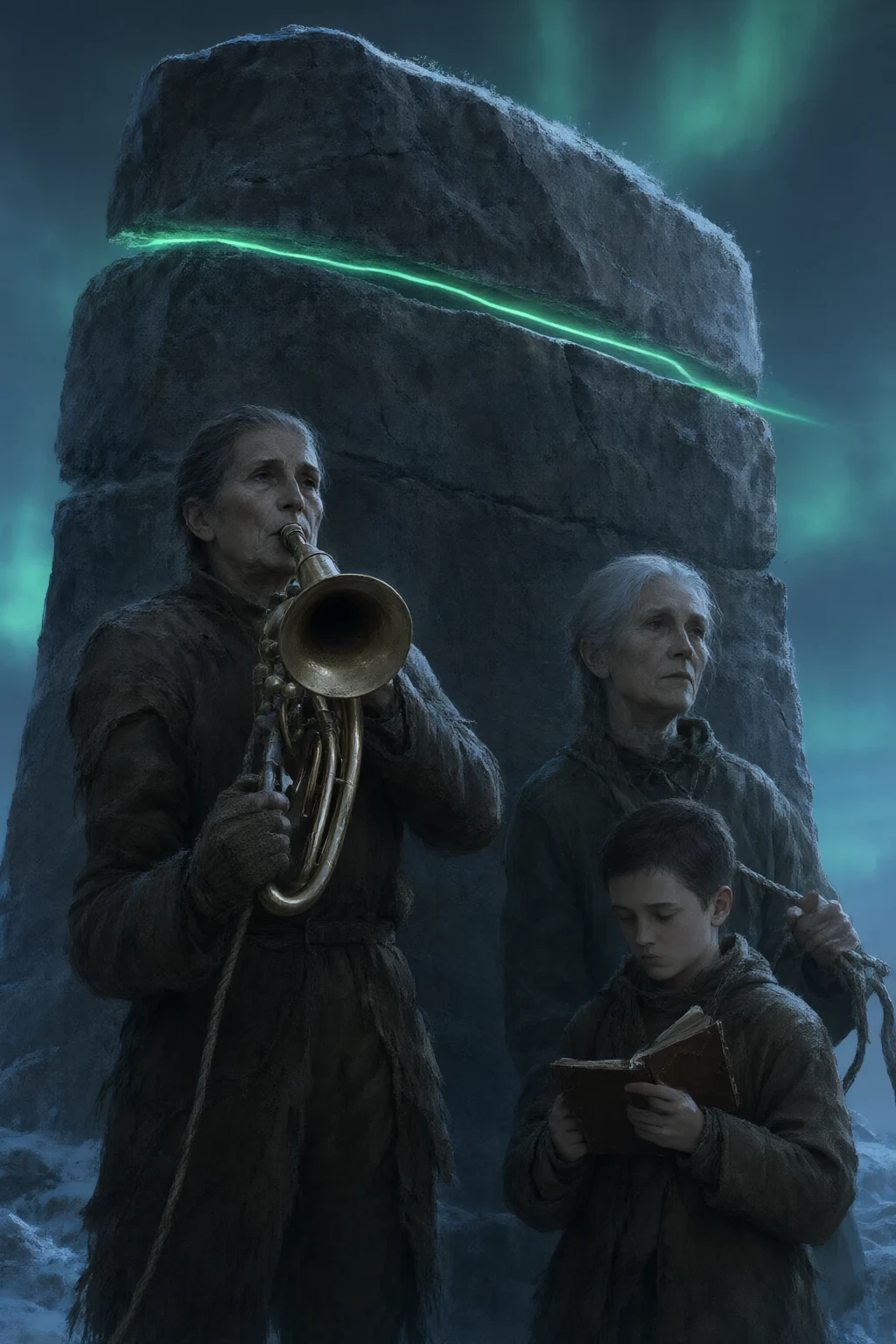
The change of watch began when Wend Cassock came round the ring with her lantern held low, which was how she had done it for nineteen years, and which was not for the light. It was so that the players would see her coming and none of them would have to be startled into a note. “Collector approaches the bass place,” she said. “The bass sits. Horn-line stands. The small-bell is had by an apprentice with a ledger against her chest. Ysolde takes the great bell.” Four names for nine parts. She had set that sentence down in the same order every ninth night for long enough that it had stopped being an observation and become a wall, and there was no way of taking a wall down except by saying it in a different order. The west wind came over the slab with its whistle in it and carried the fine white ash that formed instead of frost, and the ash got into the eyes and into the teeth and into the seams of every coat on the mountain. It came up through the nine gaps in the granite and out again and never once dropped. In six hundred years of record, and there was a great deal of record, no one had ever written down a wind that dropped.
Pell Underhay stood at the small bell with her notebook inside her coat and the broken spine of it against her sternum, and the notebook was open to a page she had ruled herself, ruled in pencil in the margin, in a hand that was not yet steady. Three columns of dates from the last two years. She had added a fourth, and the fourth was not a date. She had not yet decided what to call the entries in it. “Small-bell,” Sef Anhalt said, going past her with a padded mallet tucked under his arm, “you are holding that note like a plate.” “I am holding it the way it is meant to be held.” “Small-bell. There is no way it is meant to be held. There are four of us. Everything is the way it is meant to be held because there is nobody left to do it properly.” He said it without cruelty, and then he went to the third horn and put his hand flat on the tuning slide and left it there, which he did perhaps forty times a night and had done every night for eleven years.
Maran Ostler worked the valves with her left hand, because her left was the hand that knew where they were, and her left hand was white to the second knuckle and had been white to the second knuckle since she was thirty-four. She wore a mitten on it with the thumb cut off so that the tip of the thumb could find the third valve, and the mitten had been re-lined twice and would not need lining again. There was frost ash in her eyebrows. She had not been warm in the sense that other people were warm since a winter she could remember the ending of. “Third,” she said. “The third is fine.” Higher up, on the ninth segment, where the granite was oldest and the mortar had gone the colour of a wet stone, the aurora had a place where it was not a line.
It had been there four months. From the floor of the ring it looked like a hand's width of nothing in the middle of an unbroken green edge. Not a colour, not a light: the place where the curtain stopped being the thing it was and went back to being sky. It did not flicker. It opened and shut on a slow count, the way a lid does, the way an eye does when it is deciding about you. Sef had measured it with a folding rule on a bad night and called it four inches, and on a worse night it had been a foot and a half, and on one night Wend Cassock had recorded it as a place rather than a size, and it had been gone entirely for the length of a held note and had come back. She had written that down. She had written it in the flat hand she used for the survey, with the date and the hour and the phase of the chord, and she had not written a word about what she thought it meant, because a collector's record is a record. It was the fourth month of the deep night. The deep month is the month in which the players stop being able to feel their feet.
Ysolde Vant took the great bell at the eleventh hour and held it for three, which was long, and which the older rubrics of the Foundation permit to a keeper of the silver chimes who has been on the shoulder since before the wall was old. The great bell was the size of a cart and hung from a yoke of antler roped in hide, out in the open, with the sky for its only roof. Its wire was a single line of drawn silver as fine as a wrist, and it went eight metres up into nothing. When she struck it she put her whole weight into the clapper, and the sound came off the mountain in a broad green sheet that went out past the wall and stood there. She held it. That was the work. Not striking it but staying with it while it rang itself down through its own long argument, because a bell that is not stayed is only a noise, and a noise does not hold a wall up.
The cold came in on the second hour. It came the way it always came, which was not like wind but like attention: the flesh of her forearms first, then the joints, then a place behind her sternum where the air goes that is not air. In the second hour the pain stopped and the cold took the rest, and she had always known that was the worst part, because pain at least meant she was in it. In the third hour she heard the mountain. It was not a memory. She had said so, every ninth night, to anyone who asked, and no one on the shoulder had asked in eleven years. It was there when the cold got deep enough: six hundred years of the Standing Chord played all at once with the players still in it, every one of them cold, every one of them going, none of them gone. It always ended the same way. Nine parts holding, and then the ninth part, which is not a part anyone played, which is the low thing under the low thing that a body takes without hearing. And then, past the end, where the record stopped, a shape.
She had been hearing the shape for six years. It was the only thing the mountain had ever given her that she had not asked for. She could not sing it. She had tried, standing on the eighth segment at two in the morning with her mouth open to the sky, and what came out was her own voice and a whistling, dry, and the sound died nine feet from her and lay down in the ash. But she knew where it went in the chord: after the bass, before the horn, not loud. And she knew it had a room in it, the way a chord has a room in it when a note is missing and the missing note has taken a shape by being gone for six hundred years. The bell finished ringing. Ysolde lowered the clapper and stood with her hands on the yoke-rope, breathing, that faint dry whistle in and out audible from anywhere on the ring, and the ash on her eyebrows had gone hard and white as spilled salt.
“Well,” she said, to nobody, in the cadence she used for everything, which was the cadence of a woman reading aloud something that had been written down a long time ago and settled. “Well. It is the same. It is always the same, and it is always one note short, and I am seventy-two years old, and I have perhaps two winters in me, and one of them could be spent, and it would have to be spent here, because it cannot be spent anywhere else, and I would not want to spend it anywhere else.” She said it to the empty ring. The wind took the first four words and kept them, and gave the rest back flat, with no weather in it at all.
She found Pell at the small bell an hour later, at the bottom of the ring where the mortar keeps the wind out. “Apprentice.” Pell closed the notebook over her thumb. “Keeper.” “Give me the arithmetic of it.” Pell's face did something complicated. “What is the number for that?” “It is four hours I have just held, and the question is not that. The question is this. There is a note. I have heard it for six years and I cannot make it and I am not going to be able to make it, because I am seventy-two and my hands are the hands of a woman of eighty, and because it is not a sound, and because it cannot be given by mouth. It is a thing that is played. You are the only one of the four of us with a year in you that the ring has not already had. So the question is whether you will give it, and I am asking you now, tonight, before the change, so that you cannot say afterward that I put it in front of the ring and made it into a thing that had to be answered.” Pell said nothing for a while. The wire above the small bell ticked faintly in the cold, being silver, contracting. “Keeper,” she said. “How many years do you have?” “Two. Perhaps a little less. There is a cough that has opinions.”
“Then one of them is all of the years you have that is yours to give, and if you give it you have no winters left at all, and a person with no winters left is not giving a year. They are handing over the plate.” “Yes,” said Ysolde. “I had hoped you would say that, and I asked you anyway.” “You asked me because I am the ninth player.” “I asked you because you would have said yes.” Pell shut the notebook the rest of the way and put it back inside her coat, against the broken spine, and stood in the shelter of the mortar with the ash coming past her shoulders in the flat sideways way it always came, and did not speak for long enough that the wind had to fill the space.
“Maran taught me the columns,” she said at last. “She taught me when I came up. She said the first thing a player learns is what a note costs, and the second thing is whose note it is, and the third thing is that you do not have to be the cheapest one available. She said it to me on my second night. I have had two years of writing it down. And you are asking me for a year, and I am fifteen, and I have four years of my mother's arithmetic still in this book that nobody has ever come and looked at, and I do not want to give you a year, and I want you to be alive in the spring more than I have ever wanted anything, and I do not know the number for that either.” “No,” said Ysolde. “You do not. Nobody does. That is the whole of what I have learned in seventeen years on this rock, and it is the one thing the mountain will not put in a column.”
The four of them stood in the ring at the change, where the standing of an order is done, and Ysolde said it in her cadence, straight through, without stopping, the way a person reads a charge. “I, Ysolde Vant, keeper of the silver chimes, seventeen years on this shoulder and forty years before it of a life I can still account for, offer to the ring one year of my own life, given freely, of my own body, not by proxy, not paid for by the mountain. I set the terms myself and I will not be interrupted.” The wind went round the nine gaps and came back. “I have heard the note the ring was built around, and the ring has taught it to me whether I asked or not, and there is one thing it wants, and I am the one who has it, and I am offering it, and I am seventy-two and it is the only thing I will ever be good for again. Let it be written that I asked, and that the asking was not a trick, because an offering that is arranged is not an offering but a hand reaching.”
Sef Anhalt had stopped moving. He stood at the third horn with one hand on the tuning slide and the mallet forgotten in the other, looking at the middle distance in the way he looked at things when he was listening past them. Maran Ostler took the mouthpiece off the third horn and set it down on the stone. She had not done that in the holding in forty-two years. It put the whole east side of the chord a third of a tone flat for as long as it took her to speak. “No one gives a year that the ring has already taken,” she said. Eleven words. There was no note-name at the end of any of them. Pell, watching from the small bell with her hand still on the clapper rope, wrote the number in the margin of the fourth column without being told to, and underlined it, and did not yet know why she had underlined it. The wind stopped.
Not dropped. Stopped, the way a player stops, which is a different thing entirely, and it lasted the length of a note that nobody on the shoulder was making. The nine gaps in the wall made a silence with nine edges to it. The ash that had been crossing the slab in a level sheet simply stopped in the air, hanging, every flake visible at once, a room full of falling snow that had forgotten to fall. Then the wind came back and the ash resumed, and in the east the curtain had closed to a hair. Nobody moved for a while. “That,” said Sef Anhalt, “was not a note the ring is holding.” “No,” said Maran. “Then what was it, Horn-line, because I have been on this mountain eleven years and I have never heard the wind do that.” Maran looked at him. There was a piece of knowledge in her mouth that had not been there a minute before. It was not a sound. She could not have said to anybody in the world where it had come from. “It was a refusal,” she said. “It does not matter.” Sef Anhalt went back to his horn. He took the slide up a quarter of a tone, which was wrong, and put it down, and took it up again, because he could not stop tuning, and the third horn went sour for eleven seconds and came back.
Ysolde Vant had not moved at all. She stood with her hands still on the yoke-rope, and her face, in the green light from above and behind, was the face of a woman who has been carrying a heavy thing up a stair and has just been told to put it down in a room she did not know was there. “It has gone,” she said. “Gone where, Keeper.” “The note. The shape of it. The place it had in the chord.” Her breath went in with its whistle. “It was in me for six years. I could find it any time I wanted, the way you find a tooth with your tongue. He has said it out loud and it has moved into him. I am not angry at him. I would like him to be careful with it, because it is not a note any more. It is a thing that has been said. Those are different animals, and the second one cannot be taken back.”
She was right about that, and she was right about the rest of it too, and Maran did not sleep for two days. The knowledge sat in her the way the cold sat in the four of them: always, in the back of the sternum, patient. She knew the pitch. She knew where the pitch went, which was between the bass and the horn, in the place where the chord stops being a chord and becomes a floor. She knew what it would cost, which was a year, and a year was the width of a man of sixty-one laid end to end with the man he would be. She stood with her mitten hand on the cold sill and read it eleven times over the course of the day, and it did not get softer. What she did not know was whether she could spend it. She went down to the Foundation to find out. The Foundation is cut into the sill of the ninth segment, where the oldest masons worked, and it is not writing so much as a set of instructions cut with a chisel by men who expected to be gone. A year given. Not by proxy. Not by the mountain. The mountain would not take it from her until she had given it. Which meant that until she gave it, the note was hers and unusable, a key in a lock on her own side.
And the price of spending it was cut under the price, in the same hand, and had always been cut there, and she had read it when she was nineteen and had not understood one word of it. The night ends. The wall ends with it. What the Year was before the first chord becomes the Year. So that was the price. Not a year of her life. A year of her life, and the end of the wall, which was the end of the reason she had ever been a person. The wall was the chord. The chord was nine parts held in nine hands for six hundred years, and the ring was the only thing that had ever made her Maran Ostler rather than a woman from Sillvane with a good ear and a cold hand who was once, briefly, a young-one, and who had spent every year since arranging that no one else in the world would ever have to be a young-one either. Take the wall and you take the ring, and you take the standing, and you take the eleven words, and you take the whole apparatus by which a person who has given her life to a thing is able to say that the thing was worth it.
And then you are sixty-two, in an ordinary winter, in Sillvane, where the bell in the tower has not been rung in six hundred years because nobody has ever been able to tune it without an aurora-player to listen to, and where there would be no aurora-players any more, and where the bread is dense grey rye and the soup is called weather and there is nothing whatever to be done about any of it. That was what the mountain wanted. It wanted a woman who would say yes to both halves, and it would not take a yes to one.
On the ninth night the valley's carriers came up the Gallows Stair with peat and mortar: two hundred and forty steps of cut stone worn into shallow bowls in the middle of each tread. Kell Ostler came up with them because he always came up with them. He was fifty-eight and a harness-mender and he had been a bass-pipe player once, and he stood at the eighth segment in the wind and did not come into the ring, and did not ask to, and Maran watched him from the far side of the shoulder for the length of one measure and then looked away, and it was the whole of the visit. Sef Anhalt found her at the third horn in the second watch, which was the only hour she ever came out of herself in. “Horn-line. That note you spoke.” “Leave it.”
“I have thought about nothing else for a week. Chimerunner.” He put his scarred hand flat on the granite, spread, the burn in the web of it shaped like a fork and white as a scar goes. “If there is a note that ends the winter and the wall with it, then the ring is finished. A wall that is not a wall is not a wall. There is no chord, no nine parts, no obligation, and no one on this mountain. I have been on this rock eleven years on a six-month labour term. I would like to go to Sillvane. I would like it very much more than I have ever been able to say to anybody, and I have now said it to a woman who is going to hold it against me until it is useful to her.” “I will hold it,” said Maran, “and I will not use it, and both of those are true at once, and I am not going to explain which is which, because the explanation is four hours of a note and you have to be inside the four hours to get anything out of it.” The third horn sat where it was. Out in the east the curtain was a hair's width thinner than it had been a month before, opening and shutting on its slow count, the way a lid does.
Pell Underhay came up the ring at the change with her notebook already out, and she had a page torn out and folded twice, and she stood in front of Maran and held it up. Maran took it. On it, in the margin, in a young person's unsteady pencil, was a single figure, underlined twice. Eleven. “What is this,” said Maran. “The number of words.” Pell's jaw was set in the way it went when she had decided something a long time ago and was only now finding out what it cost. “It is the first number in the fourth column. I do not know yet what the column is for. I ruled it in the second month because there was going to be a fourth kind of thing, and I have had three kinds in two years: notes that cost hours, years that cost years, and now one sentence that cost nothing and changed everything, and there is no heading for that, and I am not going to invent one. So I am writing down how many words it was. It was eleven. That is all I know.” Maran folded the page and put it inside her coat on the side where a person keeps a name.
The collector walked the ring at the change, as she walked it every ninth night, with the lantern low and the rule on its cord, and she found the thing at the ninth segment and stood over it for a long time without writing anything at all. It was a line. Cut into the sill of the Foundation, beside the four chiselled lines about the year, in a stroke that was not chisel work at all but something that had gone into the granite the way a fingerprint goes into wax. It was a single unbroken stroke the length of her forearm, and it was new, in the only sense that mattered to a collector, which is that no record of it existed. She had read the Foundation four thousand times. In six hundred years, with nineteen collectors before her and their books in the press in the maintenance store, not one had reported an addition to the sill. She took out the oldest, whose hand she could still read, and held the two pages side by side at the lantern. The older page had the four lines and nothing else.
Wend Cassock wrote the date, the hour, the phase of the chord. Then she took out the other book, the smaller one, begun in the first year of her office and filled with eleven pages of flat assertions about a note none of them had ever heard, and turned to the first clean page after those eleven, and wrote four lines about what she believed would happen, in the same hand, in the same tone, as though it were a survey of a wall she had already measured. Then she sat back on her heels in the ash and read them, and understood that a collector's record is a record and that what she had just written was not one, and that nobody would ever be able to tell the difference, because there is no collector appointed to check the collectors. She wrote one more line, in the margin, in a smaller hand, the first opinion she had entered in nineteen years. It is not knowable from here whether this is a door or a trap, and I have written down what I think it does, and I am going to leave this book on the shelf where it can be found, because a thing that is written down can be argued with, and a thing that is only remembered cannot.
Dawn on the fourth month of the deep night is not dawn. It is the point at which the green goes out of the sky and the grey comes in and the difference is measured in the way a person feels about it. It came at the ninth hour, as it had come for six hundred years, and the four of them had been in the ring since the first dark without a rest, because the Standing Chord has no rests in it, and they were the colour of wet slate and thin as their own shadows. Ysolde Vant put the clapper down and stood with her back to the great bell and looked east, where the place in the curtain was already opening again on its slow count, four inches this time, and would be six by noon. Maran Ostler took the mouthpiece down and wiped the brass on her sleeve and put it in the case, which she had not done in forty-two years at the end of a night, and which is the kind of thing a person does when a change of watch has been arranged and has not arrived. Sef Anhalt was at the tuning slide, and would be at the tuning slide in an hour.
Pell Underhay stood in the shelter of the mortar with her notebook against her chest and a pencil in her hand, and did not write, and did not leave, and had no heading for the column she had ruled herself in the second month of the year before. Somewhere three thousand feet down, in a sheltered fold of the valley where peat smoke stood straight up in the still cold, two hundred people went about a morning that was getting shorter and would go on getting shorter, and none of them sang the Standing Chord indoors, which they had stopped doing in the fourth month, which nobody had asked them to stop, and which the collector had entered as a change in the population of the valley and no more than that. And on the ninth segment, under a line that had been cut into the granite by something that was not a chisel, the four chiselled lines stood in the order they had stood for six hundred years. A year given. Not by proxy. Not by the mountain. The night ends. The wall ends with it. What the Year was before the first chord becomes the Year.