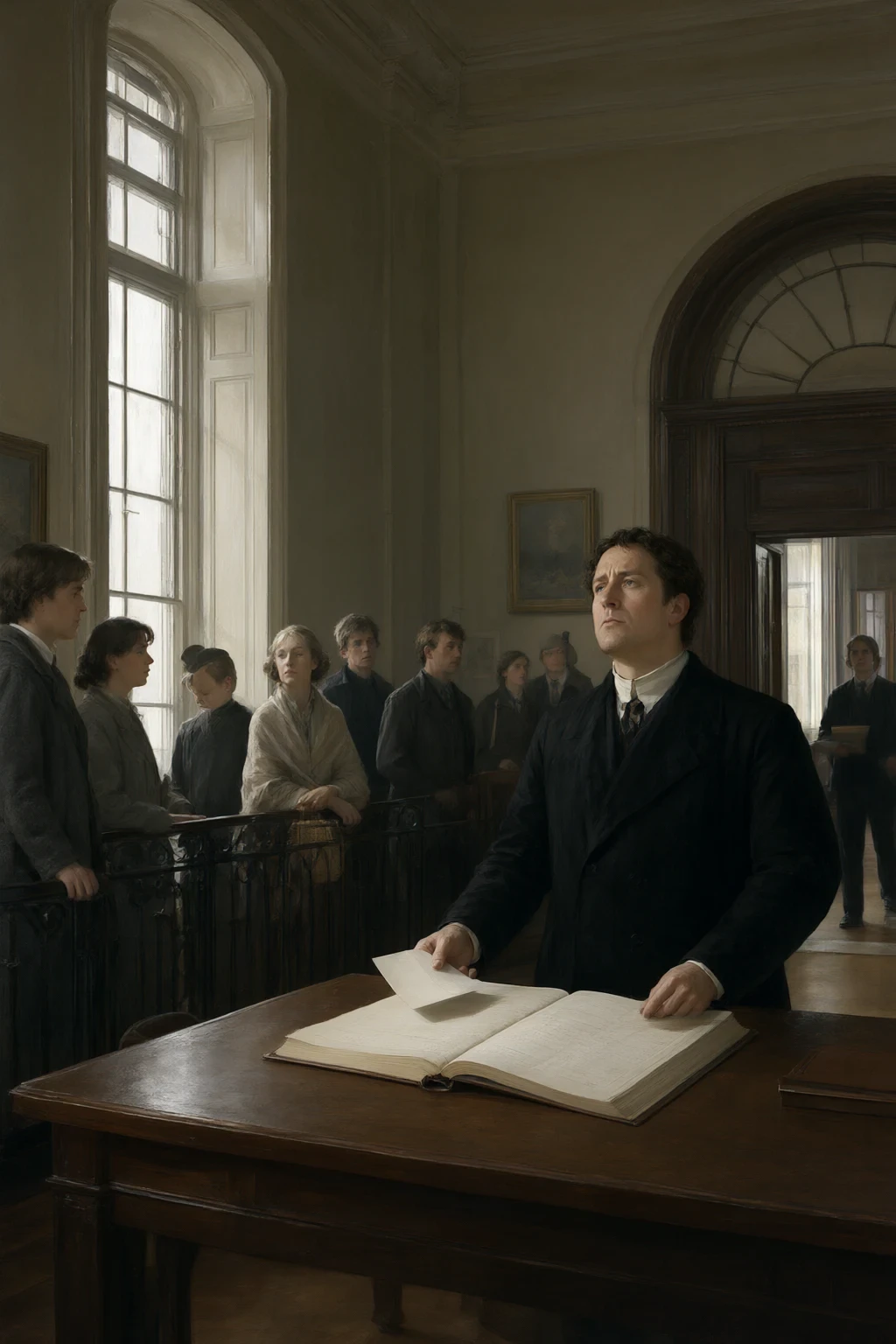
The register of sharp findings is read aloud once a year, in the Reading Room, in full, in the order of the cards, and it takes about nine minutes, and it is the shortest entry in the whole of the Bureau’s calendar. The rule is old and it is not written down anywhere except in the practice, and the practice is this: a finding is permanent and a finding is public, and the only way a thing in this county is public is that somebody has said it out loud in a room with the door open. So the twenty-four cards of drawer one are read in October, at half past ten in the morning, in the Reading Room, with the register on the table and the door propped, and anybody in Featherstone may stand at the back. Cobb Tarn had read them nine times. He had read them in 1802’s hand and 1874’s and the four hands between, and he read them in his own voice, which is a flat voice and does not do anything to a sentence, and the reason he read them was that the registrar reads the register and the junior clerk cannot, being twenty-three and five months in the building and not a member of the Bureau.
He had one habit in the reading and everybody in the room knew it, and it was that when Cobb Tarn came to a card he did not know, he stopped in the middle of a word. There had been four such cards in nine years, and on two of the four he had stopped and gone back and started the card again, and the room had waited, and nobody had ever minded, because a registrar stopping is a registrar checking. The Vantry family came at a quarter to eleven. They were early because the child was seven weeks old and the certification of a household with a newborn is fixed by the calendar and does not move for a coach, and Lady Hesp Vantry had come in from the south road with the two girls and a folded certificate and had told the coachman to put the horses five minutes at the corner, because there is a house on the corner that does good coffee, and being forty-one, and the mother of three, and the instrument of her own house in 1974, she wanted coffee in the way that a person who has been doing a hard thing for twenty years wants coffee and not a chair.
The household of a great house is a set of measurements. A child born into one means that every bed, every door, every stair and every floor in it is re-tested against the family’s declared sensitivity, and that one child is designated the Sharp One, and the Sharp One is the house’s instrument. That is the whole of what Lady Hesp Vantry had come for, and she had come for it with a folded certificate in her handbag, and the certificate had a printed line on it that she had not filled in and had no intention of filling in, and she had brought the certificate to the Bureau with a blank line in it, and the blank line was the entire content of the visit. They came into the Reading Room because the Certification Room is on the same landing and the door of the Reading Room was propped, and there were eleven people standing at the back of it, and a woman from the four counties who had come to check that a bed she was buying was in tolerance, and a man from a shop in Ketch who came every year, and a schoolmistress, and two men off the towpath, and a boy of nine. Cobb Tarn had the nineteenth card in his hand and the reading was at the eleventh.
The chief tester was not in the room. Aldis Prome was on the test floor with a household at eleven o’clock and had been since eight, and Cobb Tarn had wanted him in the Reading Room and had not asked, because a registrar does not ask the chief tester to stand at the back of the register; and it turned out afterwards that if Prome had been in the room the reading would have been stopped inside thirty seconds, for the reason that a chief tester is the only man in Featherstone who has been inside the strongroom and the finding of 1802 is his business, and everybody who has been inside the strongroom knows what is on the back of that card. Nobody at the back said anything, because nobody at the back ever says anything in the Reading Room, and because the room is thirty-one feet by nineteen and the ceiling is high and the door is propped and the reading is going on, and the rule about the Reading Room is not that people may listen. The rule is that people may not be asked to leave it.
The cards go in the order of the register and the register goes in the order of the finding, and the first one is the first one. Cobb Tarn had had it in his hand for thirty-one days once before, in the long room, alone, and had turned it over, and had seen what was on the back, and had not read it out loud to anybody including himself, and had gone home and eaten and thought about a form clause for a hundred days. The front of the first card said: FINDING OF SHARPNESS. The household of Vantry, of the great house at Featherstone, in the county of Featherstone, is found sharp. Declared sensitivity of the household, one tenth of an ounce. This finding is made in the year of our Lord 1802, upon a proof, and is permanent.
It said proof. Not standard. The word on the card was proof, and it had been the word on the card for two hundred years, and it is the whole of the law in six letters: a pea that has been under a mattress is a proof, not a standard. The finding of 1802 was made with a pea that had been slept on, in a house, by a child, and then dried, and then put in a glass case in a room nine feet of air in every direction, where it has been ever since, and the making of a standard out of the evidence of a finding is the founding act of the Bureau and the founding joke of the town and nobody in the Bureau will tell it at work. Then Cobb Tarn turned the card over, because the finding is the card, and the card is both faces, because both faces went to the Bureau, and because he had read it nine times and eight of them had been the front. On the back, in the 1802 hand, the hand that signed the front, below the signature, was one word. He said it. He said it in the flat voice, at the volume he uses for the rest of the register, and he said it the way he says everything, and there was nothing in the voice at all, which was the difficulty afterwards, because there was nothing in it to be sorry for. “Sabra.”
There is a thing that happens in a room when a person says a name that nobody in the room has heard before, and it is not silence, and the word for it is not shock. It is a small movement of heads, and it goes round the room in about a second and a half, and it stops. Lady Hesp Vantry did not move her head. She was standing at the back on the left with her hand flat on the rail and she had a cold face and a very warm hand, and she had introduced nobody to anybody that morning because there was nobody to introduce, and her hand stayed on the rail. Her husband said, afterwards, that he thought somebody had dropped something. The woman from the four counties, who had come about a bed, said afterwards that she had assumed it was a place, because there is a place called Sabra in the north of the county and everybody has heard of it, and she had assumed the registrar was reading a parish. The schoolmistress said afterwards that she had a Sabra in the second row and that she had a Sabra in the second row of every class she has ever taught, and that it was a common enough name, and that it did not matter.
The boy of nine, who had his back to the door, because he always stood with his back to a door and had done since the day in the spring when the school inspection had put a caliper on his own forearm and found that he could feel a thing nine other children in the room could not feel, said nothing at all. Cobb Tarn read the rest of the register. Cards two to twenty-four. The Marrow house, 1819, and a house that had burned in 1861 and whose card had been kept. Auld Sluice, spelled two ways and settled on the second. Vantry, nineteenth, in 1874, in his predecessor’s voice and not in his own, one tenth of an ounce, and the figure repeated at the end the way a figure is repeated when the person saying it wants the room to have the number rather than the word. The finding of 1802 having been read, the finding of 1802 being the only card in the drawer that was not a modern sentence, the reading went smoothly, and Cobb Tarn finished at eleven minutes past eleven, and said the words that end the reading, which are: the register of sharp findings is read in full and is closed until October. He then said thank you to the room, which he has said every year for nine years, and which nobody had ever told him was unusual.
Nobody did anything. That is the part that has to be said plainly about a thing like this, because the alternative is a story about a conspiracy, and there was no conspiracy, and there was no villain, and there was a boy of twenty-three who carried a board to the wrong room on a Tuesday in October because the board lives in the same press as the register and the register lives in the Reading Room, and because a certification is not public and a register is, and because nobody has ever been told to check that the two things are in different rooms. The Board met on the Monday. It sat for an hour and a half. The minute is four lines long and it is on the page opposite the sewing of the January returns, and it reads: RESOLVED: that the register of sharp findings was read in full at half past ten on the said Tuesday, in the Reading Room, in accordance with the practice; that the said reading was not interrupted; that no person in the Reading Room was asked to leave; and that the Board has no power to make a public thing private, and does not propose to attempt it.
The fourth line was not in the draft. It was added at the request of the chairman, who is a woman of sixty-eight and has been on the Board for twenty-two years and who has never in twenty-two years moved that the Bureau’s authority is not secrecy, and who said, in the room, that if the Bureau’s only defence against a thing it has said is that nobody heard it, then the Bureau is a rumour with a building. The fourth line was also, and both of these are true, and the second is the reason the first was written, the reason nothing could be done. A minute is a reading. A minute of the Board that says the register was read in the wrong room is a second reading of the register, in a room with a minute taken, and the second reading is a permanent public document, and the word on the back of the first card goes into it, and the word goes into it with a date and a signature and the words of a resolution, and a thing that is in a resolution cannot be taken out of a resolution.
There is no minute that undoes a minute. Cobb Tarn sat in his own room afterwards and worked it out on paper, four times, in four different arrangements, and it does not work, and the reason it does not work is rule seven: a thing found under a mattress never goes back under a mattress, and what is found goes to the Bureau, and a finding is permanent, and the finding of 1802 is the oldest and the most permanent thing in the building, and its front says its own name and its back says a girl’s, and both faces went to the Bureau, and both faces are the finding. Cobb Tarn had wanted to be told he was wrong. He had wanted it for eleven years and had wanted it most on the Monday, when the Board could have told him in one sentence that the reading of the reverse of a card is not a reading of the register, and it is a matter of practice and not of finding, and the practice can be amended at the next sitting.
The Board did not tell him. The Board does not tell anybody anything, because the Board is five people and a table, and the thing the Board does is decide what is going to be true by the end of the year, and the thing that was going to be true by the end of the year was that the register had been read. The registrar entered the reading in the register on the Tuesday afternoon, in the ordinary way, and the entry said: the register of sharp findings was read in full in the Reading Room at half past ten, the door open, twenty-four cards, and the registrar.
The Bureau was the last place in the county where the word still meant what it had always meant, and Cobb Tarn established that inside a week without asking anybody a question. The Bureau reads the fronts. The fronts are the findings. The fronts are two hundred years of a household being found sharp, in a form, in a hand, and when a clerk in the finding department writes the word Vantry onto a new card it means what it meant in 1874, because that is what the card says and the card is the document. A tester on the floor says Vantry in the ordinary way, meaning a household that can feel the pea, meaning a house whose beds must be made to one tenth and whose name is a warning to anybody buying a bed in four counties. Aldis Prome said it twice in that week, both times by accident, and both times stopped the sentence and started it again with a figure in it, because a chief tester is a man who says the figure, then the verdict, then the figure, and has no nouns at all. “The figure is 0.10,” Prome said, on the Thursday, on the end row, with his heel flat on a stripped mattress. “And the verdict is that it is the nineteenth. The figure is 0.10.” “The nineteenth is the Bureau,” Cobb Tarn said.
“The nineteenth is the Bureau,” Prome agreed, “and there is a great deal of paper in a drawer for a building, and I have never once been asked to test a building, and a building cannot sleep.” On the Friday he came to the long room, which he does perhaps twice a year, and stood at the end of it. “I have been inside the strongroom twice,” he said, “and the second time was in 1979, and you know what I did in there.” “You did not touch the case.” “I did not touch the case. I read the card on the wall the way I read a bed foot, which is what a tester does with a figure, and the card on the wall has a date and a signature on it, and the signature is the signature on the finding of 1802, and I knew the finding, and I did not know the finding had a back, because the finding does not have a back, because the finding is on the front.” He turned round. “I have been a tester for twenty-two years and I have never once thought about the back of a card.” “No,” Cobb Tarn said. “You read it.” “It is what the reading is. The finding is the card.”
“Then that is the whole of what happened, and there is nothing to be done about it, and I want you to understand that I would have stopped it, and that I was on the floor, and that I would have stopped it.” “Yes,” Cobb Tarn said. “I would have said out loud that the reverse is the tester’s working and not the finding, and eleven people would have agreed with me, and the Board would have agreed with me, and it would have been in the practice and not in the register, and the reading would have gone on.” Prome put his hands in his pockets. “The figure is 0.10. The verdict is that you are not a fool and it has cost you. The figure is 0.10.”
The boy of nine asked Cobb Tarn what a finding was for at twelve o’clock, in the corridor, when the household was waiting for the Certification Room to be free. He did it the way he does everything, standing with his back to a door, in a small flat voice, and he did it before anybody had thought of a way to talk to him, and it was unnervingly effective, as it always was, because nobody in Featherstone has ever had an answer ready for a child who asks the purpose of a thing before he will allow it to be done to him. “What is a finding for,” the boy said. Cobb Tarn had four hours left to think of an answer and he used about ninety seconds on this one.
“It is for the register,” he said. “It is permanent and it is public. It is how the Bureau knows that a house is sharp, and how anybody who buys a bed from a house knows, and how anybody who is thinking of buying a bed from a house can go and read it. There are two hundred and six of you at the terrace school in the last thirty years and nineteen of you at one time or another have been found out, and a finding is how the Bureau says that you can feel a thing, and it is the only thing the Bureau has ever said about you.” The boy was quiet for a moment, in the way of a child doing arithmetic. “Then it is for him,” he said. “It is for the household.” “It is for him,” the boy said, and nodded at the door of the Reading Room, and Cobb Tarn understood that the boy meant the one on the back of the first card, and that the boy had heard a name read out in a room and had already, in under an hour, in a corridor, on his own, without being told anything, worked out what a name read out in a room is for. Cobb Tarn had answered the question of what a finding is for, in a corridor, in ninety seconds, to a boy of nine from the terrace, and the answer was the register, and the answer had a name in it now. It took a fortnight for the whole of the four counties to arrive at the other answer, and it arrived in shops.
A name that has meant one thing in four counties for two hundred years does not change on the day it is redefined. It changes over about three months, and it changes the way a floor settles: a little at a time, and then all at once, and then it is the new shape, and nobody remembers the old one except the people who were standing up. The old sense was an adjective. You said a thing was Vantry, or you said a bed was Vantry, and you meant sharp, and you meant it the way you mean a thing is well made. The new sense is a noun with a child inside it. The shop is where it went first, because a shop is where a word is used eight hundred times a day by people who are not thinking.
Nell Crumm had the first one. She was in her own shop on the second Wednesday, at the stuffing end, with a girl of fifteen on the tearing machine and grey hair going everywhere, and a man from Ketch came in for a bed and asked whether anything in the place was Vantry, and meant it the old way, and had been coming for nine years and had never once been ambiguous, and Nell Crumm said: not any more, and then stopped with her hand in the flock, because she had said not any more, and there was only one thing in the world that the sentence could mean, and she was standing in a room with two men in it. “They burned the beds,” she said, in the third person, as if she were narrating somebody else being stuffed. “They burned the beds, and they took the feather, and they made the mattress three inches short, and the man said he would have the money back, and the man did have the money back, and the man came again on the Thursday and he said the figure.” “What figure.” “0.14,” said Nell Crumm. “He said the figure was 0.14 and it was 0.14, and it was 0.14 all the way down the shop.”
It was in Ketch in the second week of December. It was in Auld Sluice before Christmas. It reached the terrace in the new year, and it reached the terrace in the worst possible place for the trade, because the terrace is where the people live who cannot be sensitive, and being dull is stated in Featherstone as a compliment and is not one, and the new word let a person in the terrace say out loud, in a shop, the thing the terrace had never been able to say. It also reached the Bureau, and the Bureau did not change, and the Bureau was not going to. That is the second thing about a permanent finding, and Cobb Tarn wrote it in the margin of his own copy of the reading entry in his own small hand, and it is the only sentence he wrote anywhere that winter that is not a figure: a finding is permanent in the register and in the language, and the two are not the same length, and the register is the one that can be proved.
The name went out of the shops entirely inside four months. There is no shop in the four counties where a bed is called Vantry now, and the shops did not decide that, and no shopkeeper made a speech about it. The word simply stopped fitting. A shopkeeper who wanted to say a bed was excellent said excellent. A shopkeeper who wanted to be careful about a buyer said, we will write the figure on the foot, and the figure is the figure. There was a whole vocabulary available for saying a thing was good without saying a house was sharp, and it turned out that Featherstone had been using the word Vantry because it was short.
Lady Hesp Vantry came to the Bureau on the fourth Thursday, alone, and she did not bring the girls. She came at four, when the floor was quiet, and she came in by the front door rather than the yard, and Cobb Tarn was in the long room and came out. She was forty-one. She had a cold face and a very warm hand, and when she introduced him to the junior clerk, who was standing there with a board under his arm, she turned her palm down, which she does. “I want a re-declaration,” she said. “Of the household.” “Of the household. I want it brought down.” “The declared sensitivity of the household is one tenth of an ounce and it has been one tenth since 1874.” “I want it brought down to a figure at which my family sleeps,” Lady Hesp Vantry said. Cobb Tarn told the junior clerk to put the board down outside, which the junior clerk did, and which Cobb Tarn had no authority to require and did anyway, and which was the correct act.
“That is not a figure that can be entered,” he said. “A declared sensitivity is a figure, and it is set by the household, and it is a promise about how wrong a bed may be, and it binds at the declared figure and not at the true one, so the promise is the thing that was sold. It cannot be brought down by wanting a different number. It is brought down by a finding.” “Then let there be a finding.” “There is a finding. There has been a finding since 1802 and it is the reason your name means what it means in four counties, and the reason people cannot say it any more. A finding of sharpness is not removed by a later declaration. It is permanent.” “Then what removes it.” “An instrument,” Cobb Tarn said. The room was the front room and the clock was the wall clock over the returns and it was four minutes past four and there was nobody in it but the two of them. “A finding of sharpness is proved and kept by the sensitivity of the household, and the sensitivity of the household is a child, and the child is exhibited to the standard, and the finding stands while the child can feel the pea. Your household has not had a child who can feel the pea since you were declared blunt in 1989.” “My daughters could feel it.”
“They could feel it. I have both cards. They were certified in your own hand, and the figures are on them, and the figures are correct, and the findings are permanent, and both of those children were declared blunt inside the year, and both of them are blunt now. That is not a thing that can be got round. You know it better than I do, because you did it twice, and you were the first.” She was quiet for a while. She was not a woman who put a hand to a rail. “It will have to be the baby,” she said. “It will have to be an instrument,” Cobb Tarn said. “The baby is seven weeks. A child who cannot feel the standard is certified dull, and a household with no instrument is certified dull, and that is the ordinary road, and it is the road nine houses out of ten in this county came in on, and nobody has any feeling about it because nobody has to.” “Then who is there.” “There is a daughter.”
“There is not a daughter,” Lady Hesp Vantry said. “There is a girl of sixteen who cannot sleep on a bed this town has made, and a girl of thirteen who has not spoken to me since the spring, and you are asking me for the third one. There is no third one. There is a boy of seven weeks, and a boy of seven weeks is not sharp, and if I certify the household dull the word goes out of the shops for good, and my family is ordinary. I have wanted my family to be ordinary since the year I was thirty-one years old.” Cobb Tarn said nothing, which was the correct act, and which he was going to have to account for later. “We are not a delicate house,” Lady Hesp Vantry said. “We have not been a delicate house since 1989. The house has not been a delicate house since 1989, and it is not going to be one again, and I have never said so out loud to anybody, and I have said it to you, and I would like it minuted.”
“It can be minited,” Cobb Tarn said, “in a room with the door shut. It will be a private minute of a conversation between a registrar and a lady about her own household, and it will not be in the register, and it will not be in the language, and it will not do one single thing.” “I know,” she said. “I wanted it in a room with the door shut. That is all. I have wanted to say it to somebody in a room with the door shut for twelve years, and there is nobody in this town you can say it to, and I have found that out, and the finding on Tuesday has not helped.” “Nothing has helped,” Cobb Tarn said. “I should like to be able to tell you that I have looked.” “You have looked for a hundred days.” “I have looked for a hundred days,” Cobb Tarn said, “and what I found was a sentence in the fourth paragraph of a form, and I have entered it, and it is the twenty-fourth card in drawer one, and the twenty-fourth card is about the Bureau and not about your house, and the Board has read it and thanked me for the recount and has recommended no action, because there is no line on the form for it.”
Cobb Tarn had wanted to be told he was wrong for eleven years and had never once been told it, and in the winter after the Tuesday he understood that the wanting had been a form of the same thing the Bureau is. Nobody had asked him whether the word was all right. It was his office to establish that a thing was a thing. He had established it. He had established it in ninety seconds in a corridor to a child who was nine, in the flat voice, without a figure in it, which for Cobb Tarn is the equivalent of a man taking off his coat in a room where he has been standing for eleven hours. He went down to the strongroom on the second Monday in March, for the first time in eleven years, to check the state of a card that was not in the strongroom but in the register, which is a thing registrars do, and because he wanted nine feet of air.
There is a wall of numbered drawers and in drawer one, of the strongroom, on a shelf of bare stone, there is a glass case the size of a fist with a single dried pea inside it, on a card, and on the card there is a date and a signature, and the signature is the signature on the front of the finding of 1802, and the date is two days after the finding, because the finding was made with a pea that had been under a mattress, and the standard was made out of it afterwards, and it was dried in a room and put in a case by a man who has no name in anything. He did not open the case. Nobody opens the case. He looked at it for about as long as it takes to count to sixty, and he went up.
The name Sabra is a common name in the county of Featherstone. In the school at the terrace in the last thirty years there are two hundred and six children and nineteen of them at one time or another have been called Sabra, and the schoolmistress who was in the Reading Room on the Tuesday had a Sabra in the second row that same morning, and has had a Sabra in the second row of every class she has taught for twenty-six years, and she said, afterwards, that it did not matter. She was wrong about that and she was being kind, and Cobb Tarn established it in four days, and the thing that had changed was not the name. The name had not changed at all. A name is a name. What had changed was the number of times a person in the four counties had to do a sum before saying it, and the sum was one subtraction, and the subtraction had been performed in a room in October by nine men, and once a person has done a sum about a word, the word is a different word forever, and the person cannot un-do it and does not try to, because there is no day on which anybody decides to start.
So the word is in the four counties. It is there now. It is in the mouths of people who have never had anything to do with the Bureau and never will, and it does not mean sharp any more, and there is no proceeding and no minute and no form. It means the one who was felt. That is all it means. It is a small, quick, unemphatic word for a child of nine, and it is the reason the finding of 1802 is permanent in the language as well as in the register, and it is going to be in the language for as long as there is a register to read it out of once a year in a room with the door propped. The great house at Featherstone had a figure on the foot of every bed in it in a testing hand, in pencil, never crossed out, and legible to whoever slept there next, and it was 0.10, and it had been 0.10 since 1874, and on the second Monday in March the figure on the foot of the bed in the room at the back, which was a girl of sixteen years old, was still 0.10, and the girl slept in it, and the bed was in tolerance, and the promise held, and the promise was the thing that was sold.