Three weeks after the fourteenth of September the choir was singing column ninety-six a half-step under, and the only person in the loft who had noticed that this was new was Nissa Ashkel, who had noticed it in her sleep. That is not a figure of speech and it is not even much of an exaggeration. She had been sleeping eleven hours a day since the summer before, in a bunk under the crossing with the sunlit shaft coming down on her face at noon whether she was in it or not, and the half-step had come up through the floor of the bed and through the back of her skull at some hour she had not marked, and she had heard it, and had answered it in her sleep, and had woken with her jaw aching and the front of her hair singed white against the pillow where the light had found her again. She did not tell anybody for nine days. On the tenth she told the Reader, because the Reader was the only person in the building whose job was a number, and because a half-step in six voices is a thing that belongs in a book.
Ilde Marrow had not changed her habits, which was the difficulty. Every night at the second hour she took her stall at the second hour and sang the note she had sung for twenty-two years, at the pitch she had always sung it, and the building heard her and the crystal heard her, and the column called Marrow stood in the fourth bay of the south aisle and did absolutely nothing, because it was not entered, because on the fourteenth of September a woman with a stamp and a small firm hand had struck a line through the whole of it and the salt that had been holding the fourth bay of the south aisle was in a black pool under the crossing and was eleven inches higher for it. The other five had had to change. That was the arithmetic nobody had said out loud. A note is held in a column by a person; if the person keeps singing and the book has stopped paying, the note goes into the building with nothing behind it, and it finds whatever is nearest, and the nearest thing is the salt in the bay, and the salt takes a note that is not entered the way a loose thread takes a hem. So the five had spent three weeks singing ninety-six a half-step under, and holding it, and being leaned on by a sixth thing in the room that had not been asked to hold anything and was doing it anyway.
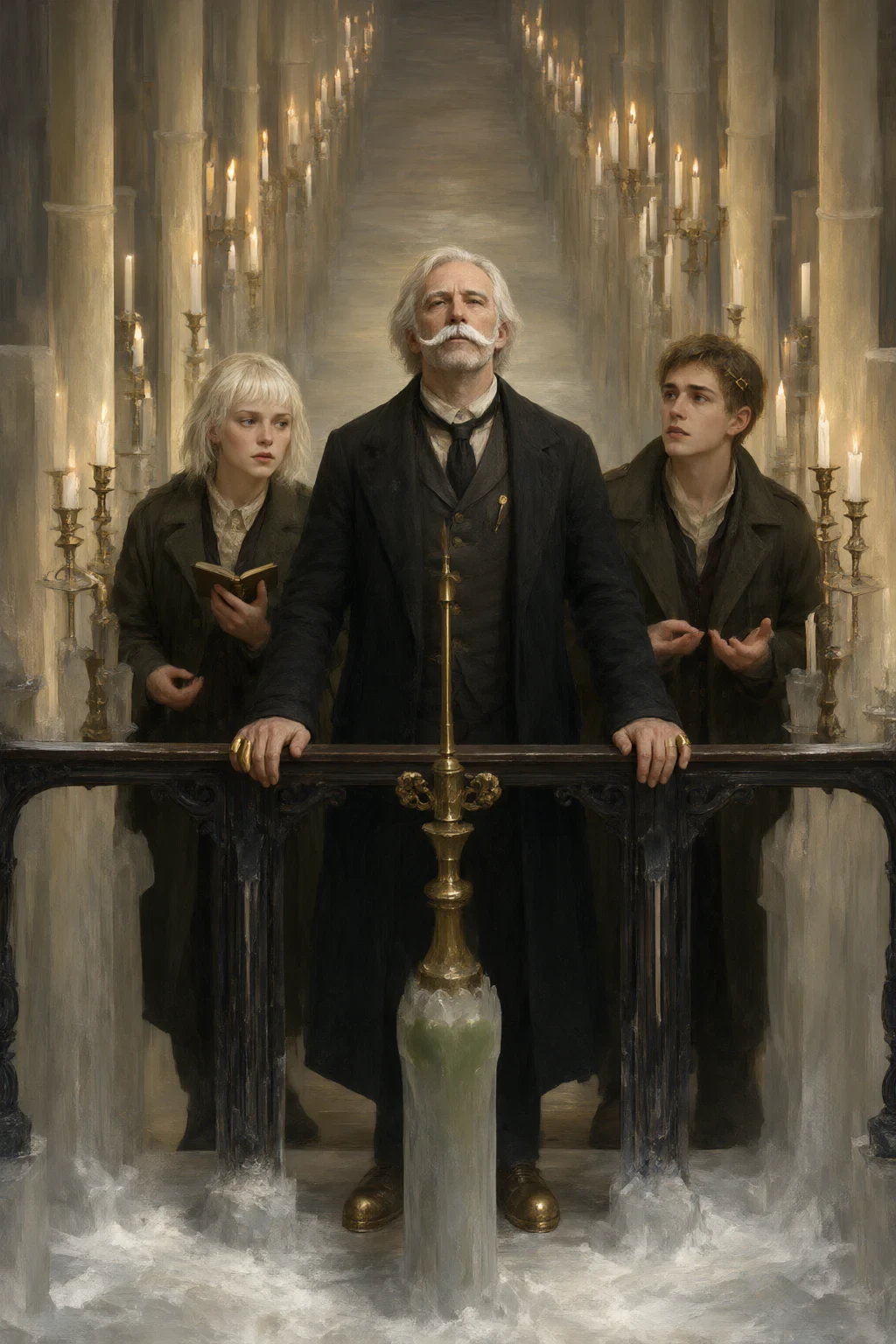
Marda Vole had held the alto for eleven years and had the best voice in the building. Ivo Salter kept the water moving and had the worst, and said so, twice a day, in a mild and unanswerable way. Ordin Brack sang the still note so low that it arrived in the room before he did and made the lamp flames sit up. The sixth was not a person. The sixth was whoever was not singing, standing in the middle of the loft with both hands open, holding the room’s quiet in shape so the air would stay out of the other five; on the night the half-step changed it was Hesper Vail, who was seventeen, and who had been the sixth for four hours, and who discovered that the quiet of that loft is not empty but has a grain in it, running one way, and that you can lean against the grain. And in the second stall, singing a note the book had struck out, with her hand on a rail she no longer needed, was a woman of forty-seven with a white moustache of salt crust above her upper lip, which she kept daily with a small three-inch file she carried in her breast pocket, and four teeth, and a body that had been mostly salt for some years without either of them noticing the date.
Lida Trask had begun, in the third week, to sit on the stool with the book shut in front of her. It was the only stool in the building anybody was permitted to sit on and she had never once been able to explain why, in nineteen years, to a person who was not the Reader. It was too low. The lectern was too high. A book open on a lectern above a stool at that height can be read for about nine minutes before the neck begins to object, and the Reader reads for six hours. So the stool is for the eleven minutes at the end of the afternoon, when the figures are in and the certification is written and there is nothing left to do but hold the fact in one’s hands for a moment before shutting it. The book was shut. The room was too warm. On her left wrist, under the cuff, was a black mourning ribbon renewed every twelfth month, and it was not due until the eighteenth, and she checked it twice a day and had begun to suspect that she was checking it because of something else.
The trouble with the fourteenth of September was not arithmetic. The arithmetic was finished and correct and closed. The trouble was that ninety-six had been paid for by a woman for twenty-two years, and that the book had stopped paying her, and that the woman had gone on doing it. Nobody is required to stop. There is no rule about that. The rule is about what is sung and what is entered; there is no rule saying that a person who has been singing a note since she was twenty-five must stop when the book strikes her page, and the reason there is no such rule is that in four hundred years nobody has ever wanted one.
Garrick Bole kept the small hours. It was not a virtue and it was not insomnia. The Ledger Room is eight feet square and holds one candle and one lectern and one stool and one man, and a man alone in it at the third hour of the morning is doing arithmetic nobody will check, and Garrick Bole had discovered at twenty-six that this is the only hour in which the book will say anything to him at all, because at the third hour there is no reader to tell him what a figure means. He had a sheet of his own paper, unruled, which was a waste of good paper and which he allowed himself because ruled paper in this building is the book and the book is not for thinking in. What he wrote that night was this, in the shorthand the book uses: 96 NOT PAID. HELD BY MARROW UNPAID BY ENTRY SINCE 14/9. 5 VOICES CARRYING UNDER. TOLERANCE 168 CUBIC FEET PER WEEK BEFORE BLOOM SETS. BLOOM AT BASE OF 96 SINCE 3/10, NOT MEASURABLE, NO STATION. Then he stopped, and read it, and then he wrote four more lines:
PAGE 96 EXISTS. PAGE 96 IS NOT BLANK. IT IS A STRUCK PAGE WITH A STAMP AND A DATE. A STRUCK PAGE OWES NOTHING AND IS NOT GROWING. IF THE COLUMN WERE PAID FOR, PAGE 96 WOULD NOT BE EARNED BACK. A COLUMN IS PAID FOR BY A NOTE SUNG BY A PERSON, WITNESSED, ENTERED IN INK BY HAND WITH A DATE. And then he sat with the pen out of the ink for some time, and the candle went down half an inch, and the Gallery hummed a fifth above the room, and he read his own five lines back to himself in a voice nobody was in the room to hear, which meant that whatever he said next was unwitnessed, which he knew, because he had been clerk for nine years and the whole of his trade is the law and the law begins and ends with somebody standing there. So he did not say it. He wrote it instead, because writing is not singing. The entry he made is this, in his hand, with the date, and it is the exact wording of a page as it has been kept in this book for four hundred years: COLUMN 96. SOUTH 4. NOTE AS ENTERED 11/3/1866. HELD BY ILDE MARROW, CANTRIX, TWENTY-TWO YEARS. WITNESSED THIS DAY BY G. BOLE, CLERK.
He initialled it. He put the date beside it. He did not put the stamp on it, because the stamp says CANCELLED and this was not that; there is no stamp for this, and the absence of a stamp is why nobody had thought of it in four hundred years. Then he went up the seven steps and lay on the floor of the loft with his back against the rail and slept for two hours, and Ilde Marrow was three feet above him singing the note he had just entered, and he heard her, and she was witnessed, and that is the whole of the mechanism and it takes nine words to write and it does not feel like anything at all.
What happened next took eleven days and nobody stopped it. Ilde stopped being thirsty. That was the first thing and the only thing that anybody remarked on, and it was remarked on by Marda Vole, who said on the fourth day that the water chest under the stalls was full, and had been full, and that nobody had drunk from it, and then everybody in the loft looked at the six stalls, and the six stalls looked at the water chest, and nobody said the thing that was in the room. On the seventh day Ilde came down off the rail. Not stepped down. The rail was there, and her hand was on it, and it came off the rail, and she put both arms at her sides and stood and sang the whole of the second hour with her hands hanging, and afterwards she said that she had not known she was leaning, and Ordin Brack said, from the far end of the loft, in a voice so quiet that everybody had to take a step toward him, “Closer. The floor carries,” which is a thing he says about the floor, and which on that evening happened to be the whole of what anybody needed to hear.
On the ninth day the crystal at the foot of the second stall had come up over the boards. Not much. It was a white bloom, wet-looking, the colour of the inside of a shell, and it came up around the legs of the stall the way a thing comes up around a post that has stood in the same wet place for a long time, and it had a very clean edge on it, the edge of a thing set on purpose by a careful workman. On the tenth day the shadow of the second stall stood in the nave below, in the middle of the aisle, where the lamp should have put it, and it did not move when the lamp moved. And on the eleventh day, at the second hour, with the whole loft behind her, Ilde Marrow held a note for forty minutes that she had never been able to hold for more than thirty-one, and did not lose it, and did not have to breathe, and afterwards she sat down on the step of her own stall and put her hand flat on the boards and said, to nobody, in a speaking voice and not a note at all: “Ah. So that is what the file is for.”
The Reader found the entry on the twelfth day because the under-reader read it aloud, which is the under-reader’s chore, and because the chore is not optional, and because Hesper Vail had got into the habit of reading the whole of the front of the book on the first of every month, which nobody had asked her to do and which had been quietly saving everybody a great deal of time for two years. She read it standing up, at the ordinary pace, in the voice used for entries. “Column ninety-six. South four. Note as entered the eleventh of March, eighteen-sixty-six. Held by Ilde Marrow, Cantrix, twenty-two years. Witnessed this day by G. Bole, clerk.” Then she said, “Hesper has finished the page,” and waited, because that is also the chore, and because the waiting is the part where somebody says whether it is right. Lida Trask said, “It is correct.” “It is correct,” Hesper agreed, and put the tablet down. The room was very warm and very quiet and the candle had not moved. Lida said, in the voice used for entries, because she could not at the moment find any other: “The column called Marrow stands. It is held. It is entered.” And she felt the sentence go out into the crystal and come back twice, the way a thing does, and it was true. Every word of it was true. She had signed a great many true sentences in her life and none of them had ever come back changed.
They put it to her in the Ledger Room on the fourteenth day, all four of them, because it is a difficult thing and there is no form for a difficult thing and so the difficult things are done with everybody in the room. Hesper read the page again from the lectern. Garrick stood with his thumb on the ledger frame, because he had made the entry and it was his hand on it and that is where a man puts his hand. Ilde came up the seven steps and sat on the stool, which nobody was supposed to do, and which Lida did not stop, because a person who is going to be the subject of a difficult thing may sit down. Nissa stood in the doorway with her arms crossed.
“It is exactly what I wrote,” Garrick said. He had not slept properly since the third hour of the fourteenth and it showed in the hands, which were steady, because the finger-cuff is for exactly that. “Per the entry, the note is sung. Per the entry, the note is witnessed. Per the entry, a page exists and the note is on it in ink by hand with a date. I did not put one word on that page that I could not support. You may check every word of it and every word of it is true, and if any word of it is not true then I will strike it myself tonight, and I would prefer that you would not strike it for me.” “Strike nothing,” Lida said. “Then say what is to be done, because it is being done, and it has been being done for twelve days.” “We are going to ask her,” Lida said, “and then we are going to write down exactly what she says, and then we are going to see whether what she says is a thing the salt can hold.”
Ilde Marrow had the three-inch file in her hand. She had taken it out of her breast pocket when she sat down and had been turning it over without looking at it, and when she spoke she spoke in the note she had been holding, which was a low note, and which made the candle flames sit up, and which nobody in the room corrected, because in nine years they had all learned that you do not correct her pitch, you wait. “Ask me, then,” she said. “Did Garrick Bole ask you?” “No.” “Did you know that he had entered it?” “No.” “Did you consent to it?” She was quiet for a while. The Gallery hummed a fifth above the room and did not come back down. “Girl,” she said, dropping to a speaking voice, because she had noticed that Nissa was in the doorway and Nissa was twenty-two and had not eaten. “That is not a fair question and it is a true one, and I am going to answer it and you are all going to write it down, so you had better be ready for what I am actually going to say.” They wrote it down.
“I have sung for twenty-two years,” Ilde Marrow said, “and I have wanted for eleven of them to stop, and to go up the hundred and forty rungs, and to live out the rest of it as a woman, and to be let out of this room without a line round it. That is the whole of what I want. There is no second thing.” “And the book has made it impossible to want that in a way that is not a death.” “The book has made it impossible to want it at all. Do you understand what has happened here? Garrick has paid for my column. My column is paid for. It is entered, in ink, with a date. And a column that is entered is a column that is held, and held forever, by whoever the page says is holding it, and the page says me.” She put the file down on the stool beside her. “I am going to be that pillar. Not tonight. In a month, or a year, or the night after I stop being able to stand up. I am going to be a clear upright thing in the fourth bay of the south aisle, blind, and quiet to myself, holding one note perfectly, for as long as this building stands, and the rest of you will lean on me for four hundred years and it will be the best note any of you ever heard, and I will not be in it.” Nobody said anything.
“So no,” Ilde said. “I did not consent. I am not refusing anything, because there is nothing being offered. I am telling you that you have not asked, and that you cannot ask, and that not asking is the whole of what you have done, and that Garrick has written down a true sentence and let a book finish it for him, and that is not Garrick’s fault, and it is not the book’s fault either, and it is not mine, and it is the fault of a thing we have all agreed to call the form.” The remedy took four days and it was Garrick Bole’s, and it came out of him the way a sum comes out of a man who cannot sleep. He came into the Ledger Room at the third hour with the unruled sheet and put it on the lectern upside down, which is what you do when the argument you have come to make does not need a figure. “The page is paid for and the payment is a person,” he said. “That is the difficulty and the whole of the remedy is in it. The page does not care whether the words on it are true. It cares what shape the words make. Right now the words on page ninety-six make a shape with a woman in it, and a woman in a shape is a pillar, and I put the woman there and the salt has taken her and it will finish taking her inside a month, and none of us can undo it, because there is no stamp for undoing it.” “So strike it.”
“If I strike it, it is a cancellation. It goes on the schedule. It releases the salt that the column is holding, which is two thousand one hundred and something cubic feet of very good salt into Ordin’s pool in one night, and the shortfall this month is four and a half columns, and if the pool comes up over the sill it comes into this room and there is no book and there is no remedy and the whole thing is a pool in the dark. Per the standing orders. Per the count. Per everything you have spent nineteen years being.” Lida said, “Then what is the remedy, Garrick.” “Another shape.” He turned the sheet round. On it he had written, in a hand that was not his clerk’s hand and was not much better, one line. HELD BY THE CHOIR OF SIX IN SUCCESSION, ILDE MARROW FIRST AMONG THEM.
“It is true,” he said. “It is a fact about the world. The choir is six. They sing in turns. She is first among them because she has been singing it longest and she will go on singing it longest. I have not put in one word I cannot support. I have supported rather more of them, in fact, and the difference is that the shape has six people in it and it is a shape this building has been holding for four hundred years without a single person dying of it.” “The note has to be sung.” “The note has to be sung. That is what the law says and I am not going to pretend to the law. A pattern has to be put into the salt and the only way a pattern gets into the salt is by singing it, and if you put a form on a page that nobody has sung then the page is a sentence and the salt never sees it, and then you are no better off than you are now except that you are also a coward.” “So somebody has to sing it.”
“No,” Garrick said. “All of them have to sing it. Together. Once. In the loft, in full view of the floor, with the building as full of living people as anybody can make it, because a form sung by six and heard by a room is the only kind of form this book has ever had any use for, and a form sung by one person and heard by one person is a pillar, which is what we have now, and I would like the record to show that I said that.” They looked at her. “No,” said Nissa Ashkel from the doorway, and then, in the habit that had been with her since she was a child and which nobody had ever been able to cure, she repeated the last three words she had heard before she answered, which were: “one person is a pillar.”
It took four days to fill the building, and filling the building was the hardest part of it, because there were eleven people in the cathedral and the whole of the law turns on somebody standing there hearing. They went up. Ordin Brack, who had not been up the hundred and forty rungs in nineteen years and who went up them like a man going down, and Marda Vole, and Ivo Salter, and Nissa, and Garrick, and Hesper, and Lida Trask, who had not been on the surface in eleven months and who stood in the mouth of the shaft in the wind and looked at the pan going away to the Rim for a while before she came back down. And Ilde Marrow, who went up, all hundred and forty rungs, at the second hour of the morning with the lot of them, because there was no room left for her in the loft and no reason for her to be in the loft, and she went up because the note had to be sung and she was going to be first among them and first among them means first, and you cannot be first from the bottom of a shaft.
The wind over the pan makes a sound that people who have not heard it describe as a room being swept, and it was making that sound, and there were nine people standing in the mouth of the shaft at two in the morning in the dark, and Lida Trask looked at the nine of them in the light off a shuttered lamp and thought, with the clarity people get at two in the morning and are usually wrong about by noon: this is a book. That is what a book is. It is not a record. It is the people who were in the room. Then they went back down, because there is a shift that ends at six, and Ilde Marrow sang at two, and at ten past four in the morning the choir of six in succession sang column ninety-six out loud, together, once. It was not a note. It was closer to a room being opened.
Six people who each carry one order of this building — the still, the drift, the plate, the spire, the brine, and the sixth, who holds the quiet — cannot sing one note. They can only, at the very outside, agree on where one note is, and what they produced for four minutes and ten seconds was a wide flat grinding sound with a woman’s voice somewhere in the middle of it holding the centre of the floor together while five other people leaned on the note she had been holding alone for twenty-two years. It is not in any book. It cannot be entered. It was not a beautiful thing and it was the only thing the salt had ever been offered in four hundred years that was bigger than one person. Nissa Ashkel took the spire in it and her two upper teeth went at the ninth minute, and she kept singing, and afterwards she said that the pain was nothing at all next to the thing she had heard underneath it, which was the growing column, which for a year and a day had been saying her name into the underside of her sleep, and which under that wide flat sound went quiet. Not gone. Quiet. The way a room is quiet when a person in it has finally stopped pretending to sleep.
Ilde Marrow stood at the top of the hundred and forty rungs with her hand on the last one and listened to four minutes and ten seconds of five people trying to do what she does. She had done it for twenty-two years. She had taught three of the five everything they knew about it, and one of them, Nissa, without knowing it, for eleven years. There is no word in this world for a thing that happens in an empty shaft. She wept, for a while, with her forehead on the rock and the wind going over the pan above her, and there was nobody in the shaft, and nobody on the pan, and the note was still going four hundred feet below her and could not possibly have reached her and would not have been heard if it had. She was forty-seven years old. She had wanted for eleven years to stop. She was going to find out, in about four hours, in a warm room eight feet square, whether the book can be made to let a person out, and the answer was going to be yes, and it was going to cost a page and a debt and a second page and a great deal more paper, and she was going to be alive and unrecorded and it was the best thing that had ever happened to anybody in this world.
And she was alone on a ladder, crying, at four in the morning, and nobody saw it and nobody heard it and no part of it was ever written down, and it went into the building, and the building did not know what to do with it, and would go on not knowing what to do with it, in the way of a thing that has not been written down, for a year, and then for two, and then for a very long time indeed.
The amendment was entered on the seventeenth day of October in ink, by hand, with a date. COLUMN 96. SOUTH 4. NOTE AS ENTERED 11/3/1866. HELD BY THE CHOIR OF SIX IN SUCCESSION, ILDE MARROW FIRST AMONG THEM, FROM 17/10. THE FORM WAS SUNG AT 4.10 A.M. BY SIX AND WITNESSED BY NINE. WITNESSES: M. VOLE, I. SALTER, O. BRACK, N. ASHKEL, G. BOLE, H. VAIL, L. TRASK, AND ONE OTHER, WHO ASKED NOT TO BE NAMED. And the last line of the page, which is the longest witness line in four hundred and eleven pages and which took Garrick Bole the better part of a morning, is a list of the names of everybody who stood in the loft and heard it, and it runs down the ruled margin and across into the gutter and into the flyleaf, because a form sung by six voices and heard by a room does not fit in a book ruled for one person to a page. Garrick read it out. Then Hesper read it out, as the check. Then Lida Trask certified the total, in a hand that did not wobble, and initialled it with the T too long, and shut the book. “Reader,” Garrick said. He had his thumb on the ledger frame in the way he always had. “Per the entry, there is no woman on that page.” “No.”
“Per the entry, there is a shape with six people in it, and the six are entered, and their names are entered, and the page is the longest page in the book, and I have written the name of G. Bole nine times in the last four lines and not once in the line above them.” “No.” “That is correct,” Garrick said, “and I have checked it, and I would like it minuted that I checked it.” “Minuted,” said Lida, who did not write it, and Hesper Vail, who had said nothing at all for eleven days and had a great deal to say and did not say any of it, and Nissa Ashkel, who had lost two teeth and was sleeping nine hours a day instead of eleven and could hear, for the first time in a year and a day, a silence that was only a silence. From the eighteenth day of October the note of column ninety-six was sung by turns, and the turns were written down. That was Garrick Bole’s doing and it was the last thing he did that autumn, and he did it in the correct manner, which is to say that he did it without asking anybody. The amendment says IN SUCCESSION. Succession is not a fact. Succession is a schedule, and a schedule is the clerk’s, and the clerk’s is not a kindness, it is a list of times.
So the flyleaf of page ninety-six carries fifteen-minute divisions against the whole twenty-four hours, because a note held in succession is held at three in the morning as well, and the six do not all sleep at once. Marda Vole has the first four hours of the shift and loses a tooth in the second month of it. Ivo Salter takes the middle and comes up out of the cistern ladder short of breath, every time, for the rest of his life. Nissa Ashkel has the two hours before dawn, and sleeps nine hours, and wakes up having heard a thing go quiet. Garrick sings it with a clerk’s hand, which is to say he sings it accurately and without any music in it at all, and the column is paid for, and the paying for it is now an entered fact, and the badly is entered too, because a badly cannot be left off a page on the grounds that everybody already knows. Ordin Brack has it once an hour, all night, because the still note is the only one that can hold a note being sung badly by five other people, and when Marda Vole tried to thank him for it in the second week he said, “Closer. The floor carries,” and went back to it, and has never since allowed the subject to be reopened.
The cost of all this is entered too, because there is a column for everything: the drift of the six, which is the salt that comes out of people for holding a note in turns rather than in one throat, and Garrick has it at eleven point four cubic feet a month, and has initialled it, and has not rounded it, and there is no version of this in which any of the six gets to be sentimental about the arithmetic. And on the flyleaf, in the ruled space where a name would go if a name were what this was, there is nothing. “Ilde Marrow is first among them,” Garrick said, when Lida asked him about it, “and not in them. Those are two different clauses and I wrote both of them and I would like them read as written.” “Read how, Garrick.”
“Not as kindness. I am not putting a woman of forty-seven on a rota in her forty-seventh year. As accuracy.” He put his thumb on the flyleaf, which is where he puts his thumb. “She is first among them because she has sung it longest. She is not in them because she is not in the succession. If she was in the succession then the succession had six places and one of them would be hers, and a place in this book is not a thing a person can be in and then come out of, and she is going to come out of it, and I would like the page to be able to say so afterwards.” “It is the only space in the book that anybody has ever left on purpose.” “It is the only space in the book that anybody has ever been in a position to fill,” Garrick said. Hesper Vail, who has her name on the witness line four times and nowhere else, read the flyleaf over twice, and then announced that Hesper was going to go and find out whether there was anything to eat, which is the first thing she has ever announced that was not in the chore, and everybody let her go.
At the top of the shaft, in the dark, four hundred feet above the nave, the wind over the pan stopped for about a minute and then started again, and the Rim came up out of the black the way it does, and somewhere on the surface a hundred and forty rungs below, a woman with salt in her teeth put her hand on the rail of a freight cage and waited for the others to be able to follow her up, because there was going to have to be a great deal of arguing about water, and the cage would be late, and she was not going to miss it.