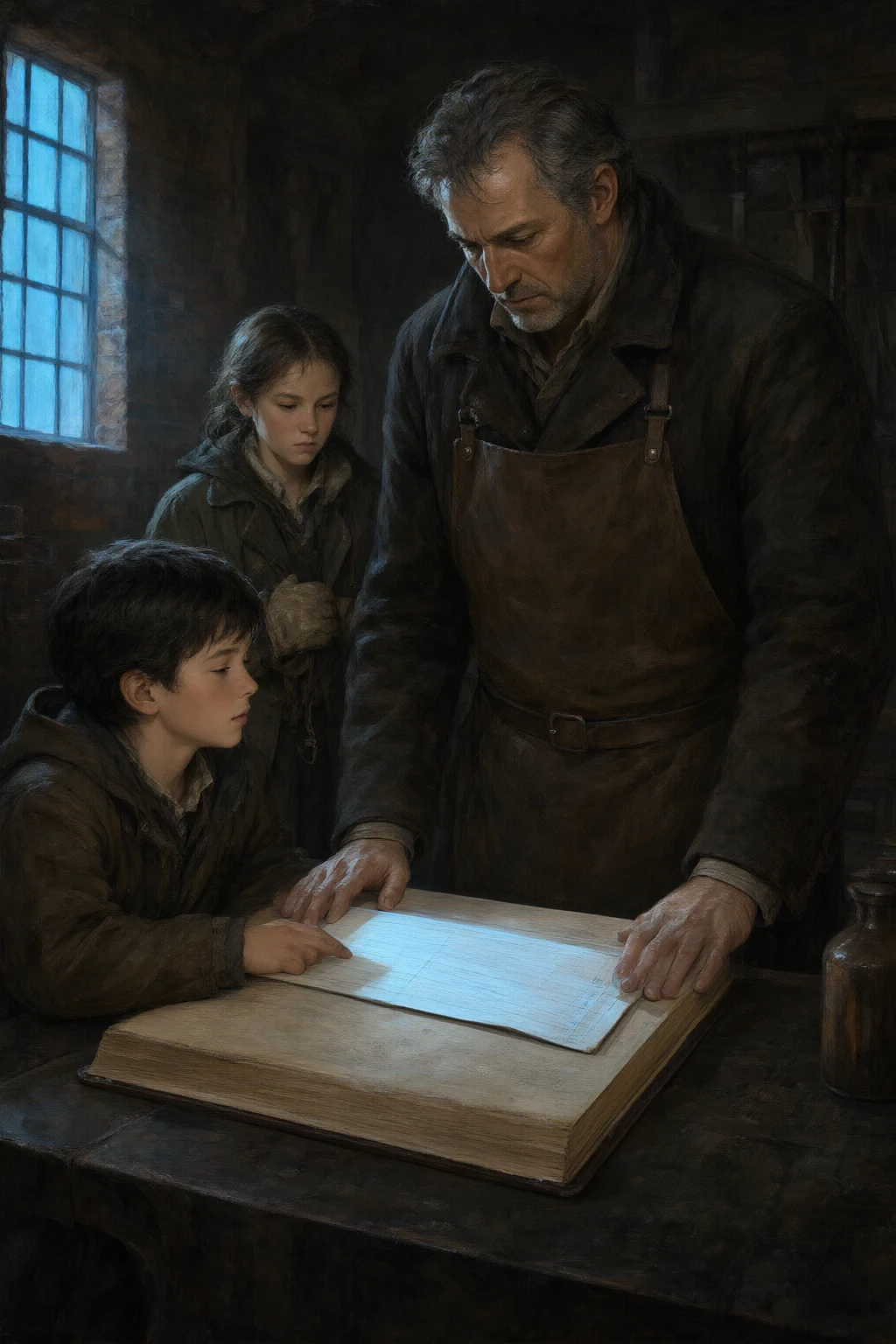
The forge at the back of the smithy had gone out on the second of December and had not been lit since, and the top of the bench it stood beside had a shallow ring in it where a great flat book had lain for thirty-one years, and on the Thursday in question there were four men sitting round that bench in their coats and a boy of fourteen standing at the end of it with a brickfield wage docket folded in two and held under his arm in the manner of a person who has decided to produce it. Fennick Roke looked at the docket, and then at the boy’s hands, because he has looked at hands before faces since he was twenty-two and has never had a reason to stop. “Tomas.” “I’ve copied it out.” “Copied what out.” “The book.”
“The book,” said Fennick Roke, and put both hands flat on the bench on either side of it, and did not touch it, which was the first thing he had done differently in twenty-six years. The smithy was cold. That was the point of the week. Marl’s smithy is the only warm room at the end of the furlong and it is warm because somebody is building something, and nothing was being built anywhere in Marl in the second week of February, and so four men sat in a cold room with a book they could see perfectly well, which is the only condition under which anybody has ever been able to look at Marl’s finances. “It’s forty-one leaves,” Tomas Peake said. “I did it in the winter, on the back of the wage dockets, because the dockets are the only paper the works gives you for nothing. I started when I was ten. I did not know I was doing it wrong until I was eleven and I found a name in my own copy that was not in the book.” “What name.” “I’ll not say it in front of the four of you.” The four men, who had been told no that afternoon, in the order in which they had been told no, took an interest. “All right,” said Fennick Roke. “Show me.”
He did not take the docket. That was the second thing that was different. He put his thumb on the corner of it, the way a man puts a thumb on a corner of a thing he does not own, and Tomas Peake slid it out flat on the bench, opened it to a leaf, and turned round so that the light from the one window came along the lines and not across them. The copy was in pencil. It was not a facsimile; it was an honest copy, with the columns and the ruling and the ruled columns kept straight, and the figures in the figures’ places, and where the original had a blot Tomas had put a blot. PEAKE, A. — 9 d. — 3rd field, 2nd yr — charge 12 4 0 ROCHE, W. — 4 d. — top of the furlong — 0 8 6 COPSE, T. — 6 d. — 11, Terrace — 4 6 0 Fennick Roke read it the way a man reads his own handwriting in a mirror and does not enjoy. “That’s the tenth page.” “That’s the tenth page of the first book,” said Tomas. “That’s 1889 to 1901. There are five books. This one’s the third. I’ve done two of the five.”
The finding came on the second evening, and it came because four men who had been told no kept turning up, and because in the second week of February there was nowhere else to be. “The book does not say no to anybody,” Tomas said. “That’s the whole of it. I’ve got five books, from 1889, and I’ve got them all copied, and there is not one line in any of the five in which a man is refused. Not one. There are names and dates and figures and the figure is the charge, and the charge is against the house, and the house pays it whether anybody comes to blow or not, and that’s all there is. There is no line in a hundred and fifty years that says no to anybody.” Nobody spoke for a while. The forge was still out. “That’s not the same as saying yes,” said Fennick Roke.
“No,” said Tomas Peake. “It’s not. It’s the same as not saying no. And there is no difference in the book between those two things, and I mean that literally, there is a line and a figure and a date, and both men are on the next page, and a man cannot tell, by opening the book, whether he has been refused or whether he has not yet been reached. And I have been not yet reached eleven times and I have watched four men in this room be not yet reached and one of them has been not yet reached twice, and he thinks he was refused the first time.” The man who thought he had been refused was a bricklayer of thirty-odd with a licence in his inside pocket, and he said, “I was refused in October.” “There was no builder in October,” said Fennick Roke. “The kiln was not lit and there was no new brick in the county before the eleventh. The book is the book.” “Then somebody should have said.”
“Somebody should have said,” Fennick Roke agreed, and had been saying not this year for twenty-six years and had never once been asked to say why, and had always assumed there was a why there, and that it was his, and that it was not written down because writing it down would have been to admit it did not exist. This was the first of the assumptions that could be tested. “Then put it in,” said the girl.
She was twelve and she was not on the bench, and she had been in the smithy for two hours because nobody in Marl sends a child home in February. Wren Copse, of number eleven in the Terrace, with a bricklayer’s glove with no hand in it hung on a string at her waist under her coat, which she touched about nine times an hour, and which nobody in the room except Tomas Peake had any idea what it was for. “Then put it in,” she said again. “There. In the book. Not no. Pass. Write what it is. Because it’s one of the two and the book can’t tell, and I’ve watched my father’s face when you say it, and he comes away thinking it means one of the two, and he doesn’t know which, and that is the worst of it, isn’t it, that you can’t even be told no.” Fennick Roke looked at the child. He had told four men no that day. It had taken nine seconds in each case and he had never been asked for them by anybody, least of all by the men. “It’s not the court,” he said.
“Course it isn’t the court,” said Wren Copse. “There isn’t one. That’s the first thing I asked. I asked if I could be assessed on the straw house and the man in Marl wrote back to say there’s no court and no appeal and a licence and a queue and a ledger, and I have got the letter, and I have read it about forty times, and I’d have brought it.” Nobody had ever said the word court in this smithy before that week. What happened over the following four evenings became known afterwards, without anybody deciding it, as Marl’s Building Court, and the name was laughed at twice in the chapel and never again, because the second week of the hearing the sentence went into the head of the book and a thing in a book stops being a joke. It was not a court. It has never been suggested that it was a court. A court has power over a house, and Marl’s court had power over nothing whatever: it could not make a house stand, it could not make a house fall, it could not call a creditor, it could not stay a default, and it had no power to make any man pay any sum of money to any other man. What it could do was write. And what it had to do was four and a half books of not writing.
The method was Tomas Peake’s and he was fourteen and it took him nine weeks and he explained it in the smithy on the third evening to four men, two of whom were being paid to sit there, which is the whole of Marl’s experience of public administration. He had five books, and the running totals of eleven walls, gathered in four years of walking past them with his hand on them, which is every house at the end of the furlong and the three in the Terrace and the five that face the weighbridge. A wall does not need a key. A wall needs somebody to read it, and there is one such person in Marl and he is not permitted to be paid for it. “A name in the book and a figure against the name,” he said, “and a figure on the wall. In one hundred and fifty years, in five books, I have not found one name in the book with a figure against it that is not on a wall, and I have not found one figure on a wall that is not in a book. The book and the walls are the same book. One of them is a copy.” “Copies differ,” said Fennick Roke. “They differ here.” Tomas turned the docket round. “They differ about who is holding the pen.”
The second finding was the order. Nobody had ever asked Fennick Roke how he decided. He had been asked that day four times in nine seconds apiece and had answered, as he has answered everything since 1889, that he does not know, there being no rule. It was Mira Sedge who found the order, on the fourth evening, by asking for the book and being refused and then asking again in a tone that got it. “There is no order in here,” she said. “Names, dates, figures. The names are not in the order of the figures and they are not in the order of the dates and they are not alphabetical, and I was a schoolmistress’s daughter before I married him and I know what a list is.” “They’re in the order they came in,” said Fennick Roke. “They are not,” said Mira Sedge, “and I can show you that in four minutes, and it is a thing you will not enjoy.” She took the docket, and turned back through the leaves with her second creditor’s key on its chain swinging against her wrist, a key whose cloth was worn through, and which was the key of a deed box kept in a kitchen at the far end of the street, and which she had the care of because the man it belonged to was seventy-four and worked twelve hours a day at basket work.
“The order here is the charge order,” she said. “Look at the figures in the first column. Nineteen fourteen. Twenty-six. Nine. Thirty-one. They run up. Not every one. But the page is sorted by the date the charge began and not by the date the man came to the bench, and I can show you four men in here whose entry is dated six weeks or more after the charge against their house, and every one of those four is a man who came in a hurry.” The smithy was quiet in the way that a room is quiet. “Who sorted it,” said Tomas Peake, “in 1889?” “No one knows. The man is dead. He made the book in 1889 and kept it till 1919 and the entries in his hand are the ones where the date and the charge date are the same, and every one of them after 1919 is a man copying a book and not adding to it.” Fennick Roke put the heel of his right hand on the bench where the ring was. “Then it isn’t a queue,” he said. “If it’s a charge order then it’s a book of what people owe.”
“It’s both,” said Mira Sedge. “That is the difficulty and I have been inside it twice.” She set her thumb on a line. “A queue means the man who has waited longest gets the builder next. A charge order means the man who has been charged longest gets the builder next. And in 1889 the two were the same man, because every house in Marl owed about the same and had been charged about as long, and they came in at about the same rate. And then the kiln got faster.” Nobody said anything for some time, and the forge was still out. “A man who is in a queue is a man who is owed a building,” said Mira Sedge. “A man in a charge order is a man who owes money. They are the same man for forty years and then they are not, and on the day they stop being the same man somebody is stood at that bench and told not this year and goes home believing he has been kept out, and he has not been kept out. He has been put in his place by an arithmetic.”
The third finding was at the head of the first book, and nobody had read it in a hundred and fifty years, and it took Tomas Peake nine weeks to find it, because he was copying the book in February, in a cold smithy, and a man copying a book gets to the head of the page, and reads four lines, and stops. “Brick,” he read out. “Timber. Straw. And nothing else.” “Materials,” said Fennick Roke. “That’s the standing. Brick does what it’s asked. Timber’ll do what it’s asked by somebody else. Straw is nothing until the man who promised it is watching, and that’s the whole of the straw house, and it’s been in that book since before I was born and it’s the truest thing in Marl.” “Read the fourth line.” Fennick Roke did not read the fourth line, because he had never read the fourth line, and it took a boy of fourteen to say it for him. “And no house shall be entered but the builder’s own name.” The four men looked at the book.
“In 1889,” said Tomas Peake, “the man who made this book wrote down what a house may be built of, and then he wrote down who may go in it, and the man who may go in it is the builder. The builder, and not the person who lives in it. That is the first rule of Marl and it has been the first rule ever since, and every clerk and smith and warden and creditor in this village has been keeping it without knowing it was a rule, because it is one line at the top of a page and you do not read the top of a page.” “It says the builder’s name,” said Fennick Roke, in the voice of a man reading a licence. “It says the builder’s name. Not the man who owes. Not the man who is standing in the cold on the other side of that bench. Not a woman, not a widow, not a boy, not a house. The builder.”
Marl has built everything out of brick since 1871 for one hundred and fifty years, and has gone without a great many things, and has got poorer, and has got a reputation in four counties for a certain kind of honesty, and the origin of the whole of it is a sentence about a name that a dead man wrote in a good hand at the top of a page in 1889 and which nobody has needed to consult since because it has never been wrong.
The court called the only man in Marl who could be shown to have been in the book and put in his place, and he was seventy-nine and came on the fourth evening and sat down with his back to the north wall, because that is what he does, and apologised to the smithy wall before he said anything, because that is also what he does. Obadiah Cressy had held a wolf’s licence for thirty years, and had been the last man in Marl to be granted one and the only one to refuse a renewal, and had taught one son to be a wolf and one son to be an assessor and had never told either of them which, and had sat in that corner through all four evenings without saying eleven words. “You’re in the book,” said Tomas Peake. “Second book, 1919, sixth of October. Your name and a figure of one and four for a wall, and it’s been on the north gable of the brick house at the top of the furlong ever since, and that is not your house. You live in the middle of the street. I have checked.” “It is,” said Obadiah Cressy. “Were you passed.” “No.” “Were you refused.” “No.” “Then what happened to you, Mr Cressy.”
The old man sat with his back to the wall and his jaw clicked twice before he answered, and what he said was the sentence the court had been assembled to hear and had not known it was going to hear on a Thursday. “I was not reached,” he said. “And there is no word for that, and I have had sixty years to look for one, and there isn’t. In 1919 the war took the builders out of Marl and my name was in the book and nobody came. Not no. Nobody came. And the year after I looked for the line that said I was passed, and there was no line, and I have been a man who cannot find out what was done to him ever since, and I have held a licence for thirty years that lets me take a man’s door, and you cannot take a man’s door if you cannot say what was done to yours.” He put his hand flat on the bench, on the ring, the way a man puts a hand on a thing he has been coming to for sixty years. “Put a word in,” he said. “And put a figure against it. Because a figure is a thing a man can be shown.”
The rules were written on the third week, and they were written to be exactly the rules that had been in use, because a court that writes down a rule Marl has not been keeping has written down a lie, and Mira Sedge said so twice and was right twice. A name is entered when the charge begins, and not when the man applies. The date entered is the date of the charge. No house is entered but the builder’s own name. A name is passed when no builder may be had. The passing is entered with a figure. The figure is charged to the house and the house pays it. The first two are a hundred and fifty years old, and the third is a hundred and fifty years old and has never once been written. The court wrote it in Fennick Roke’s hand, which is a smith’s hand and a worse hand than a mason’s, and he said so himself. The fourth rule was new and it was Mira Sedge’s and it is the only one of the four that costs anything. A house is entered with the name of the person standing in it.
Nobody voted on it. There is no voting in Marl and there is no minute book in Marl and the four men who had been paid to sit there came in again on the last night because the room was the warmest room in the village and that is the whole of public participation in Marl. “Do you understand what that does,” said Mira Sedge. “You are putting the people in the book. Every one of them. And a person in the book can be passed. I have asked for that line for twenty-one years and it is going to be me at the front of it, because I am the only person in Marl who has been through this twice and come out with a house standing, and when a house goes I will be the one it goes to. Write it.” Fennick Roke wrote it. He wrote it the way he writes everything, in a hard small hand, and when he had done it he read it out to the room to see whether it was right, which is the practice in Marl and is called reading it out.
The first passing in the history of Marl was made on the same page, in ink, four days later, and the person passed was the girl who had started it. Wren Copse had a name in the book because her father had put it there in the autumn, on the ordinary grounds that a man with a terrace house and two children and a trade in hand is a man who may be wanted for a building in due course. She had asked, in writing, to be assessed on the straw house, and had been told in writing that there is no court and no appeal and that a child may not be a creditor at all, and had understood every word of it, and had written the word not on the letter and dated it and sent it back, which is the single most Marl act in the whole of Marl’s history and has never been repeated.
The court could not pass her. That was the finding of the last night. A person in the book can be passed, and a child cannot be entered at all, because no house is entered but the builder’s own name, and a girl of twelve is not a builder, and a child may not be a creditor, and so there is no place in Marl’s book for a person who cannot be a builder, cannot be a creditor, and cannot be brought into a queue. There are nine such persons in the street. Everybody knew it. Nobody had ever had to say so. “Then she is passed,” said Fennick Roke, “and I will enter her, and a passing is entered with a figure.” “You have not got a figure,” said Mira Sedge. “I have not got a figure for that house.”
“You have, because you have got the same house in your book from the man’s own charge, and there is a figure on that wall, and the wall is a legal document, and it is £4 6 0, and it is against a promise of nine days at a man’s rate of three-and-six a day with lime at two shillings the bushel, and it is fair.” She said that is fair the way she says everything, and then she gave a figure that proved it, which is what she does, and which is how she has come through two creditors and a fallen house and eleven winters. “Write £4 6 0,” said Fennick Roke. He wrote it. And against Wren Copse’s name, for the first time in a hundred and fifty years, Marl put a figure and a date and the word PASSED, and the figure went on to the wall of number eleven in the Terrace, where it stands under the rest, and where it can be read.
What came out of it, in the end, was not the passing. Everybody in that room expected the passing to be the thing and it turned out to be the smallest of the four, and the largest was a sentence about a man’s honesty. Fennick Roke had spent twenty-six years believing that he was the queue. He had not been the queue. He had been the reader of a page that had been sorted in 1889 by a dead man’s arithmetic, and he had read it correctly, every day, without a single error, and had believed for twenty-six years that the times he had said not this year to four men in a cold forge were times he had used a discretion, and had not once slept well for it. It was not his fault. That was the finding, and it was entirely fair to him, and it was the worst thing that has ever happened to anybody in Marl.
He had not decided anything. Not once. Not in twenty-six years. The order on the page had decided it, and the page had been in charge order since before he was born, and the two men before him had read the same page and not known it was sorted, and the man who sorted it had known exactly what he was doing, and had written the rule at the top of the page, and had gone home to a house that is still standing. The four men he had said no to had not been refused by him. They had been put in their places by the order of the charges on a wall. And a man who has been put in his place by an arithmetic can be put in his place again tomorrow, and the day after, and the year after that, and it has nothing to do with the smith, and there is nobody to be angry at, and that is why it has gone on. “I did not know that,” Fennick Roke said, to the bench. “I want it entered that I did not know that.” “It is entered,” said Mira Sedge. He got up and went round the fire and came back, and said the thing that everybody in the room had come to hear and none of them had wanted. “Not this year,” he said. “That’s what I’ve been saying. Twenty-six years. And I could never say why, and I have always thought it was because I hadn’t a rule and ought to have had one. I have had a rule. I have had a book with a hundred and fifty years of rules in it and I could not read the head of the page.”
The last entry was made on the Friday morning in the week the counting came round, and it was not a passing and it was not a charge, and it was the second sentence of the third rule, and the court had not known there were two. Fennick Roke wrote, under the names, a column. He ruled it himself with a straightedge and a bit of chalk, and it was four inches wide, and it was headed DATE, and the column above it was headed CHARGE, and the distinction was the whole finding of Marl’s Building Court, and it took a hundred and fifty years and a boy with a wage docket to make. “A book that has only got charges in it is the same book again,” he said. “It has got to have the day a thing was done in it as well, or it is a bill, and there is no bill in Marl, and there has never been a bill, and a village that has never had a bill is a village that has never admitted that anything happens in it.” He put the pen in the shelf, where it had not been since his wife’s father kept the book, and uncapped the one on the docket, and the ink had gone thick in the cold and he warmed the nib on the face of the anvil until it ran, and wrote in a smith’s hand:
ROCHE, W. — passed — 14 2 — no builder. And the first thing the column did, on the same page, three weeks later, with four men in the smithy and no forge lit, was to hold the date a man was told a thing he had not been told before. The forge was still out. Nobody offered to light it, and the four men had gone home down a road twelve feet higher than the rest of Marl, and the bench had five cold rings on it where five mugs had been, and a sixth, which was the ring the book had made in a hundred and fifty years.