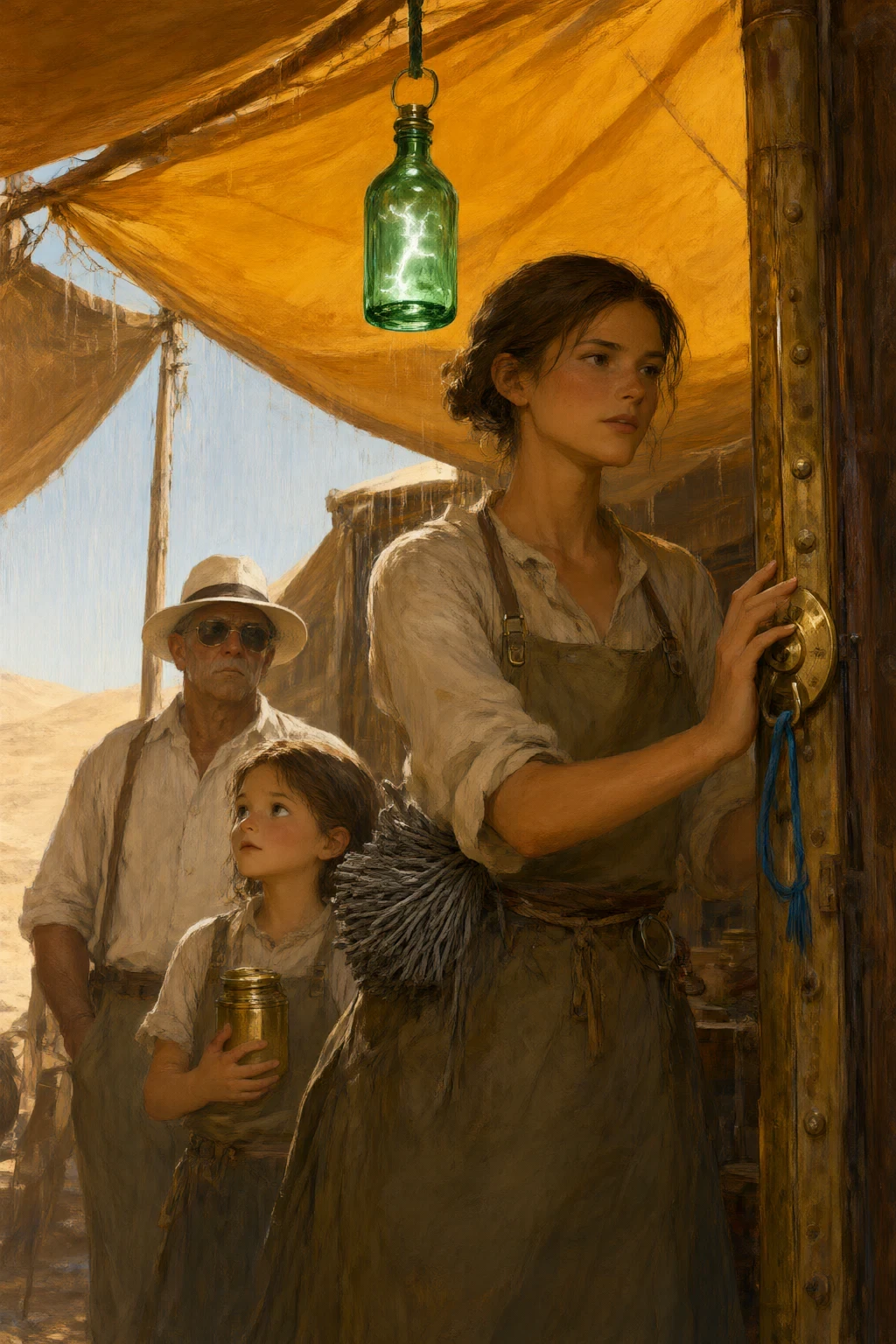
The Underdune Bazaar opens when the first train lets a jar of stored morning into the roof lamps, and on a market day the whole place runs in low amber light until noon, so that traders awake since three cannot tell by the sky whether they are early or late. Wenna Rust trimmed those lamps. She had done it for nineteen years, which is four thousand of them, and she went up the ladder at four with her snips and came down at six with the basket on her hip, and she could tell to the minute how much wick a lamp had given up, because the trimmings came out in a man’s handful or a woman’s handful and she weighed nothing and knew anyway.
Her habit was numbers, and she had it from the tanks. Ask her how far the ladder was and she will tell you eleven metres. Ask her how long she has been married and she will tell you thirteen years, which was also how long the ladder was, and she is not willing to discuss that. “Morning,” she said to the lamps, and counted them, because counting is what you do with a row of things at six in the morning. “Forty-one. Forty-two. Forty-three. You are all smoking at the top.”
Stall eleven was Vail’s, and it was the only stall in the bazaar with a chair, and the chair was for looking expensive in. Septimus Vail was fifty and wore a white panama hat and sunglasses cut from smoked window glass, so that in the amber light of the bazaar he could look at anybody without appearing to look at them. He sold bottled weather, spare hours, and, in a curtained booth at the back that he did not discuss, other things. He had been coming to Sirocco for thirty-one years and had never once been in a hurry. “Rust,” he said. “Eleven hundred spare minutes, jar and twine, four hundred and eighty clatter. Two for one if you take the Thursday consignment, and I would take the Thursday consignment, because Thursday is when the tanks are full and Thursday is a good day to be rich.” He turned the jar in the light. It hummed. “Same again?” “One,” said Wenna Rust. “And the small one for the girl.”
“The small one is not for sale, it is a gift, and a gift costs me nothing and is worth more to you than the money you did not spend. Eight hundred minutes for a child, sealed, blue twine. She can have it when she is old enough to know what an afternoon is, which is later than you would think.” Peri was eight and had already decided to spend it when she was nine. “Go on,” said Wenna, and got the number out first, before anything else. “One thousand one hundred, and eight hundred to the child. Two thousand. That is thirty-three and a third hours, and you have not given me a name, and I am not asking for one. I know what a person looks like on the morning they are about to spend something they should not have.”
Her son Dab was thirteen and had bought his own jar that week, which was the thing that started the whole business, though nobody in the bazaar knew that yet except Wenna and the man who sold it. Nine hundred minutes, so that he could take the night watch at the Sirocco gantry and not be short of it. He had been short of it twice, and once he had fallen asleep on the ballast plates at two in the morning, which is a thing that kills people in the desert and had very nearly killed him, and after that he saved up. “Three hundred,” he had said, on the Tuesday. “Three hundred, and I will owe you the rest and pay it in the spring, and you can have my name, my father’s name, the name of the gantry. Take the gantry.” “Nine hundred,” said Septimus Vail. “No name, no interest, no spring. Nine hundred minutes, jar and twine, three hundred and ninety clatter. Same again?” Dab had not gone to the gate and cut his fare. He had carried the jar home under his shirt, unopened, on the strength of a promise, and the promise was the first thing that went wrong, and Wenna found out eleven days later, on a ladder, with snips in her hand.
It was Peri who told her, and Peri told her badly, in a whisper, on the way down. “Mam, Dab was at the yard last night.” “He takes the watch Tuesdays.” “He was at the yard at three. And then he was at the yard at eight, and then he was on the ballast, and he says he cannot remember the part in the middle, and Mam, his hands.” “What about his hands.” “They are the hands of a man who has been doing it for years.” She said it the way children say the true things. “I could not stop looking at them all night.”
Nobody in the Ochre Basin ages visibly. That is the first thing you are told and the last thing you believe. A man loses a decade and his face is his face. What he loses is the days, and the days show up in the hands first, in the way a man holds a cup, in the knees, in the length of the stride across a platform. Wenna had been married thirteen years and had a face her sister said was still her face, and when she looked at her son’s hands on the ladder that morning she understood for the first time in her life what everybody in the Basin had always politely known. She went to the platform at the eight o’clock gate with Dab and put his disc in the brass column.
Rav Ostry had been the Sirocco gate clerk for twenty-two years, and the column was an old honest instrument of riveted brass with a slot at the top and a number under a glass at the bottom, and it did one thing: it read out the minutes a passenger had left when they came off the train. “Nine hundred off,” said Rav Ostry. “Nine hundred minutes, Rust, Dab, and here is the disc you cut with.” “That is a lie,” said Wenna. “That is a column,” said Rav Ostry, kindly, because he had said this to people before and it never once helped. “And the second lie is more interesting than the first. That disc was not cut at this gate. It was cut at a stall in the bazaar, by a broker, with a jar, in amber light, and a broker cannot cut a fare. A broker can sell you a jar. And when you ride on a jar, the Line takes its payment out of the passenger, and the passenger gets no scar for it, and the passenger gets old in the hands.”
By the second day there were eleven discs on the counter at the Sirocco gate, and by the third day the queue had the shape of a crowd that has come to be told something it already knows. Nim Ferrous came in on the nine with the gate slips in a leather wallet, because couriers carry what everybody else has lost. She was thirteen, a junior courier, not yet on the registry, and she squared the slips with both hands before she said anything. “Same block,” she said. “Eleven discs, eleven different people, and the jar number on the back is the same jar number on every one. Four four slash oh two oh nine, out of a Kellvetch clearance, brass and blue twine. Sold eleven times.” “Once a jar is once a jar,” said somebody at the back of the queue.
“It is once a jar if the twine is tied once,” said Nim Ferrous. “The twine is the seal. A loop tied twice has been cut and retied, and a loop tied twice lets the count go. The packers at the Yard can see that from the ridge, which is the whole reason every handle on every jar on this Line carries a blue loop.” She squared the slips again. “You do not look at the back of your own disc. Nobody looks at the back of their own disc.”
Marmalade came up out of the floor of the brake van that afternoon and got as far as the gantry before she was caught, which she considered a considerable achievement, and she was also carrying a thing she had only half heard, which is her usual condition. “The tall man in the white hat buys at the Yard,” she whispered, to nobody, in the voice of a girl sharing a state secret. “I saw him on the Ridge road. And the man at the Yard gate said the block had gone out four times, and the tall man said that is impossible, and the man said it is only impossible if you count, and then the tall man said his price out loud and the man went away.” “Four times,” said Wenna Rust. “Four,” said Marmalade, and held up four fingers, and then whispered: “I was not there for the first three.”
Nev Sarn was a packer in the Hour Yards at Kellvetch, and he had not slept properly in six days, because somebody had been writing his name on a clearance for a month. He came in on the third afternoon with the Yard slip in a tin tube, because packers carry their evidence in tin tubes, and he put it on the counter in front of Wenna Rust and unrolled it. “Four four slash oh two oh nine,” he said. “Four hundred and six jars, brass and twine, cleared to a broker. Month of Salt, month of Iron, month of Long Heat, month of Dust. Four signatures, four dates, four clearances.” “That is a lie somebody told four times,” said Wenna.
“No ma’am.” Nev Sarn looked at her with the tiredness of a man who has stopped being able to be angry about it. “That is the truth, told four times by four different men, in four different hands, all signing properly, because the block was in the rack. The block was always in the rack. They re-listed it because the inventory sheet said it was there, and the sheet said it was there because nobody ever walked the aisle. That is not forgery, ma’am. That is a shelf, and I have worked in a shelf for eleven years.” He rolled the slip back up. “And every one of those jars was sold to somebody as full,” he said. “And not one of them ever was.”
Septimus Vail came down to the gate at four in the afternoon with his smoked glass pushed up into the white band of the panama, which he did exactly twice a year, and both times people remembered it afterwards. The crowd made a hole for him the way a crowd makes a hole for weather. “Seventy-one,” said Wenna Rust, before he said anything, because she had the number ready and she had had it ready since the second day and she had been carrying it around the bazer with a basket of lamp trimmings in her hip like a woman carrying a child. “Seventy-one jars out of that one block, sold through that one stall, to seventy-one households in three months, and the number of minutes in them was thirty-four thousand two hundred, and every one of those minutes was taken out of the bodies of the people who spent them.” Vail took off his hat.
He put it on the counter, flat, the way you do when you mean business, and he read the slip, and he did not do the thing people were waiting for. He did not go pale. He did not put a hand to his mouth. What he did was worse, and it was what he had done all his life: he considered the matter. “Thirty-four thousand two hundred minutes,” he said. “Five hundred and seventy hours. At the Thursday rate that is a hundred and ninety clatter the hour, so the block was worth eleven thousand and thirty, and I sold it for seven thousand four hundred. I have been undercutting the Yard for thirty-one years, which is why I had customers, which is why your son is standing there with the hands of a man of forty.” He put his hat back on. “I did not take them from anybody. I bought at a price and sold at a price and kept the difference, and not one of those words is untrue.” “There is a fourth word,” said Wenna.
“There is always a fourth word,” said Septimus Vail. “And if you say it I shall have to think about it, and I have never yet had to think about a customer, and I tell you now, in front of all of them, that I do not intend to start. Who in this bazaar would buy their own afternoon? Nobody. Somebody keeps a stock of afternoons nobody wants to own, and somebody buys one after a bad day, and if the stockkeeper is a decent man he prices it so the buyer can meet it. I am a decent man with a hat and a wagon. I have never in my life put a knife in anybody’s hand.”
“Right. Listen,” said Captain Rell Ferrite, who had come down from the gantry with his beard, his three singed copper wires and a bad temper, and who was now standing on a platform in a way that made the water tower nervous. He put a hand into the ballast pipe housing under the platform boards and brought it out holding a fistful of warm grey grit, and everybody looked at it, and it was not desert sand, because it was the colour of an hour and it weighed more than an hour should weigh. “That,” he said, “is a full Line. That is the Long Noon’s ballast, six hundred hours of it in my hand, and every jar in the Yards of Kellvetch came up short by the same six hundred this morning, because I have been taking them out of my own Line all week to pay for a bridge. The Basin is not short of time. There is more time in the ground at Kellvetch than there is sand, and the Line burns nine hundred hours a week to cross nine hundred miles of it. There is no famine. There is a warehouse.” He dropped the grit and wiped his hand on his coat.
“Now listen to me. Every one of you who spent a jar from that block has paid twice. Once in money to a man in a white hat, and once in days, out of the body, by the Line, which takes it from whoever spends an hour it did not cut. Vail sold you an empty jar. But he sold it to you as a full one, and the whole trade of this Basin runs on nobody checking the difference. I have spent thirty years treating people as parts, and today the parts were the jars, and I am not going to pretend that is somebody else’s sentence.” Sol Brannen came out through the coal door with his green-shaded lamp and his white gloves, and did the thing he had been doing for eighteen years, which was to stand in front of people and say numbers and ask them to be sure they had heard them. “Rust, Dab, nine hundred minutes. Twenty-two households, thirty-four thousand two hundred minutes, four hundred and six hours and fifty minutes, out of a block cleared four times and never once filled.” He looked up. “Confirm you heard it correctly.” “We heard it,” said Wenna.
“Right. Then here is what a jar is. A jar is not a vessel. A jar is a receipt. The hours in it are cut from a person by an engine, in the presence of a clerk, and entered in a book, and the book is the jar’s memory, and the twine is the seal that says the count has not moved since. There is no other kind of jar in this Basin. A man in a white hat has been selling people a shape made of brass and letting them believe it was a receipt.” He closed the book. “And I have sold a great many of them,” he said. “I have never once refused to sell a ticket. I would like the record to show that I noticed what that makes me only this week.”
They wired Emberwhistle in the end, and Ivo Tarrow read the whole thing back in the flat calm of a man reading a price off a board, and the wind came off the flat and made everybody lean in. “Seventy-one,” said Wenna. “And the number of minutes in them was thirty-four thousand two hundred.” “Thirty-four thousand two hundred,” said Ivo Tarrow. “Confirm you heard it correctly. I heard it correctly.” A pause with a great deal in it. “And I have taken the number you want me to take, which is his profit, and here it is: two thousand six hundred and forty. Two hundred and sixty-one hours and forty minutes, out of a man of fifty who will not be able to explain any of it to himself afterwards.” “And the rest?” said someone.
“The rest of it,” said Ivo, “is not his. It came out of your bodies and there is no jar in Kellvetch that puts it back, and I have looked, and I have been counting things for fifty-one years, and a thing you learn is that a debt you cannot remember incurring is still a debt. The only discharge the Basin knows is one true name spoken once into a book, and the speaker is off the Line for a year, and nobody in this Basin will say a name out loud for that. The price is not the point. The price is the easiest part. That is the arithmetic of it.”
The settlement happened at the gate at eight the next morning, because a settlement that happens indoors is a complaint, and Rav Ostry knew the difference and had seen men hanged for less. Septimus Vail put his hat on the counter flat again and read out his terms himself, because he would not let anybody else say them. “Three things,” he said. “One. I never again sell a jar I have not seen filled at this gate by a clerk with a book, in front of the buyer, and I take one clatter in ten for standing there and nothing on the time. Two. I give back the two thousand six hundred and forty minutes of my own margin, cut at this gate, in jars, sealed, twine tied once, distributed by name to the twenty-two households on that list, with no charge for the service. Three.” He stopped. He had a good face for a pause.
“Three, I do not apologise, because I did not do it, and if I apologise for it I will be telling you I knew, and I did not know, and I have spent three nights with a clerk and two hundred pages of slips and I still cannot make myself feel the weight of it, and I would rather be an honest man who cannot feel it than a sad man performing it on a market day.” “Say the third thing properly,” said Wenna Rust. “The third thing is that the first honest act of my remaining trade is a weather jar,” said Septimus Vail, “and the weather jar is not a pleasure.”
The weather jars sat at the back of his stall under oiled cloth, in rows, each one a squat green flask with a crackle of white light frozen inside it, the only green in a hundred yards of rust and brass. Rell Ferrite took one out and held it up to the lamps and did not say anything at all, which from Captain Ferrite was a speech. “This one is a bred storm,” he said. “Deep-mirror vat, four years in the ground, and it will water the eastern clay pits for nine days, and without it Kellvetch goes to brick before the end of the month, and then there is no Line and no market and no gate and no broker and no arithmetic, and you are all very welcome to go on quarrelling about it on a nice flat piece of ground with your own water.” “Released here,” said Wenna.
“Released here,” said Rell Ferrite, “because I am standing here and the jar is here and the Line is long. And the ground it falls on is sterile for a year, and the fine is ruinous, and the fine is mine, and the fine will put my hat through the roof. Kellvetch watered, Sirocco sterile, and the man who chooses is me, and I would like it read back to me.”
It rained on the Underdune Bazaar for forty minutes, in the middle of a market day, with the lamps still burning amber under the canvas and the whole town standing in the open with its face turned up. The bottled thunder went off twice overhead, green-white, and the sound came down onto the dune and rolled back at them, and the smell of it was hot iron and cut grass and wet brick. Children came out from under the awnings. A stall of dry dates took the water and came apart. The gutters ran in a brown rush for the first time in three years, and the runners, who are the ones who will be charged with the sterilisation, stood in it and looked at each other and had nothing to say, because the water was very good and the year would be long.
At the gate, in the middle of it, with the rain going down the inside of her collar, Vail had four thousand and sixty-one hours cut from him in the presence of a clerk, and the hours went into jars, and the jars were sealed, and the twine was tied once. Rav Ostry read the column out. “Four thousand and sixty-one hours, and eleven minutes. Confirm you heard it correctly.” “I heard it correctly,” said Septimus Vail. He stood a while with the rain on the white hat, and then he lifted the sunglasses out of the white band and put them on, and took the hat off and wrung it out, and made a small ordinary face at the hat, and then he said his price out loud for the last time.
“Seventy-one jars, gone, and the rate is one clatter in ten, and I will be at this gate at six every morning with a book and a clerk, and the buyer’s name goes in the book in the buyer’s own hand, and if the buyer cannot read then the broker says it twice and the buyer says it back, and if the buyer says it wrong we start again.” He shook the hat. “Same again?” “No,” said Rav Ostry. “No,” said Septimus Vail. “Quite right. I shall be here at six.”
The refund went out in name order on the third day, twenty-two households, and Wenna Rust carried the last jar of her own, because hers was the twenty-second name and she had made herself wait. Nine hundred for Dab. Two hundred and forty for herself, which was the difference between what she had paid in money and what her son had paid in days, worked out to the minute by a clerk who did not know her and was not asked to. Peri was standing on the platform with the small jar in both hands, the one Vail had given her for nothing, still sealed, still tied once, still humming. “Mam,” she said. “Do I have to give it back?”
“It is not his to give back,” said Wenna. “It is yours, and it is full, and it cost him eleven hundred and forty minutes he cannot remember paying, and he will not be able to tell you about it, and neither can I, and that is the trade we are all standing in the rain in.” She put her hand flat on the lid. “And you are not opening it this year. You will open it at fifteen, in front of somebody, and you will say the time out loud first so that the glass knows what it is for, and I will be there, and I will not remember that I was, and I will be there anyway.” The rain thinned. East along the line, four hundred miles off, over clay pits four hundred jars deep, it began to rain on Kellvetch, and nobody there looked up, because at Kellvetch it was nine in the evening and they were working. It went on for nine days.